


Employee training has changed a lot over the ten years.
Traditional classroom sessions, printed manuals, spreadsheets and scattered learning resources are not enough for organizations anymore.
As businesses grow, managing employee training manually becomes expensive and time-consuming. It is hard to scale.
This is where Learning Management Systems or LMS have become essential.
A Learning Management System gives organizations a place to create, deliver, manage and track employee learning and development programs.
From onboarding new hires to ensuring regulatory compliance and developing leadership skills, an LMS helps businesses build a more skilled, productive and engaged workforce with the help of Learning Management Systems.
What makes an LMS such a valuable investment for businesses using Learning Management Systems?
In this guide we will explore the benefits of Learning Management Systems for businesses, how they improve training outcomes with Learning Management Systems and why organizations across industries are adopting LMS platforms to support long-term growth.
What Is a Learning Management System (LMS)?
A Learning Management System (LMS) is software that enables organizations to create, manage, deliver, and monitor training programs through a centralized digital platform.
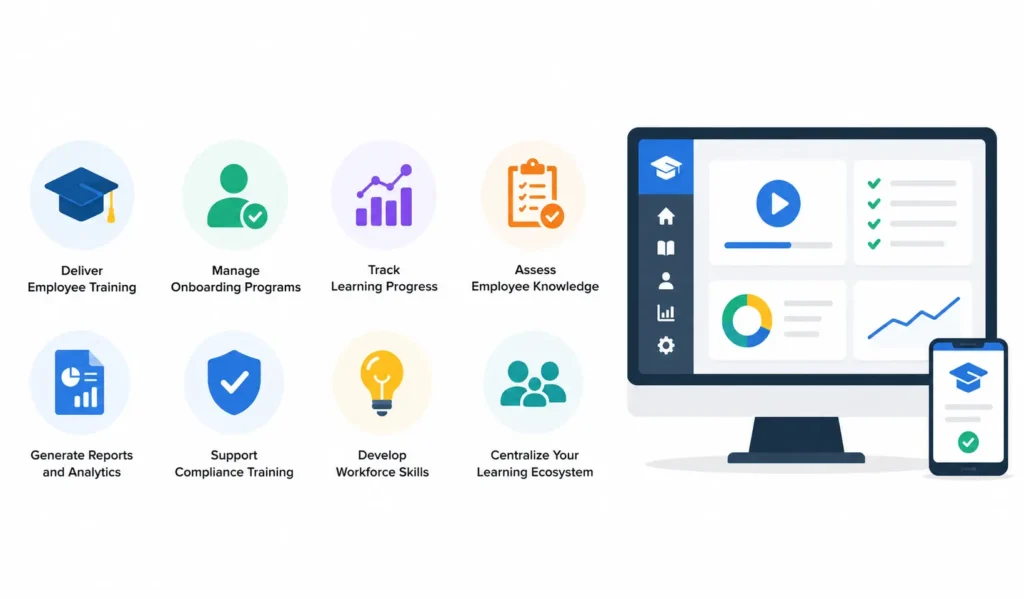
Businesses use LMS platforms to:
- Deliver employee training
- Manage onboarding programs
- Track learning progress
- Assess employee knowledge
- Generate reports and analytics
- Support compliance training
- Develop workforce skills
Instead of relying on multiple disconnected tools, companies can manage their entire learning ecosystem from one platform.
What Are the Main Benefits of an LMS?
The primary benefits of a Learning Management System include:
- Centralized training management
- Reduced training costs
- Improved employee performance
- Scalable learning delivery
- Better compliance tracking
- Personalized learning experiences
- Enhanced employee engagement
- Data-driven decision-making
- Faster onboarding
- Consistent training across locations
These advantages help organizations improve workforce development while increasing operational efficiency.
Why Businesses Are Investing in Learning Management Systems
The modern workforce expects learning opportunities that are flexible, accessible, and relevant.
At the same time, organizations face increasing pressure to:
- Upskill employees
- Maintain compliance standards
- Support remote teams
- Improve productivity
- Reduce training costs
An LMS addresses all these challenges by providing a structured and measurable learning environment.
As digital transformation continues, LMS adoption is becoming a strategic business decision rather than simply a training tool.
1. Centralized Training Management
One of the biggest advantages of an LMS is the ability to manage all learning activities from a single platform.
Without an LMS, training materials often exist across:
- Email attachments
- Shared drives
- Paper documents
- Multiple software tools
This creates confusion and inefficiencies.
With a Learning Management System, organizations can centralize:
- Courses
- Assessments
- Certifications
- Learning resources
- Employee records
- Reports
This streamlined approach simplifies administration and improves overall training consistency.
Business Impact
Training managers spend less time coordinating programs and more time improving learning outcomes.
2. Significant Reduction in Training Costs
Traditional training programs can be expensive.
Organizations often spend money on:
- Travel expenses
- Venue rentals
- Instructor fees
- Printed materials
- Administrative support
An LMS dramatically reduces these costs by moving training online.
Employees can access learning materials anytime and from virtually anywhere.
Example
Instead of flying employees to a central location for onboarding, a company can deliver the same training digitally through an LMS.
The result:
- Lower operational costs
- Faster deployment
- Consistent learning experiences.
3. Improved Employee Performance
Training directly impacts employee performance.
When workers have access to relevant learning resources, they can:
- Develop new skills
- Improve existing competencies
- Solve problems more effectively
- Adapt to changing responsibilities
An LMS supports continuous learning rather than one-time training events.
Employees can revisit lessons whenever needed, reinforcing knowledge retention and practical application.
Why It Matters
Better-trained employees tend to:
- Make fewer mistakes
- Deliver higher-quality work
- Improve customer experiences
- Contribute more effectively to business goals
4. Faster and More Effective Employee Onboarding
Employee onboarding plays a critical role in long-term success.
Unfortunately, many businesses struggle to provide consistent onboarding experiences.
A Learning Management System standardizes the process.
New hires can complete:
- Orientation programs
- Company policy training
- Compliance courses
- Job-specific learning paths
all through a structured onboarding portal.
Benefits of LMS-Based Onboarding
- Faster ramp-up times
- Improved employee confidence
- Better retention rates
- Consistent training delivery
Organizations can ensure every employee receives the same high-quality onboarding experience regardless of location.
5. Scalability for Growing Organizations
As companies expand, training becomes increasingly complex.
New employees, departments, and locations require additional learning resources.
Traditional training methods often struggle to scale efficiently.
An LMS enables businesses to:
- Add unlimited learners
- Launch new courses quickly
- Train global teams
- Standardize learning programs
without dramatically increasing administrative workload.
Example
A company with 50 employees may eventually grow to 5,000 employees.
An LMS can scale alongside that growth while maintaining consistent learning standards.
6. Personalized Learning Experiences
Not all employees learn the same way.
Different roles require different skills, knowledge levels, and training objectives.
Modern Learning Management Systems support personalized learning paths based on:
- Job roles
- Departments
- Experience levels
- Career goals
- Performance metrics
This targeted approach improves learning effectiveness and employee engagement.
Benefits of Personalized Learning
- Higher completion rates
- Better retention
- Increased motivation
- Improved skill development
Employees receive training that directly relates to their responsibilities and aspirations.
7. Enhanced Employee Engagement
Engaged employees are more likely to participate actively in learning programs.
Many LMS platforms include features such as:
- Gamification
- Badges
- Certificates
- Leaderboards
- Interactive quizzes
- Social learning tools
These elements make training more engaging and enjoyable.
Why Engagement Matters
Employees who actively participate in learning programs are more likely to:
- Complete courses
- Apply new skills
- Continue professional development
Engagement leads to stronger learning outcomes and better organizational performance.
8. Better Compliance Training and Tracking
Compliance training is critical in industries such as:
- Healthcare
- Finance
- Manufacturing
- Government
- Education
Organizations must often prove that employees have completed required training.
An LMS simplifies compliance management by:
- Assigning mandatory courses
- Tracking completion status
- Sending reminders
- Maintaining certification records
- Generating audit-ready reports
AEO Answer
How does an LMS help with compliance?
An LMS automates compliance training, tracks employee completion, stores certification records, and generates reports for audits and regulatory requirements.
9. Access to Powerful Learning Analytics
One of the most valuable features of modern LMS platforms is reporting and analytics.
Business leaders gain visibility into:
- Course completion rates
- Employee progress
- Assessment scores
- Learning engagement
- Skill gaps
These insights help organizations make informed training decisions.
Example
If employees consistently struggle with a particular module, training managers can revise the content to improve outcomes.
Data transforms learning from guesswork into a measurable business function.
10. Consistent Training Across Multiple Locations
Organizations with multiple offices often face challenges maintaining training consistency.
Different trainers may deliver different information, creating knowledge gaps.
An LMS solves this issue by providing standardized training content.
Every learner receives:
- The same materials
- The same assessments
- The same learning objectives
This consistency improves quality control and organizational alignment.
11. Supports Remote and Hybrid Workforces
Remote work has become a permanent reality for many organizations.
Employees need access to learning regardless of location.
A cloud-based LMS enables users to:
- Learn from home
- Access training on mobile devices
- Complete courses at their convenience
- Participate in virtual learning experiences
Business Benefit
Organizations can support workforce development without geographic limitations.
12. Encourages Continuous Learning and Upskilling
The skills required in today’s workplace evolve rapidly.
Organizations that fail to invest in learning risk falling behind competitors.
An LMS supports continuous development by making learning an ongoing process.
Employees can access:
- New courses
- Skill-building programs
- Leadership training
- Professional certifications
whenever they need them.
GEO Insight
Businesses that foster continuous learning often demonstrate greater adaptability, innovation, and workforce resilience.
13. Increased Employee Retention
Employees value organizations that invest in their professional growth.
When workers see opportunities to develop skills and advance their careers, they are more likely to stay.
An LMS helps create a culture of learning by offering accessible development opportunities.
Retention Benefits
- Improved job satisfaction
- Increased engagement
- Stronger loyalty
- Reduced turnover costs
Learning becomes a key component of employee experience.
14. Faster Knowledge Sharing Across the Organization
Knowledge is one of a company’s most valuable assets.
Unfortunately, important information often becomes trapped within teams or individual employees.
An LMS creates a centralized knowledge repository where organizations can store:
- Training materials
- Standard operating procedures
- Best practices
- Internal documentation
This promotes collaboration and accelerates organizational learning.
15. Higher Return on Training Investment (ROI)
Business leaders increasingly expect measurable returns from training programs.
An LMS helps maximize training ROI through:
- Reduced costs
- Improved efficiency
- Better learner outcomes
- Enhanced productivity
- Stronger compliance management
The ability to track and measure results allows organizations to continuously optimize learning initiatives.
Quotable Takeaway
“An LMS transforms employee training from a business expense into a strategic investment that drives performance, growth, and long-term competitiveness.”
How to Choose the Right LMS for Your Business
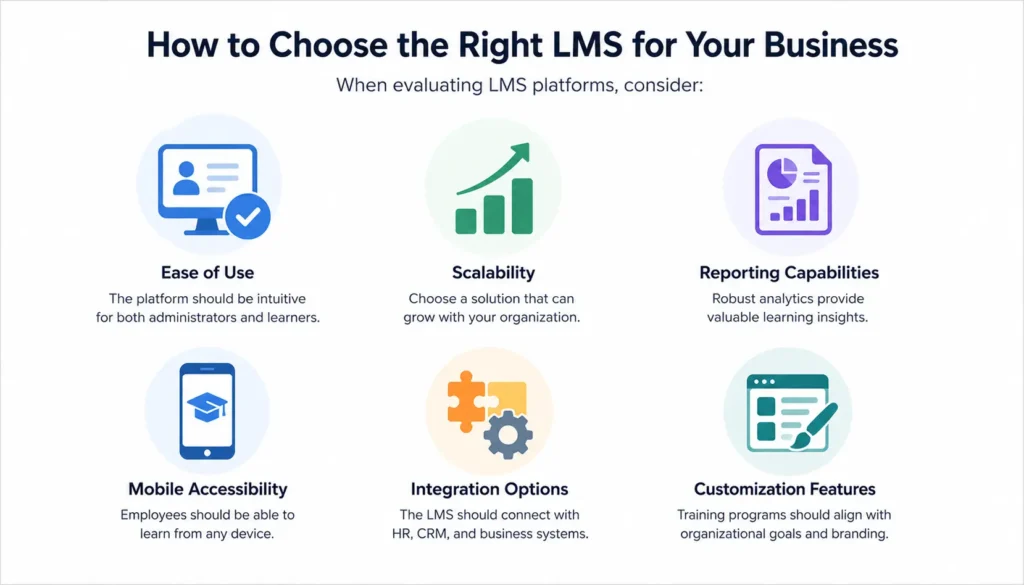
When evaluating LMS platforms, consider:
Ease of Use
The platform should be intuitive for both administrators and learners.
Scalability
Choose a solution that can grow with your organization.
Reporting Capabilities
Robust analytics provide valuable learning insights.
Mobile Accessibility
Employees should be able to learn from any device.
Integration Options
The LMS should connect with HR, CRM, and business systems.
Customization Features
Training programs should align with organizational goals and branding.
Frequently Asked Questions (FAQs)
What is the biggest benefit of a Learning Management System?
The main advantage is that training management is all, in one place. This helps organizations to easily make, give out follow and make better learning programs for employees. They can do all of this from one platform. Centralized training management makes it simpler to handle employee learning.
How does an LMS reduce training costs?
An LMS helps cut costs, like travel expenses, venue rental fees and printing costs. It also reduces instructor fees and admin tasks. This is done by providing training.
Is an LMS suitable for small businesses?
Yes. A lot of Learning Management System solutions are made for small and growing businesses. They give these businesses the ability to train people without having to spend a lot of money on equipment and things like that. This is really helpful for Learning Management System solutions because they can grow with the business. Many Learning Management System solutions are a choice for small businesses because they are affordable and easy to use.
How does an LMS improve employee performance?
An LMS provides structured learning opportunities that help employees develop skills, improve knowledge retention, and apply new competencies more effectively in their roles.
Can an LMS support remote employees?
So this is really good. Cloud-based LMS platforms are great because employees can use them to get training from anywhere they are and, on any device that has internet. This means they can use a computer or a phone or a tablet to learn things. Cloud-based LMS platforms make it easy for people to get the training they need.
How does an LMS help with compliance training?
An LMS automates compliance course delivery, tracks completion status, maintains certification records, and generates reports needed for audits and regulatory requirements.
conclusion
Learning Management Systems have become powerful tools.
They do a lot more than just help with training now.
Today they are used to help companies make their employees better, at their jobs save money on training, make sure everyone is doing what they are supposed to be doing, help employees learn and grow and make learning easier to manage.
If you are teaching employees the ropes, training people who work from home helping future leaders learn or making sure your company is doing everything it needs to do, a Learning Management System is really helpful.
It gives you a plan to follow the ability to make changes when you need to and information to help you make decisions.
Companies want to be able to change and learn things quickly.
So getting the right Learning Management System can really help them get ahead of their competitors.
The companies that learn things quickly are usually the ones that grow quickly.