


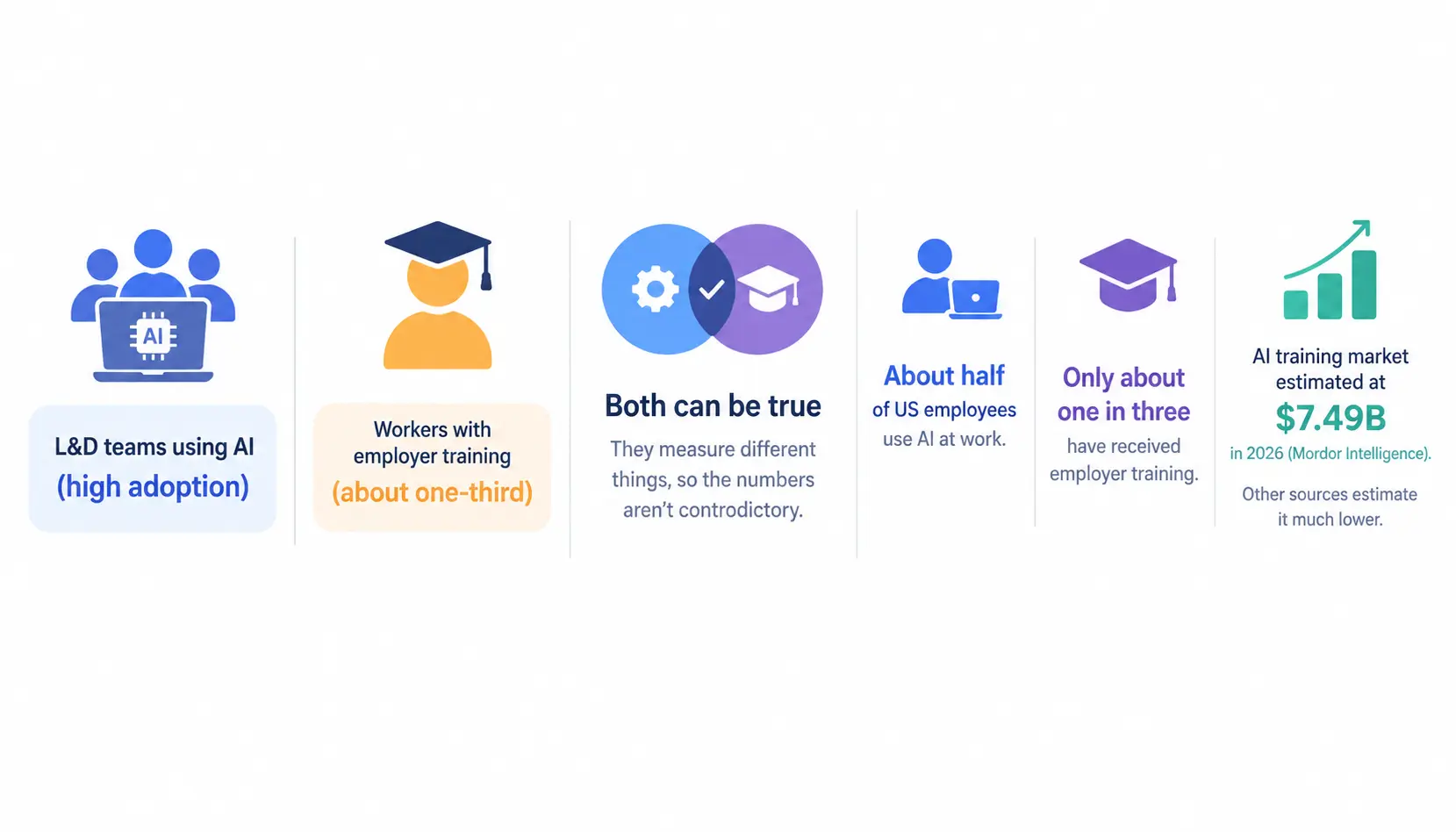
AI in corporate training has moved from pilot projects to daily habits. But the numbers you see online often clash. One report says 87% of L&D teams use AI. Another says only about a third of workers have received employer training.
Both can be true, because they measure different things. This guide sorts the figures by what they actually count, who was surveyed, and when. It also shows how to measure your own
In 2026, about half of US employees use AI at work (52% in Gallup’s Q2 2026 data), yet only around one in three say they have received employer-provided AI training. The AI-powered corporate training market is estimated at $7.49 billion in 2026 by Mordor Intelligence, but other publishers estimate it much lower.
Key AI in Corporate Training Statistics at a Glance
These eight figures give a fast, verified picture. Each one covers a different group, so do not mix them up.
| Statistic | Figure | Source, date and population | Why it matters |
| Employees using AI at work (a few times a year or more) | 52% | Gallup, Q2 2026, US employees | Shows broad, employee-level use |
| Frequent users (a few times a week or more) | 30% | Gallup, Q2 2026, US employees | Routine use is far lower than occasional use |
| Employees who say their organisation has adopted AI | 47% (up from 41% in Q1) | Gallup via Semafor, Q2 2026 | Organisational adoption lags personal use |
| Workers who used AI at work in the past year | 64% | PwC Global Workforce Hopes and Fears 2026, 49,364 workers in 48 countries | A global view, with a wider definition of use |
| Workers with adequate access to job training | 51% (down from 59%) | PwC, 2026 | Training access fell while AI use rose |
| Workers who received proper AI training from their employer | 32% | Indeed and YouGov, July 2026, 1,000+ US workers and hirers | Formal training is the weak link |
| L&D teams using AI in some form | 87% | Synthesia, 2026 (vendor survey) | Counts any use, including light experiments |
| AI-powered corporate training market | $7.49B (2026) | Mordor Intelligence, global estimate | A forecast-based figure, not audited revenue |
The pattern is clear. Tool use is rising quickly, while structured training and workflow redesign trail behind.
AI Adoption in Corporate Training: What the Latest Statistics Show
How Many L&D Teams Use AI?
The most quoted figure is 87% of L&D teams using AI in some form, from Synthesia’s 2026 report. Synthesia sells AI video tools, so treat the number as a directional signal. “In some form” can mean anything from drafting quiz questions to running an AI coaching programme.
Other sources point the same way but with softer wording. LinkedIn’s Workplace Learning research, as cited by industry summaries, put L&D professionals who were exploring or integrating AI at 71% in 2025. You can read LinkedIn’s own framing in its Workplace Learning Report.
The Global Sentiment Survey 2026, led by Donald H. Taylor, describes adoption as selective rather than complete. Teams use AI mostly for content creation, adaptive learning, and learner support. They are slower to use it for analytics and proving business impact.
A useful way to read any L&D adoption number is to ask which stage it describes:
- Experimenting: individuals test tools with no shared process.
- Routine use: AI is part of standard design or delivery work.
- Scaled: AI is built into the learning platform, with governance and measurement.
Most published statistics blur the first two stages. Very few measure the third.
How Many Organisations Use AI at Work?
McKinsey’s 2025 global survey found that 88% of respondents said their organisation regularly used AI in at least one business function. Gallup’s employee survey gives a lower number: 47% of US employees said their organisation had adopted AI tools by Q2 2026.
The gap is not a contradiction. McKinsey asked executives and managers whether AI is used in any single function. Gallup asked employees across all roles whether their own organisation has adopted AI. A company can pass the first test while most staff never see the tools.
Gallup also notes that having AI tools does not guarantee use. In organisations that have begun integrating AI, only about 30% of employees use it regularly.
How AI Adoption Has Changed Over Time
Gallup is the best source for year-on-year comparison because it asks the same US employee question each quarter.
| Measure (US employees) | Q4 2025 | Q1 2026 (February) | Q2 2026 (May) |
| Use AI at work, a few times a year or more | 46% | 50% | 52% |
| Use AI a few times a week or more | n/a | 28% | 30% |
| Use AI daily | n/a | 13% | 15% |
| Say their organisation has adopted AI | n/a | 41% | 47% |
Gallup reports that the 50% reading in early 2026 was 21 points higher than three years earlier. That is steady growth, not a sudden spike.
PwC’s global survey shows a similar direction. Daily generative AI use rose from 14% to 22% between its last two surveys, and overall use in the past year rose by roughly ten points to 64%.
Do not place Gallup and PwC in one trend line. They use different populations, geographies, and wording. Compare each source only with its own earlier editions.
AI Adoption Versus AI Readiness
Using AI is not the same as being ready for it. Readiness covers training, policy, manager support, and confidence.
| Dimension | Latest figure | Source |
| Use AI at work | 52% | Gallup, Q2 2026 |
| Strongly agree their manager supports AI use (AI-integrating organisations) | 36% | Gallup, May 2026 |
| Received proper employer AI training | 32% | Indeed and YouGov, 2026 |
| Adequate access to job training | 51% | PwC, 2026 |
| Strongly agree AI has transformed how work gets done (AI-adopting organisations) | 14% | Gallup, May 2026 |
The last row is the most telling. Two in three employees in AI-adopting organisations say AI improved their productivity. Yet only 14% say it changed how work gets done. Gallup’s reading is that AI helps with individual tasks, while few organisations have redesigned roles and workflows around it.
That is exactly where corporate training can help.
AI in Corporate Training Market Size and Growth
Current AI-Powered Corporate Training Market Size
Mordor Intelligence estimates the AI-powered corporate training market at $6.27 billion in 2025 and $7.49 billion in 2026. Its figures were updated with data available as of January 2026.
The Business Research Company gives a much smaller estimate: $3.88 billion in 2025 and $4.5 billion in 2026. Neither number is wrong. They define the market differently, such as which software, services, and hardware count.
When you quote a market size, always name the publisher and the year.
Forecast Market Growth and CAGR
Mordor forecasts the market reaching $18.19 billion by 2031, a 19.43% compound annual growth rate over 2026 to 2031. The Business Research Company projects about $8.01 billion by 2030 at a 15.5% CAGR.
Both are projections built on assumptions. They are not observed results, and publishers revise them often. The safest takeaway is that analysts expect double-digit growth, not that any specific number is guaranteed.
Industries and Organisations Driving Demand
The evidence on industries is thin. Mordor reports these 2025 splits and growth rates:
- Large enterprises: 62.83% of revenue, so big companies still buy most of it.
- SMEs: the fastest-growing group, at a forecast 21.93% CAGR through 2031.
- North America: 38.74% of revenue, the largest region.
- Asia-Pacific: the fastest-growing region, at a forecast 20.58% CAGR.
- Cloud deployment: 78.44% of revenue.
On the usage side, Gallup’s earlier workforce surveys found AI use is higher in technology-related fields. About six in ten tech workers reported frequent use. I would avoid ranking other industries without a primary source.
AI Training Market Growth Versus Overall Corporate Training Spend
The AI-powered segment is a small slice of a much larger market. Grand View Research puts total corporate training at about $458.7 billion in 2026, growing at 7.8% a year to 2033. Research and Markets estimates $460.12 billion for 2026.
Using Mordor’s AI figure against Grand View’s total, AI-powered tools are roughly 1.6% of corporate training. This is a rough comparison, because the reports use different scopes. It still shows that most training budgets go to traditional content, instructors, and platforms.
Employee AI Usage and Workplace Training Statistics
How Many Employees Use AI at Work?
The answer depends on the survey. Gallup finds 52% of US employees use AI at least a few times a year, and 15% use it daily. PwC finds 64% across 48 countries used it in the past year.
Some surveys report higher numbers. A January 2026 Study.com survey of 1,000 workers found 89% using AI, with 41% using it daily. Small online panels often over-represent people already comfortable with AI, so I treat that figure as an upper bound.
Use differs by job type too. A Businessolver report found hands-on workers face a 13-point AI training gap compared with computer-based employees. Frontline teams are easy to overlook in AI programmes.
How Many Employees Receive Formal AI Training?
Fewer than half. The recent surveys agree on the broad picture:
- 32% said they received proper employer AI training (Indeed and YouGov, July 2026).
- 33% reported employer-provided AI training (Study.com, January 2026).
- 49% said they received little or no employer-sponsored AI training (Businessolver).
- 51% reported adequate access to job training in general, down from 59% (PwC, 2026).
The Study.com survey found 46% of workers were self-taught. Informal learning is valuable, but it spreads habits unevenly. Indeed’s data shows the split: 77% of self-described AI natives said their training was adequate, against 15% of workers who had not yet integrated AI heavily.
Formal training means structured, employer-provided courses or programmes with clear outcomes. A shared prompt document or a Slack channel helps, but it is not the same thing. For a wider view of workforce learning data and benchmarks, read our guide to employee training statistics.
The Gap Between AI Adoption and Employee Preparedness
Confidence and clarity are different. Study.com found 68% of workers felt confident using AI for everyday tasks. Yet many were unsure what company policy allowed, and 20% were cautious because the rules were unclear.
Gallup adds a manager angle. Only 36% of employees in AI-integrating organisations strongly agree their manager supports their team’s AI use. Where that support exists, Gallup finds better outcomes.
A reliable readiness check covers four things: approved tools, written guidance, role-based skills, and manager backing. If any is missing, expect uneven results.
Why Employees Use Unapproved AI Tools
Shadow AI is the AI version of shadow IT. Microsoft and LinkedIn’s 2024 Work Trend Index found that 78% of AI users brought their own AI tools to work.
The reasons are practical:
- Approved tools are missing, slow, or weaker than public ones.
- Deadlines reward speed over process.
- Policies are unclear or unknown.
- Training does not cover safe use.
Banning tools rarely works. A better approach is to provide approved options, classify what data can never be pasted into AI, and teach the reasons behind the rules.
The Most Important AI Trends in Corporate Training
For a broader look at how artificial intelligence is changing workplace learning, explore our guide to AI in learning and development.
AI-Personalised and Adaptive Learning
Adaptive learning adjusts content to each learner’s performance. AI makes it cheaper by recommending modules, skipping known material, and mapping content to skills. For example, a sales rep who already knows pricing rules can jump straight to objection handling.
AI-Generated Training Content
Teams use AI to draft course outlines, quiz questions, translations, and practice scenarios. It can cut first-draft time sharply.
Subject-matter review is not optional. AI can invent policy details or give outdated guidance, and a confident wrong answer in a compliance course is a real risk.
AI Tutors and Virtual Learning Assistants
AI tutors answer questions on demand, explain concepts in plain language, and give feedback on practice work. A new hire can ask, “How do I handle a refund request over the limit?” and get an answer drawn from approved material. Limit the assistant to your own vetted knowledge base to reduce errors.
AI-Powered Simulations and Role-Play
AI role-play lets people rehearse difficult conversations. Customer service agents can practise with an upset caller, and managers can practise delivering tough feedback. The benefit is safe repetition. The risk is that a poorly designed AI character teaches unrealistic behaviour, so test scenarios with experienced staff first.
AI-Driven Skills Assessment
AI can help spot skills gaps by analysing assessments, work samples, and learning history. It can also give quick feedback on written or spoken practice. Treat the output as a prompt for a conversation, not a final verdict on someone’s ability.
Learning Analytics and Predictive Insights
Analytics tools flag learners who are stalling, topics where many people fail, and content nobody finishes. This lets L&D intervene early. It is also where many teams lag, since the Global Sentiment Survey suggests measurement is adopted more slowly than content creation.
AI Embedded in Everyday Workflows
Learning is moving into the tools people already use, such as chat, documents, and CRM systems. Instead of leaving work to take a course, an employee gets a tip or a worked example at the moment of need. This is the closest link between training and the “redesigned work” that Gallup finds missing.
For practitioner views, communities such as instructional design is useful for tool comparisons. Treat posts as anecdotes, not evidence.
Benefits of AI in Corporate Training: What the Evidence Shows
Benefit claims come in four grades: measured results, employee perceptions, vendor case studies, and projections. I label each below.
Faster Training Content Development
Evidence grade: mostly vendor and practitioner reports. I could not find an independent, large-scale benchmark for time saved on course creation. Measure your own: hours of design time per finished course hour, before and after.
Personalised Learning at Scale
Evidence grade: logical and plausible, thinly measured. Personalisation is technically easier with AI. Public evidence that it improves workplace results at scale is limited, so run a comparison against a standard course.
More Frequent Practice and Feedback
Evidence grade: mostly perception and case studies. AI makes unlimited practice cheap. Track whether people practise more and whether their assessed performance improves.
Employee Productivity and Time Savings
Evidence grade: strongest here, but be careful.
- Measured: A well-known study of 5,000 customer support agents, by Brynjolfsson, Li, and Raymond, found an AI assistant raised issues resolved per hour by about 14% on average. The gain was about 34% for less experienced workers.
- Perceived: In Gallup’s data, around two in three employees in AI-adopting organisations say AI improved their productivity.
- Reality check: Only 14% strongly agree AI has transformed how work gets done.
The support-agent study measured on-the-job AI assistance, not training courses. It supports the idea that AI helps novices most, which is a strong case for pairing AI tools with onboarding.
Improved Knowledge Retention and Skill Proficiency
Evidence grade: limited public data. Businessolver found employees with adequate AI training were more confident: 80% versus 57% of those with limited training. That is a vendor-run survey of perceptions, and it shows correlation, not proof of cause.
Potential Cost Savings and Training ROI
Evidence grade: mostly projection. Claims of 20% to 30% lower training costs appear in vendor-linked content, but I could not trace them to independent measurement. Build your own business case from your costs and results (see the ROI formula below).
AI Training Adoption Challenges and Risks
AI Skills Gaps and Limited Training Access
Only about a third of workers report proper employer AI training, and 40% of CHROs in one BCG-cited summary named limited AI skills in their own HR teams as the top barrier to AI in talent management. Mitigation: train L&D and managers first, then roll out to staff by role.
Data Privacy and Information Security
Employees may paste customer data or confidential plans into public tools. Mitigation: give approved tools, define data that must never be entered, and keep the rules to one page. Study.com found 20% of workers felt cautious because rules were unclear.
Inaccurate AI Outputs and Hallucinations
Hallucinations are confident but false outputs. Mitigation: require expert review for compliance, safety, and legal content, and ground AI tutors in approved documents.
Bias, Accessibility, and Inclusion
AI can reflect bias in its training data, and not every tool works well with screen readers or varied accents. Mitigation: test with diverse users, check accessibility standards, and review assessments for uneven results across groups.
Integration With Existing Learning Systems
AI tools that do not connect to your LMS or HR system create manual work and poor data. Mitigation: check integrations before buying, and clean up skills and role data first.
Employee Resistance and Change Management
Fear is real. PwC found 44% of workers worry about AI displacement, though 57% cite economic volatility as the top job threat. One US survey reported by Allwork.Space found 30% of Gen Z workers said AI made their job feel less secure, against 20% overall. Mitigation: be honest about role changes, involve employees in pilots, and train managers to coach.
Difficulty Measuring Learning Outcomes
Completion rates are easy to count, while skill change and business impact are hard. Mitigation: define outcome measures before launch, as described next.
How to Measure AI Adoption and Training Effectiveness
Track AI Training Adoption Rate
Adoption rate = (Active eligible users ÷ Total eligible users) × 100
Define “active” clearly, such as at least one use per week. If 260 of 400 eligible employees are active, adoption is 65%.
Measure Training Participation and Completion
Track eligible employees, enrolments, completions, and where people drop off. A sharp drop at one module usually points to a content or relevance problem.
Measure Skills and Proficiency
Use pre- and post-assessments, practical tasks, and role-specific standards. Ask people to complete a real work task, not just answer multiple-choice questions. To choose meaningful benchmarks for training performance, see our guide to corporate training statistics and KPIs.
Measure Productivity and Business Outcomes
Track time saved, error rates, quality scores, and relevant KPIs such as resolution time or sales conversion. Compare trained and untrained groups where possible.
Calculate AI Training ROI
ROI = ((Measured benefits − Total costs) ÷ Total costs) × 100
For example, if measured benefits are $120,000 and total costs are $80,000, ROI is 50%. Include licences, content review time, and employee time in costs. Count only benefits you measured, not projected ones.
Build an AI Training KPI Dashboard
| Area | Example KPI |
| Adoption | Active eligible users, weekly use |
| Training access | Share of staff with completed role-based training |
| Proficiency | Assessment scores, task pass rate |
| Productivity | Time saved, error rate |
| Cost | Cost per learner, licence cost |
| Risk | Policy incidents, flagged AI errors |
How Businesses Can Increase AI Training Adoption
Assess Current AI Skills and Readiness
Survey staff on tool use, confidence, and policy awareness. This gives you a baseline.
Identify High-Value Training Use Cases
Pick tasks that are frequent, time-consuming, and low-risk, such as drafting quizzes, summarising policies, or onboarding Q&A.
Create Role-Specific AI Learning Paths
A recruiter, an engineer, and a store manager need different skills. Short, role-based paths beat one generic course.
Establish Approved Tools and Responsible-Use Policies
Name approved tools, list prohibited data, and explain who reviews AI-generated content. Keep it short enough to be read.
Run a Small, Measurable Pilot
Start with one team and clear success measures. A pilot of 30 to 50 people is often enough to find problems.
Evaluate Results Before Scaling
Compare pilot outcomes with your baseline. Expand only what shows real gains.
Review Adoption and Skills Regularly
Tools and risks change quickly. Review usage, skills, and policy at least quarterly.
A suggested 30/60/90-day framework (this is a planning example, not an industry benchmark):
| Period | Focus | Output |
| Days 1 to 30 | Baseline survey, policy draft, tool shortlist | Readiness report, approved-tool list |
| Days 31 to 60 | Pilot with one team, role-based training | Pilot data on use, skills, and time saved |
| Days 61 to 90 | Review results, fix gaps, plan rollout | Go or no-go decision, scaling plan |
How to Evaluate AI in Corporate Training Statistics
Check the Original Source and Research Date
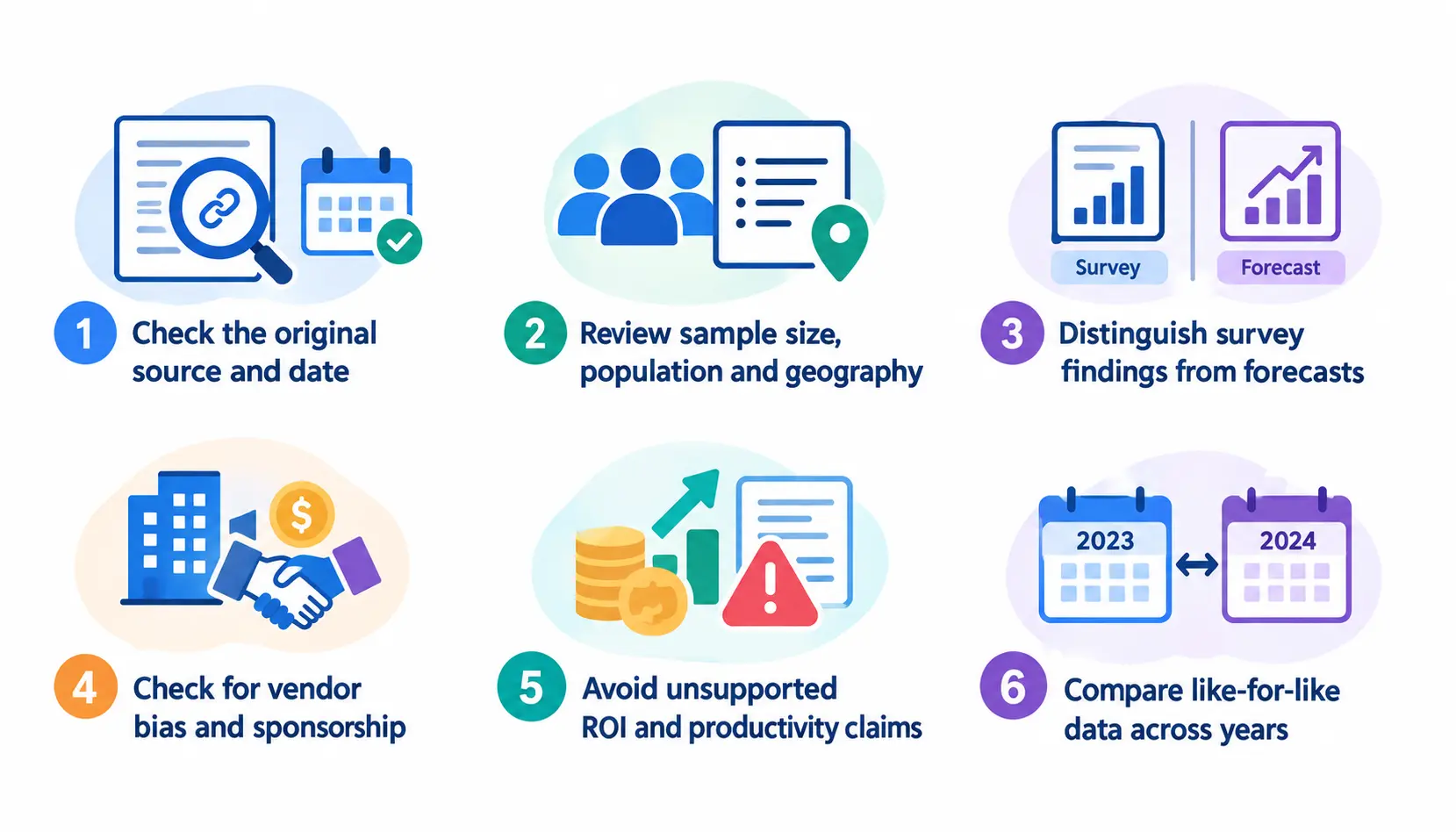
Many articles repeat numbers without links. Trace each figure to the original report and check the year.
Review Sample Size, Population, and Geography
A survey of 1,000 online respondents is not the same as 23,717 randomly sampled US employees. Note who was asked and where.
Distinguish Survey Findings From Market Forecasts
A survey describes what people report. A forecast is a model’s projection. Do not present a CAGR as something that already happened.
Check for Vendor Sponsorship and Commercial Bias
Vendors often publish useful research, but their questions and framing can favour their product. Look for the sponsor and the methodology.
Avoid Unsupported ROI and Productivity Claims
Be cautious with big round numbers and “up to” claims. Ask what was measured, against what baseline, and over what time.
Compare Like-for-Like Data Across Years
Only compare surveys that use the same question and population. Otherwise, a change may come from the method, not the real world.
Frequently Asked Questions About AI in Corporate Training
1. What Are the Latest Statistics on AI in Corporate Training?
As of Q2 2026, 52% of US employees use AI at work and 30% use it a few times a week or more (Gallup). About one in three report proper employer AI training. The AI-powered corporate training market is estimated at $7.49 billion in 2026 (Mordor Intelligence).
2. What Percentage of Companies Use AI for Employee Training?
There is no single figure. One vendor survey reports 87% of L&D teams use AI in some form. McKinsey found 88% of organisations use AI in at least one function, which is a broader measure.
3. What Are the Main Benefits of AI in Corporate Training?
The most common benefits are faster content creation, personalised learning paths, on-demand support, and more practice. Measured evidence is strongest for on-the-job productivity and weaker for retention and ROI.
4. Does AI Improve Employee Training Outcomes?
It can, but evidence varies. A peer-reviewed study of support agents found about 14% higher productivity, and much more for novices. Evidence specifically on training courses is limited, so pilot and measure.
5. What Are the Biggest Barriers to AI Training Adoption?
The main barriers are limited training access, unclear policies, lack of time, fear of mistakes, privacy concerns, and weak manager support.
6. How Can Companies Measure AI Training ROI?
Use ROI = ((Measured benefits − Total costs) ÷ Total costs) × 100. Set a baseline first, count only measured benefits, and include all costs.
7. What AI Training Trends Should Businesses Watch?
Watch adaptive learning, AI tutors, simulations, skills assessment, learning analytics, and AI built into daily workflows.
Conclusion
The statistics show a clear story. AI in corporate training is growing fast on the usage side, with roughly half of US employees using AI at work. Training, policy, and measurement are catching up more slowly.
The gap is the opportunity. Start with a baseline, run a small pilot, measure real outcomes, and scale what works. When you quote statistics, name the source, the year, and the population.