


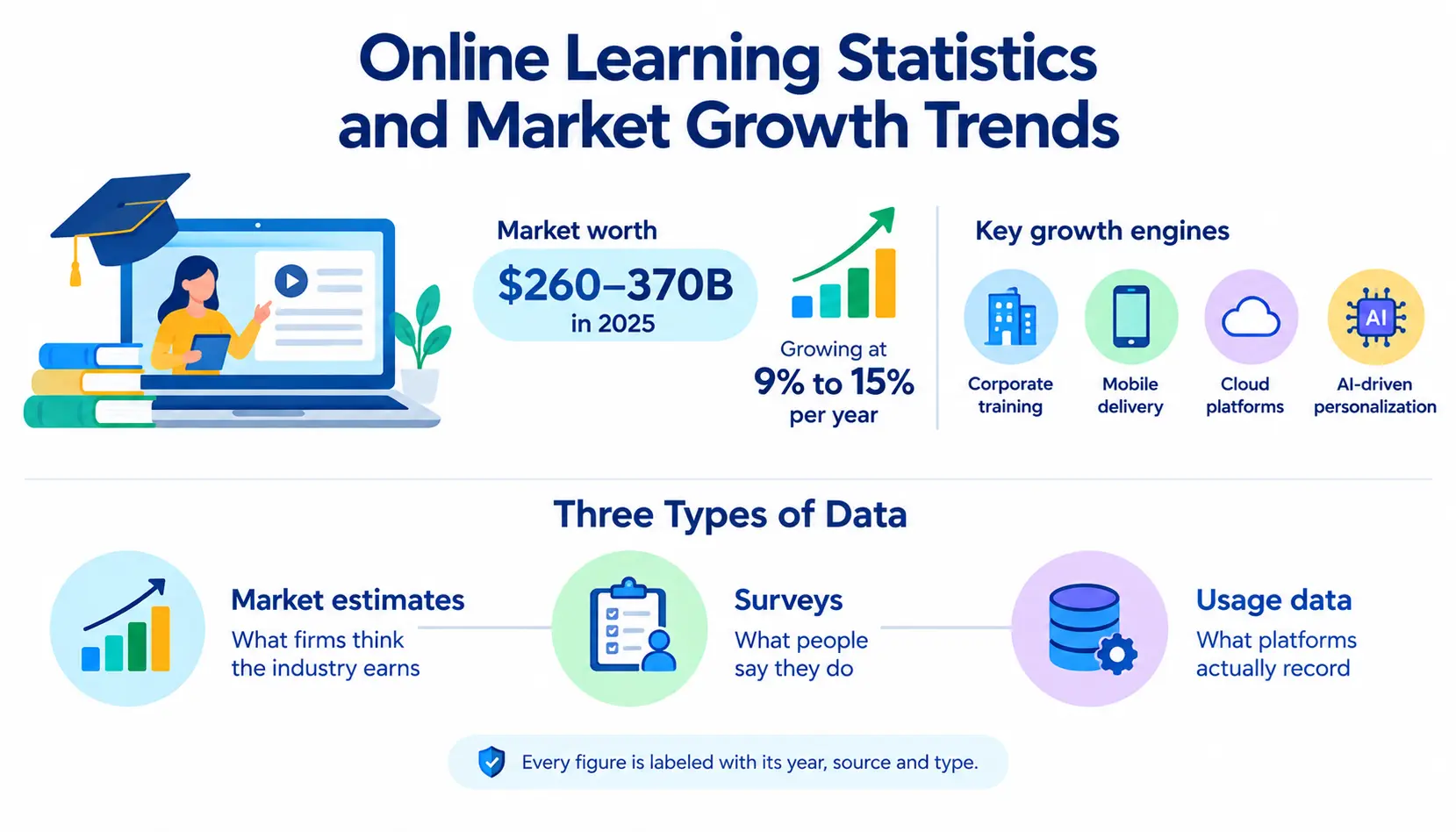
Online learning statistics show a market worth roughly 260–370 billion in 2025, depending on who is counting, and growing at about 9% to 15% a year in most forecasts. Corporate training, mobile delivery, cloud platforms, and AI-driven personalization are the main growth engines.
That range is wide on purpose. Every research firm defines “online learning” differently, so no single number is the “right” one.
This guide pulls the key online learning statistics into one place and explains what sits behind them. It also shows you how to judge any number you find, because the data comes in three very different types: market estimates (what firms think the industry earns), surveys (what people say they do), and usage data (what platforms actually record). Every figure below is labeled with its year, source, and type.
Online Learning Statistics at a Glance
Here is the short version. Treat each row as one source’s view, not a universal truth.
| Metric | Figure | Source | Year | Scope | Data type |
| Global e-learning market size | ~325billion,risingto~665 billion by 2031 (12.68% CAGR) | Arizton | 2025 | Global e-learning market | Market estimate |
| Global e-learning market size | ~370billion,risingto~622 billion by 2031 (9.04% CAGR) | Ken Research | 2025 | Global e-learning market | Market estimate |
| Global online learning market | ~263.5billion,risingto~933.5 billion by 2032 (14.8% CAGR) | Market report summarized on Learnopoly | 2025 | Global online learning market | Market estimate |
| Online education growth | +$141.3 billion between 2024 and 2029 (11.1% CAGR) | Technavio | 2024–2029 | Online education | Market forecast |
| Corporate e-learning growth | +$131.01 billion between 2024 and 2029 (12.7% CAGR) | Technavio | 2024–2029 | Corporate e-learning | Market forecast |
| US e-learning growth | +$45.37 billion between 2024 and 2029 (14.1% CAGR) | Technavio | 2024–2029 | United States | Market forecast |
| Mobile-based delivery growth | 14.38% CAGR, the fastest delivery segment | Arizton | 2026–2031 | Global, by delivery mode | Market forecast |
| Microlearning growth | +$3.15 billion between 2024 and 2029 (15% CAGR) | Technavio | 2024–2029 | Microlearning | Market forecast |
| AI in education growth | ~45.9% CAGR (2023–2028), as cited by Devlin Peck | Secondary citation | 2023–2028 | AI education market | Market forecast |
A quick note on how to read this table. A CAGR (compound annual growth rate) is the steady yearly growth rate that would take a market from its start value to its end value.
Global market size
For 2025, the three estimates above land between about $263 billion and $370 billion. The gap is real and explained in the market size section below.
Market growth rate
Most forecasts fall between roughly 9% and 15% per year. Ken Research also reports a historical growth rate of 8.16% for 2020–2025, so it expects growth to speed up slightly.
Number of online learners
Learner counts are the least consistent numbers in this space. Platforms count “registered users,” surveys count “people who took a course,” and market firms count “users” in modeled revenue segments. Always check which one you are reading.
Corporate e-learning adoption
Technavio projects corporate e-learning to add about $131 billion over 2024–2029. That makes it one of the larger single segments in the forecast.
Mobile learning growth
Arizton reports that mobile-based delivery has the fastest growth rate of any delivery mode in its report.
AI and digital learning trends
AI is the fastest-growing label in the data, though estimates vary and are often built on small bases. Treat the high percentages as direction, not precision.
Regional market leaders
North America is usually reported as the largest or one of the largest regional markets, and Asia-Pacific as the fastest growing. Exact shares differ by firm.
What Is Online Learning?
Online learning means learning through the internet instead of in a physical classroom. It covers everything from a university degree taken remotely to a ten-minute compliance video at work. The wider field is often called educational technology.
Online learning definition
Online learning is any structured learning delivered mainly through digital networks. Learners may study live with an instructor, on their own schedule, or in a mix of both.
Online learning vs e-learning
The two terms overlap heavily, and many reports use them as synonyms. E-learning is the older and broader term, and it sometimes includes offline digital content like CD-based courses. Online learning specifically needs an internet connection.
Online education vs online learning
“Online education” usually points to formal schooling: schools, colleges, and accredited programs. “Online learning” is wider and includes informal learning, such as a marketer taking a short course on analytics. This matters because Technavio’s online education forecast and a general e-learning forecast measure different things.
Online learning platforms vs LMS
A learning management system (LMS) is software that organizations use to host, assign, and track training. An online learning platform, like a course marketplace, is usually a consumer-facing service where individuals browse and buy courses. Some products do both, which blurs the data.
Global Online Learning Market Size and Growth
This is where online learning statistics get confusing, so it is worth slowing down.
Current global market size
For 2025, published estimates include about $325 billion (Arizton), about $370 billion (Ken Research), and about $263.5 billion (a market report summarized on Learnopoly). That is a spread of over $100 billion for the same year.
Historical market growth
Growth has not been one smooth line. Online learning grew steadily for years, jumped when schools and employers moved online in 2020, and then settled into a more normal pace. Ken Research puts the 2020–2025 average at 8.16% per year.
Forecast market size
The same sources project 2031 or 2032 values between about $622 billion and $933.5 billion. Forecasts that run further out, or that start from a lower base, produce larger percentage growth.
Online learning market CAGR
The CAGRs in the sources above range from 9.04% to 14.8%. Narrower segments can look faster. Technavio’s microlearning forecast sits at 15%, and its online language learning forecast at 27.5%, but those start from smaller bases.
Why market forecasts differ
Think of it like estimating the size of “the restaurant industry.” Do you include food trucks, hotel dining, and delivery apps? Your answer changes the total. Online learning has the same problem. Here are the five main reasons the numbers disagree.
Different market definitions
Some firms count only course platforms and software. Others add content, services, hardware, and tutoring. A broader definition means a bigger number.
Different base years
A 2023 base year and a 2025 base year will not match, even if both firms use the same method. Always check the year before comparing.
Different revenue categories
Some reports include software licenses, content sales, and services. Others count only subscription or course revenue. These are not the same pie.
Different geographic coverage
A global report, a US report, and an Asia-Pacific report cannot be added or compared directly. Check whether a figure is global or regional before quoting it.
Different research methodologies
Firms mix company filings, interviews, surveys, and their own models. Two careful analysts can produce different answers from the same market. That is normal, not an error.
My practical advice: when you cite a market size, quote the source, the year, and the scope together. If you can, show a range instead of a single number.
Online Learning Market by Region
Regional data is patchy, so use it for direction rather than exact ranking.
North America
North America is commonly described as the largest regional market. The drivers are mature enterprise training budgets, widespread broadband, and a large higher-education sector. Technavio expects US e-learning to add about $45.37 billion over 2024–2029.
Europe
Europe has strong digital education programs, a large corporate learning sector, and strict privacy rules. Regulation like the GDPR shapes how platforms collect and store learner data, which affects product design and costs.
Asia-Pacific
Asia-Pacific is usually named as the fastest-growing region. Large young populations, rising smartphone use, and strong demand for exam prep and language learning all push growth. Many learners there start on a phone, not a laptop.
Latin America
Latin America shows growing demand for affordable, flexible courses, though connectivity and cost remain barriers. Mobile access plays a big role.
Middle East and Africa
Government digital education programs are a major driver in parts of the Gulf region. In much of Africa, access to reliable internet and devices is still the main limit.
India
India has a very large student and job-seeker population and heavy smartphone use. This makes it one of the most watched online learning markets, especially for test prep and skills training.
China
China has a large domestic online education sector. Policy changes, including tighter rules on after-school tutoring in recent years, have reshaped parts of that market, so older China figures can be misleading.
Online Learning Adoption Statistics
Adoption data is mostly survey-based, so the question wording matters. “Have you ever taken an online course?” produces a very different answer from “Do you take courses regularly?”
Individual learner adoption
Individuals mostly use online learning for career skills, certificates, and personal interests. Language learning is one of the fastest-growing consumer categories in the Technavio data.
Student adoption
Most universities now offer at least some online or blended options. For global access and use, the UNESCO digital learning resources are a good starting point.
Employee adoption
Employers use online training to address employee training challenges such as onboarding, compliance, and skills development. The LinkedIn Workplace Learning Report is a respected yearly survey of how L&D teams and employees approach learning.
Corporate e-learning adoption
Corporate adoption is high among mid-size and large employers, mainly because online delivery scales cheaply across locations. Smaller firms adopt more slowly.
Enterprise vs individual learning
The enterprise segment (B2B) is paid for by employers. The individual segment (B2C) is paid for by learners. They behave differently, so never mix their statistics.
Online learning platform users
Statista tracks revenue, user numbers, penetration, and average revenue per user for its defined online education and platform markets. These are modeled estimates built on Statista’s own definitions, so cite them as such.
Online Learning Statistics by Delivery Format
Self-paced learning
Self-paced courses let people learn anytime. They are cheaper to scale but tend to have lower completion rates.
Instructor-led online learning
Live classes cost more to run but usually give stronger engagement and accountability.
Blended learning
Blended learning mixes online and in-person teaching. Many schools and employers prefer it because it keeps human contact while saving time and travel.
Synchronous learning
Synchronous means everyone learns at the same time, such as in a live webinar or virtual class.
Asynchronous learning
Asynchronous means learners work through material on their own time, such as recorded lessons and forums.
Microlearning
Microlearning delivers short lessons, often under ten minutes. Technavio forecasts the segment to add about $3.15 billion between 2024 and 2029 at 15% a year.
Mobile learning
Mobile learning is study done on a phone or tablet. Arizton reports mobile-based delivery as the fastest-growing delivery mode at 14.38% CAGR.
Corporate Online Learning Statistics
Corporate e-learning market growth
Technavio forecasts corporate e-learning to grow by about $131 billion between 2024 and 2029 at 12.7% a year. Other firms report similar low-teens growth.
Employee training adoption
Most large employers now run at least part of their training online. The main reasons are cost, speed, and the ability to track completion.
Workforce reskilling
Reskilling is now a top driver. Companies want to move people into new roles instead of hiring from scratch, and online programs make that practical.
Skills gaps and skills intelligence
Skills intelligence means using data to see what skills your people have and what they lack. It helps HR teams target training instead of guessing.
Employee engagement
Engagement in online training depends heavily on relevance. In my experience, a short course tied to a real task is finished far more often than a long generic one.
Productivity and performance
Link training to business metrics, such as ramp-up time for new hires or error rates. Workforce productivity through training can be evaluated using these outcomes rather than relying only on completion rates. Completion alone does not prove performance improved.
Corporate training ROI
ROI claims vary widely and often come from vendors. Look for studies that explain how they measured results, and run your own small pilot before committing a large budget.
Online Learning Effectiveness Statistics
Be careful here. No single percentage tells you whether online learning is “more effective.” Outcomes depend on course design, learner motivation, support, and the subject.
Online learning outcomes
Well-designed online courses can match classroom results for many subjects. Poorly designed ones do not. The format is not the deciding factor. The design is.
Learner engagement
Engagement rises with interaction, feedback, and clear goals. It falls with long videos and no human contact.
Course completion
Completion is the weakest part of open online learning. One widely cited 2015 analysis of massive open online courses (MOOCs) by Katy Jordan found average completion of roughly 13%. Paid, cohort-based, and employer-required courses usually do much better. Read more on MOOCs on Wikipedia.
Knowledge retention
Retention improves with practice, spacing, and real application. Short, repeated lessons usually beat one long session.
Learner satisfaction
Satisfaction surveys are useful, but they measure how people felt, not what they learned. Pair them with skill checks.
Online vs traditional learning
Research comparisons exist, but results differ by subject, age group, and how “traditional” is defined. Avoid any article that gives one universal winner.
What affects online learning effectiveness?
Five things matter most:
- Quality of course design
- Level of instructor or peer interaction
- Learner motivation and digital skills
- Access to a reliable device and connection
- Whether learners get to apply what they learn
Mobile Learning Statistics
Mobile learning adoption
Mobile learning keeps growing because phones are the main internet device for many people, especially in Asia, Africa, and Latin America. For global connectivity data, see the ITU statistics.
Smartphone access and online learning
Access is not the same as good access. A phone with limited data cannot stream long videos. Courses for these learners need small file sizes and offline options.
Mobile-first course design
Mobile-first design means building for a small screen first: short lessons, large buttons, and simple navigation. Retrofitting a desktop course for mobile rarely works well.
Mobile microlearning
Phone-based microlearning fits into commutes and breaks. It works best for refreshers, product knowledge, and compliance reminders.
AI in Online Learning Statistics and Trends
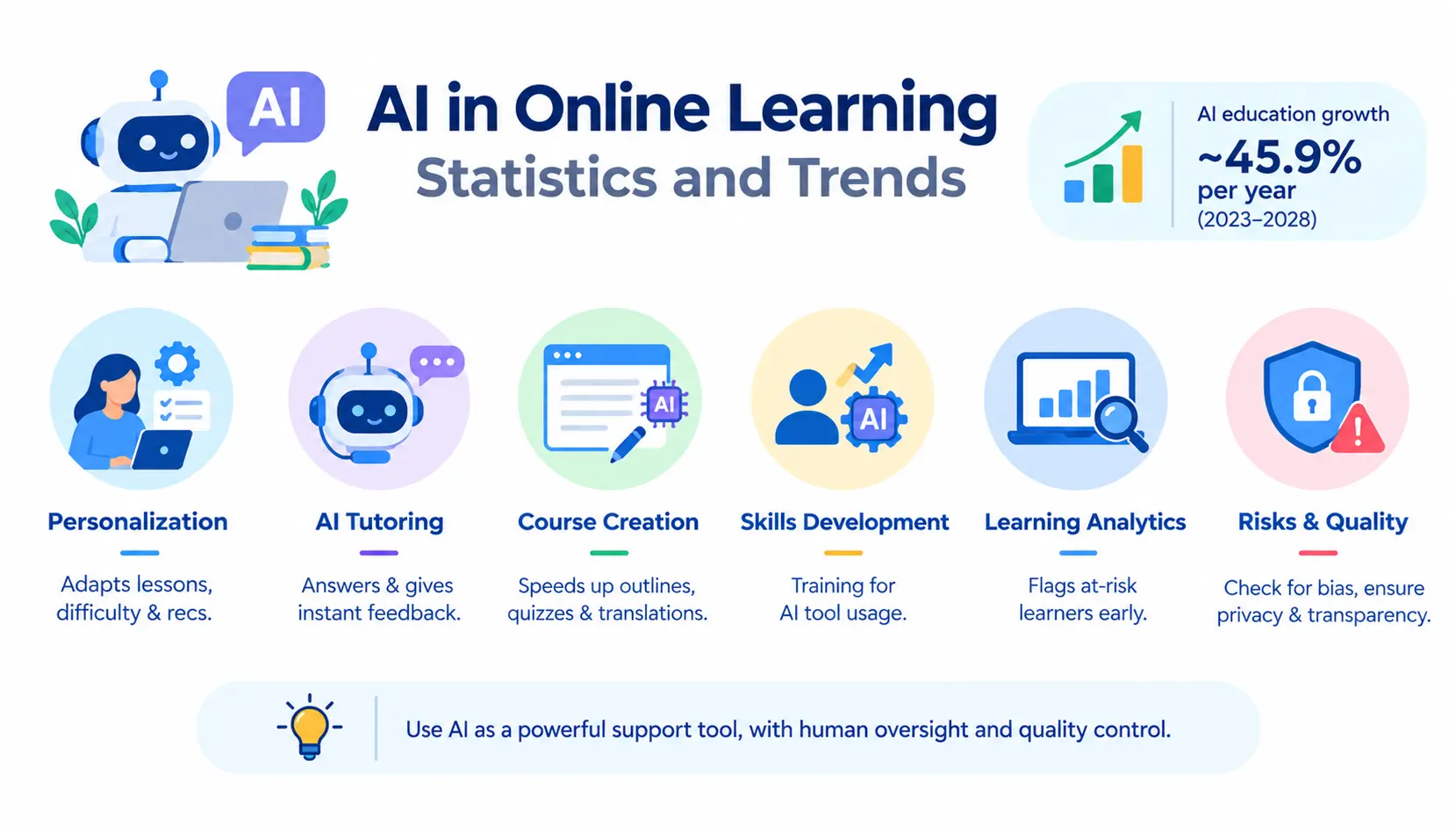
AI figures change quickly and often rest on small starting markets. One citation, from Devlin Peck’s market summary, puts AI education growth near 45.9% a year for 2023–2028. Use numbers like this as a signal of direction.
AI-powered personalization
AI can adjust lesson order, difficulty, and recommendations to each learner. This is a leading growth driver in current market reports.
AI tutoring
AI tutors answer questions around the clock and give instant feedback. They work best as a support tool, not a replacement for teachers.
AI-assisted course creation
AI speeds up drafting outlines, quizzes, and translations. Some research firms credit it with lowering content costs. A human expert still needs to check accuracy.
AI skills development
Employers are buying training to teach staff how to use AI tools. This is one of the clearest new demand areas in corporate learning.
AI learning analytics
Analytics can flag learners who are falling behind before they quit. The value comes from acting on the signal, not just collecting it.
Risks and quality-control considerations
AI can produce wrong or biased content and raises privacy questions. Review all AI-generated material, protect learner data, and be open about where AI is used.
Online Learning Statistics by Technology
Learning management systems
LMS software is the backbone of corporate and academic training. A corporate training platform can also support employee onboarding, skills development, compliance, and training analytics. Cloud-based LMS products make up most new deployments.
Learning experience platforms
Learning experience platforms (LXPs) focus on discovery and recommendations, closer to a streaming service than a course catalog.
Learning analytics
Learning analytics tracks progress, drop-off points, and results. It is the data layer that supports ROI claims.
Virtual classrooms
Virtual classrooms power live online teaching with video, chat, and breakout rooms. They became mainstream after 2020.
Cloud-based learning
Cloud delivery is reported as the largest deployment mode in several market reports because it is cheaper to start and easier to update.
AR and VR learning
AR and VR suit hands-on training such as safety, healthcare, and equipment practice. Adoption is growing but still small compared with video-based learning.
Adaptive learning
Adaptive learning changes content based on how a learner performs. It is closely tied to AI personalization.
Skills intelligence
Skills intelligence platforms map skills across a workforce and link them to training. HR teams use them for planning and internal mobility.
Online Learning Statistics for Course Creators
Keep creator data separate from enterprise numbers. A solo course creator’s market looks very different from an LMS vendor’s.
Online course demand
Demand is strongest for career skills, certificates, and language learning. Several market reports name online certification and professional courses as a leading course type.
Course creation
Creation tools keep getting cheaper and easier, so competition is rising. Niche expertise now beats broad topics.
Learner engagement
Short lessons, community access, and live sessions improve completion. A simple Q&A call can lift engagement more than extra video.
Subscription and membership models
Subscriptions give creators steady income and give learners ongoing access. They work best with fresh content and an active community.
Professional certificates
Certificates tied to job skills sell well because learners can show them to employers. Credibility of the issuer matters.
What Is Driving Online Learning Market Growth?
Digital transformation
As work moves to digital tools, people need new skills faster than classrooms can teach them.
Workforce reskilling
Companies are retraining staff for changing roles, which supports corporate e-learning growth.
AI adoption
AI both creates demand for new skills and lowers the cost of creating training.
Mobile internet access
Cheaper smartphones and data plans bring millions of new learners online.
Cloud technology
Cloud platforms let providers scale quickly without heavy infrastructure.
Remote and hybrid work
Distributed teams need training that works from any location.
Demand for flexible learning
Adults who work or care for family need courses they can fit around their schedule.
Skills shortages
Employers struggle to find skilled hires, so they train internally.
Government digital-learning initiatives
Many governments fund digital education programs, which boosts access and platform adoption.
Online Learning Market Segmentation
Research firms slice the market in similar ways. This table shows the most common cuts.
| Dimension | Segments |
| Delivery | Self-paced, instructor-led, blended |
| Technology | LMS, mobile, virtual classroom, microlearning |
| Deployment | Cloud, on-premise |
| User | Individual, academic, corporate, government |
| Geography | North America, Europe, Asia-Pacific, Latin America, Middle East and Africa |
One market report summarized on Learnopoly names content as the largest supplier segment, cloud as the largest deployment mode, and the academic user group as the largest end-user segment. Another, from Arizton, splits the market by learning mode, content, delivery, technology, and end user.
Online Learning Market Challenges
Digital access and affordability
Many learners still lack a reliable device or affordable data. This is the biggest barrier in low-income regions.
Learner engagement
It is easy to start a course and easy to quit. Low engagement is a design problem as much as a motivation problem.
Course quality
Anyone can publish a course, so quality varies widely. Look for clear outcomes, expert authors, and real practice tasks.
Technology limitations
Weak connections, outdated devices, and clunky tools can ruin the experience.
Accessibility
Courses must work for people with disabilities, with captions, screen reader support, and clear layouts.
Data privacy
Platforms collect detailed learner data. Providers need clear policies and secure handling.
Digital skills gaps
Some learners need basic computer skills before they can benefit from online courses. Human connection also matters, and many learners miss it online.
What Do Online Learning Statistics Mean for Businesses?
What growing market demand means for L&D
More vendors and more choices. L&D teams should spend less time hunting for content and more time matching it to real business needs.
What mobile growth means for training design
Design short lessons that work on a phone. If frontline staff are your audience, mobile is not optional.
What AI adoption means for workforce learning
Plan for both sides: train people to use AI, and use AI to build and personalize training, with human review.
What skills intelligence means for HR
Skills data helps HR plan hiring, promotion, and training from the same picture of the workforce.
What cloud adoption means for learning infrastructure
Cloud tools reduce setup costs and speed up updates. Check security, data location, and integration with your HR systems.
Which metrics businesses should track
Track a short list that ties to results:
- Completion and drop-off rates
- Time to competence for new hires
- Assessment scores before and after training
- Learner satisfaction and manager feedback
- Business outcomes such as sales, quality, or safety measures
How to Evaluate the Reliability of Online Learning Statistics
I use a simple checklist before I trust any number. You can too.
Check the publication date
Online learning moves fast. A figure from before 2020 may describe a very different market.
Identify the original source
Trace the number back to the report, survey, or filing. Many blogs repeat each other without ever linking the original.
Check the methodology
Look for how data was gathered and modeled. If the method is hidden, be cautious.
Check the market definition
Is it “e-learning,” “online education,” or “online learning platforms”? The label changes the total.
Check the geography
Make sure a figure is global or regional before comparing it.
Check the sample size
Small surveys can mislead. A poll of 200 people should not be quoted as “what learners think worldwide.”
Separate historical data from forecasts
A 2025 value is an estimate of the present. A 2031 value is a forecast. Do not present them the same way.
Distinguish surveys from market research
Surveys report opinions and behavior. Market research reports revenue and models. Both are useful, for different questions.
Avoid comparing incompatible statistics
Do not set a $325 billion global figure against a $45 billion US growth figure and call one “bigger.” Check scope first.
To see how practitioners discuss these numbers in the real world, communities like instructional design on Reddit are useful for reality checks, though they are opinions, not data.
Online Learning Statistics: What to Watch Next
AI-powered learning
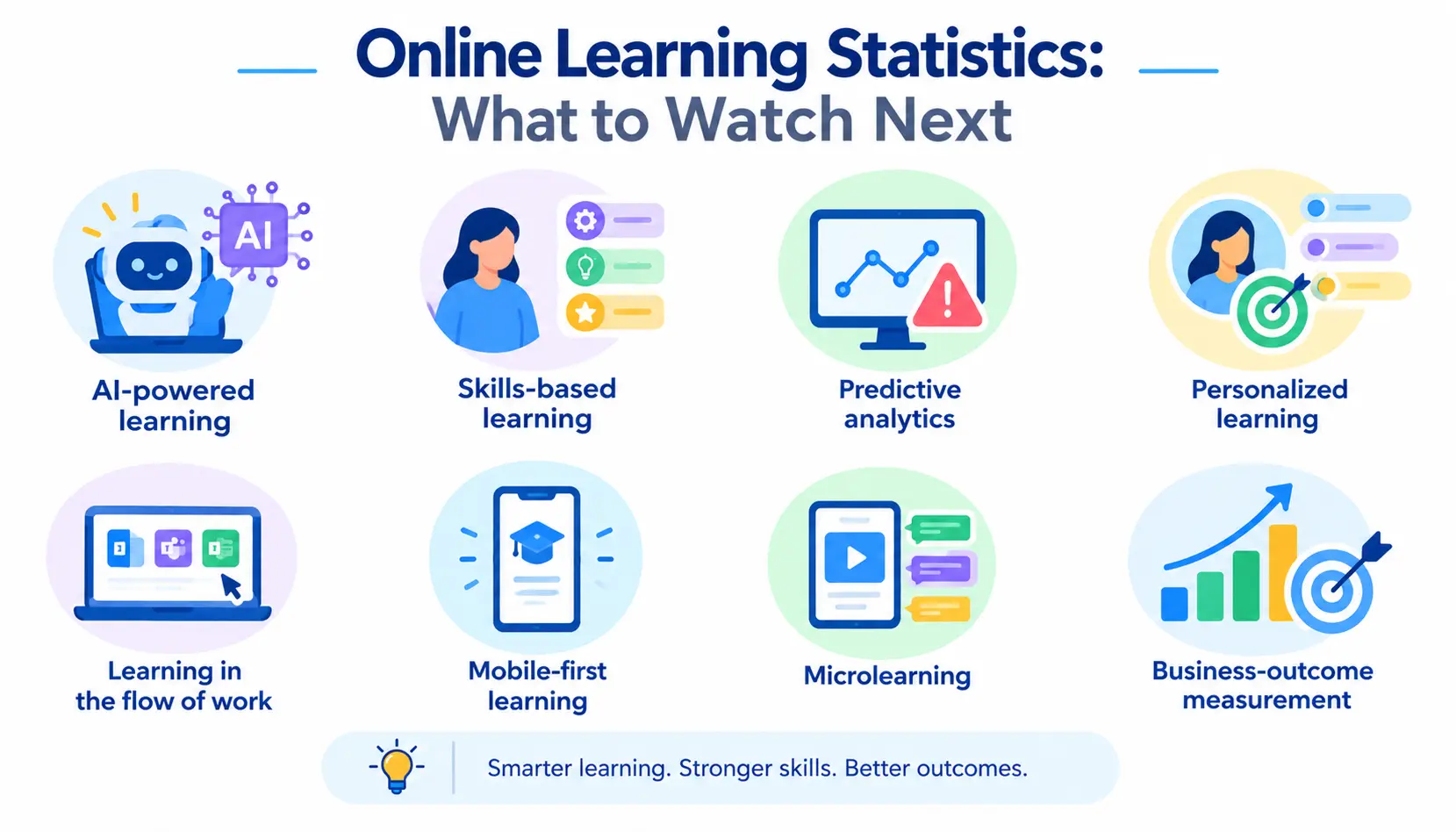
Watch how AI tutoring and course creation affect quality and cost.
Skills-based learning
Employers are moving from job titles to skills. Learning will follow.
Predictive learning analytics
Expect more tools that warn you when a learner is likely to drop out.
Personalized learning
Learners will expect content that fits their level and goals.
Learning in the flow of work
Training will show up inside the tools people already use, not in a separate portal.
Mobile-first learning
Mobile will keep gaining share, particularly in emerging markets.
Microlearning
Short lessons will remain a main format for busy workers.
Business-outcome measurement
Buyers will ask for proof of results, not just completions.
Frequently Asked Questions About Online Learning Statistics
1. What is the current size of the online learning market?
In 2025, estimates range from about $263.5 billion to $370 billion, depending on the source and scope. Arizton reports about $325 billion and Ken Research about $370 billion.
2. How fast is online learning growing?
Most forecasts put growth between about 9% and 15% a year. Ken Research reports 9.04% for 2026–2031, and Arizton reports 12.68%.
3. How many people use online learning?
There is no single reliable global count. Different sources define “user” differently. Check whether a number counts registered accounts, active learners, or survey respondents.
4. Is online learning effective?
It can be, depending on course design, interaction, and learner support. No single percentage applies to every situation.
5. What percentage of companies use e-learning?
Adoption is high among mid-size and large employers, but exact percentages vary by survey, region, and company size. Look for recent surveys such as the LinkedIn Workplace Learning Report.
6. Which online learning technology is growing fastest?
In the sources reviewed here, AI-related learning and mobile delivery show the fastest growth. Arizton gives mobile 14.38% CAGR. AI estimates are higher but start from a smaller base.
7. What is the future of online learning?
Expect more AI personalization, mobile and microlearning, skills-based training, and stronger links between learning and business results.
8. Why do online learning market estimates differ?
Firms use different market definitions, base years, revenue categories, regions, and methods.
9. How reliable are e-learning statistics?
Market and survey data are useful but imperfect. Check the date, original source, scope, and method before you rely on a number.
10. How is AI changing online learning?
AI is making courses more personalized, speeding up content creation, and creating new demand for AI skills training. Human review is still needed for quality.
Conclusion
Online learning statistics tell a clear story: the market is large, growing, and still changing fast. For 2025, credible estimates range from about $263.5 billion to $370 billion. Most forecasts expect growth of roughly 9% to 15% a year, led by corporate training, mobile delivery, microlearning, and AI-powered personalization.
The numbers only help if you read them carefully. Each firm defines the market differently, so always check the year, source, scope, and whether a figure is a survey, a market estimate, or real usage data. Quote ranges instead of a single “official” number.
Effectiveness also depends on design, support, and learner motivation, not on the online format alone. If you are building training, choosing a platform, or writing about this market, use these online learning statistics as a guide to direction. Then test what works for your own learners and track real outcomes, not just course completions.