


Artificial Intelligence is not something you see in movies anymore. It is actually changing the way people learn and grow at work.
Companies have a problem to solve: people need to learn new things all the time and businesses have to keep up with new technology. The old way of teaching people does not work well because it is not personal or interesting.
This is where Artificial Intelligence in Learning and Development is making a difference.
Artificial Intelligence in Learning and Development is helping people learn in their way and it is suggesting things that they might want to learn about. It is also testing people automatically. Trying to guess what they will do next.
In this guide we will talk about Artificial Intelligence in Learning and Development’s how it works, what is good about it, how people are using it, what problems it has and what will happen in the future with Artificial Intelligence, in Learning and Development.
What Is AI in Learning and Development?
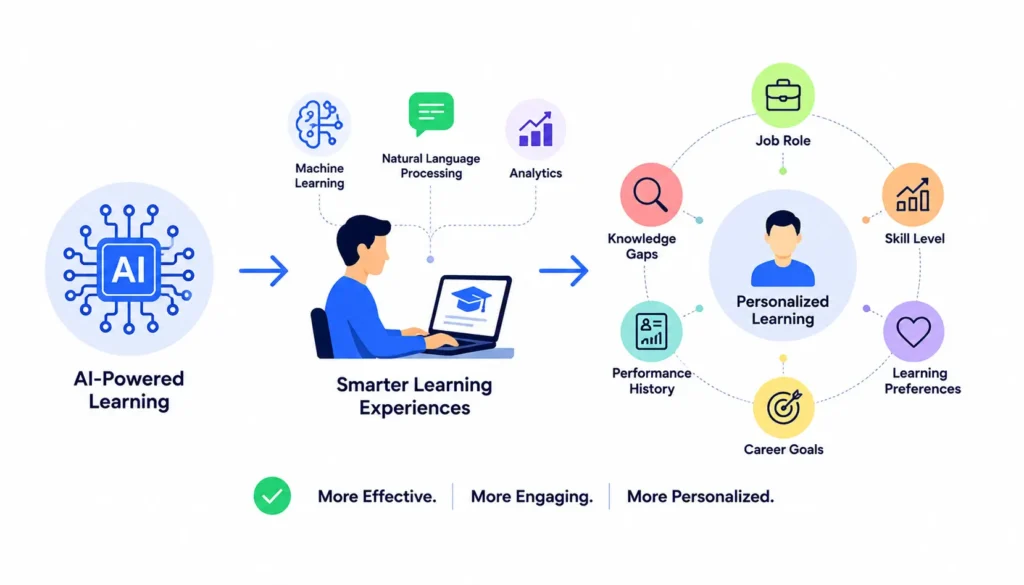
Artificial Intelligence in Learning and Development is about using Artificial Intelligence to make learning for employees. This includes things like machine learning and natural language processing to help employees learn things. Artificial Intelligence also uses analytics to improve the way employees are trained.
The goal of Artificial Intelligence, in Learning and Development is to make learning more effective and help employees do their jobs better. Artificial Intelligence is used to make employee learning experiences more enjoyable and useful.
Instead of delivering the same training to everyone, AI helps organizations create learning experiences tailored to individual employees based on factors such as:
- Job role
- Skill level
- Learning preferences
- Career goals
- Performance history
- Knowledge gaps
The result is a more effective, engaging, and personalized approach to workplace learning.
Why AI Is Becoming Essential in Modern Learning and Development
The workplace is changing faster than ever.
According to multiple workforce studies, skill requirements are evolving rapidly due to digital transformation, automation, and emerging technologies. Organizations can no longer rely on annual training programs to keep employees competitive.
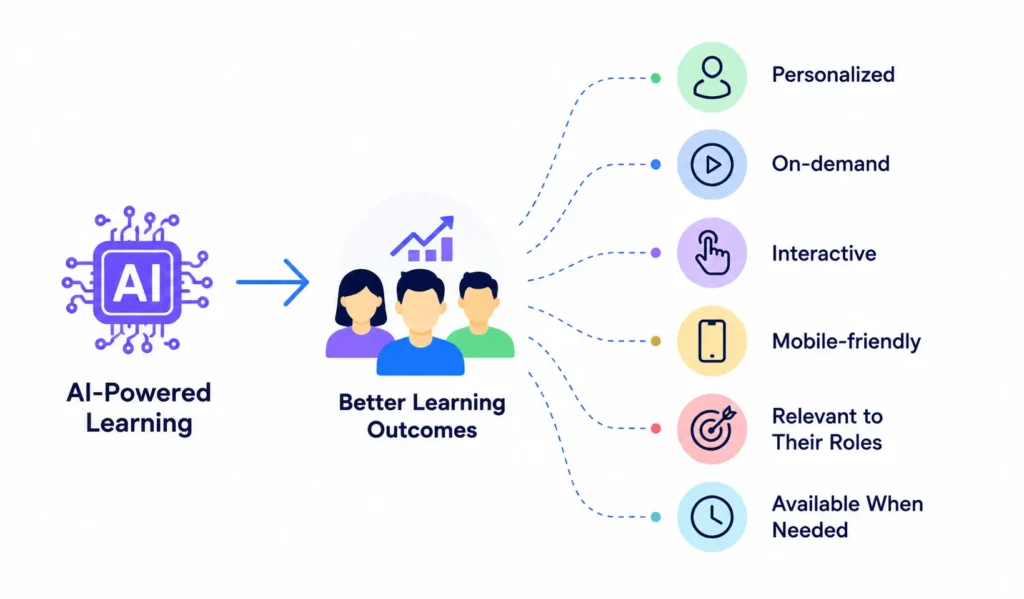
Modern learners expect training that is:
- Personalized
- On-demand
- Interactive
- Mobile-friendly
- Relevant to their roles
- Available when needed
AI helps organizations meet these expectations while reducing administrative workload and improving learning outcomes.
How AI Works in Learning and Development
AI-powered learning systems collect and analyze data from various learner interactions.
These systems can evaluate:
- Course completion rates
- Assessment results
- Learning behavior
- Engagement patterns
- Skills progression
- Career development goals
Using this information, AI continuously improves the learning experience.
Example
If an employee struggles with cybersecurity training modules, an AI-powered platform may:
- Recommend additional beginner content
- Suggest microlearning videos
- Provide practice assessments
- Adjust future learning pathways
This adaptive learning approach helps employees learn at their own pace.
Key Applications of AI in Learning and Development
Personalized Learning Experiences
One of the things about artificial intelligence is that it can be used to make things personal for each person.
Traditional training programs usually give every employee the same information, no matter what they already know or what they need to learn.
Artificial intelligence is different because it creates a learning path for each person, which is what we call customized learning journeys.
Artificial intelligence creates these learning journeys, for people and that is a big deal because it helps people learn better.
Benefits of Personalized Learning
- Higher learner engagement
- Improved knowledge retention
- Faster skill development
- Reduced learning fatigue
- Better learning outcomes
For example, a new sales representative and an experienced sales manager may receive entirely different learning recommendations despite working in the same department.
Intelligent Content Recommendations
Modern AI-powered learning platforms function similarly to Netflix or Spotify.
Based on learner behavior, AI recommends:
- Courses
- Videos
- Articles
- Certifications
- Learning paths
- Expert resources
This ensures employees always have relevant learning opportunities available.
Why It Matters
Employees often don’t know what training they need next.
AI removes the guesswork by recommending content aligned with business goals and individual career growth.
Adaptive Learning
Adaptive learning systems adjust content difficulty and learning pathways in real time.
When learners perform well:
- Content becomes more advanced.
- Learning progresses faster.
When learners struggle:
- Additional support materials are provided.
- Concepts are reinforced.
- Learning pace slows down.
This creates a highly effective learning environment tailored to individual needs.
AI-Powered Learning Assistants
Virtual learning assistants and AI chatbots are becoming increasingly common.
These tools can:
- Answer learner questions
- Recommend courses
- Explain concepts
- Provide instant support
- Guide employees through learning programs
Instead of waiting for instructors or administrators, employees receive immediate assistance whenever needed.
Example
An employee completing compliance training can ask a virtual assistant for clarification and receive an instant explanation without leaving the course.
Automated Content Creation
Creating training content can be time-consuming.
AI helps L&D teams generate:
- Course outlines
- Assessment questions
- Training summaries
- Knowledge checks
- Learning objectives
- Interactive learning materials
This significantly reduces content development time.
Benefits
- Faster course creation
- Reduced development costs
- Consistent training quality
- Increased productivity for instructional designers
Automated Assessments and Feedback
AI streamlines evaluation processes by automatically grading assessments and generating feedback.
Capabilities include:
- Quiz scoring
- Skill assessments
- Knowledge evaluations
- Performance tracking
- Personalized feedback
This enables learners to receive immediate insights into their progress.
Skills Gap Analysis
Many organizations struggle to identify workforce skill gaps.
AI can analyze employee performance and compare existing skills against organizational requirements.
This helps businesses answer critical questions:
- Which skills are missing?
- Which departments need training?
- Which employees are ready for advancement?
- What future skills will be required?
The result is more strategic workforce development planning.
Predictive Learning Analytics
AI doesn’t just analyze current performance—it predicts future outcomes.
Predictive analytics can help organizations identify:
- Employees at risk of falling behind
- Future training needs
- Certification renewal requirements
- High-potential talent
- Learning programs with low effectiveness
This proactive approach enables better decision-making.
Benefits of AI in Learning and Development
Organizations implementing AI-driven learning solutions often experience substantial improvements across multiple areas.
Increased Learning Engagement
Personalized content is naturally more relevant.
When learners receive training aligned with their goals and interests, engagement levels increase significantly.
Engagement Drivers
- Personalized recommendations
- Interactive learning
- Real-time support
- Relevant content
- Adaptive learning experiences
Improved Knowledge Retention
Employees retain information better when learning experiences match their needs and learning styles.
AI supports retention through:
- Reinforcement learning
- Spaced repetition
- Personalized review recommendations
- Adaptive assessments
This helps transform learning into long-term knowledge.
Greater Training Efficiency
AI automates many time-consuming administrative tasks.
Examples include:
- Enrollment management
- Content recommendations
- Reporting
- Progress tracking
- Assessment grading
L&D teams can focus more on strategy and less on administration.
Enhanced Employee Development
AI enables continuous learning rather than occasional training events.
Employees gain access to learning opportunities that support:
- Career growth
- Leadership development
- Upskilling
- Reskilling
- Professional certifications
This creates a culture of ongoing improvement.
Better Business Outcomes
Well-trained employees contribute directly to organizational success.
AI-powered learning can improve:
- Productivity
- Employee performance
- Innovation
- Customer satisfaction
- Employee retention
The business impact often extends far beyond training metrics.
Real-World Examples of AI in Learning and Development
Employee Onboarding
AI personalizes onboarding programs based on role, department, and experience level.
New hires receive:
- Customized training paths
- Relevant documentation
- Role-specific learning resources
- Automated guidance
This accelerates productivity and reduces onboarding time.
Leadership Development
AI identifies leadership competencies and recommends development opportunities.
Potential leaders can receive targeted training in:
- Communication
- Decision-making
- Strategic thinking
- Team management
- Emotional intelligence
This creates stronger leadership pipelines.
Compliance Training
Compliance training often suffers from low engagement.
AI improves effectiveness by:
- Delivering personalized content
- Monitoring completion rates
- Identifying knowledge gaps
- Providing targeted reinforcement
This helps organizations reduce compliance risks.
Sales Training
AI can analyze sales performance data and recommend specific training interventions.
For example:
- Negotiation skills
- Product knowledge
- Customer communication
- Objection handling
This enables more focused and impactful sales development.
Challenges of Using AI in Learning and Development
While AI offers tremendous benefits, organizations should also understand potential challenges.
Data Privacy Concerns
AI systems rely on learner data.
Organizations must ensure:
- Secure data storage
- Regulatory compliance
- Transparency
- Ethical AI usage
Protecting employee information should remain a top priority.
Content Quality Risks
AI-generated content is only as effective as the data and prompts behind it.
Human review remains essential to ensure:
- Accuracy
- Relevance
- Inclusivity
- Alignment with organizational goals
AI should enhance human expertise—not replace it.
Change Management
Some employees may hesitate to adopt AI-driven learning technologies.
Successful implementation requires:
- Clear communication
- Training
- Leadership support
- User-friendly experiences
Building trust is critical.
Technology Integration
Organizations often use multiple HR and learning systems.
Integrating AI tools with existing platforms can require:
- Technical expertise
- Data migration
- Workflow adjustments
- Ongoing maintenance
Planning ahead minimizes implementation challenges.
Best Practices for Implementing AI in Learning and Development
Start With Clear Goals
Before adopting AI, identify specific objectives such as:
- Improving engagement
- Reducing training costs
- Accelerating onboarding
- Closing skill gaps
Clear goals guide technology decisions.
Focus on Learner Experience
Technology should improve learning—not complicate it.
Prioritize:
- Simplicity
- Accessibility
- Relevance
- Mobile compatibility
The best AI solutions feel intuitive rather than overwhelming.
Combine AI With Human Expertise
AI excels at automation and analysis.
Humans excel at:
- Coaching
- Mentoring
- Emotional intelligence
- Strategic decision-making
The most effective L&D programs combine both strengths.
Continuously Measure Results
Track key metrics such as:
- Course completion rates
- Engagement levels
- Assessment scores
- Skills development
- Business performance indicators
Use insights to refine learning strategies over time.
The Future of AI in Learning and Development
AI’s role in workplace learning is expected to expand dramatically over the next decade.
Emerging trends include:
Hyper-Personalized Learning
Future systems will deliver increasingly individualized learning experiences based on real-time performance and career aspirations.
AI Coaches and Mentors
Virtual coaching assistants will provide personalized guidance, feedback, and development recommendations.
Skills-Based Workforce Development
Organizations will increasingly focus on skills rather than job titles.
AI will help identify, track, and develop critical workforce capabilities.
Immersive Learning Experiences
AI will combine with technologies such as:
- Virtual Reality (VR)
- Augmented Reality (AR)
- Mixed Reality (MR)
to create highly engaging learning environments.
What Are the Benefits of AI in Learning and Development?
The primary benefits of AI in Learning and Development include personalized learning experiences, automated administration, adaptive training, skills gap analysis, predictive analytics, improved learner engagement, faster content creation, and enhanced employee performance. AI helps organizations deliver more effective, scalable, and data-driven training programs.
Frequently Asked Questions (FAQs)
How is AI used in Learning and Development?
AI is used to personalize learning paths, recommend training content, automate assessments, analyze skills gaps, provide virtual learning assistance, and optimize training effectiveness through data-driven insights.
What are the benefits of AI in employee training?
AI helps people learn and remember things better. It makes learning easier and faster. AI also helps companies train their workers and do overall. At the time AI reduces the amount of paperwork and tasks that people have to do. This means that AI improves engagement, knowledge retention and learning efficiency. AI is also good for workforce development. It helps with the overall business performance of a company.
Can AI replace Learning and Development professionals?
No. AI supports L&D professionals by automating repetitive tasks and providing insights, but human expertise remains essential for strategy, coaching, mentoring, and organizational development.
What industries use AI in Learning and Development?
Artificial intelligence is used in a lot of areas like healthcare and finance. It is also used in manufacturing and technology. You can even find intelligence, in retail and education. The government and professional services use intelligence too. Artificial intelligence is really used across industries, including healthcare, finance, manufacturing, technology, retail, education, government and professional services.
Is AI in Learning and Development expensive?
Costs vary depending on the platform and implementation. However, many organizations achieve significant returns through improved efficiency, scalability, and workforce performance.
What is the future of AI in workplace learning?
The future includes hyper-personalized learning, AI coaching, predictive workforce development, immersive learning experiences, and skills-based talent management.
Conclusion
Artificial Intelligence is rapidly becoming a cornerstone of modern Learning and Development strategies. As organizations navigate skill shortages, digital transformation, and evolving workforce expectations, AI provides the tools needed to create learning experiences that are personalized, scalable, and effective.
From adaptive learning and intelligent content recommendations to predictive analytics and automated content creation, AI is helping organizations develop talent more efficiently than ever before.
Businesses that embrace AI-driven learning today will be better positioned to build agile, future-ready workforces capable of thriving in tomorrow’s rapidly changing world.