

The skills your team had when they were hired will not carry them for the next five years. Tools change. The customer needs a shift. Even a job title that stays the same often looks very different after two or three years.
AI and automation have sped this up. Tasks that once took hours are now handled by software, and new tasks appear in their place. Employees who keep learning adapt. Teams that stop learning fall behind quietly, then suddenly.
That is why a culture of continuous learning has become a business priority, not a nice-to-have. It means learning happens all the time, at every level, as a normal part of how work gets done.
In this guide, you will learn what a culture of continuous learning is, why it matters, and which elements make it work. You will also get a step-by-step implementation plan, a 90-day roadmap, tool recommendations, ways to measure results, and fixes for the problems most organizations run into.
What Is a Culture of Continuous Learning?
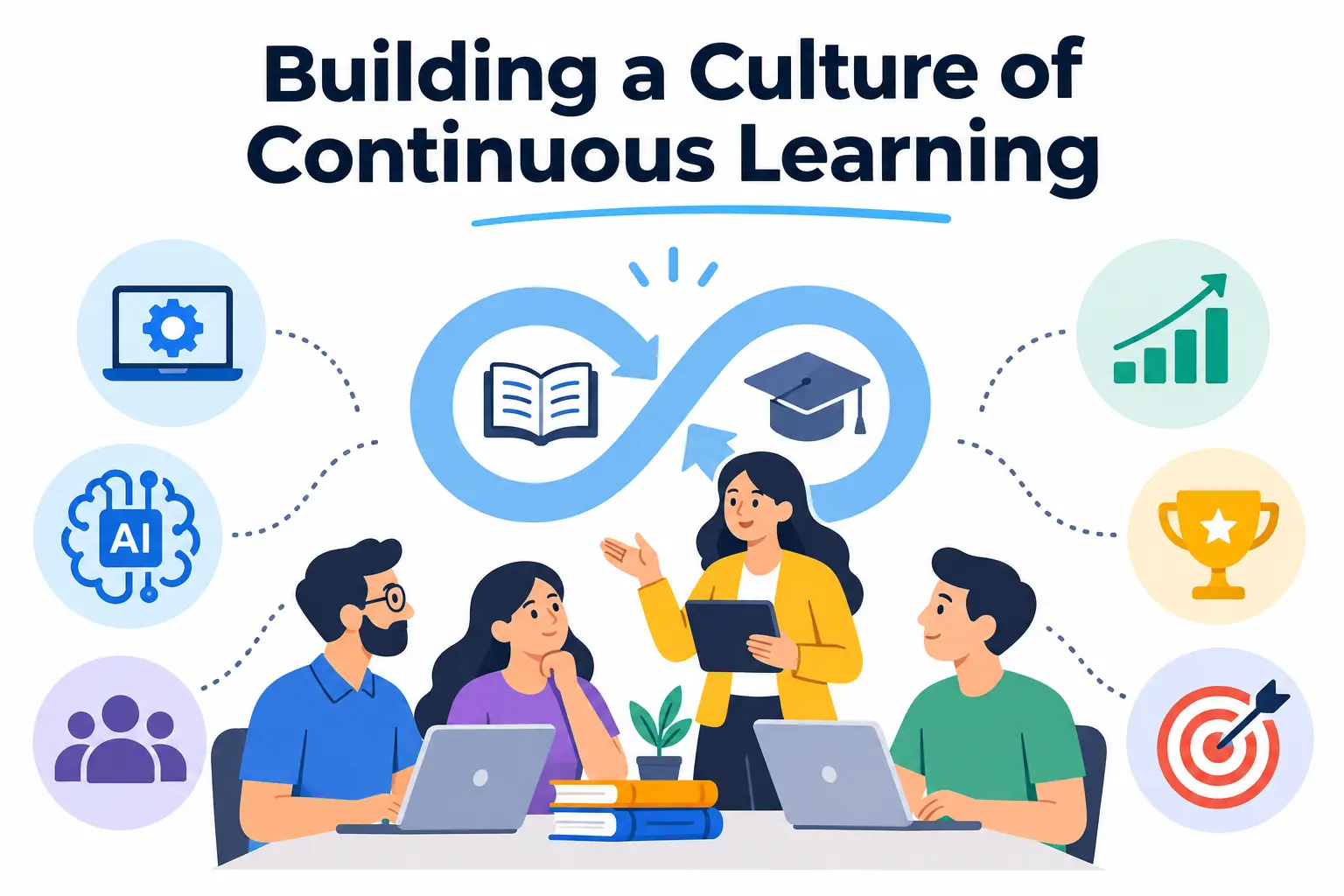
A culture of continuous learning is a workplace where employees are expected and supported to keep building new skills and knowledge throughout their careers. Learning is not limited to scheduled training days. It shows up in team meetings, project reviews, mentoring chats, and everyday problem-solving.
The idea builds on the concept of the learning organization, popularized by Peter Senge in his book The Fifth Discipline. The core belief is simple: organizations improve when the people inside them keep improving.
It helps to separate two levels:
- Individual learning: One person gains a skill, such as learning a new analytics tool.
- Organizational learning: That knowledge spreads, gets documented, and changes how the whole team works.
Individual learning is common. Organizational learning is the hard part, and it is where a real learning culture shows up.
Key Characteristics of a Continuous Learning Culture
You can spot a strong learning culture by looking for these traits:
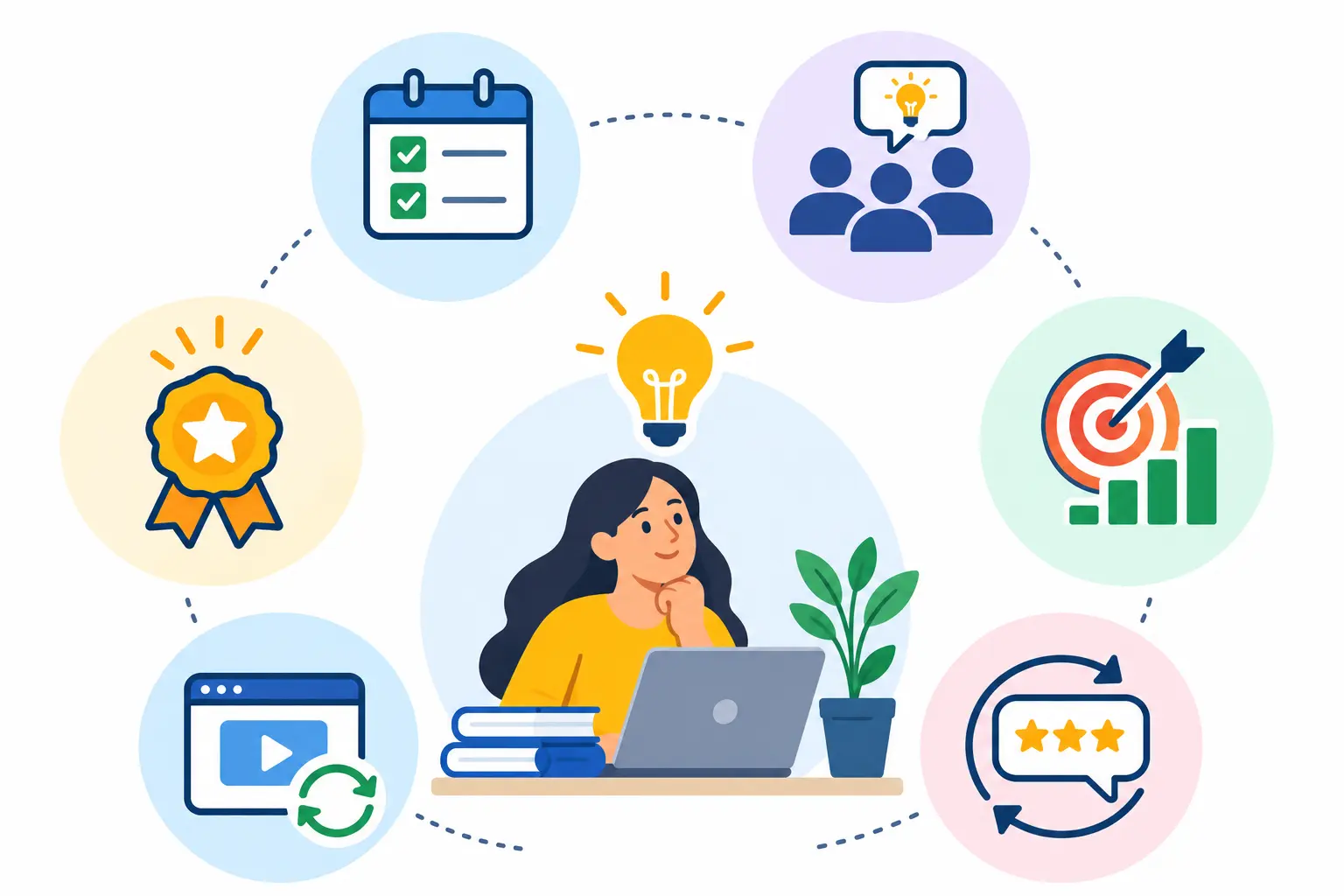
- Leadership commitment: Leaders fund learning, make time for it, and take part themselves.
- Curiosity and a growth mindset: People see skills as something they can build. The growth mindset idea, developed by psychologist Carol Dweck, describes this well.
- Knowledge sharing: What one person learns does not stay locked in one person’s head.
- Psychological safety: People can ask questions and admit mistakes without fear.
- Continuous feedback: Feedback is regular and specific, not saved for annual reviews.
- Accessible learning: Resources are easy to find and available when people need them.
Continuous Learning vs. Traditional Employee Training
Traditional training usually happens in short bursts. Continuous learning is ongoing and tied to real work. The table below shows the main differences.
| Factor | Traditional Training | Continuous Learning Culture |
| Learning frequency | Occasional events, such as onboarding or annual workshops | Ongoing, woven into weekly work |
| Accessibility | Fixed schedules and locations | On-demand, flexible, often mobile-friendly |
| Employee participation | Often assigned or mandatory | Mix of assigned and self-directed |
| Feedback | Limited, usually at the end | Regular, from managers and peers |
| Skill application | Left to the employee after the session | Built into projects and assignments |
| Evaluation | Attendance or a short quiz | Skill growth, work quality, and business results |
Training still has a place. A new safety procedure or compliance rule needs a formal session. The difference is that in a learning culture, training is one tool among many, not the whole strategy.
Why Is Continuous Learning Important in the Workplace?
Continuous learning matters because it helps employees adapt, stay engaged, work better, and solve problems. It also makes the organization more resilient when conditions change. Here is how each benefit plays out.
Helps Employees Adapt to Changing Skills and Technologies
Job requirements rarely stay still. A marketing coordinator now needs to understand analytics dashboards and AI writing tools. A finance analyst may need to automate reports that used to be built by hand.
The LinkedIn Workplace Learning Report is a good place to see how skills priorities are shifting across industries each year. When learning is a habit, your team adjusts to digital transformation and AI without panic.
It also lets you build industry-specific skills, such as data privacy for healthcare staff or cloud basics for IT teams, before gaps become problems.
Improves Employee Engagement and Retention
People tend to stay where they can grow. When employees see a path to build skills and move up, they have a reason to stay. Organizations can further strengthen employee engagement through training by offering personalized learning opportunities, practical activities, and clear career development pathways.
Learning supports internal career development too. Filling a role with someone already inside the company often saves hiring costs and keeps valuable context in the business. It also signals that the company invests in its people, which improves satisfaction.
Increases Workplace Productivity
Better knowledge leads to better work. An employee who understands a system well makes fewer mistakes and finds shortcuts faster.
Teams that learn together also solve problems faster. Instead of each person reinventing the same fix, they share what worked. Over time, workflows get cleaner and rework drops.
Encourages Innovation and Creativity
New ideas often come from combining knowledge from different places. When people learn across functions, they notice patterns others miss.
A learning culture also treats small experiments and failures as information. A team that reviews what went wrong after a project is more likely to try bolder ideas next time.
Strengthens Leadership and Organizational Resilience
Organizations that keep learning build a deeper bench of future leaders. Employees practice leading projects, mentoring others, and making decisions long before they get a manager title.
When a market shifts or a reorganization hits, adaptable teams handle the change better. They have already practiced learning new things quickly.
10 Key Elements of a Successful Continuous Learning Culture
These ten elements work together. You do not need to perfect all of them at once, but weak spots in one area can hold back the rest.
1. Strong Leadership Support and Commitment
Employees watch what leaders do more than what they say. If executives talk about learning but skip every workshop, the message is clear.
Leaders can set the tone by sharing what they are learning, joining sessions, and putting learning goals into team and company objectives. A manager who blocks time for a course on their own calendar gives everyone else permission to do the same.
2. A Growth Mindset Across the Organization
A growth mindset means believing that skills can be developed through effort and practice. It shapes how people react to challenges.
You can encourage it by rewarding curiosity, treating mistakes as lessons, and making room for small experiments. Even simple phrases help, such as “What did we learn?” instead of “Who got this wrong?”
3. Psychological Safety and an Open Learning Environment
Psychological safety is the shared belief that you can speak up, ask questions, or admit an error without being punished or embarrassed. Researcher Amy Edmondson helped bring the idea into mainstream management thinking.
Without it, people hide gaps in their knowledge. That makes learning almost impossible. Managers build safety by thanking people for questions, responding calmly to mistakes, and admitting their own gaps openly.
4. Accessible and Flexible Learning Opportunities
People learn best when they can learn at the moment of need. That means on-demand content, self-paced courses, and mobile-friendly resources.
Flexibility matters for shift workers, remote teams, and parents with tight schedules. If learning only happens at 2 p.m. on Tuesdays in one room, many people are shut out.
5. Personalized Employee Learning Pathways
A new analyst and a senior manager do not need the same learning plan. Role-specific pathways and individual development plans make learning relevant.
Start with each person’s current skills and career goals. Then recommend courses, projects, or mentors that close the gap between where they are and where they want to go.
6. Knowledge Sharing and Cross-Functional Collaboration
Some of the most useful knowledge is not in any course. It lives in the heads of experienced employees.
Peer-to-peer learning, department knowledge-sharing sessions, cross-functional projects, and internal communities help move that knowledge around. They also build relationships that make collaboration easier.
7. Coaching, Mentoring, and Feedback
Managers play a big role here. Regular one-on-one development conversations, not just performance reviews, keep learning on the agenda.
Mentorship programs add another layer. A mentor can explain unwritten rules, share career lessons, and offer honest feedback. Peer feedback adds a third view of how someone is doing.
8. Recognition and Rewards for Learning
What gets recognized gets repeated. Celebrate learning efforts through certificates, digital badges, shout-outs in team meetings, and, most importantly, real career opportunities.
Recognition works best when it is tied to growth, not just to course completion. Praise the person who applied a new skill to fix a real problem, not only the person who finished a module.
9. Learning Integrated Into Everyday Work
The strongest learning happens on the job. Microlearning, which means short lessons of a few minutes, fits easily into a busy day. You can read more on the concept in this overview of microlearning.
Other ways to build learning into work include project-based learning, job shadowing, practical assignments, and short post-project reviews that capture what the team learned.
10. Continuous Evaluation and Improvement
A learning culture is never finished. You need to check what works and adjust.
Use employee feedback, skills assessments, and learning analytics to see which programs help and which do not. Then update the program regularly. Dropping a low-value course is as important as launching a new one.
8 Practical Ways to Encourage Continuous Learning in the Workplace
The ten elements above describe the foundation. The ideas below are the actual activities you can start running this month.
1. Organize Weekly Knowledge-Sharing Sessions
Set aside 20 to 30 minutes each week for a short internal talk. One employee shows a tool, a lesson from a recent project, or a shortcut that saves time.
Keep it informal and rotate presenters. Department-level exchanges, where one team explains its work to another, also reduce silos.
2. Introduce Microlearning Activities
Microlearning delivers one idea at a time in five to ten minutes. Think short videos, quick tutorials, or a single-page guide.
It works well because busy people can finish a lesson between meetings. Pair each short lesson with one small action to try that same day.
3. Create Internal Mentorship Programs
Pair experienced employees with newer team members. Agree on two or three development goals at the start so the relationship has direction.
Schedule regular check-ins, ideally every two to four weeks. Without a calendar invite, most mentoring programs fade within a few months.
4. Encourage Cross-Departmental Learning
Let employees spend time in other parts of the business. Job shadowing, short department rotations, and cross-functional assignments all work.
A customer support agent who spends a day with the product team will bring back sharper feedback. The product team, in turn, hears real customer problems firsthand.
5. Provide Access to Online Courses and Certifications
Online libraries give employees choice. Offer technical courses, professional certifications, and leadership development programs.
A learning budget, even a modest one, signals trust. Ask employees to share one takeaway with their team after each course so the benefit spreads.
6. Conduct Regular Learning Workshops
Hands-on workshops help people practice, not just listen. Run industry-specific sessions, product demonstrations, and technology walkthroughs.
Keep groups small and include a real task to complete. People remember what they do far better than what they hear.
7. Introduce Learning Challenges and Gamification
Gamification means using game elements, such as points, badges, and leaderboards, in non-game settings. Used lightly, it adds a bit of fun to learning.
Try a monthly learning challenge or a friendly skills competition. Keep the stakes low, since heavy competition can discourage people who are new to a topic.
8. Connect Learning With Career Development
People invest effort when they see where it leads. Link learning to individual development plans, career conversations, internal job postings, and skill-based promotions.
If employees learn new skills but never get a chance to use them, they will eventually look elsewhere.
How to Build a Culture of Continuous Learning: Step-by-Step Implementation
Here is the short answer. To build a culture of continuous learning, assess where you are, set clear goals, personalize development plans, give people time and tools, apply skills on real work, and measure results. The eight steps below explain how.
Step 1. Assess Your Organization’s Current Learning Culture
Start by finding out what already exists. List your current training programs, learning resources, and who uses them.
Then ask employees directly. A short survey or a few small-group conversations will show you skill gaps, barriers, and what people actually want to learn. Expect some surprises. Leaders often assume people are too busy, while employees say they lack clear guidance on what to learn.
Step 2. Define Clear Learning Goals
Tie learning goals to real business priorities. If the company plans to launch a new product line, the matching learning goal might be “Sales and support teams can explain the new product confidently by the end of the quarter.” A well-structured employee training program helps organizations turn these learning goals into practical activities, measurable outcomes, and employee development opportunities.
Set department-level goals and add measurable outcomes, such as assessment scores or reduced error rates. Vague goals like “learn more” do not drive action.
Step 3. Create Personalized Learning and Development Plans
Sit down with each employee, or have their manager do it. Identify development needs, map skills to their current and future responsibilities, and suggest relevant resources.
Add milestones, such as “complete a data analysis course by March and use it in the Q2 report.” Short, specific targets are easier to keep.
Step 4. Choose the Right Learning Methods and Resources
No single format fits every topic. Technical skills often suit online courses and practice projects. Soft skills usually grow better through coaching, mentoring, and peer discussion.
Mix formats: online courses, workshops, coaching, mentoring, peer learning, and hands-on projects. A good rule is to favor methods that let people practice on real work.
Step 5. Provide Dedicated Time and Learning Resources
This step is where many programs fail. If learning is always something to do “when things calm down,” it will never happen.
Protect time for it, for example two hours a week or a half day each month. Back that up with a learning budget, easy access to digital resources, and managers who actively support the schedule.
Step 6. Introduce a Learning Management System
A learning management system (LMS) is software that stores learning content, assigns courses, and tracks progress in one place. It gives employees a single spot to find what they need.
Use it to build structured learning paths, monitor progress, and manage assessments and certifications. Choose one after you define your needs, not before. Buying the tool first often leads to an expensive platform nobody uses.
Step 7. Encourage Employees to Apply New Skills
Learning that is never used fades quickly. Build in ways to practice right away.
Assign small real projects, run workplace simulations, and present real-world problems to solve. After training, ask people to teach what they learned to a teammate. Teaching is one of the best ways to lock in knowledge.
Step 8. Measure Results and Improve the Learning Strategy
Track participation, skill growth, employee feedback, and changes in work performance. Review the data every quarter.
Be ready to change course. If a popular course does not change on-the-job behavior, redesign it or replace it. Measurement is covered in more detail later in this guide.
90-Day Roadmap for Building a Continuous Learning Culture
If the eight steps feel like a lot, here is a simple 90-day plan to get started.
| Timeline | Key activities | Expected outcome |
| Days 1–30 | Assess skills, identify gaps, collect feedback, define objectives | Clear learning priorities |
| Days 31–60 | Introduce learning paths, workshops, mentoring, and learning tools | Active employee participation |
| Days 61–90 | Evaluate learning transfer, collect feedback, measure KPIs, improve programs | Measurable learning progress |
First 30 Days: Assess and Plan
Focus on listening and planning. Run a skills survey, meet with department heads, and review current training spend and usage.
By day 30, agree on three to five learning priorities linked to business goals. Choose one or two pilot teams so you can test ideas on a small scale first.
Days 31–60: Implement Learning Initiatives
Launch the first activities. Start weekly knowledge-sharing sessions, set up mentoring pairs, and publish learning paths for pilot roles.
If you are adopting an LMS or other tool, roll it out to the pilot teams only. Gather quick feedback after the first few weeks and fix obvious friction.
Days 61–90: Measure and Optimize
Look at what has changed. Check participation, completion, assessment results, and whether managers see skills used on the job.
Talk to participants about what worked and what did not. Then adjust the plan and decide how to expand to more teams in the next quarter.
Best Tools and Technologies That Support Continuous Learning
Tools do not create a learning culture, but the right ones make learning easier to reach and track. Pick tools that match your goals and team size.
Learning Management Systems (LMS)
An LMS centralizes training, offers learning pathways, runs assessments, and tracks progress. Well-known examples include Moodle, TalentLMS, and Docebo. Moodle is open source, while the other two are commercial platforms. Compare features, pricing, and integrations against your needs before choosing.
Learning Record Stores (LRS)
A learning record store collects data about learning activity from many sources, such as courses, apps, and simulations. It relies on a standard called the Experience API (xAPI). This helps you see learning that happens outside a single platform and supports deeper employee learning analytics.
E-Learning Authoring Tools
These tools let your team build interactive courses, video lessons, and scenario-based training without starting from scratch. They are useful when you need training that reflects your own processes and products.
AI-Powered Learning Platforms
AI-based platforms can recommend content based on someone’s role, skills, and past activity. Some adapt the difficulty as the learner progresses.
Use these features thoughtfully. Personalized recommendations save time, but a human conversation about career goals still matters. Always review how the platform handles employee data.
Collaboration and Knowledge-Sharing Tools
Platforms like Microsoft Teams and Slack make it easy to create channels for questions, tips, and shared resources. An internal knowledge base or wiki gives people a searchable place to store answers.
The habit matters more than the tool. A well-kept shared document beats an expensive system nobody updates.
Emerging Technologies in Workplace Learning
Virtual reality (VR) and augmented reality (AR) can simulate situations that are risky or costly to practice for real, such as equipment repair or emergency response. Gamification adds motivation. Learning analytics helps you spot patterns in how people learn.
These technologies can be powerful, but they are not required to start. Many organizations build a strong learning culture with simple, low-cost tools.
Real-World Examples of Continuous Learning in the Workplace
The four scenarios below are illustrative examples based on common practices. They are not verified case studies of specific companies.
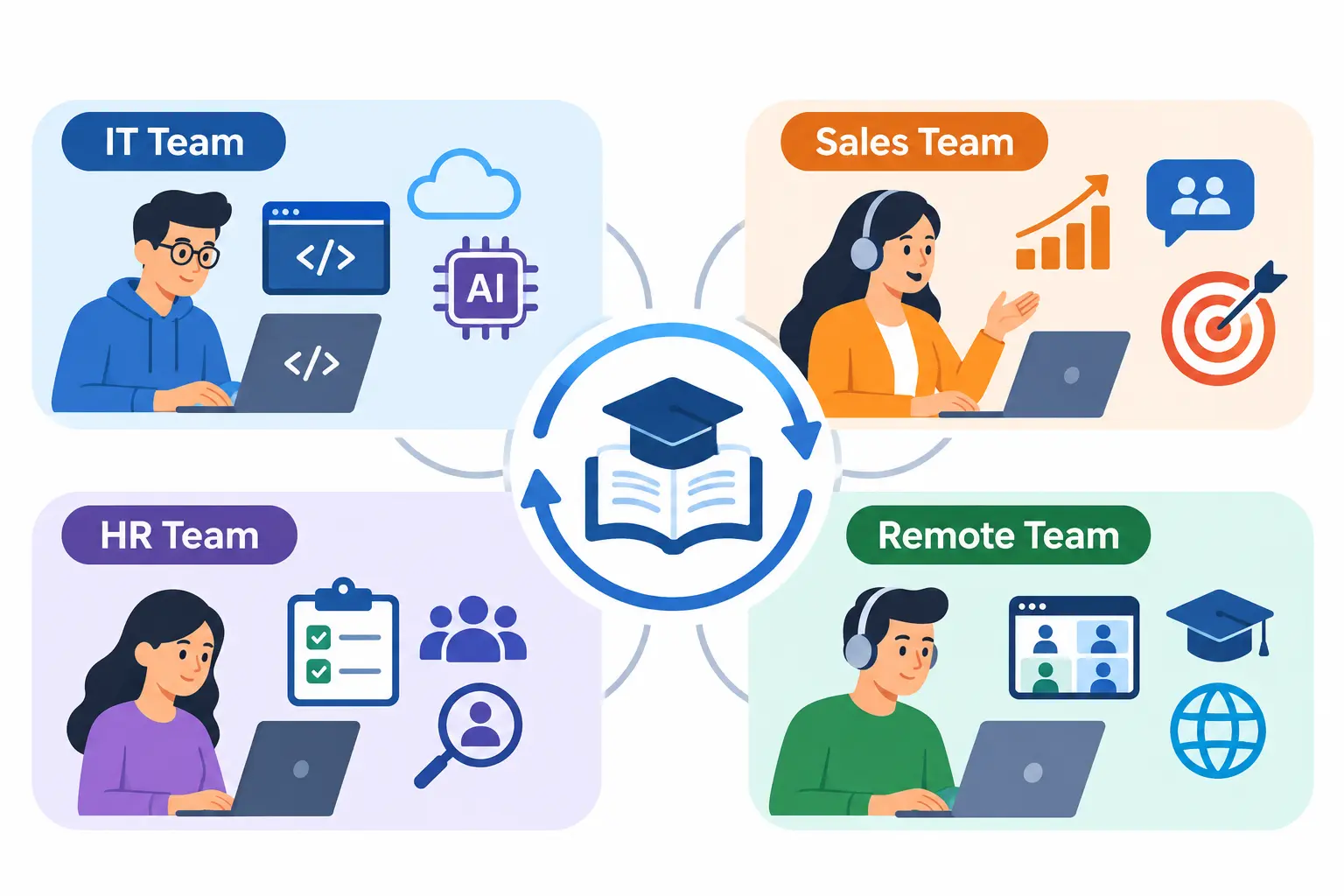
Example 1. Continuous Learning in an IT Company
Imagine a software team that holds a 30-minute technical session every Friday. Developers take turns presenting a new technique or lesson from a recent bug fix.
The company also funds cloud and AI courses, and each learner applies the skill on a small internal project. Within months, the team shares code patterns more consistently and onboards new hires faster.
Example 2. Continuous Learning in a Sales Team
Picture a sales team that releases a new product every quarter. Instead of a single product lecture, they run short product briefings, role-play sales calls, and hold customer communication workshops.
Managers review recorded practice calls and give specific feedback. Reps get a safe place to practice before they talk to real customers.
Example 3. Continuous Learning in an HR Department
An HR team might build skills in recruitment analytics, employee engagement, and leadership development. Team members take turns learning a topic and teaching it to the group.
They also review hiring data together each quarter. That turns abstract training into practical decisions about sourcing, interviewing, and retention.
Example 4. Continuous Learning in a Remote Organization
A remote company cannot rely on hallway conversations. It might use virtual workshops, asynchronous courses, digital mentoring, and online communities where staff share what they learn.
Recorded sessions and written summaries make sure people in different time zones are not left out. Clear communication channels become the “hallway” of the remote workplace.
How to Measure the Success of a Continuous Learning Culture
What you measure shapes what people pay attention to. Do not stop at attendance. Look at skills, behavior, and business results.
The widely used Kirkpatrick model evaluates training at four levels: reaction, learning, behavior, and results. It is a handy frame for the measures below.
Track Employee Learning Participation
Start with the basics: course enrollment, course completion, workshop attendance, and voluntary learning activity. Voluntary participation is especially telling because it shows real interest. sing a structured system to monitor employee training progress also helps managers identify skill gaps, evaluate learning outcomes, and improve future training initiatives.
Participation numbers alone do not prove value. They show whether people are engaging, which is the first step.
Measure Skill Development and Knowledge Retention
Use pre- and post-training assessments, skills assessments, practical demonstrations, and competency evaluations. Comparing before and after scores shows what people actually gained.
Check again a few weeks later. Retention tells you whether the learning stuck.
Evaluate Learning Transfer to Workplace Performance
Learning transfer is the use of new skills on the job. Ask managers to watch for specific changes, such as better work quality, fewer errors, and stronger problem-solving.
This is the stage where learning turns into business value. It is also the stage most organizations skip.
Monitor Employee Engagement and Retention
Track employee satisfaction, internal mobility, retention, and feedback on development opportunities. If people feel they are growing, those numbers tend to improve over time.
Remember that many factors affect retention. Use these figures as signals, not as proof that learning alone caused a change.
Calculate Learning and Development ROI
Training ROI compares the benefit of a program with its cost. The basic formula is:
ROI (%) = (Program benefits − Program costs) ÷ Program costs × 100
Costs include content, tools, instructor time, and employee time. Benefits might include time saved, fewer errors, or lower hiring costs. Be honest about estimates, and isolate the effect of training where you can.
Important KPIs for Measuring Continuous Learning
| KPI | What it measures |
| Learning participation rate | Employee involvement in learning |
| Course completion rate | Completion of learning programs |
| Skill improvement rate | Development of employee competencies |
| Training transfer rate | Application of new skills at work |
| Internal mobility rate | Career movement within the organization |
| Employee retention rate | Employee retention over time |
| Training ROI | Business value relative to learning investment |
Pick three to five KPIs to start. Too many metrics make reporting a chore and hide what matters.
Common Challenges in Building a Continuous Learning Culture and How to Overcome Them
Every organization hits obstacles. Here are the most common ones and practical fixes.
Lack of Time for Employee Learning
Solution: Introduce protected learning hours and use microlearning. Even 30 minutes a week, guarded by managers, builds momentum.
Low Employee Participation
Solution: Personalize learning and connect it to career development. People join when they see what is in it for them.
Limited Training Budget
Solution: Use internal mentors, peer learning, open educational resources, and targeted training. Many of the most effective learning methods cost little.
Resistance to Organizational Change
Solution: Involve managers early, explain the benefits clearly, and roll out changes gradually. Pilot programs reduce fear and give you real feedback.
Lack of Leadership Support
Solution: Establish leadership accountability and have leaders take part visibly. Share early results from pilots so leaders see the value.
Difficulty Measuring Learning Effectiveness
Solution: Combine learning analytics with assessments and workplace performance indicators. No single number tells the whole story.
Best Practices for Sustaining a Continuous Learning Culture
Launching a program is the easy part. These habits keep it alive.
Make Learning Part of Everyday Work
Build learning into team meetings, project plans, and daily tasks. A five-minute “what did we learn this week?” At the end of a team meeting is a good start.
Encourage Employees to Share Knowledge
Make sharing easy and visible. Short write-ups, lunch-and-learns, and shared channels all work. Thank people publicly when they teach others.
Align Learning With Business and Career Goals
Revisit your learning priorities every quarter. Make sure they still match company strategy and what employees want for their careers.
Recognize Consistent Learning Efforts
Reward steady effort, not just big achievements. Recognition that is regular and specific keeps motivation high.
Regularly Update Learning Resources
Outdated content hurts credibility. Review courses and guides on a schedule, and retire anything that no longer reflects how work is done.
Gather Feedback and Improve Learning Programs
Ask learners what is useful and what is not. Then act on the answers and tell them what changed. People give honest feedback when they see it leads somewhere.
Frequently Asked Questions About Building a Culture of Continuous Learning
1. What is a culture of continuous learning?
A culture of continuous learning is a workplace where employees are supported and expected to keep developing skills throughout their careers. Learning is part of daily work, shared across teams, and backed by leadership.
2. How do you build a culture of continuous learning?
Assess current learning habits, set clear goals, create personalized development plans, provide time and resources, and use an LMS if needed. Then help employees apply new skills at work and measure results regularly.
3. Why is continuous learning important in the workplace?
It helps employees adapt to new technology, improves engagement and retention, raises productivity, supports innovation, and makes the organization more resilient to change.
4. What are the key characteristics of a continuous learning culture?
The main traits are leadership commitment, a growth mindset, knowledge sharing, psychological safety, continuous feedback, and accessible learning opportunities.
5. How can managers encourage employees to learn continuously?
Managers can protect learning time, hold regular development conversations, model learning themselves, give useful feedback, and link learning to career growth. Small, consistent actions matter more than big announcements.
6. What are some examples of continuous learning in the workplace?
Examples include weekly knowledge-sharing sessions, microlearning, mentoring, job shadowing, online courses, hands-on workshops, and post-project reviews.
7. What tools support continuous learning in organizations?
Common tools include learning management systems such as Moodle, TalentLMS, and Docebo, learning record stores, e-learning authoring tools, AI-powered learning platforms, and collaboration tools like Microsoft Teams and Slack.
8. How do you measure the effectiveness of continuous learning?
Track participation, skill improvement, learning transfer to the job, engagement and retention, and training ROI. Combine assessments, manager observations, and business data for a fuller picture.
9. What are the biggest challenges in creating a learning culture?
The most common challenges are lack of time, low participation, limited budget, resistance to change, weak leadership support, and difficulty measuring results.
10. How can small businesses create a continuous learning culture?
Start small and low-cost. Hold short weekly knowledge-sharing sessions, pair people for mentoring, use free or low-cost online resources, and make time for post-project reviews. In a small team, the owner’s example carries a lot of weight.
Conclusion
Building a culture of continuous learning does not require a huge budget or a complex system. It starts with leaders who value growth, a safe space to ask questions, and simple habits that make learning part of the workday.
Begin with an honest look at where your team stands. Pick a few priorities, run a small pilot, and measure what changes. Then keep improving.
Organizations that treat learning as an ongoing practice are better prepared for whatever comes next. Start this week with one small step, such as a 20-minute knowledge-sharing session, and build from there.