

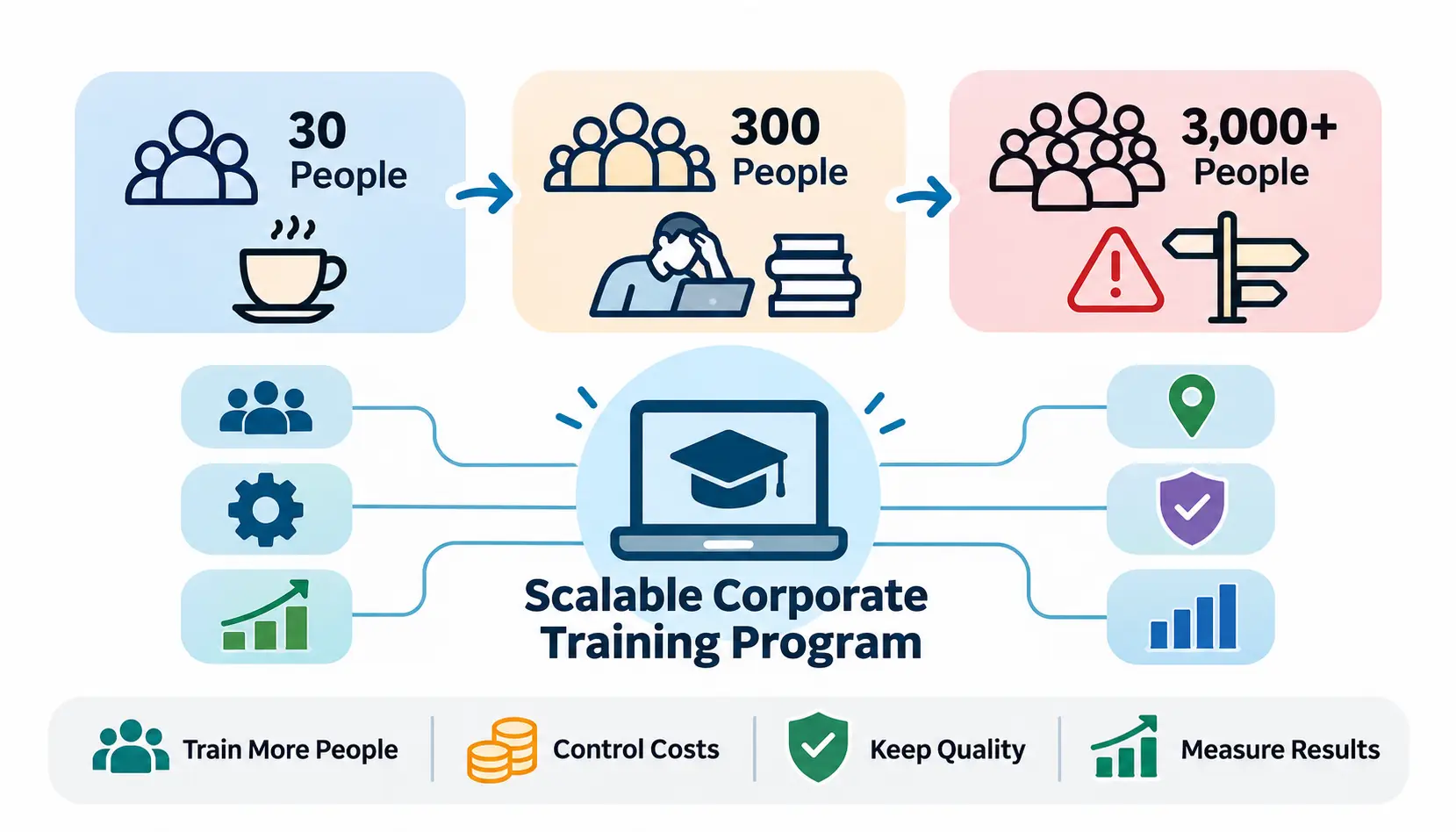
A company with 30 people can train everyone over coffee. A company with 300 cannot. By 3,000, the old methods fall apart completely: trainers burn out, new hires get different advice from different managers, and nobody can say whether training works.
This is the point where you need a scalable corporate training program. It is a system that lets you train more people, in more places, without your cost, effort, or quality growing at the same speed.
In my experience, most training problems at growing companies are not content problems. They are system problems. This guide walks through a 10-step framework you can use to fix that, plus the tools, metrics, costs, and mistakes to watch for.
What Is a Scalable Corporate Training Program?
A scalable corporate training program is a repeatable training system that keeps quality steady as headcount, locations, and roles increase. Adding 500 employees should not mean adding 500 times the work.
Understanding Corporate Training and Employee Development
Corporate training teaches employees the skills they need for their current jobs. Employee development looks further ahead and prepares people for bigger roles. Both fall under what Wikipedia describes as training and development, and a healthy program covers both.
What Makes a Corporate Training Program Scalable?
Three things separate a scalable program from a pile of courses:
- Reusable content. You build a lesson once and use it many times.
- Automation. Enrollment, reminders, and reporting run without manual effort.
- Clear standards. Every location follows the same core requirements.
Scalable Training vs. Traditional Training
| Factor | Traditional training | Scalable training |
| Delivery | Mostly live, in person | Mix of self-paced, virtual, and live |
| Content | Built for one group or trainer | Modular and reusable |
| Administration | Spreadsheets and email | Automated through an LMS |
| Consistency | Varies by trainer or site | Standardized core, flexible paths |
| Cost as you grow | Rises almost in step with headcount | Rises slowly |
| Measurement | Attendance sheets | Analytics tied to performance |
Key Components of a Scalable Corporate Training System
Every scalable system has the same five parts: clear goals, a modular curriculum, a delivery plan, a technology platform (usually an LMS), and a way to measure results. Weakness in any one of them limits the rest.
Why Do Businesses Need a Scalable Corporate Training Program?
Because growth exposes every weakness in informal training. The business case comes down to six benefits.
Support Workforce Growth Without Increasing Training Costs
Reusable content and automation mean the hundredth new hire costs far less to train than the first. You pay to build once and reuse many times.
Improve Employee Productivity and Performance
Well-structured training shortens the time it takes people to do their jobs well. Faster ramp-up is often the first result managers notice.
Maintain Consistent Training Across Departments
When every team follows the same core standards, customers and colleagues get a similar experience everywhere. This matters most for safety, compliance, and brand-critical skills.
Close Employee Skills Gaps
Skills gaps grow quietly. A scalable program gives you a way to spot them early and respond with targeted learning, not a one-size-fits-all course.
Improve Employee Engagement and Retention
Many employees want to grow where they work. LinkedIn’s Workplace Learning Report has consistently explored how learning opportunities connect to career growth and retention, and it is a good source for current benchmarks.
Prepare Employees for Emerging Technologies and Industry Changes
Tools and regulations change fast. A system that can push updated modules to everyone quickly keeps your team current without starting from scratch each time.
Common Challenges in Scaling Corporate Training
Knowing the usual problems helps you design around them.
Managing Training Across Large and Distributed Teams
Time zones, languages, and shift schedules make live sessions hard. Self-paced and virtual formats solve much of this.
Delivering Personalized Learning Experiences
A new sales rep and a senior engineer need different things. Role-based learning paths give personalization without custom-building every course.
Maintaining Consistent Training Quality
When ten trainers teach the same topic, you get ten versions of it. Shared materials, scripts, and assessments keep quality level.
Managing Training Costs and Resources
Trainer time, travel, and content work add up. Without a plan, budgets grow faster than results.
Keeping Training Content Updated
Outdated content is worse than none. Policies, products, and tools change, and your lessons must change with them.
Measuring Training Effectiveness and ROI
Many teams track attendance and stop there. Attendance shows who showed up, not who improved.
Overcoming Low Employee Participation
People skip training that feels irrelevant or dull. Short, practical lessons and manager support lift participation more than reminder emails do.
How to Build a Scalable Corporate Training Program Step by Step
This is the core framework. Follow the steps in order, because each one feeds the next.
Step 1: Identify Business Goals and Training Requirements
Start with the business, not the course catalog. Ask what the company needs to achieve this year and what people must do differently to get there. Creating a structured corporate training plan helps organize learning objectives, employee requirements, training methods, budgets, and implementation timelines.
Align training objectives with organizational goals. If the goal is to cut customer churn, training might focus on support quality and product knowledge. If it is faster expansion, think onboarding and manager skills.
Identify department-specific training needs. Talk to each department head. Sales, IT, and operations will name very different priorities.
Define employee performance expectations. Write down what “good” looks like in each role. You cannot train toward a target nobody has defined.
Step 2: Conduct a Training Needs and Skills Gap Assessment
A needs assessment shows the gap between current skills and required skills. It stops you from spending money on training people do not need.
Analyze existing employee skills. Use skills surveys, manager reviews, and performance data.
Identify critical competency gaps. Focus on gaps that affect results, such as errors, delays, or customer complaints.
Gather feedback from employees and managers. Ask both groups. Managers see performance issues, while employees know what blocks them.
Prioritize training requirements. You cannot fix everything at once. Rank gaps by business impact and urgency, and start with the top few.
Step 3: Define Clear Learning Objectives
Learning objectives say what a person will be able to do after training. Vague goals like “understand the CRM” are hard to measure.
Set measurable training outcomes. Try “log a customer interaction in the CRM in under two minutes with no errors.”
Connect learning objectives with job responsibilities. Every objective should map to a real task. If it does not, cut it.
Establish employee proficiency targets. Define levels such as beginner, working, and advanced so you know when someone is ready.
Step 4: Develop a Modular Training Curriculum
Modular design is the single biggest driver of scalability. Think of modules as building blocks you can rearrange for different roles.
Divide training content into reusable learning modules. Keep each one focused on one skill and short enough to finish in one sitting.
Create foundation and role-specific learning paths. Everyone takes the foundation modules, such as company values, security basics, and tools. Then each role adds its own modules.
Include practical exercises and assessments. People learn by doing. Add scenarios, quizzes, and short practice tasks.
Standardize training materials across departments. Use one template for structure, tone, and format. It makes content easier to build, update, and trust. Good instructional design principles help here.
Step 5: Choose the Right Training Delivery Methods
No single method works for every topic. Match the method to the skill, the audience, and your budget.
Instructor-led training (ILT). Best for complex, sensitive, or hands-on topics such as leadership coaching. It is high-touch but hard to scale.
Virtual instructor-led training (VILT). Live sessions online. You keep interaction while removing travel costs.
Self-paced online learning. Employees learn on their own schedule. This is the most scalable format for knowledge-based topics.
Blended learning. Blended learning combines online content with live practice. For many companies, this is the best balance of cost and results.
Microlearning and mobile learning. Microlearning delivers short lessons, often under ten minutes. It suits frontline staff and busy managers.
Social learning and peer-based training. Mentoring, communities, and knowledge-sharing let experienced employees teach others. Practitioners swap ideas on this in communities like instructional design on Reddit.
Step 6: Select the Right Learning Management System (LMS)
A learning management system is software that hosts, delivers, and tracks training. Without one, scaling usually means more spreadsheets and more admin work. A well-designed corporate training platform can bring course delivery, employee skill tracking, certification management, and training analytics together in one place.
Essential LMS features for corporate training. Look for an easy interface, mobile access, content support for standards like SCORM, and good support.
Automated enrollment and training assignments. The system should assign courses based on role, department, or hire date with no manual work.
Progress tracking and learning analytics. You need to see who has finished what, where people struggle, and which courses work.
Assessment and certification management. For compliance training especially, you need quizzes, certificates, and expiry reminders.
Integration with HR and business systems. Connecting the LMS to your HR system keeps employee data accurate and removes duplicate entry.
Step 7: Create Engaging and Reusable Training Content
Good content is clear, practical, and easy to update.
Develop videos, interactive lessons, and job aids. Short videos explain concepts, interactive lessons build skill, and one-page job aids support people on the job.
Use real-world workplace scenarios. A support team learns more from a real angry-customer scenario than from a list of tips. Ask your best performers for real examples.
Incorporate AI-assisted learning where appropriate. AI can help draft quiz questions, summarize material, or answer learner questions. Always have a subject expert review the output before it reaches employees.
Establish a content review and update process. Give every module an owner and a review date. Without ownership, content goes stale.
Step 8: Launch a Pilot Training Program
A pilot is a small-scale test. It protects you from rolling out a flawed program to the whole company.
Select a representative employee group. Choose a mix of roles, experience levels, and, if relevant, locations.
Test learning materials and delivery methods. Watch for confusing instructions, technical issues, and lessons that run too long.
Collect employee and manager feedback. Use short surveys and a few conversations. Ask what was useful, what was not, and what was missing.
Identify improvements before full rollout. Fix what you find, then retest if the changes are large.
Step 9: Scale Training Across Departments and Locations
Once the pilot works, expand in phases rather than all at once.
Standardize core training requirements. Make foundation modules mandatory everywhere.
Customize learning paths for different roles. Add role-specific and local content on top of the core.
Automate training administration. Let the LMS handle enrollment, reminders, and reports so your team can focus on quality.
Support remote and hybrid employees. Offer mobile access, recorded sessions, and flexible deadlines so no one is left out.
Step 10: Evaluate Training Results and Continuously Improve
Training is never finished. Review results regularly and adjust.
Measure learning progress and knowledge retention. Use short follow-up quizzes weeks later, not only at the end of the course. People forget quickly without reinforcement, a pattern known as the forgetting curve.
Track employee performance improvements. Compare real job metrics before and after training.
Collect feedback and identify training gaps. New gaps will appear as the business changes.
Update training content based on results. Retire what does not work and improve what does.
Which Corporate Training Methods Are Best for Different Employee Groups?
Different groups need different approaches. Use this table as a starting point.
| Employee group | Best methods | Main learning objective | Suggested assessment |
| IT and engineering | Self-paced labs, sandbox practice, peer reviews | Apply technical skills and keep up with new tools | Hands-on tasks, code reviews |
| Sales teams | Role-play, VILT, microlearning | Run effective customer conversations | Call reviews, scenario tests |
| Managers | Blended learning, coaching, cohorts | Lead, coach, and give feedback | 360 feedback, case discussions |
| All employees (compliance) | Short online modules | Follow policies and laws | Quizzes, annual certification |
| Customer service | Scenario practice, microlearning | Resolve issues quickly and kindly | Quality scores, call reviews |
| New hires | Blended onboarding path | Reach productivity quickly | 30-60-90 day check-ins |
Technical Training for IT and Engineering Teams
Technical staff learn best by building. Give them hands-on labs and time to practice, and let senior engineers contribute content.
Sales Training for Revenue Teams
Sales skills need rehearsal. Short lessons on product and process, combined with live role-play, work well.
Leadership Training for Managers
New managers often struggle with feedback and delegation. Cohort-based programs with coaching build both skill and peer support.
Compliance Training for All Employees
Compliance needs reliable tracking and clear records. Self-paced modules with automatic reminders and annual renewals fit best.
Customer Service Training for Support Teams
Use real tickets and calls (with personal details removed) as practice material. Short refreshers keep skills sharp.
Onboarding Training for New Employees
Onboarding sets the tone for a new hire’s experience. Combine a standard welcome path with role-specific tasks, and assign a buddy for support.
How to Choose the Right Technology for Scalable Corporate Training
Technology should follow your needs, not lead them. Define your goals first, then shop.
Learning Management System (LMS) vs. Learning Experience Platform (LXP)
An LMS manages and tracks required training. A learning experience platform focuses on discovery, recommending content that fits each learner’s interests. Many companies use an LMS for compliance and assigned learning, and some add an LXP for self-directed growth.
Essential Features to Consider When Selecting an LMS
- Ease of use for learners and admins
- Role-based automatic assignments
- Reporting and analytics
- Mobile access
- Integrations with your HR and other systems
- Security and data protection
- Vendor support and a clear roadmap
Popular Corporate Training Platforms
These are well-known options. Features and pricing change often, so check each vendor’s current information and request a demo.
- Moodle Workplace: Built on the open-source Moodle ecosystem, with strong customization.
- Docebo: Known for AI-supported features and enterprise use.
- Cornerstone OnDemand: A broad talent management suite popular with larger organizations.
- TalentLMS: Often chosen by small and mid-sized teams for its simplicity.
- Absorb LMS: Known for its user-friendly admin experience.
- LearnUpon: Often used for customer, partner, and employee training.
Practitioners often compare real-world experiences with these tools on Reddit, for example in humanresources. Treat those opinions as one input, not a verdict.
When Should You Choose a Custom Corporate Training Platform?
Consider a custom platform only when off-the-shelf tools cannot meet a clear need, such as unusual integrations, strict data rules, or a unique learner experience. Custom builds cost more and need ongoing maintenance, so most companies should start with an existing LMS.
Integrating Training Software With HRIS and Other Business Systems
Connect your LMS to your human resources system so new hires, role changes, and departures update training records automatically. Standards such as xAPI can also help track learning activity beyond the LMS.
How AI Is Changing Corporate Employee Training
AI is helping teams draft content faster, personalize learning paths, and give learners instant answers. The risks are inaccurate output and weak oversight. Use AI to speed up work, and keep people responsible for accuracy.
Best Practices for Scaling Corporate Training Successfully
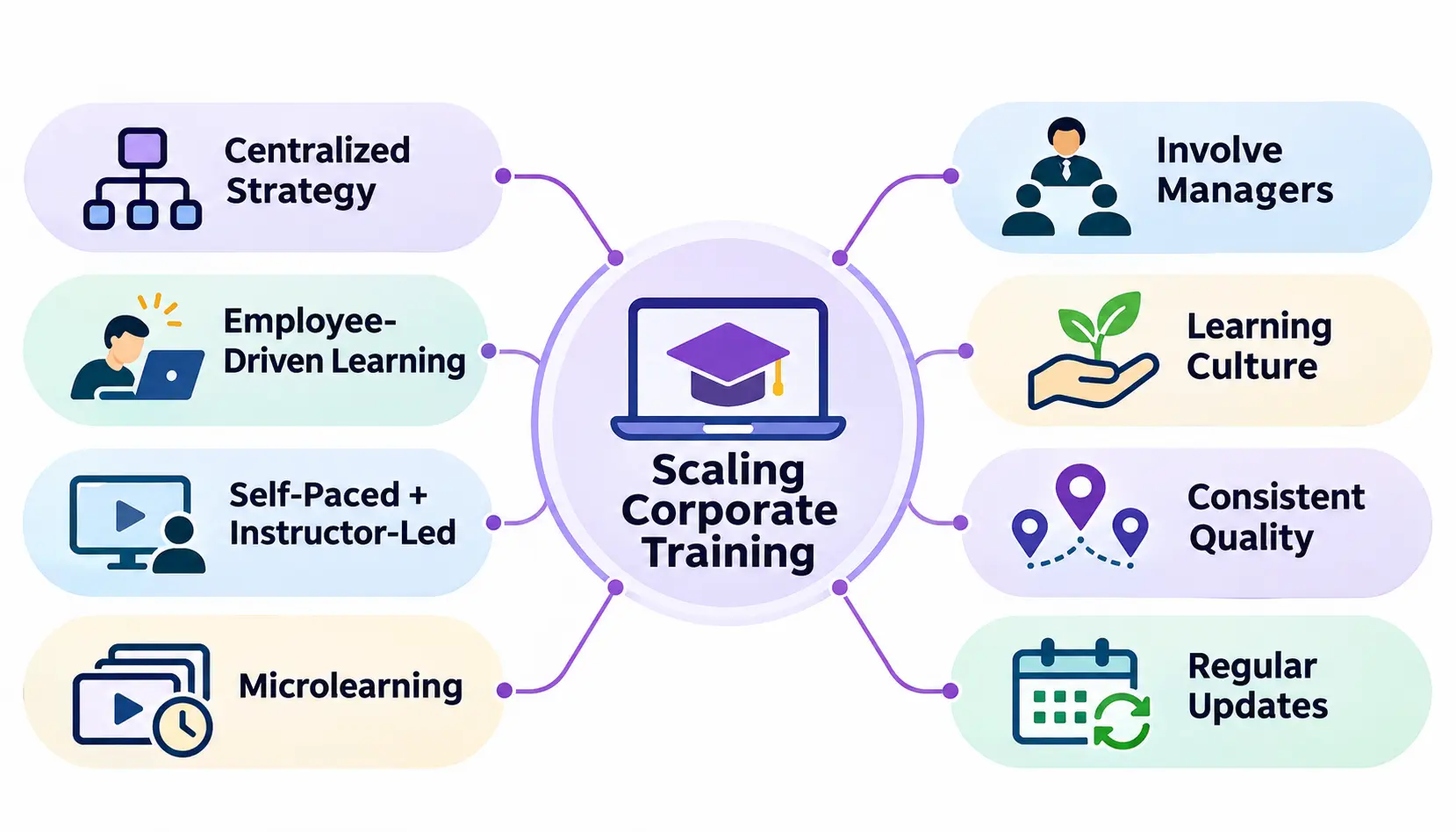
Use a Centralized Training Strategy With Flexible Learning Paths
Set standards and ownership in one place, then let departments adapt paths to their needs. This avoids both chaos and rigidity.
Encourage Employee-Driven Learning
Give people a library of optional content and time to use it. Learners who choose topics tend to stay more engaged.
Combine Self-Paced and Instructor-Led Training
Use self-paced lessons for knowledge and live sessions for practice and discussion. Together, they cost less than all-live training and work better than all-online.
Use Microlearning for Continuous Skill Development
Short refreshers sent over weeks reinforce learning better than one long session.
Involve Managers in Employee Learning
Managers decide whether training sticks. Give them a simple guide to discuss goals before training and check in afterward.
Build a Culture of Continuous Learning
Leaders should model learning, protect time for it, and recognize progress. Culture takes longer than software, but it matters more.
Maintain Consistent Training Quality Across Locations
Use shared templates, train-the-trainer sessions, and the same assessments everywhere.
Review and Update Training Materials Regularly
Schedule reviews, such as every six or twelve months, and review sooner after any major policy or product change.
How to Measure the Effectiveness of a Corporate Training Program
Effective measurement links learning to business results. A well-known approach is the Kirkpatrick model, which looks at reaction, learning, behavior, and results. To make these measurements more actionable, organizations need a consistent system to track employee training progress, assessment scores, course completion, and certification status.
Training Completion Rate
The share of assigned learners who finish. It shows reach but not impact.
Employee Engagement and Participation Rate
Track voluntary enrollments, time spent, and feedback scores. Low numbers often point to irrelevant or hard-to-access content.
Knowledge Retention and Assessment Scores
Test right after training and again later. The second test shows what stuck.
Time to Proficiency
How long it takes a new hire or newly trained employee to reach the expected performance level. Shorter is usually better.
Employee Productivity and Performance
Look at job-specific measures such as sales per rep, tickets resolved, or error rates.
Employee Retention and Internal Mobility
See whether trained employees stay longer and move into new roles. Be careful about claiming training alone caused the change.
Training Cost Per Employee
Total training cost divided by the number of employees trained. This should fall as your program scales.
Return on Investment (ROI)
Return on investment compares benefits to costs. Be honest about which benefits you can truly link to training.
Sample KPI table
| KPI | Definition | Formula | How often |
| Completion rate | Share of learners who finish | Completed ÷ assigned × 100 | Monthly |
| Assessment score | Average quiz result | Total scores ÷ number of learners | Per course |
| Time to proficiency | Days to reach target performance | Date at target − start date | Per cohort |
| Cost per employee | Training spend per learner | Total cost ÷ employees trained | Quarterly |
| Training ROI | Net benefit versus cost | (Benefit − cost) ÷ cost × 100 | Annually |
One tip from experience: choose three to five KPIs tied to your Step 1 goals. Tracking everything leads to tracking nothing well.
How Much Does It Cost to Build a Scalable Corporate Training Program?
Costs vary widely based on company size, content type, and tools, so any single number would mislead you. It is more useful to know what you will pay for.
Employee Training and Content Development Costs
Content creation is often the largest upfront cost, especially for video and interactive modules. Reusing material and updating it in small pieces keeps it manageable.
LMS Subscription and Software Costs
Most LMS vendors charge by user count, feature tier, or both. Ask for a written quote based on your expected headcount in two years, not just today.
Instructor and Training Coordinator Costs
Trainers and coordinators remain a cost even in a digital program. Their time shifts from repeating lessons to coaching, improving content, and supporting managers.
Technology Integration and Maintenance Costs
Budget for setup, integrations, user support, and regular updates. These ongoing costs are often forgotten at the start.
How to Reduce Corporate Training Costs Without Reducing Quality
- Reuse and repurpose modules across roles.
- Move knowledge topics online and keep live time for practice.
- Train internal experts to teach and create content.
- Retire courses nobody uses.
- Automate administration.
Common Mistakes to Avoid When Scaling Corporate Training
Using the Same Training for Every Employee
One generic course bores experts and overwhelms beginners. Use role-based paths.
Focusing on Course Completion Instead of Performance
A 100% completion rate means little if job results do not change. Measure behavior and outcomes.
Choosing Technology Before Identifying Training Needs
Buying a platform first usually leads to expensive software with no clear purpose. Do Steps 1 to 3 before any demo.
Creating Too Much Training Content
A huge library is hard to maintain and hard to navigate. Fewer, better modules win.
Ignoring Employee Feedback
Learners will tell you what is broken if you ask. Make feedback easy and act on it visibly.
Failing to Update Training Materials
Outdated lessons erode trust quickly. Assign owners and review dates.
Scaling Without Testing the Pilot Program
Skipping the pilot is tempting when deadlines loom. It almost always costs more time later.
Neglecting Post-Training Reinforcement
Training that ends on the last slide fades fast. Add follow-up quizzes, manager check-ins, and job aids.
Example of a 90-Day Corporate Training Implementation Plan
Here is a realistic way to put the framework into action. Adjust the timing to your company size.
Days 1–30: Assessment and Program Design
Meet with leaders, run the skills gap assessment, set learning objectives, and choose your first priority groups.
Days 31–60: Content Development and Pilot Launch
Build core modules, set up the LMS, and run the pilot with a small group. Gather feedback weekly.
Days 61–90: Organization-Wide Rollout and Evaluation
Fix pilot issues, roll out in phases, and start tracking your KPIs.
| Timeline | Key activities | Expected outcome |
| Days 1–30 | Needs assessment, skills mapping, goal setting | Defined training strategy |
| Days 31–60 | Curriculum development, LMS setup, pilot testing | Tested training framework |
| Days 61–90 | Rollout, employee assessments, performance tracking | Scalable training system |
Frequently Asked Questions About Scalable Corporate Training
1. What Is a Scalable Corporate Training Program?
It is a repeatable training system that serves more employees and locations without a matching rise in cost or effort. It relies on modular content, automation, and clear standards.
2. How Do You Build a Corporate Training Program From Scratch?
Start with business goals, assess skill gaps, set learning objectives, and build modular content. Then choose delivery methods and an LMS, pilot the program, roll it out in phases, and measure results.
3. What Are the Main Components of a Corporate Training Program?
The main components are clear goals, a needs assessment, a curriculum, delivery methods, a learning platform, and an evaluation process.
4. How Can Companies Train Hundreds of Employees at Once?
Use self-paced online modules, virtual live sessions, and an LMS that automates enrollment and tracking. Keep live sessions for practice and discussion in smaller groups.
5. What Is the Best LMS for Corporate Training?
There is no single best option. The right LMS depends on your size, budget, integrations, and goals. Shortlist two or three, run demos with real scenarios, and test with a pilot group.
6. How Can Businesses Reduce Employee Training Costs?
Reuse modular content, move knowledge topics online, use internal experts, automate administration, and remove unused courses.
7. How Do You Measure Corporate Training ROI?
Compare the measurable benefits of training, such as faster ramp-up or fewer errors, to the total cost, then divide the net benefit by cost. Be transparent about assumptions.
8. How Often Should Corporate Training Programs Be Updated?
Review content at least once or twice a year. Update immediately after major changes to policy, tools, or regulations.
9. What Is the Difference Between an LMS and an LXP?
An LMS assigns, delivers, and tracks required training. An LXP helps employees discover and choose learning that matches their interests and goals.
10. How Can AI Improve Corporate Training?
AI can speed up content drafting, personalize learning paths, and answer learner questions. Human experts should always review the output for accuracy.
Conclusion
Building a scalable corporate training program is less about big budgets and more about good structure. Start with business goals, find real skill gaps, and build modular content you can reuse. Choose delivery methods and technology that fit your people, then pilot before you scale.
Most important, measure what changes on the job, not just who clicked “complete.” If you are unsure where to begin, take the 90-day plan above, pick one priority group, and run a small pilot. A scalable corporate training program grows through steady improvement, one tested module at a time.