


For years corporate training followed the same routine: create a course, send it to everyone, run a quiz at the end and hope something sticks. That routine is breaking down. Employees now expect learning that fits their role, their pace and the exact moment they need help, not a module sitting in an LMS that nobody opens twice.
This shift is why the future of AI in learning and development matters so much right now. AI does not speed up how training is built. AI changes how learning is personalized, delivered, measured and tied back to business performance. A learning path that once took an instructional design cycle to update can now adjust itself based on how an employee is actually performing.
In this guide we will walk through how AI’s used in L&D today, the technologies driving that change the risks worth taking seriously, a practical implementation roadmap and where this is all heading over the next few years. Think of it as a working reference something you can come back to whether you’re pitching AI to leadership or already knee-deep, in a pilot program.
What Is the Future of AI in Learning and Development?
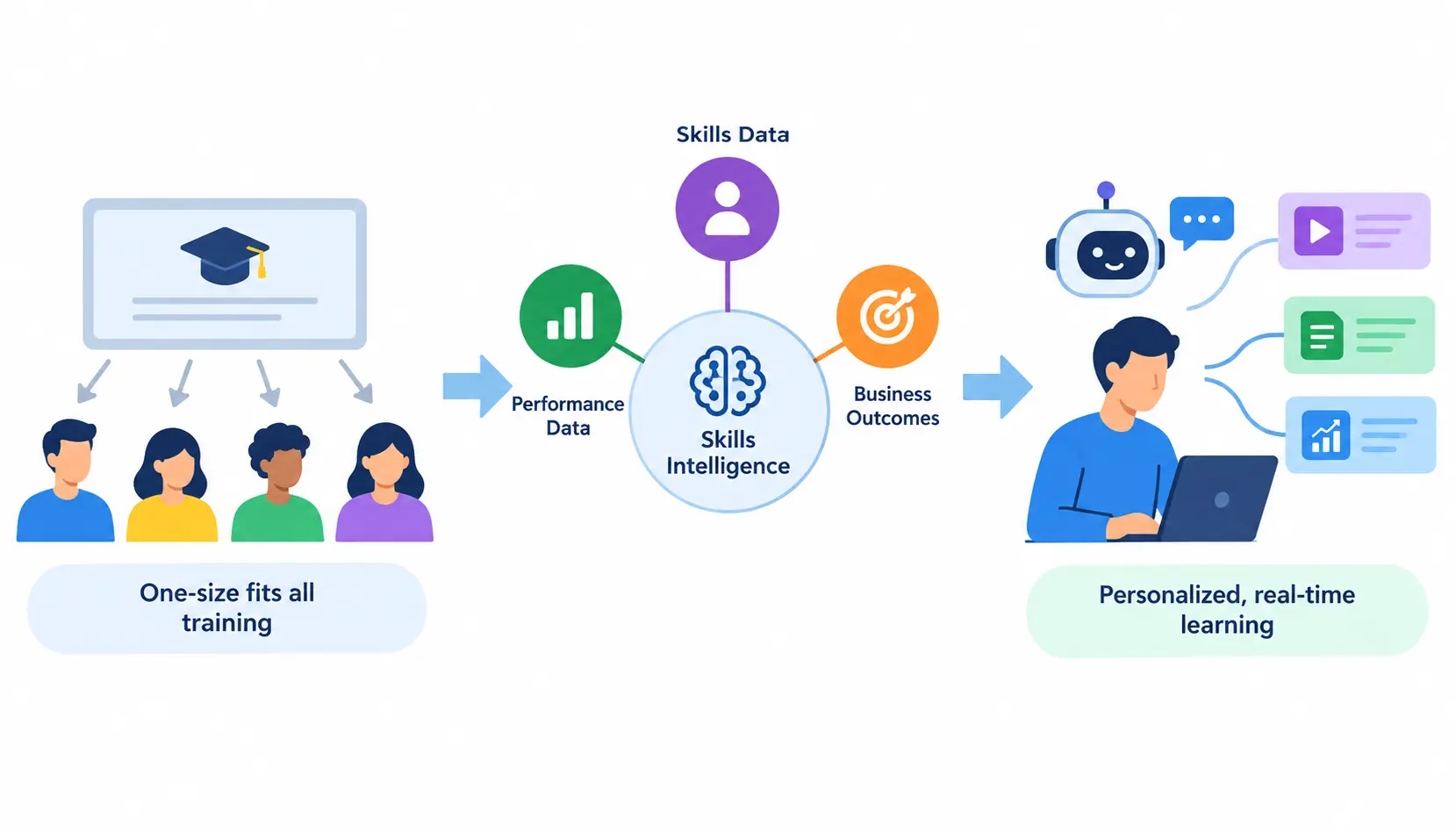
In other words, the future of AI in learning and development means moving away from one‑size fits all training to learning systems that detect, adjust and reply to each employee almost in real time.
At present most companies find themselves in the middle of this change. Many have added AI‑assisted content creation or a chatbot‑style learning helper. A much smaller number have linked AI to skills data, performance data and business outcomes in a single cohesive system. That connecting layer, usually known as skills intelligence is where the next big investment will happen.
From Course Delivery to Continuous Learning
Traditional L&D was built around events: a course launch, a certification deadline, an annual compliance refresh. AI-enabled L&D is built around a continuous loop. Learning content, coaching nudges, and skill assessments show up throughout the employee’s workflow instead of being boxed into a scheduled training event.
Why Personalization and Skills Intelligence Are Becoming Central
Every employee comes to the job with a starting point, a different role, different skill gaps, different ways of learning and different career goals. AI makes it possible to consider all of that as the situation instead of something unusual. Skills intelligence platforms use this information to show what an employee knows, what they should learn next and what the company is missing in a team or department.
AI as an Augmentation Layer, Not Just an Automation Tool
It’s easy to look at AI in learning and development and see it as a tool to save time like automating quiz creation, cleaning up transcripts or building slides. That part is true.. Focusing only on time savings misses the bigger picture. AI is starting to act like a smart assistant. It helps instructional designers make choices. It supports managers in giving coaching.. It helps employees get the right information when they need it most. It’s not about replacing human effort with automated tasks. It’s about enhancing what people already do.
How AI Is Changing the Traditional L&D Model
| Traditional L&D | AI-Enabled L&D |
| Fixed courses | Dynamic learning paths |
| Periodic assessments | Continuous assessment |
| Generic content | Personalized content |
| Manual reporting | Automated analytics |
| Scheduled support | On-demand coaching |
| Reactive skill development | Predictive skill development |
How AI Is Used in Learning and Development Today
AI in L&D isn’t a single tool, it’s a set of overlapping applications, each solving a different piece of the training puzzle. For a closer look at how these capabilities are being applied in the workplace, see our guide to how AI is transforming corporate training.
Personalized Learning Paths
Instead of assigning the same course to everyone in a role, AI systems recommend content sequences based on an employee’s existing skills, assessment history, and stated career goals. A new sales hire and a five-year sales veteran moving into a leadership track will see very different learning paths, even if they started in the same job title.
Adaptive Learning and Assessments
Adaptive learning platforms change how hard the questions are and how fast the content moves based on what a learner’s doing right now. If someone gets through the basics quickly the system jumps ahead. If they have trouble, with an idea it slows down and gives more practice before going to the next part.
AI-Generated Training Content
Generative AI tools can create course outlines, scenario-based scripts, quiz questions and narrated video content using a source document or an interview with a subject-matter expert. This doesn’t remove the designer’s role. Instead it changes how they spend their time. They now focus more on reviewing, improving and checking the content than writing every first draft from the beginning.
AI Coaching and Learning Assistants
Conversational AI assistants are becoming common inside workflow tools. They help people answer questions, like “how do I…” away. These assistants guide employees step by step through a task. They can also review a draft email or sales pitch. Give feedback before it is sent out.
Skills-Gap Analysis and Skills Mapping
AI models compare an employee’s skill profile with the skills required for the employee’s role or for a role the employee wants to reach and show specific skill gaps. When these data are gathered across a department the same data point out where the organization is at risk, to leadership.
Predictive Learning Analytics
By just looking at what has already happened like completion rates or pass/fail scores predictive analytics can show which employees might fall behind. It can also highlight which skills are likely to become important and point out when people leaving their jobs connect with learning progress.
AI-Powered Simulations and Role-Play
Simulated conversations, a performance review, an angry customer call, a safety incident let employees practice high‑stakes scenarios in a low‑stakes environment with AI acting as the counterpart and giving feedback afterward.
Automated Administration and L&D Operations
A large portion of L&D time used to be spent on logistics, such, as scheduling, enrollment tracking, compliance reminders and certificate generation.
Now AI-driven automation handles most of these tasks freeing L&D to focus on design and strategy.
Translation, Localization, and Accessibility
AI translation and text-to-speech tools help make training content feel more real when it is adapted into languages. These tools also let people access the content in ways, like captions, audio narration or simpler reading levels without making production costs go up a lot.
Why AI Is Becoming Important for L&D Teams
Personalization at Scale
Manually personalizing training for thousands of employees was never realistic. AI makes it operationally possible.
Faster Content Development
Drafting, editing, and localizing content happens in a fraction of the time it used to take, which matters most when a product, policy, or compliance requirement changes quickly.
Better Employee Engagement
Content that’s relevant to someone’s actual role and goals gets more attention than generic modules, engagement tends to follow relevance.
Faster Skill Development
Adaptive paths cut out redundant material, so employees spend time on what they don’t yet know instead of repeating what they do.
Continuous Learning
Learning stops being an annual event and becomes an ongoing thread woven through daily work.
Improved Knowledge Retention
Spaced repetition, embedded practice, and just-in-time reinforcement, all easier to automate with AI, support better long-term retention than a single training event.
Better Workforce Planning
Aggregated skills data gives HR and business leaders a clearer picture of where talent gaps exist before they become urgent.
Stronger Internal Mobility
When skills data is visible and current, employees are easier to match to open roles inside the company, which supports retention as well as mobility.
Connecting Learning to Business Outcomes
Perhaps the most important shift: AI-enabled analytics make it more feasible to trace a line from a specific learning intervention to a measurable business result, something L&D has struggled to prove for decades.
The Evolution of AI in Learning and Development
AI in L&D didn’t arrive all at once, it’s been building in stages.
Stage 1: Digital Learning. E-learning modules, LMS platforms, and video-based training replaced classroom-only delivery.
Stage 2: AI-Assisted Content Creation. Generative AI tools start speeding up course and content production. If you need a broader framework for structuring employee training before adding AI, see our guide on how to build an effective employee training program.
Stage 3: Personalized Learning. Systems begin recommending content based on role, history, and stated goals.
Stage 4: Adaptive and Predictive Learning. Platforms adjust in real time and begin forecasting skill gaps and risk.
Stage 5: AI Coaching and Learning Companions. Conversational assistants provide on-demand coaching and feedback.
Stage 6: AI Agents and Embedded Workflow Learning. Learning stops being a separate destination and becomes embedded directly inside the tools employees already use.
What Changes at Each Stage?
| Stage | Technology | Learner Experience | L&D Role | Business Impact |
| 1. Digital Learning | LMS, e-learning | Self-paced modules | Content builders | Consistency at scale |
| 2. AI-Assisted Content | Generative AI drafting | Faster content refresh | Editors/reviewers | Reduced production time |
| 3. Personalized Learning | Recommendation engines | Role-relevant paths | Data curators | Higher engagement |
| 4. Adaptive/Predictive | ML-driven adjustment | Real-time difficulty tuning | Analysts | Faster skill development |
| 5. AI Coaching | Conversational AI | On-demand feedback | Coaches/designers | Continuous support |
| 6. Embedded Agents | AI agents in workflow tools | Learning inside daily tasks | Strategists/governance | Learning tied to performance |
The AI Technologies Shaping the Future of L&D
It helps to know the difference between the underlying technologies, since they show up in vendor pitches constantly.
Generative AI creates new content, text, images, audio, video, from a prompt or source material. It’s the engine behind most AI-authored course drafts today. You can read a general technical overview on <a href=”https://en.wikipedia.org/wiki/Generative_artificial_intelligence” target=”_blank” rel=”noopener noreferrer”>Wikipedia’s generative AI entry</a>.
Machine Learning is the broader field of systems that improve at a task by learning from data rather than following fixed rules, it underpins adaptive learning and predictive analytics.
Natural Language Processing (NLP) allows systems to understand and generate human language, which is what makes chatbots, transcript analysis, and automated content tagging possible.
Predictive Analytics uses historical data to forecast future outcomes, such as which employees are likely to disengage or which skills a team will need in the next planning cycle.
Conversational AI covers chat- and voice-based assistants that can hold a back-and-forth interaction, used for coaching, FAQs, and simulations.
Multimodal AI processes and combines multiple input types, text, images, audio, video, in a single system, which is increasingly used for richer, more realistic simulations.
AI Agents are systems that can take multi-step action toward a goal, not just respond to a single prompt, for example, an agent that monitors a new hire’s progress and automatically adjusts their onboarding path.
Retrieval-Augmented Generation (RAG) grounds an AI model’s answers in a specific set of trusted documents (like your company’s policy library), reducing the risk of the model making things up.
Virtual and Augmented Reality create immersive practice environments for hands-on or high-risk skills, from equipment operation to customer-facing scenarios.
How AI Is Personalizing Employee Learning
Data AI Uses to Understand Learners
Personalization engines typically draw on a combination of:
- Role
- Existing skills
- Previous performance
- Assessment results
- Learning behavior (what they click, skip, or revisit)
- Career goals
- Content interaction patterns
How AI Builds a Personalized Learning Path
Most personalization engines follow a version of this loop:
Collect → Analyze → Recommend → Learn → Assess → Adjust
The system collects data on the employee, analyzes it against role and skill requirements, recommends a learning path, delivers it, assesses progress, and adjusts the path based on results, then repeats.
Example of AI-Personalized Employee Training
Consider a customer support representative who knows the product well but always gets low scores when dealing with angry customers. A regular training program might put her in the general customer service course that everyone else takes. An AI system does things differently.
It skips the parts about the product that she already understands and focuses on helping her get better at handling situations. It gives her chances to practice with simulations that show how to calm down callers. It also gives her videos to watch about how to speak and move at the right speed. After she has a few calls the system checks in to see if her scores have gotten better.
Where Personalization Can Go Wrong
Personalization isn’t automatically good, it depends on how it’s built and governed.
- Excessive data collection: gathering more behavioral data than is actually needed for the learning purpose
- Poor recommendations: content that technically matches the data but misses the employee’s real need
- Bias: systems trained on historical data can quietly reinforce existing inequities in who gets recommended for advancement
- Incorrect assumptions about learner preferences: treating a single data point (like course completion speed) as a full picture of how someone learns best
How AI Will Change the Role of L&D Professionals
What AI Can Automate
Content drafting, quiz generation, translation, scheduling, basic reporting, and first-pass content tagging are all reasonably safe to automate today.
What L&D Professionals Should Continue Doing
- Strategy
- Instructional design decisions
- Coaching
- Empathy
- Complex judgment
- Content validation
- Governance
New Skills L&D Professionals Will Need
- AI literacy
- Data literacy
- Prompting
- AI evaluation (knowing when an output is good enough to use)
- Learning analytics
- Governance
- Change management
Research on the future of work, including analysis published through outlets like the <a href=”https://www.linkedin.com/pulse/” target=”_blank” rel=”noopener noreferrer”>LinkedIn Learning and workforce insights community</a>, consistently points toward HR and L&D practitioners spending more time on strategic work as routine tasks get automated. The role isn’t disappearing; the mix of work inside it is changing.
AI in L&D: Practical Use Cases by Training Type
| Training Type | AI Application | Human Involvement | KPI |
| Employee Onboarding | Personalized ramp-up paths | Manager check-ins | Time to productivity |
| Compliance Training | Automated tracking & reminders | Policy review | Completion & audit readiness |
| Leadership Development | Coaching simulations | Executive mentoring | 360-feedback improvement |
| Sales Training | Pitch practice & role-play | Sales manager coaching | Win rate, ramp time |
| Technical Training | Adaptive skill modules | SME validation | Certification pass rate |
| Customer Service Training | De-escalation simulations | QA review | CSAT, resolution time |
| Soft-Skills Training | AI conversation practice | Peer/manager feedback | Behavioral assessment scores |
| Reskilling/Upskilling | Skills-gap-driven pathing | Career coaching | Internal mobility rate |
Benefits of AI-Powered Learning for Businesses
Reduce training development time. Drafting, editing, and localizing content happens faster, so new programs launch sooner.
Personalize learning at scale. Every employee gets a path relevant to their role without requiring a designer to build it manually.
Improve employee engagement. Relevant, well-timed content earns more attention than generic modules.
Accelerate skill development. Adaptive systems cut out redundant content and focus time where it’s needed.
Support internal mobility. Clear skills data makes it easier to match employees to open roles.
Improve knowledge retention. Spaced, reinforced learning beats one-off training events.
Reduce administrative work. Automation handles scheduling, tracking, and reporting.
Make learning more accessible. Translation, captioning, and adjustable reading levels widen who can use the content.
Connect learning with business performance. Better data makes it possible to show which training actually moved the needle.
Measuring the ROI of AI in Learning and Development
This is where AI genuinely changes the game for L&D, for the first time, it’s realistic to connect training activity to business results with reasonable confidence, rather than relying on satisfaction surveys alone. For more practical guidance on connecting training with measurable business results, see our guide to increasing workforce productivity through training.
Learning Metrics
- Completion rates
- Assessment scores
- Knowledge retention over time
- Engagement (time spent, return visits, interaction depth)
Performance Metrics
- Time to proficiency
- Productivity change
- Error reduction
- Skill application on the job
Business Metrics
- Revenue impact
- Employee retention
- Internal mobility rate
- Compliance outcomes
- Cost per learner
A Simple AI-L&D ROI Formula
A workable, simplified way to frame it:
ROI = (Value of Business Gains − Cost of AI Implementation) ÷ Cost of AI Implementation
“Value of business gains” should reflect measurable outcomes, reduced time to proficiency multiplied by headcount, retention improvements translated into avoided replacement cost, or productivity gains tied to a specific process. “Cost of implementation” includes licensing, integration, content migration, and change management, not just the software subscription. The formula is simple; the discipline is in defining each variable honestly rather than inflating the gains side.
Challenges and Risks of AI in Learning and Development
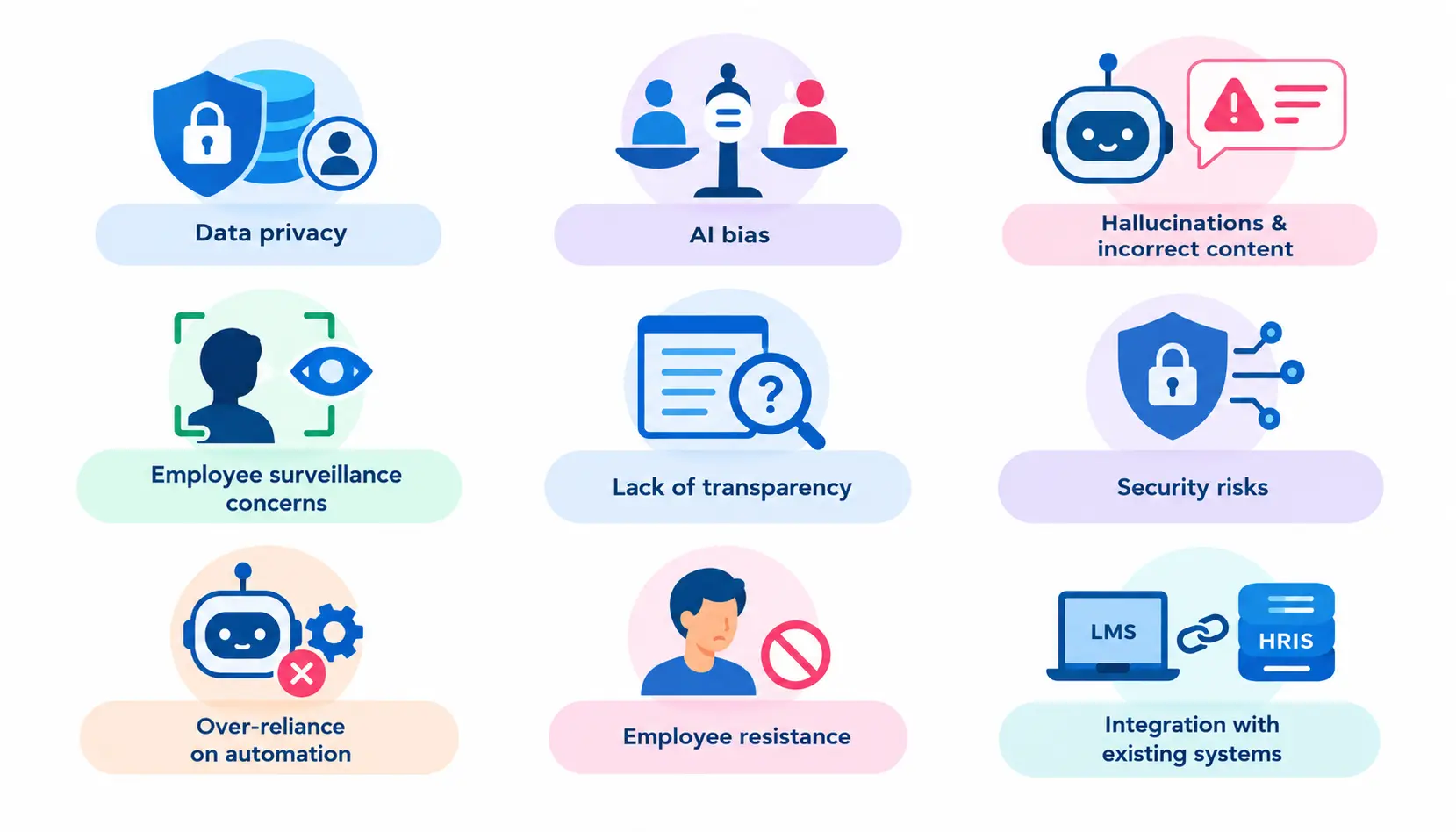
Data privacy. Personalization requires employee data, which raises real questions about what’s collected, how long it’s retained, and who can access it.
AI bias. Models trained on historical performance or hiring data can replicate past inequities in who gets recommended for growth opportunities.
Hallucinations and incorrect content. Generative AI can produce confident, plausible, and wrong information, a serious risk in compliance or safety training.
Employee surveillance concerns. Learning analytics can start to feel like monitoring if employees aren’t told clearly what’s being tracked and why. This concern shows up frequently in workplace discussions, including on communities like <a href=”https://www.reddit.com/r/humanresources/” target=”_blank” rel=”noopener noreferrer”>r/humanresources</a>, where practitioners regularly debate the line between helpful personalization and overreach.
Lack of transparency. Employees and managers often can’t see why an AI system made a particular recommendation, which erodes trust.
Security risks. AI tools that connect to HR and performance systems expand the attack surface for sensitive employee data.
Over-reliance on automation. Treating AI output as final rather than a draft increases the risk of errors slipping through.
Employee resistance. Some employees will reasonably distrust AI-driven coaching or assessment, especially early on.
Integration with existing systems. Many organizations run legacy LMS or HRIS platforms that weren’t built with AI integration in mind, which complicates rollout.
How to Implement AI in Learning and Development
- Identify the business problem. Start with a specific gap, slow onboarding, high error rates, stalled internal mobility, not “we should use AI.”
- Define learning and business outcomes. Set targets for both, before selecting a tool.
- Audit existing content and data. Know what you already have and how clean your data is before layering AI on top.
- Identify high-value AI use cases. Prioritize based on impact and feasibility, not novelty.
- Select the right AI technology. Match the tool to the use case rather than buying a platform and searching for a problem afterward.
- Integrate AI with the LMS/LXP and HR systems. Personalization is only as good as the data flowing into it.
- Establish AI governance. Set rules before scaling, not after something goes wrong.
- Run a controlled pilot. Test with a defined group and timeframe before a company-wide rollout.
- Measure results. Use the learning, performance, and business metrics outlined earlier.
- Scale what works. Expand deliberately, carrying governance and measurement forward with it.
AI Governance for L&D Teams
Governance is what separates a responsible AI rollout from a risky one.
- Create an approved AI tool list so employees and teams aren’t using unvetted tools with sensitive content.
- Define what employee data can be used, and get explicit sign-off from HR and legal.
- Establish human review requirements for anything compliance-related, sensitive, or high-stakes.
- Validate AI-generated learning content against source material before publishing.
- Monitor bias and accuracy on an ongoing basis, not just at launch.
- Maintain audit trails so decisions and recommendations can be traced and explained.
- Establish ownership and accountability: someone specific should own AI governance in L&D, not “the team” generally.
What Will the Future of AI-Powered Learning Look Like?
AI learning companions that follow an employee across their career, not just a single course.
Always-on learning woven into daily tools rather than scheduled sessions.
AI agents for L&D that proactively adjust learning paths, flag risk, and handle routine administration without manual triggers.
Predictive skill-gap detection that flags emerging gaps before they show up in performance reviews.
Real-time workflow learning, help delivered at the exact moment an employee needs it, inside the tool they’re already using.
AI-powered career navigation that maps an employee’s current skills to realistic next roles.
Hyper-personalized learning paths built from a much richer data set than today’s systems use.
Multimodal learning experiences blending text, video, voice, and simulation in a single adaptive flow.
AI-powered simulations for an expanding range of high-stakes scenarios, from leadership conversations to safety incidents.
Skills-based organizations where roles, pay, and mobility are increasingly organized around verified skills rather than job titles alone, a trend widely discussed in HR and workforce circles, including on <a href=”https://en.wikipedia.org/wiki/Skills-based_organization” target=”_blank” rel=”noopener noreferrer”>Wikipedia’s overview of skills-based organizations</a>.
What AI Should and Shouldn’t Automate in L&D
| AI Is Well Suited For | Humans Should Lead |
| Content drafts | Strategic decisions |
| Recommendations | Complex coaching |
| Data analysis | Empathy |
| Assessments | Sensitive conversations |
| Administrative work | Ethical decisions |
| Practice simulations | High-stakes judgment |
The dividing line is fairly consistent: AI handles scale, speed, and pattern recognition well. Humans handle nuance, trust, and judgment calls where the “right” answer depends on context AI can’t fully see.
AI vs Traditional Learning and Development
| Factor | Traditional L&D | AI-Enabled L&D |
| Personalization | Limited, manual | Scalable, data-driven |
| Speed | Slower content cycles | Rapid drafting and iteration |
| Scalability | Constrained by staff time | Scales across large workforces |
| Cost | High per-learner cost at scale | Lower marginal cost per learner |
| Human interaction | High | Selectively preserved for high-value moments |
| Feedback | Delayed, periodic | Immediate, continuous |
| Assessment | Static, infrequent | Adaptive, ongoing |
| Data analysis | Manual reporting | Automated, predictive |
| Accessibility | Resource-dependent | Easier to scale (translation, captioning) |
| Governance | Simpler, fewer risks | Requires active oversight |
| Best use cases | Complex coaching, culture-building | Content creation, personalization, analytics |
Neither model wins outright. The realistic conclusion, and where most mature L&D functions are headed, is a hybrid approach: AI handles scale and speed, humans handle judgment, empathy, and the moments that actually build trust.
Frequently Asked Questions About AI in Learning and Development
1. What is the future of AI in learning and development?
The future of AI in learning and development is continuous, personalized, and embedded directly into daily work, moving away from static courses toward adaptive learning paths, predictive skill-gap detection, and AI coaching delivered in real time.
2. How is AI changing L&D?
AI is changing L&D by automating content creation and administration, personalizing learning paths at scale, and enabling predictive analytics that connect training to measurable business outcomes.
3. Will AI replace L&D professionals?
No, AI automates routine tasks like content drafting and reporting, but strategy, coaching, empathy, and complex judgment remain human responsibilities that AI can’t fully replicate.
4. How does AI personalize employee training?
AI personalizes training by analyzing data like role, skills, performance, and learning behavior, then recommending and adjusting content through a continuous collect-analyze-recommend-adjust loop.
5. What are the benefits of AI in corporate learning?
Key benefits include faster content development, personalization at scale, improved engagement and retention, reduced administrative work, and a clearer connection between learning and business performance.
6. What are the risks of AI in L&D?
Main risks include data privacy concerns, algorithmic bias, hallucinated or inaccurate content, employee surveillance perceptions, and over-reliance on automation without human review.
7. How can companies implement AI in learning and development?
Start by identifying a specific business problem, defining outcomes, auditing existing data, selecting the right AI tools, establishing governance, and running a controlled pilot before scaling.
8. What AI tools are used by L&D professionals?
L&D teams commonly use generative AI for content creation, adaptive learning platforms, AI-powered coaching assistants, skills-mapping tools, and predictive analytics dashboards, often integrated with an LMS or LXP.
9. How do you measure AI training ROI?
AI training ROI is measured by combining learning metrics (completion, retention), performance metrics (time to proficiency, productivity), and business metrics (revenue impact, retention, compliance), weighted against implementation cost.
10. What will corporate training look like in the future?
Corporate training will increasingly happen inside daily workflows rather than separate courses, guided by AI agents and learning companions, with human coaching reserved for high-stakes, judgment-heavy moments.
Conclusion
The future of AI in learning and development is not about replacing trainers, instructional designers or coaches. It is about giving trainers, instructional designers and coaches tools and freeing up time for the parts of the job that actually need a human touch. Content creation becomes faster. Personalization becomes realistic at scale. Skill gaps are caught before they turn into performance problems. For the time being, learning and development has a real chance to prove its worth in the language that business already speaks: outcomes, not just completion rates.
None of this happens automatically. The organizations that get value from AI in learning and development treat it as a discipline. They have governance, honest measurement and a willingness to keep humans in the loop where judgment and empathy still matter most. Start with one well‑defined problem and measure it properly. Build from there. That is a more durable strategy, than chasing every new AI feature that pops up in a vendor demo.