


Five years ago “training” meant a course and a completion certificate that no one ever looked at again. That time has passed. The AI trends that are changing how people learn at work now are not about making courses digital. They are about creating learning systems that watch. React to people as it happens.
This change is important because work is changing faster than any training program can follow. New tools come out every month. Jobs change every year, not every ten years. A set of fixed courses simply cannot keep up with this speed. That is why AI has gone from being something nice to have in company training to being the main part of how smart companies develop skills.
In this article we will look at the AI trends that are changing how people learn at work today. We will talk about things, like learning paths that’re completely personal and AI systems that take care of skill development with very little help from people. We will look at each trend using a way: what the technology does, how it changes the way people learn what skills it helps build and what it means for the company. At the end you will have a way to decide which of these trends are most important to focus on first.
What Are AI Trends in Workplace Learning?
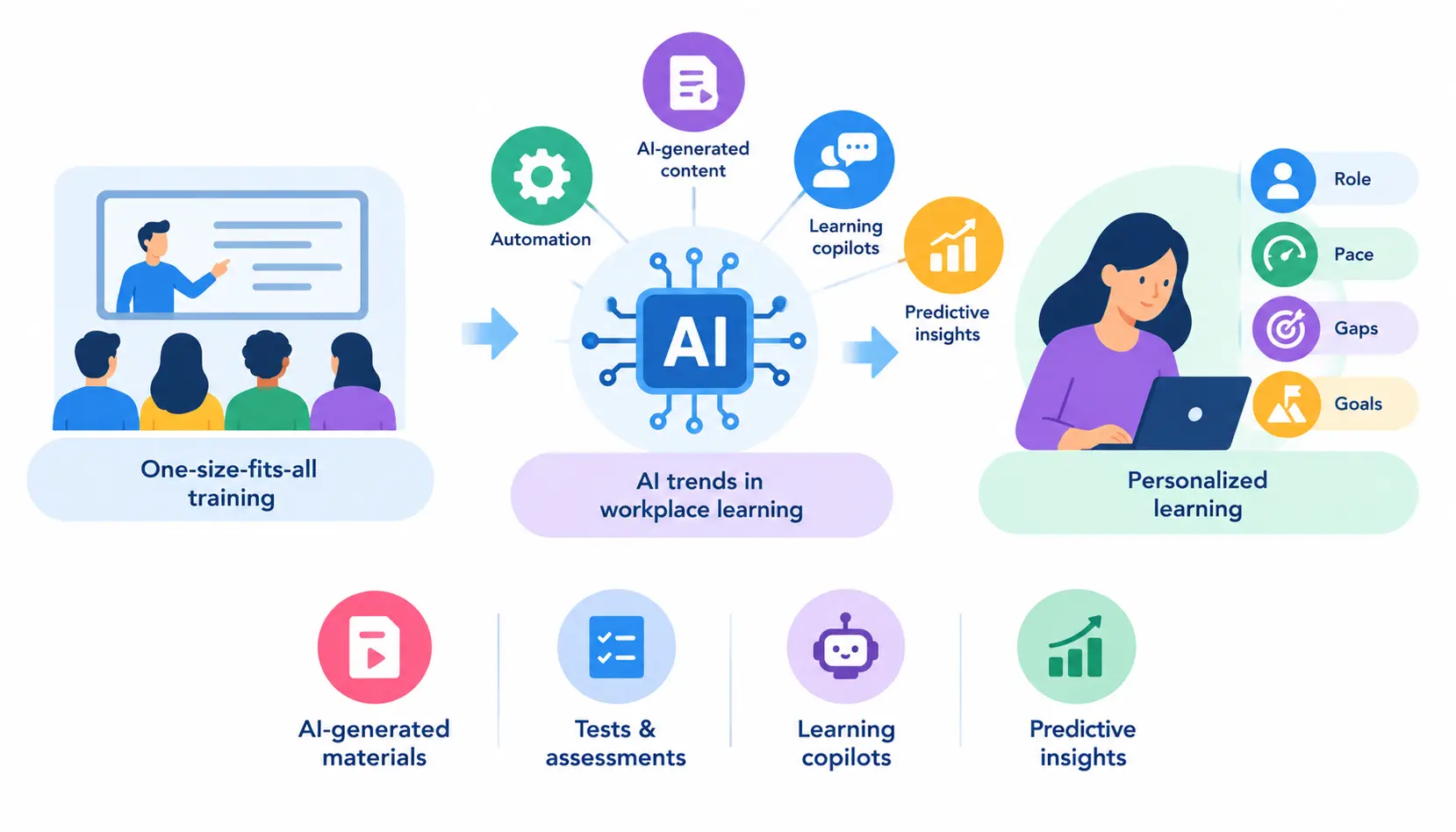
AI trends in workplace learning mean the ways that artificial intelligence is used to make training more personal, to automate tasks and to help employees learn better. These AI trends cover everything from AI-generated training materials to tests learning copilots and predictive data that spot skill gaps before they turn into performance problems.
The main theme of these AI trends is a shift, from training that fits everyone the same way toward learning that meets each person’s needs. AI trends look at the person’s role, the speed they learn, the gaps they have and the goals they set.
How AI is changing corporate learning
AI trends in workplace learning mean the ways that artificial intelligence is used to make training more personal, to automate tasks and to help employees learn better. These AI trends cover everything from AI-generated training materials to tests learning copilots and predictive data that spot skill gaps before they turn into performance problems.
The main theme of these AI trends is a shift, from training that fits everyone the same way toward learning that meets each person’s needs. AI trends look at the person’s role, the speed they learn, the gaps they have and the goals they set.
Why workplace learning is moving from courses to continuous development
Courses have a start and an end. Skills do not follow that pattern. A skill fades if it is not practiced and new skill needs appear faster than most training catalogs can be updated. That is why companies are moving toward development: a steady flow of short relevant learning moments embedded in the work process instead of a few large training events spread across the year. Artificial Intelligence is the layer for this shift because it is the only practical way to personalize learning at scale for thousands of employees at once.
AI learning vs traditional employee training
Here’s a quick side-by-side comparison to make the differences concrete.
| Aspect | Traditional Training | AI-Powered Learning |
| Content delivery | Fixed courses, same for everyone | Personalized paths based on role and skill level |
| Pacing | Set schedule, fixed duration | Adaptive pacing based on performance |
| Feedback | Delayed, often manual | Real-time, automated |
| Content creation | Manually authored, slow to update | AI-generated and continuously refreshed |
| Measurement | Completion rates | Skill proficiency and behavior change |
| Support | Scheduled instructor or manager check-ins | On-demand AI copilots and coaches |
| Scalability | Limited by instructor/design bandwidth | Scales across thousands of employees at once |
Top AI Trends Shaping Workplace Learning
1. Hyper-Personalized Learning Paths
Hyper-personalization means the system creates a learning path that’s specific to each person, not the other way around. It takes in information about the learner such as job role, current skills, career goals, previous performance and even the way someone prefers to learn (like watching videos or reading for example) and uses that to suggest what to learn next.
Imagine it like a music streaming algorithm. For skills. As a playlist changes based on what you skip and what you listen to again an AI learning platform changes suggestions based on what an employee finds difficult, what they understand quickly or what they ignore.
The real advantage is time. Employees stop going through lessons and start seeing material that is really helpful, for their next promotion or their current project. For a broader look at how AI is being applied across employee training, see our guide to how AI is transforming corporate training.
2. AI-Powered Skills Intelligence
Skills intelligence is about understanding what skills are in an organization, where the gaps exist and where those skills are headed. Artificial intelligence enables this at a scale that was never possible with assessments.
This process usually includes skills mapping, identifying skill gaps, analyzing competencies and predicting skill needs. It also connects directly to career pathing and internal mobility. For example HR teams can see that someone working in customer support already has 70% of the skills needed for a data analyst role within the company. This helps retain talent by losing them to external offers.
HR and learning and development professionals talk about this change openly on platforms like LinkedIn. Skills-based hiring and internal mobility keep coming up as topics, in workforce planning discussions.
3. Adaptive Learning and Assessments
Adaptive learning changes the difficulty and content, on the fly based on how a learner is doing. If you get a concept fast the system helps you move ahead quicker. If you’re having trouble it slows down, gives you a way to understand the idea or lets you practice more.
This works with real-time assessment, where testing happens all the time not just at the end of a course and continuous reassessment, which checks if you still remember what you learned weeks or even months later, not just right after the training.
The result is knowledge retention because the system keeps adjusting instead of assuming everyone learns at the same pace.
4. Generative AI for Training Content
I have seen that this is likely the noticeable AI trend in workplace learning today. Generative AI can draft courses, write quizzes, summarize material, build training scenarios and even localize content into many languages all in a fraction of the time that used to take instructional designers.
AI does not replace the judgment of designers but AI removes much of the slow repetitive drafting work. That means content can be updated often which matters a great deal, in industries where processes or compliance rules change frequently.
A practical example: a compliance team that once took six weeks to update a policy training course can now draft a version in a single day then spend the remaining time reviewing and refining that version for accuracy.
5. AI Learning Copilots and Virtual Coaches
A learning copilot works right where the work happens. It answers questions whenever someone needs help. Imagine having a coworker who is always around ready to explain things clearly. By digging through a learning management system to find the exact course employees can simply ask a question and get a clear personalized answer.
These copilots also give feedback while work is still happening. That’s a change. Feedback that used to come days or weeks during performance reviews now arrives right when it matters most while the task is in progress. This makes learning more meaningful.
6. Agentic AI for Learning and Development
This is where things become truly new. A copilot sits ready until you ask it. An agent acts by itself. Only inside the limits you set.
Agentic AI in L&D can find a skill gap on its own, give the training to keep track of progress and alert a manager when an employee is slipping, all without a human pressing a button for each step. This trend is still in its stage but it needs focused attention because new research on workforces keeps showing a clear difference between AI that helps and AI that acts.
The future of AI in L&D is huge: picture a learning system that spots when a team’s next project needs a skill none of the members have and then builds and gives a learning plan weeks before the problem appears.
That is the direction that agentic AI in L&D is moving toward even though most organizations are not fully ready yet.
7. AI-Powered Role-Play and Simulation Training
Some skills cannot be learned from a slide deck. Skills such as handling a customer, coaching an underperforming employee or closing a sale are best learned by practicing, especially in a setting where mistakes do not cost anything. AI‑powered simulations allow employees to practice these scenarios. AI‑powered simulations provide an AI counterpart that reacts realistically to what employees say.
Sales simulations
Employees can practice pitches and objection-handling against an AI “buyer” that pushes back the way a real prospect would, then get instant feedback on tone, structure, and persuasiveness.
Customer-service simulations
Frontline staff can rehearse de-escalating an upset customer as many times as needed, without a real customer on the other end of a bad experience.
Leadership and difficult-conversation practice
Managers can practice delivering hard feedback or navigating a conflict, which is one of the areas where people usually improve fastest through repetition rather than reading.
Safety and compliance scenarios
High-stakes situations, such as a safety violation on a factory floor or a data breach response, can be rehearsed virtually before they ever happen for real.
A strong real-world illustration of this comes from HEC Paris, which has piloted AI-based mentor and evaluator tools to give students structured feedback during simulated business scenarios, an approach corporate L&D teams are now adapting for employee training.
8. Predictive Learning Analytics
Predictive analytics uses learning and performance data to forecast what’s likely to happen next: which employees are likely to develop a skill gap, who’s struggling and might need extra support, who’s ready for a stretch assignment, and who’s showing early signs of leadership potential.
This also connects learning data directly to performance data, which is a meaningful upgrade from the old approach of treating training records and performance reviews as separate systems that never talk to each other.
9. Microlearning and Learning in the Flow of Work
Microlearning breaks training into short, focused bursts, such as a five-minute video, a quick scenario, or a single tip, rather than a 60-minute course. Paired with AI, these short interventions become contextual: the system recommends the right piece of content exactly when it’s relevant, not on a fixed schedule.
This is “learning in the flow of work”: training that shows up inside the tools people already use, delivering just-in-time knowledge instead of pulling employees away from their tasks to sit through a formal course.
10. AI-Powered Continuous Upskilling and Reskilling
Roles are changing faster than job descriptions can keep up. AI is accelerating this by automating parts of jobs and creating demand for new skills almost as quickly as it displaces old ones.
Continuous upskilling and reskilling programs, powered by AI, focus on a mix of AI literacy, technical skills, and human skills, while also supporting career development and internal mobility so employees can move into new roles inside the company rather than out of it.
Workforce research consistently connects AI adoption with a rising need for reskilling; this theme shows up repeatedly in labor market reporting and is well documented on general reference resources like overview of the future of work.
11. AI-Powered Learning for Frontline Employees
Most conversations about AI and learning focus on desk-based knowledge workers. Frontline employees, such as retail staff, warehouse workers, and field technicians, are often left out, even though they make up a huge share of the global workforce.
AI is starting to close that gap through mobile-first learning, voice interfaces, multilingual training, and shift-based learning that fits around unpredictable schedules. On-the-job assistance, like an AI that can answer a question through a phone camera pointed at a piece of equipment, is especially valuable here, along with accessibility features that support employees with different needs.
This is a real differentiation opportunity for organizations, because AI adoption in learning has not been even across the workforce. Leaders and knowledge workers have had access to these tools far longer than frontline teams.
12. Immersive AI, VR and AR Training
Virtual reality and augmented reality, combined with AI, let employees practice physical or high-risk tasks in a realistic but safe environment. Think welding practice in VR, or AR overlays that guide a technician step-by-step through a repair.
This category covers virtual simulations, AR guidance layered onto real equipment, and mixed reality environments, particularly valuable for high-risk training and hands-on practice where mistakes in the real world would be costly or dangerous.
AI Trends in Workplace Learning at a Glance
| Trend | Maturity | Best Use Case | Employee Benefit | Business Benefit |
| Hyper-personalized learning paths | Established | Large, diverse workforces | Relevant, time-efficient learning | Higher engagement and completion |
| AI-powered skills intelligence | Growing adoption | Workforce and succession planning | Clear career pathways | Better internal mobility |
| Adaptive learning and assessments | Established | Skill-building at scale | Learning at the right pace | Improved retention and proficiency |
| Generative AI for training content | Established | Fast-changing content needs | More relevant, current material | Lower content creation costs |
| AI learning copilots | Growing adoption | On-demand support | Faster answers, less friction | Reduced support burden on managers |
| Agentic AI for L&D | Emerging | Complex, ongoing skill programs | Proactive support | Reduced manual L&D admin |
| AI role-play and simulation | Growing adoption | Soft-skill and high-stakes practice | Safe practice, real feedback | Fewer costly real-world mistakes |
| Predictive learning analytics | Growing adoption | Risk and readiness forecasting | Early support before struggling | Better workforce planning |
| Microlearning in the flow of work | Established | Busy, task-focused roles | Just-in-time knowledge | Less time away from work |
| Continuous upskilling/reskilling | Established | Fast-changing job requirements | Career resilience | Reduced skill gaps |
| Frontline AI learning | Emerging | Retail, field, shift-based work | Accessible, relevant training | Better frontline performance |
| Immersive AI (VR/AR) training | Emerging | High-risk, hands-on skills | Realistic, safe practice | Fewer on-the-job incidents |
Which AI Workplace Learning Trends Matter Most Right Now?
Not every trend deserves the same priority today. Here’s a practical way to think about sequencing.
Trends organizations can implement now
Personalization, generative AI for content, adaptive assessments, AI coaching, and microlearning are the most mature trends. The tools are widely available, proven in practice, and don’t require a major overhaul of existing learning systems to get started.
Trends moving from experimentation to adoption
Skills intelligence, AI-powered simulations, predictive analytics, and learning copilots are past the experimental stage but not yet standard everywhere. Early adopters are seeing results, and the technology is maturing quickly.
Emerging trends to watch
Agentic learning systems, autonomous skill development, AI learning companions, and predictive career pathways are still emerging. They’re promising, but most organizations should treat them as things to pilot and monitor rather than bet the whole learning strategy on right now.
How AI Changes the Role of L&D Teams
From course administrators to capability strategists
L&D used to be measured on how efficiently it could roll out courses. Now, the job is shifting toward identifying what capabilities the business will need next and building the systems to develop them.
From completion metrics to skill proficiency
Tracking who finished a course tells you almost nothing about whether they can actually do the thing the course was supposed to teach. AI-enabled assessment makes it possible to measure actual proficiency, not just attendance.
From periodic training to continuous learning
Instead of an annual training calendar, L&D teams are building always-on learning ecosystems that respond to what’s happening in the business in real time.
From reactive training to predictive development
Rather than waiting for a performance problem to show up and then assigning training to fix it, AI-enabled L&D teams can spot the gap coming and act before it affects performance.
This broader shift is already being described by workforce development bodies like the Global Skill Development Council (GSDC), which frames the change as L&D moving from training administration toward strategic capability development, a framing that’s gaining traction across the industry.
How AI Learning Improves Business Outcomes
Faster employee onboarding
New hires get personalized ramp-up plans instead of a generic onboarding course, cutting the time it takes to become fully productive.
Faster time to proficiency
Adaptive learning and AI coaching help employees reach competency faster than fixed-pace courses allow.
Better skill development
Continuous, personalized learning builds deeper skills than one-off training events.
Improved internal mobility
Skills intelligence tools make it easier to match employees to open roles internally, reducing costly external hiring.
Higher employee engagement
Relevant, well-paced learning feels less like an obligation and more like genuine support for someone’s career.
Reduced training costs
AI-generated content and automated support reduce the manual hours needed to build and deliver training.
Better workforce planning
Predictive analytics gives leadership a clearer picture of where skill gaps are forming before they become a crisis.
How to Measure the ROI of AI-Powered Workplace Learning
Learning metrics
Completion, assessment scores, retention, and skill proficiency are the foundation, but they should be viewed as inputs, not the final answer.
Employee metrics
Time to proficiency, internal mobility rates, engagement scores, and retention tell you whether learning is actually changing outcomes for people.
Business metrics
Productivity, error reduction, revenue impact, customer outcomes, and cost savings connect learning investment to business performance: the metrics that actually justify budget. For practical ways to connect employee training with measurable productivity and business results, see our guide on increasing workforce productivity through training.
Why completion rate alone is not enough
Completion rate answers one question: did someone click through the material? It says nothing about whether they learned anything, applied it, or got better at their job. Several industry analyses have specifically criticized completion-focused measurement for giving L&D teams a false sense of impact, and this is a fair critique: a 100% completion rate on a course nobody remembers a month later isn’t a win.
Challenges and Risks of AI in Workplace Learning
- Data privacy: Learning platforms now collect detailed behavioral data, which raises real questions about how that data is stored, used, and protected.
- Algorithmic bias: If the data feeding an AI system reflects existing inequities, the recommendations it makes can quietly reinforce them.
- AI hallucinations: Generative AI can produce confident, plausible-sounding content that’s factually wrong, which is a serious risk in compliance or safety training.
- Employee surveillance: Detailed learning and performance tracking can start to feel like monitoring rather than support if it isn’t handled transparently.
- Over-reliance on AI: Leaning too heavily on AI-generated feedback or content can erode the human judgment that still matters in complex situations.
- Loss of human interaction: Some learning, such as mentorship, coaching, and team discussion, genuinely benefits from a human presence that AI can’t fully replace.
- Skills becoming outdated quickly: Ironically, the same pace of change that makes AI valuable for learning also makes some skills obsolete faster than ever.
- Regulatory and compliance requirements: Data protection laws and emerging AI regulations mean L&D teams can’t treat AI adoption as a purely technical decision.
Discussions on communities frequently surface these exact tensions, with practitioners weighing the efficiency gains of AI tools against legitimate concerns about data privacy and over-automation in employee development.
How to Implement AI in Workplace Learning
- Identify the business problem. Start with a real gap, such as slow onboarding, high error rates, or weak sales performance, not with “we should use AI.”
- Define the skills required. Be specific about what capability the business actually needs. Once you’ve identified the skills and capability gaps, use our guide on how to build an effective employee training program to structure the broader training plan.
- Assess current employee capability. You can’t close a gap you haven’t measured.
- Choose the appropriate AI capability. Match the tool to the problem: a content generation tool solves a different problem than a predictive analytics platform.
- Start with a controlled pilot. Test with one team or one use case before rolling out company-wide.
- Keep humans in the loop. AI should support instructional designers, managers, and coaches, not replace their judgment entirely.
- Measure learning and business outcomes. Track proficiency and performance impact, not just usage.
- Scale what works. Expand the pilots that show real results, and be willing to drop the ones that don’t.
Human Skills Still Matter in an AI-Powered Workplace
It’s tempting to assume that as AI takes on more of the technical and administrative load, human skills matter less. The opposite is true.
Critical thinking
As AI generates more content and recommendations, the ability to evaluate whether that output is actually correct and relevant becomes more valuable, not less.
Creativity
AI can remix and generate, but original thinking, connecting ideas in ways nobody has tried, remains a distinctly human strength.
Communication
Clear, persuasive communication matters more, not less, in a world where AI drafts the first version of everything.
Leadership
Leading people through change, uncertainty, and new ways of working is a fundamentally human skill AI can support but not replace.
Adaptability
The ability to keep learning and adjusting is arguably the single most important skill in an AI-driven workplace.
Emotional intelligence
Reading a room, managing conflict, and supporting a struggling colleague are still deeply human capabilities.
The strongest workforce research consistently frames this as complementary rather than competitive: AI skills and human skills are becoming more valuable together, not as substitutes for each other.
AI in Workplace Learning: What Should Companies Do Next?
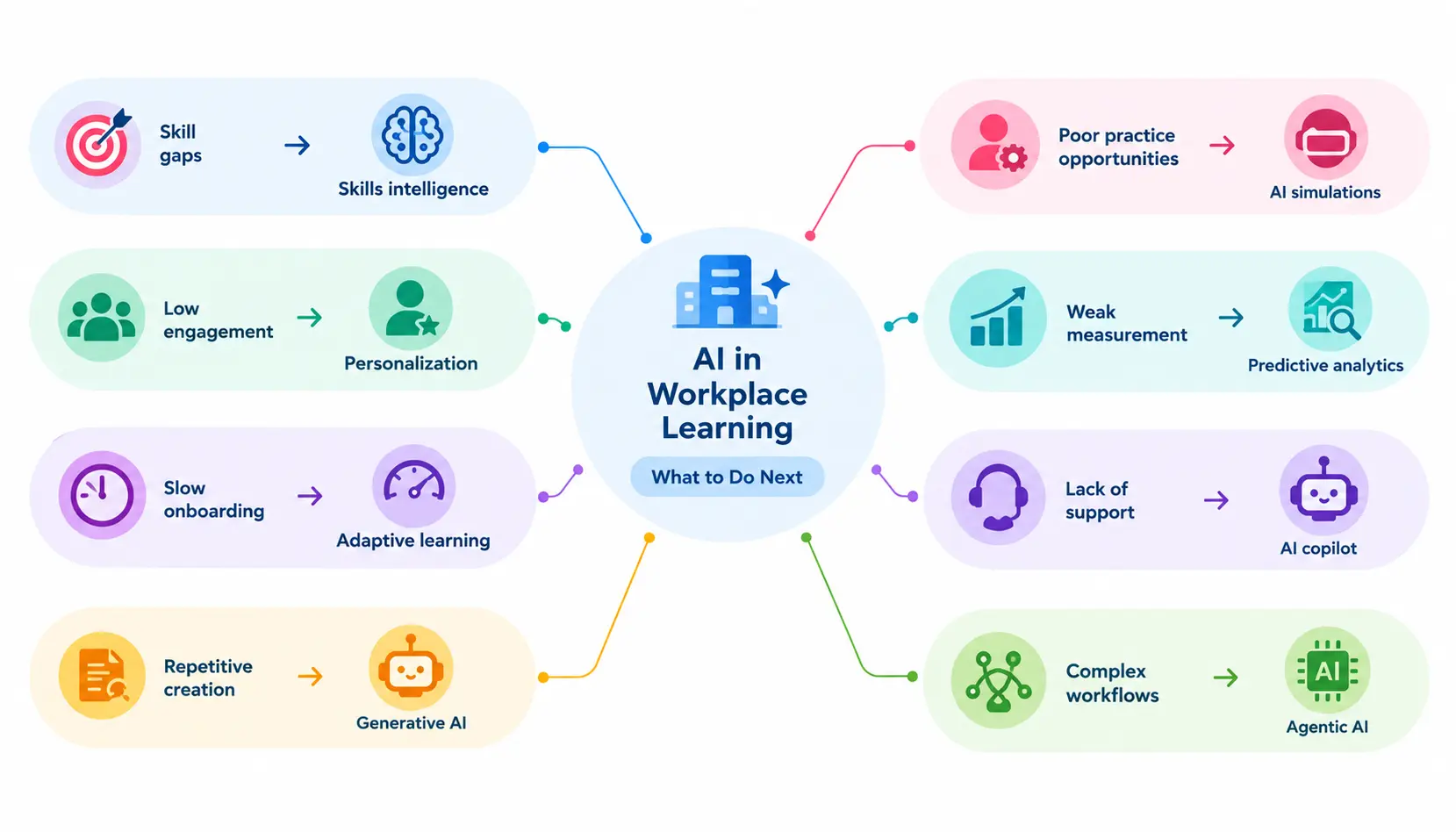
Use this simple decision framework to prioritize:
- Skill gaps → invest in skills intelligence
- Low engagement → invest in personalization
- Slow onboarding → invest in adaptive learning
- Repetitive training creation → invest in generative AI
- Poor practice opportunities → invest in AI simulations
- Weak learning measurement → invest in predictive analytics
- Lack of employee support → invest in an AI copilot
- Complex learning workflows → invest in agentic AI
Future of AI in Workplace Learning
Looking ahead, several developments are worth watching:
- AI learning companions that understand an employee’s career history well enough to guide development over years, not just individual courses.
- Agentic learning ecosystems that manage entire skill-development workflows with minimal manual oversight.
- Autonomous skill-gap detection that flags and addresses gaps before they show up in performance reviews.
- Predictive career development that maps realistic next roles based on skills, performance, and market demand.
- Real-time learning inside workflows, so the line between “doing the job” and “learning the job” continues to blur.
- Human-AI collaborative learning, where AI handles content and logistics while humans focus on coaching, context, and judgment.
- AI literacy becoming a core workplace capability, expected of employees at every level, not just technical teams.
Frequently Asked Questions
1. What are the latest AI trends in workplace learning?
The most significant trends include hyper-personalized learning paths, AI-powered skills intelligence, generative AI for training content, AI learning copilots, agentic AI for L&D, and predictive learning analytics.
2. How is AI changing employee training?
AI is shifting training from static, one-size-fits-all courses to personalized, continuous learning that adapts to each employee’s role, pace, and goals.
3. How does AI personalize workplace learning?
AI analyzes learner data such as role, skills, performance, and behavior to recommend the most relevant content and adjust the difficulty and pace of learning in real time.
4. What is the role of AI in L&D?
AI supports L&D by automating content creation, personalizing learning paths, powering coaching and simulations, and providing predictive insights into skill gaps and workforce readiness.
5. Will AI replace corporate trainers?
It’s unlikely to fully replace them. AI is better suited to scaling personalization and content creation, while human trainers remain essential for coaching, mentorship, and complex judgment calls.
6. What are the benefits of AI-powered employee training?
Benefits include faster onboarding, better skill development, improved internal mobility, higher engagement, reduced training costs, and stronger workforce planning.
7. What are the risks of AI in workplace learning?
Key risks include data privacy concerns, algorithmic bias, AI hallucinations, employee surveillance, over-reliance on AI, and the loss of valuable human interaction.
8. How can companies measure AI training ROI?
By combining learning metrics (proficiency, retention), employee metrics (time to proficiency, mobility), and business metrics (productivity, cost savings, revenue impact), not completion rate alone.
9. What skills will employees need in an AI-powered workplace?
A mix of AI literacy, technical skills relevant to their role, and human skills like critical thinking, creativity, communication, and adaptability.
10. What is the difference between an AI copilot and an AI agent?
A copilot assists when asked, answering questions or offering suggestions. An AI agent acts more autonomously, capable of detecting problems and taking action, like assigning training or escalating a skill gap, without waiting for a direct request.
Conclusion
The AI trends shaping workplace learning all point in the same direction: away from static, one-time training and toward continuous, personalized, and increasingly proactive skill development. The organizations that get this right won’t be the ones that adopt every new AI tool. They’ll be the ones that match the right trend to the right problem, keep humans firmly in the loop, and never lose sight of the fact that the goal isn’t AI adoption for its own sake. It’s building a workforce that can keep learning as fast as the work itself keeps changing.