


If you are in charge of learning and development at a mid-size or large company you already know the number that worries you, the completion rate. You start a course, promote it in three places, get support from leadership and still see half of your employees stop before finishing the last part.
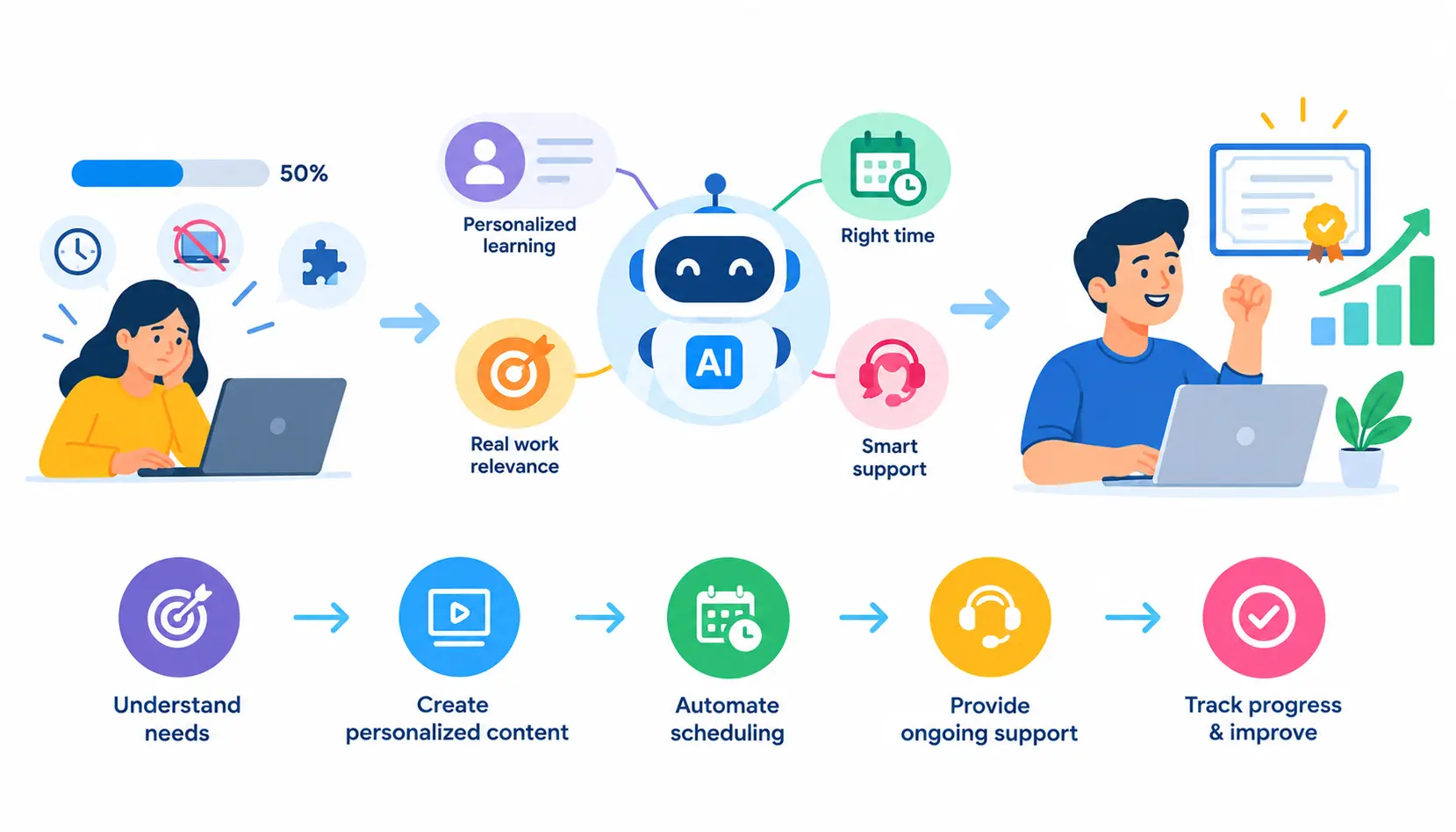
This is not a problem of motivation. It is usually a problem of design. Employees stop training when it seems not useful when it comes at the time or when it does not match their real work. AI completion rates for training are becoming a solution to this problem not because AI is special but because it allows you to make training personal, schedule it right and offer support at a level that no human team could handle on their own.
This article explains why completion rates are low, how AI can improve them and just as importantly, the difference between a person who finishes a course and a person who actually gains something from it. We will end with a step- by-step plan you can use no matter which LMS or LXP you are using.
What Are Training Completion Rates?
A training completion rate is the percentage of assigned learners who finish a course or program.
Completion rate = completed learners ÷ assigned learners × 100
If 200 employees are assigned a compliance course and 140 finish it, your completion rate is 70%. Simple to calculate, but easy to misread.
How to Calculate Training Completion Rate
First count the learners who finished every required module. Then divide that number of learners by the number of learners assigned to the course. Finally multiply that quotient by 100 to get a percentage. Most LMS platforms calculate this automatically. However, knowing the formula is useful. It lets learners, sanity‑check dashboard numbers. Compute the percentage manually for training that is delivered outside the main system.
Completion Rate vs Training Effectiveness
Completion tells you whether people finished. Effectiveness tells you whether people improved at their job because of it. Completion and Effectiveness are. Not using the same metric and calling them the same thing is one of the most common mistakes in corporate L&D.
Why a High Completion Rate Does Not Always Mean Successful Training
A 95% completion rate looks great on a report.. If learners are just clicking through slides to hit a progress bar that number is hiding a real problem. Completion is a leading indicator, not a proof of learning. Think of it as a doorway you need people to walk through, not the destination itself.
Why Employees Fail to Complete Training
Before AI can fix anything, it helps to understand where training actually breaks down.
Training Is Not Relevant to the Employee
A sales rep sitting through a generic “customer service basics” module tunes out fast if it doesn’t map to their actual day-to-day calls. Irrelevance is the single biggest driver of drop-off.
Courses Are Too Long or Difficult
Long, dense courses front-load effort without showing progress. Employees quit not because they can’t handle the content, but because the time investment feels disproportionate to the payoff.
Employees Receive the Same Content
One-size-fits-all training ignores the fact that a new hire and a ten-year veteran need very different depth on the same topic. Serving both the same module wastes one group’s time and underserves the other.
Feedback Comes Too Late
If a learner fails a quiz and doesn’t find out why for a week, the moment to correct the misunderstanding has passed. Delayed feedback breaks the learning loop.
Employees Cannot Fit Training Into Their Workflow
Training that requires blocking out 90 uninterrupted minutes competes directly with actual work. In busy roles, training loses that fight almost every time.
Learners Lose Motivation
Without visible progress, recognition, or a clear “why,” motivation fades by module three. This is a well-documented pattern in adult learning theory, sometimes discussed under andragogy, which holds that adult learners need relevance and autonomy to stay engaged.
L&D Teams Cannot See Where Learners Drop Off
Many teams only know their overall completion rate, not the specific module, slide, or question where learners bail. Without that visibility, you’re guessing at fixes instead of targeting them.
How AI Can Improve Training Completion Rates
This is where AI training completion rates start to shift from theory to practice. AI doesn’t replace good instructional design. AI in learning and development can help remove the friction that causes good content to underperform.
Personalize Learning Paths
AI can create a learning path by using inputs together: role, current skills, past performance, previous learning history, personal goals and test results. How AI personalizes learning experiences Then, instead of giving the same six-module course to every person, in a department the system can avoid content someone already understands and add more detail where real skill gaps are found.
Recommend More Relevant Training
This follows the ” content, right learner right time” model. It works like a streaming service recommends a show.. Instead of entertainment it applies to skills. AI checks what a learner has already done. It looks at what their job needs. It also sees what similar employees found helpful. Then it brings up the training that’s most likely to be important right now.
Adapt Training Difficulty
Make Content Easier When Learners Struggle
If a learner keeps getting questions on a topic adaptive systems can respond by going more slowly adding extra examples or offering a short review lesson before continuing. This helps avoid the frustration that often makes people give up in the middle of learning.
Accelerate Learning for Advanced Employees
The flip side matters too. If someone is acing every checkpoint, AI can skip ahead or offer stretch content instead of forcing them through material they’ve already mastered.
Deliver Immediate Feedback
By waiting for a manager or trainer to review a quiz, AI can flag a wrong answer instantly and explain why a wrong answer is wrong. This tightens the feedback loop. Keeps the mistake fresh in the learner’s mind, which is when correction actually sticks.
Provide AI-Powered Coaching and Assistance
A chat-based AI coach can help a learner understand something during a course. For example a learner might ask, “what does this compliance term actually mean in my job?” They don’t need to send an email to a trainer and wait for a reply. This is similar to how professionals use AI assistants for help when they need it. This way of working is something people talk about a lot on sites, like LinkedIn.
Break Training Into Microlearning
AI can chunk a 45-minute course into five 8-minute segments that fit into small gaps in someone’s day. Shorter units lower the psychological barrier to starting, and finishing.
Reinforce Learning With Spaced Practice
Rather than a single test at the end, AI can resurface key concepts days or weeks later, based on the spacing effect, a well-established finding in cognitive psychology showing that spaced review improves long-term retention far more than cramming.
Use AI-Powered Quizzes and Assessments
AI-generated and adaptive assessments can provide immediate feedback and identify weak areas, adjusting future content based on where a learner actually struggled rather than a fixed, generic path.
Use Gamification and Recognition
Progress bars, badges, streaks, and leaderboards tap into intrinsic motivation. AI can personalize these too, celebrating a milestone that matters to that specific learner instead of a blanket “well done.”
Deliver Training in the Flow of Work
Instead of pulling employees into a separate LMS tab, AI can surface a two-minute lesson inside the tool they’re already using, such as a CRM prompt before a sales call. This is one of the more practical shifts L&D teams have made in the last few years, and it shows up often in workplace-learning discussions on community.
Identify Disengagement and Drop-Off Patterns
AI can flag a learner who’s stalled for five days or who consistently disengages at the same point in a course, prompting a manager check-in before the person quits entirely.
Automate Training Reminders and Follow-Ups
Rather than one blanket reminder email to everyone, AI can time nudges based on individual behavior: a gentle prompt for someone who’s close to finishing, a different message for someone who hasn’t started.
AI Training Completion Strategies by Problem
| Problem | AI Intervention | Expected Effect |
| Irrelevant training | Personalization | Higher relevance |
| Learner confusion | AI coach | Faster support |
| Difficult content | Adaptive learning | Better progression |
| Long courses | Microlearning | Lower friction |
| Low motivation | Gamification | Greater participation |
| Forgotten knowledge | Reinforcement | Better retention |
| Poor visibility | Analytics | Faster intervention |
| Slow feedback | AI assessment | Faster correction |
How AI Improves the Employee Training Experience
From One-Size-Fits-All to Personalized Learning
Training used to be built for the “average” employee, a person who doesn’t actually exist. AI shifts the model toward content shaped around the individual sitting in front of it.
From Passive Content to Interactive Practice
Slide decks and video-only courses ask learners to absorb information passively. AI-enabled tools can turn that into scenario-based practice, simulations, and Q&A, which keeps attention and improves recall.
From Delayed Feedback to Real-Time Feedback
The gap between “I got this wrong” and “here’s why” used to be days. AI closes it to seconds, which changes how quickly a misunderstanding gets corrected.
From Course Completion to Skill Development
This is the shift that matters most. Maple’s approach draws a clear line between someone simply finishing a course and someone actually changing how they perform at work. Completion is easy to fake by clicking “next.” Skill development shows up in output: fewer errors, faster ramp time, better customer outcomes. AI’s real value is in nudging organizations to track the second thing, not just the first.
Real-World Examples of AI Improving Training Completion
AI for Employee Onboarding
A new hire gets a learning path built around their specific role and prior experience, instead of the same 40-module onboarding deck given to every department. They finish faster because they’re not sitting through content meant for a different job.
AI for Sales Training
AI can analyze which reps are missing quota on a specific skill, say, objection handling, and assign a short, targeted module instead of re-running the entire sales bootcamp.
AI for Customer Service Training
Real call or chat transcripts can be used to generate practice scenarios, so agents train on situations that mirror what they’ll actually face that week.
AI for Compliance Training
Adaptive quizzing can shorten mandatory compliance modules for employees who demonstrate mastery early, while spending more time with employees who need it, improving completion without cutting corners on rigor.
AI for Leadership Development
AI coaching tools can simulate a difficult conversation with a direct report, giving new managers a low-stakes place to practice before the real thing.
AI for Technical Skills Training
Engineers can get code-review-style feedback from an AI tutor on practice exercises, closing the loop faster than waiting for a senior developer’s review cycle.
How AI Learning Analytics Helps Improve Completion Rates
Track Where Learners Drop Off
Analytics can pinpoint the exact module, slide, or question where attrition spikes, turning a vague completion problem into a specific, fixable one.
Identify Low-Performing Modules
If one module has a consistently low pass rate across many learners, the content is probably the issue, not the employees.
Detect Knowledge Gaps
Aggregated quiz data can reveal a skill gap across an entire team, not just an individual, which helps L&D prioritize what to build next.
Analyze Assessment Performance
Patterns in wrong answers often point to a specific misconception, which is more useful than a raw score for deciding what to fix.
Identify Learners Who Need Additional Support
AI can flag at-risk learners early, based on pace, quiz results, or inactivity, so a manager or coach can step in before the person disengages completely.
Use Predictive Analytics to Anticipate Training Needs
AI analytics can combine tests, feedback and performance indicators to identify knowledge gaps and emerging needs before they show up as a performance problem on someone’s review.
How to Implement AI to Increase Training Completion Rates
Step 1: Establish Your Current Completion Baseline
You can’t measure improvement without a starting point. Pull completion, drop-off, and time-to-completion data for your last two or three quarters.
Step 2: Identify Where Learners Drop Off
Use existing LMS analytics (or a spreadsheet, if that’s what you’ve got) to find the specific point in your courses where people stop.
Step 3: Determine Why They Drop Off
Survey a sample of learners or review session data. Is it length, relevance, difficulty, or timing? The fix depends entirely on the cause.
Step 4: Choose the Right AI Capability
Match the problem to the intervention: personalization for relevance issues, adaptive difficulty for struggle points, microlearning for time constraints.
Step 5: Integrate AI With Your LMS or LXP
Most modern platforms support AI features natively or through integrations. Check what your current system already offers before buying something new.
Step 6: Start With a Pilot Program
Roll the AI feature out to one team or one course first. This limits risk and gives you real data before a company-wide rollout.
Step 7: Define Success Metrics
Decide upfront what “working” looks like: completion rate, time to completion, assessment scores, or on-the-job performance. Ideally, track more than one.
Step 8: Monitor and Optimize
AI models improve with more data. Revisit performance monthly for the first quarter, then quarterly after that.
How to Measure Whether AI Actually Improves Training Completion
Completion Rate
The baseline number: the percentage of assigned learners who finish.
Start Rate
The percentage who begin the course at all. A low start rate points to an assignment or awareness problem, separate from completion.
Drop-Off Rate
Where and how many learners quit before finishing. This is your clearest signal of a content or timing problem.
Time to Completion
How long it takes learners to finish, on average. Falling time-to-completion often signals better-fitted content, not rushed learning.
Assessment Scores
Whether learners are actually retaining what they went through, not just clicking past it.
Knowledge Retention
Scores on follow-up quizzes weeks after the course, a much stronger signal than a same-day test.
Skill Proficiency
Manager or peer evaluation of whether the learner can actually apply the skill on the job.
On-the-Job Performance
Metrics tied to the role itself, such as call quality scores, error rates, and ticket resolution time, that show training translated into real change.
Business Outcomes
The ultimate test: did the training move a business metric like retention, sales, safety incidents, or customer satisfaction?
Build an AI Training Measurement Dashboard
Pull these metrics into a single view, even a simple one, so you’re not just reporting completion rate in isolation. A dashboard that shows completion next to retention and on-the-job performance tells leadership a much more honest story.
Training Completion Metrics to Track
| Metric | What It Tells You |
| Start rate | Whether employees begin training |
| Completion rate | Whether they finish |
| Drop-off rate | Where participation stops |
| Time to completion | How efficiently training is completed |
| Assessment score | Knowledge acquisition |
| Retention score | Whether knowledge persists |
| Skill proficiency | Whether capability improved |
| Application rate | Whether learning transfers to work |
| Business KPI | Whether training affects business outcomes |
AI-Powered Training vs Traditional Training
AI-powered training differs from traditional employee training in how learning paths, feedback, assessments, analytics, and support are delivered. AI vs Traditional Employee Training provides a deeper comparison of these approaches.
| Factor | Traditional Training | AI-Powered Training |
| Learning path | Standardized | Adaptive |
| Recommendations | Manual | AI-driven |
| Feedback | Often delayed | Real-time |
| Assessments | Fixed | Adaptive |
| Analytics | Periodic | Continuous |
| Support | Instructor-dependent | AI + human |
| Content | Mostly static | Can be dynamically adapted |
| Scalability | Resource intensive | More scalable |
Benefits of AI for Training Completion Beyond Finishing Courses
Better Knowledge Retention
Spaced reinforcement and real-time feedback both feed back into completion. Learners who retain more are more likely to stay engaged with follow-up modules instead of feeling like they’re starting from zero each time.
Faster Skill Development
Shorter time-to-competency means employees can move on to the next relevant course sooner, which keeps completion momentum going across a full learning path rather than just one module.
More Efficient Trainer Workloads
When AI handles routine Q&A and first-pass feedback, human trainers can focus on the learners who are genuinely stuck, which improves completion for the people most at risk of dropping off.
Better Employee Engagement
Engaged employees don’t just finish training. They finish it faster and retain more, creating a compounding effect on completion metrics over time.
More Relevant Career Development
When training visibly connects to someone’s next role or raise, they have a personal reason to finish it, not just a compliance deadline to hit.
Stronger Training ROI
Every benefit above ties back to completion in a measurable way: higher retention and engagement drive up completion rate, and better completion rate is what makes the rest of the ROI story possible in the first place.
Limitations and Risks of Using AI for Training
AI Cannot Fix Poor Training Content
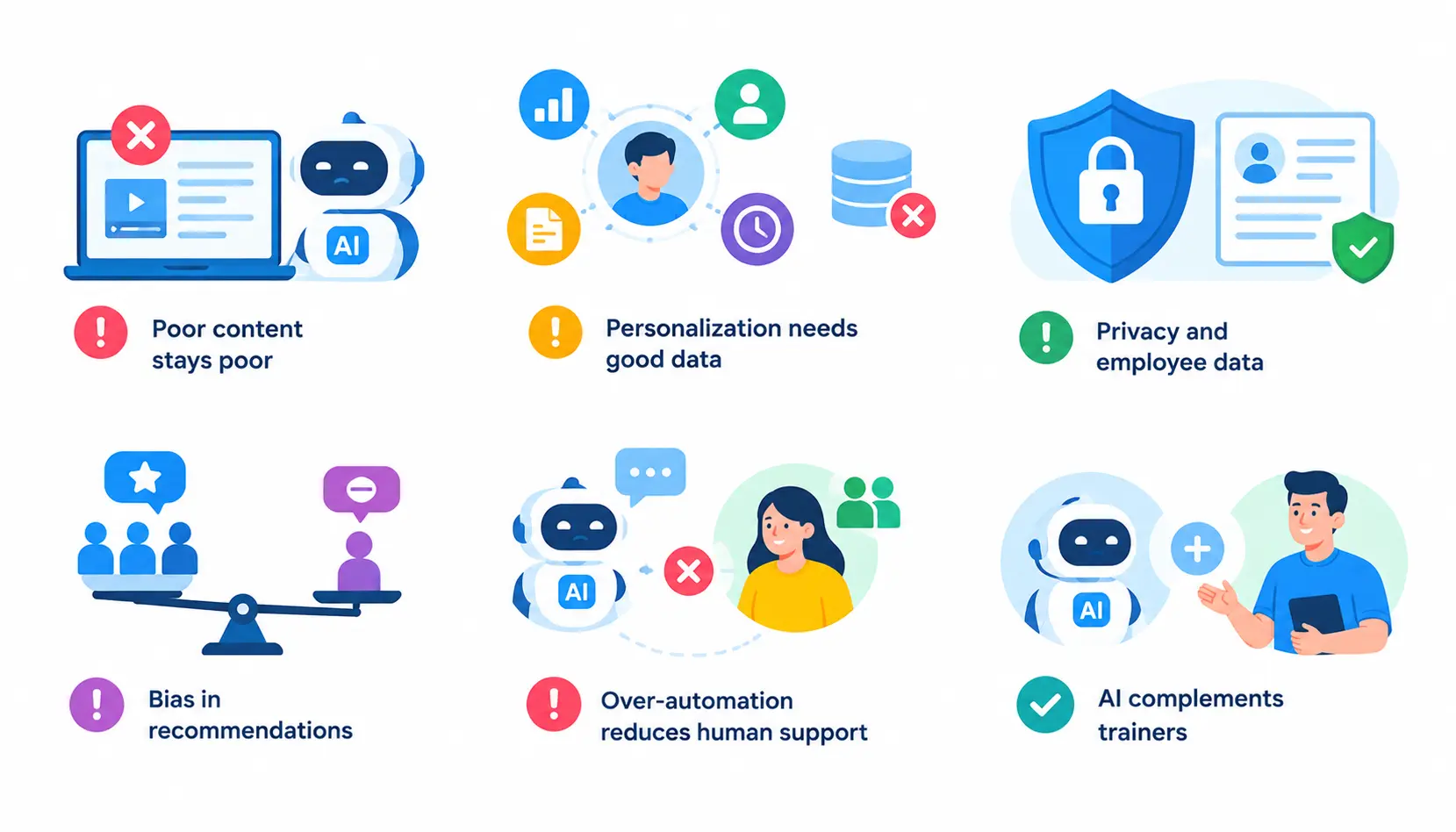
If the underlying course is badly written or outdated, AI will personalize the delivery of bad content. It won’t make the content good. Instructional design still matters most.
Personalization Depends on Good Data
AI recommendations are only as good as the data feeding them. Incomplete skills data or outdated role information leads to irrelevant recommendations, which defeats the purpose.
Privacy and Employee Data Concerns
Personalization requires tracking individual performance data, which raises legitimate privacy questions. Be transparent with employees about what’s collected and why.
Bias in Recommendations
AI systems trained on historical data can replicate existing biases. For example, they may under-recommend advanced content to a group that historically had less access to it. This needs active monitoring, not a one-time check.
Over-Automation Can Reduce Human Support
If every interaction gets routed to an AI coach, employees can lose the human relationships that make training stick: mentorship, manager coaching, team discussion.
AI Should Complement Trainers, Not Replace Them
The strongest programs use AI to handle scale and repetition, while humans handle judgment, context, and relationship-building. Neither one replaces the other.
Best Practices for Increasing Training Completion With AI
Keep Humans in the Loop
Use AI to flag issues and personalize content, but keep a human reviewing edge cases and available for real conversations.
Personalize Without Overcomplicating the Experience
Too many adaptive branches can confuse learners. Keep personalization simple enough that the learner never notices the machinery behind it.
Give Employees Protected Learning Time
No amount of AI personalization fixes a calendar with zero open time. Protect at least a small block of time each week for training.
Use Short, Relevant Learning Activities
Default to microlearning where possible. Shorter, focused sessions consistently outperform long-form courses on completion.
Provide Immediate Feedback
Whether from AI or a human, don’t let feedback sit for more than a day or two. The learning value drops fast after that.
Connect Training to Real Work
Tie every course to a task the employee actually does. Abstract, generic training is the fastest route to disengagement.
Measure Learning, Not Just Completion
Track retention and on-the-job performance alongside completion rate, so you know whether people are actually getting better, not just clicking through.
Frequently Asked Questions
1. How can AI improve training completion rates?
AI improves completion rates by personalizing content to each learner’s role and skill level, adapting difficulty in real time, delivering immediate feedback, and flagging disengagement before a learner drops out entirely.
2. How does AI increase employee engagement in training?
AI increases engagement by making training feel relevant and timely: recommending the right content at the right moment, breaking it into shorter segments, and using gamification tailored to individual motivation.
3. Can AI personalize employee training?
Yes. AI can build individual learning paths based on role, skills, performance history, and goals, rather than assigning the same course to an entire department.
4. How does AI identify employees at risk of dropping out?
AI tracks behavioral signals such as inactivity, repeated quiz failures, and slowing pace, then flags learners who match patterns associated with past drop-off, so managers can intervene early.
5. Does AI-powered training improve knowledge retention?
It can, primarily through spaced repetition and real-time feedback, both of which are well-supported techniques for long-term retention in learning science.
6. How does adaptive learning improve completion rates?
Adaptive learning adjusts difficulty based on performance, which reduces both frustration (content too hard) and boredom (content too easy), the two biggest drivers of mid-course drop-off.
7. Can AI reduce employee training time?
Yes, largely by skipping content a learner has already mastered and focusing time on genuine skill gaps, rather than pushing everyone through the same fixed-length course.
8. How can companies measure AI training effectiveness?
Track a mix of metrics, including completion rate, retention score, assessment performance, and on-the-job performance, rather than relying on completion rate alone.
9. What are the risks of using AI in employee training?
The main risks are data-quality dependence, potential bias in recommendations, privacy concerns around performance tracking, and over-automating support in ways that reduce human connection.
Conclusion
Improving AI training completion rates is not about replacing your designers or trainers with a chatbot. AI training completion rates are about removing the friction, content, delayed feedback, poor timing, invisible drop‑off that causes good training to underperform. Start small. Pick one course with a known completion problem, apply one or two AI capabilities from this article and measure the result against your baseline. The organizations getting value from AI in learning are not the ones chasing every new feature. They are the ones using AI training completion rates to solve a well‑understood problem one course, at a time.