


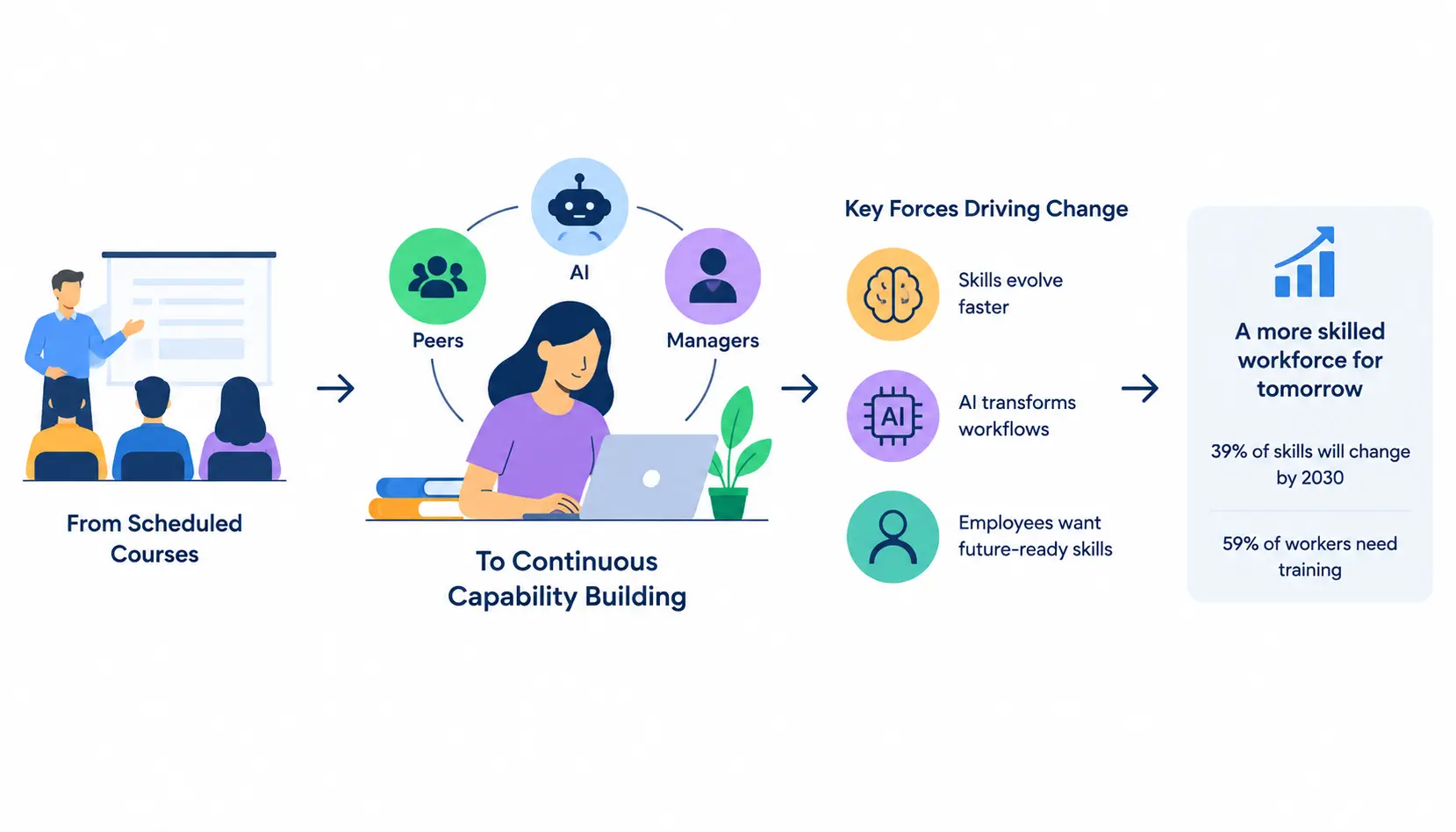
Workplace learning is moving from scheduled courses to continuous capability building. Employees no longer learn once a year in a classroom and go back to work unchanged. They learn while they work, with help from AI, managers and peers.
Three forces are driving this shift. Skills are changing faster than course catalogs can keep up. AI is rewriting everyday workflows. And employees now expect learning to connect to their next role, not just their current one.
The numbers back this up. The World Economic Forum estimates that 39% of existing skill sets will be transformed or become outdated between 2025 and 2030, and that 59% of workers will need training in that period. That is not a trend you can wait out.
This guide covers the workplace learning trends that matter most, what each one means in practice, and how to decide which ones deserve your budget first. For more benchmarks on training spend, hours, skills gaps and AI adoption, see our corporate training statistics for 2026.
What Is Workplace Learning?
Workplace learning is any structured or informal activity that helps employees build the knowledge, skills and habits they need to do their jobs and grow in their careers. It includes formal courses, on-the-job practice, coaching, peer exchange and self-directed study.
Workplace learning vs. traditional employee training
Traditional employee training is an event. Someone schedules a session, people attend, and a completion record is filed.
Workplace learning is a process. It starts with a business need, continues through practice on the job, and ends with a measurable change in performance. Training is one tool inside it, not the whole thing.
How workplace learning has changed
The old model was simple:
Course → completion → certificate
The emerging model looks more like this:
Business need → skill gap → personalized learning → application → feedback → proficiency → career mobility
The difference is that learning is now tied to a real problem at both ends. It begins with something the business needs and ends with something the employee can do and a place they can go next.
Why workplace learning is changing now
Six pressures are pushing the change at the same time:
- AI: It changes tasks inside almost every job, and it can also deliver learning itself.
- Skills disruption: Job titles stay the same while the skills behind them shift.
- Hybrid work: Teams can’t rely on hallway learning or a single training room.
- Employee expectations: People want visible growth, and they leave when they don’t see it.
- Faster technology cycles: Tools change before a course on the old version is finished.
- Pressure to show impact: Leaders want proof that training moves business results.
The Workplace Learning Trends Shaping the Future
Here is the short version before we go deeper into each trend.
| Trend | What is changing | Business value |
| AI-powered learning | Personalization and adaptive support | Faster, more relevant learning |
| Skills-based development | Training tied to capabilities | Workforce agility |
| AI literacy | Employees learn to work with AI | Adoption and productivity |
| Learning in the flow of work | Training embedded into workflows | Less time away from work |
| Continuous learning | Learning becomes ongoing | Skill resilience |
| Career-connected learning | Learning tied to mobility | Retention and engagement |
| Microlearning | Smaller learning interventions | Accessibility |
| Experiential learning | Practice replaces passive consumption | Skill application |
| Data-driven L&D | Outcomes replace vanity metrics | Business accountability |
| Blended learning | Multiple formats work together | Flexibility and scale |
1. AI-Powered and Adaptive Learning
AI-powered learning uses data and algorithms to shape what each employee learns, when they learn it and how. Instead of one course for everyone, each person gets content that fits their situation. For a deeper look at how AI is being used across L&D, see our guide to AI in learning and development.
How AI personalizes employee learning
Good personalization draws on a few simple signals:
- Role: What the person does every day.
- Skill gaps: The distance between what they can do and what the job needs.
- Performance: Where work quality or results show a weak spot.
- Career goals: Where the employee wants to go next.
- Learning behavior: What formats and pace actually work for them.
Adaptive assessments and recommendations
Adaptive assessments change difficulty based on the learner’s answers. If you answer correctly, the questions get harder. If you struggle, the system steps back and fills the gap.
The result is that experienced employees skip what they already know. New hires get the foundations. Nobody sits through a module that wastes their time.
AI learning assistants and coaching
AI assistants can answer questions, explain a concept in simpler words, or roleplay a difficult conversation. A new manager can practice giving feedback at 9 p.m. without waiting for a coaching slot.
This works best as a supplement. It fills the gaps between human coaching sessions rather than replacing them.
Where AI personalization works best
It works best where there is a lot of learner data, clear skill definitions and high volume. Large onboarding programs, compliance refreshers, product knowledge and technical upskilling are good examples.
Limitations of AI-powered learning
AI personalization is only as good as what feeds it. Watch for these risks:
- Bad underlying data: Outdated skill profiles lead to poor recommendations.
- Bias: Systems can repeat unfair patterns in past promotion or training data.
- Privacy: Learning data can reveal performance and career intentions, so it needs careful handling.
- Over-personalization: If everyone follows a different path, shared team learning can disappear.
- Incorrect recommendations: AI can suggest irrelevant or even inaccurate content.
- Human oversight: Someone should review how the system makes decisions and fix errors.
2. Skills-Based Learning Is Replacing Role-Based Training
For years, companies assigned training by job title. Every sales rep got the same sales course. But two reps with the same title can have very different strengths.
Skills-based learning flips the question. Instead of asking “What does this role take?” it asks “What can this person do, and what do they still need?”
What skills-based learning means
Skills-based learning organizes development around specific capabilities, such as data analysis, negotiation or prompt writing. Courses, projects and coaching are then chosen to build those capabilities.
Skills taxonomies and skills intelligence
A skills taxonomy is a structured list of skills with consistent names and definitions. Without one, “project management” means five different things in five departments.
Skills intelligence goes a step further. It uses data from HR systems, assessments and work output to show which skills the organization has, lacks and is building.
Assessing current vs. required skills
Start with the skills a role or project needs. Then compare them with what people can actually do, using assessments, manager input and evidence from real work. Self-ratings alone tend to be unreliable, so combine sources.
Connecting skills to learning paths
Once you know the gap, match it to a path. A path might include a short course, a stretch assignment, a mentor and a practice task. Each step should build toward a specific skill.
Connecting skills to internal mobility and career development
When skills are visible, people can see which roles they are close to. A customer support specialist with strong data skills might be one or two steps from an analyst role. Skills-based systems make that visible.
Example: turning a job role into a skills-based development plan
Take a customer success manager. Instead of assigning a generic “CSM training,” break the role into skills:
- Account planning
- Product knowledge
- Conflict handling
- Data interpretation
- AI-assisted research
The manager rates current proficiency on each one. The employee is strong on product knowledge but weak on data interpretation. Their plan then focuses on dashboards, a real client analysis project and feedback from a senior analyst.
The WEF’s Future of Jobs research identifies AI and big data, networks and cybersecurity, and technological literacy among the fastest-growing skill areas. It also lists human capabilities such as analytical thinking, resilience and creative thinking. A skills-based plan should include both kinds.
3. AI Literacy and Human-AI Collaboration Become Core Workplace Skills
Most companies are rolling out AI tools faster than they are teaching people to use them well. That gap is where mistakes, wasted licenses and quiet resistance come from.
AI literacy is the ability to use AI tools effectively, safely and with good judgment. It is closer to digital literacy than to a technical specialty.
What AI literacy actually includes
- Knowing when to use AI: Some tasks are a great fit. Others are risky or simply faster by hand.
- Prompting: Giving clear instructions, context and examples.
- Evaluating outputs: Judging whether a response is useful and complete.
- Fact-checking: Verifying claims, numbers and sources before using them.
- Data protection: Knowing what information must never go into a public tool.
- Responsible use: Following company policy and thinking about fairness and impact.
- Understanding limitations: AI can sound confident and still be wrong.
Employees will increasingly work alongside AI agents
An AI agent is software that can take a series of actions toward a goal, not just answer one question. It might gather information, draft a report and send it for review.
Microsoft’s Work Trend Index research points toward employees increasingly working with and managing AI agents. That makes agent skills a real future-of-training topic, not a novelty.
Training employees to build, delegate to and manage AI agents
Managing an agent looks a lot like managing a new team member. You define the task clearly, set boundaries, check the work and give feedback.
Training should cover three habits:
- Delegating well: Choosing tasks that suit an agent and writing clear instructions.
- Reviewing carefully: Checking output quality before anything goes to a client or system.
- Knowing when to step in: Spotting when the agent is off track and taking over.
Technical AI skills vs. practical AI skills
Most employees don’t need to build models. They need practical skills: using tools well in their own work.
Technical AI skills, such as data engineering or model development, matter for a smaller group. Don’t put everyone through technical training when practical training would help far more.
Why human skills still matter
AI handles drafts and data quickly. Humans still decide what matters. The skills that rise in value include:
- Critical thinking
- Communication
- Judgment
- Creativity
- Leadership
- Collaboration
4. Learning Moves Into the Flow of Work
People forget most of what they learn in a class if they never use it. Learning in the flow of work solves this by putting help right where the work happens.
What is learning in the flow of work?
Learning in the flow of work means employees get guidance, answers and practice inside their normal tasks, without leaving to attend a separate course. It is learning at the moment of need.
Examples of workflow-embedded learning
- In-app guidance: Tooltips and walkthroughs inside the software people use.
- AI assistants: A chat tool that answers “how do I do this?” on the spot.
- Searchable knowledge: A well-organized library of how-tos and examples.
- Performance support: Checklists and job aids at the point of task.
- Contextual recommendations: A short video suggested when someone opens a new process.
- Real-time coaching: Feedback during or right after a call or task.
Flow-of-work learning vs. traditional courses
Courses are good for building a foundation. Flow-of-work learning is good for applying it. A course explains how a new CRM works. In-app guidance helps the rep log a deal correctly on a busy Friday.
The two work best together.
When flow-of-work learning works best
It works best for tasks that are frequent, procedural or tool-based. It works less well for deep skills, like leadership or complex negotiation, that need reflection and practice away from the pressure of the task.
5. Continuous Learning Replaces One-Time Training
An annual training day cannot keep pace with skills that change every few months. Continuous learning treats development as a regular habit rather than a yearly event.
Why annual training is no longer enough
People forget new information quickly unless they use or revisit it. The forgetting curve describes how memory fades over time without reinforcement. A single yearly session simply cannot hold up against that.
LinkedIn reports that 91% of L&D professionals agree continuous learning is more important than ever for career success.
Microlearning and spaced reinforcement
Spaced repetition means revisiting material at increasing intervals. Short quizzes, scenario prompts and quick refreshers, delivered over weeks, help knowledge stick far better than one long session.
Refresher training
Some skills fade quickly, such as safety procedures, security awareness and rarely used system steps. Plan short refreshers on a schedule instead of waiting for an incident to reveal the gap.
Continuous feedback and coaching
Learning sticks when people get feedback soon after they try something. Managers who give quick, specific feedback weekly do more for skill growth than one annual review.
Building a learning culture
A learning culture is one where people feel safe asking questions, admitting gaps and trying new things. Leaders set the tone. When a senior leader shares what they are learning, others follow.
Give people protected time too. If learning only happens after hours, it will not happen consistently.
6. Career-Connected Learning Becomes a Retention Strategy
People stay where they can see a future. When training connects directly to career progress, it stops feeling like an obligation and starts feeling like an investment.
Learning and career development are becoming inseparable
Employees increasingly judge employers by whether they help them grow. A course that leads nowhere feels like a box to tick. A course that opens a path to a new role feels worth the effort.
Skills-based career paths
A skills-based path shows which skills move someone from one role to another, including sideways moves. This is more flexible than a rigid ladder and helps people see options they didn’t know existed.
Coaching and mentoring
Career conversations need humans. Mentors help employees interpret options, build confidence and navigate the organization. Pair formal mentoring with regular manager check-ins.
Internal mobility
Internal mobility means employees move to new roles within the same company. It saves hiring costs, keeps institutional knowledge and rewards loyalty. Learning is what makes it possible, since people need new skills before they can switch roles.
Learning as an employee retention tool
LinkedIn’s research shows that organizations led by career development champions are associated with stronger outcomes and greater readiness for generative AI adoption. The takeaway is practical: companies that support career growth tend to be better placed to adapt.
If you want to see how practitioners talk about this, the instructionaldesign community on Reddit is a useful place to read honest, real-world discussion.
7. Microlearning Becomes a Delivery Layer, Not a Complete Strategy
Microlearning delivers content in short, focused pieces, usually a few minutes each. It is useful, but it is often oversold. Think of it as a delivery layer, not a full strategy.
What microlearning does well
- Reinforcement: Short prompts keep knowledge fresh after a course.
- Just-in-time help: A two-minute video can solve a problem on the spot.
- Accessibility: Mobile-friendly pieces fit shift workers and busy schedules.
- Single-topic clarity: One idea per lesson keeps content easy to update.
Notice that none of these points depend on the claim that attention spans are shrinking. Short lessons work because they are focused and easy to fit into the day, not because people can’t concentrate.
What microlearning cannot replace
A five-minute video will not teach someone to lead a difficult team meeting. Complex skills need practice, context and feedback. Microlearning can support that work, but it cannot carry it alone.
Microlearning + practice + coaching + feedback
The strongest programs combine four parts: a short lesson, a chance to practice, feedback from a person, and a follow-up reminder. Each part covers a weakness in the others.
Examples of effective microlearning
- A three-minute scenario quiz sent to new support agents after a product update.
- A one-page checklist for managers before performance conversations.
- A short “how to check AI output” guide linked inside the AI tool itself.
8. Experiential and Immersive Learning Expand
People learn best by doing. Experiential learning gives employees realistic practice without real-world risk.
Simulation-based training
Simulations recreate work situations on screen or in a controlled setting. A finance analyst might work through a mock audit. A support agent might handle a simulated angry customer.
VR and AR training
Virtual reality places learners inside a computer-generated environment. Augmented reality overlays digital guidance onto the real world. Both can be powerful for physical or high-risk tasks.
Branching scenarios
Branching scenarios present a situation and let the learner choose what to do. Each choice leads to a different outcome. They are low-cost, work on any device and are very good for judgment-based skills.
Practice in safe environments
Mistakes in training are cheap. Mistakes on the job can be costly. A safe practice space lets people fail, learn and try again, which builds confidence before the real moment.
Where immersive learning makes financial sense
Immersive tools tend to pay off when the task is dangerous, expensive to recreate or hard to practice often. Examples include equipment operation, emergency response and complex machinery maintenance.
When a simple simulation is better than VR
VR is not always the answer. If the skill is a conversation, a decision or a software workflow, a branching scenario or screen-based simulation often does the job for a fraction of the cost.
A useful test: does the learner need to feel the physical space? If not, start simple.
9. Blended Learning Becomes More Flexible and Personalized
Blended learning combines in-person and digital methods in one program. The goal is to use each format where it works best.
Instructor-led + digital learning
A common pattern is to teach concepts online at the learner’s own pace, then use live sessions for discussion, practice and questions. This saves classroom time for the work that needs people in the room.
Virtual instructor-led training
Virtual instructor-led training (VILT) delivers live sessions online. It reduces travel and lets distributed teams learn together. It works best with small groups, active exercises and a skilled facilitator.
Self-paced learning
Self-paced modules suit foundational knowledge and people who want to move at their own speed. Completion tends to drop without reminders or manager support, so build in check-ins.
Mobile learning
Mobile access matters for frontline and field teams who don’t sit at a desk. Keep content short, readable on a small screen and usable with a weak connection.
Choosing the right format for the skill
Pick the format based on the learning objective, not on what employees say they like.
| If the learner needs to… | Consider |
| Remember facts or procedures | Self-paced or microlearning |
| Practice a conversation | Role-play, scenarios or live coaching |
| Handle physical or high-risk tasks | Simulation, AR or VR |
| Discuss and apply ideas with others | Instructor-led or virtual workshop |
| Perform a task in a tool | In-app guidance |
Preferences matter for engagement. But preferences should not override what actually builds the skill.
10. Social and Collaborative Learning Grow
Some of the best learning happens between colleagues, not between a learner and a course. Social learning formalizes that.
Peer-to-peer learning
Peers can explain things in practical terms because they face the same daily problems. Simple formats such as lunch-and-learns, shared channels and peer review sessions work well.
Subject-matter-expert knowledge sharing
Your experts hold knowledge that never reaches a course. Give them easy ways to share it: short recorded demos, office hours or written playbooks.
Employee-generated learning content
When employees create their own tips and walkthroughs, content stays close to real work. It needs light review for accuracy, but the speed and relevance are hard to match.
Communities of practice
A community of practice is a group of people who share a craft and learn from one another over time. Examples include a data analysts’ guild or a customer success forum.
Manager-led learning
Managers shape whether learning actually happens. When a manager discusses a course beforehand and follows up afterward, application rises. Give managers simple conversation guides instead of asking them to become trainers.
11. Learning Analytics Shift From Activity to Business Impact
Completion rates are easy to track, and they tell you very little. A person can finish a course and still not change how they work.
Why completion rates aren’t enough
Completion shows that someone clicked through content. It does not show whether they learned anything or applied it. Leaders increasingly want evidence that training changes performance.
Learning metrics
These measure engagement with learning:
- Completion
- Assessment scores
- Participation
- Time spent learning
They are useful for managing programs, but they are only the first link in the chain.
Skill metrics
These show whether capability actually grew:
- Skill proficiency
- Skills gaps closed
- Time to proficiency
Business metrics
These connect learning to results:
- Productivity
- Sales
- Errors
- Customer satisfaction
- Retention
- Time to productivity
How to connect training to business outcomes
Work backward from the result you want.
- Pick one business outcome, such as fewer support escalations.
- Identify the skill behind it, such as de-escalation.
- Measure that skill before and after training.
- Compare the business metric for trained and untrained groups where possible.
- Be honest about other factors that could affect the result.
Proving that training caused an outcome is hard. Aim for credible evidence, not perfect proof.
12. Learning Content Becomes More Dynamic and Continuously Updated
A course built two years ago may describe tools and rules that no longer exist. Outdated training is not just unhelpful. It can lead people to do the wrong thing.
Why static courses age faster
Technology, regulations and processes change quickly. Large courses are slow and expensive to rebuild, so they fall behind. Modular content is easier to refresh one piece at a time.
AI-assisted content creation
AI can draft outlines, quiz questions, summaries and scenarios in minutes. That speeds up the first draft considerably, especially for L&D teams with small headcount.
SME contribution
Subject-matter experts supply the accuracy and the real examples. A good workflow lets AI produce a draft and experts correct and enrich it, instead of asking experts to write from scratch.
Version control and content governance
Decide who owns each piece of content, when it gets reviewed and how old versions are retired. Put a review date on every item. Without governance, outdated material quietly stays in circulation.
Reviewing AI-generated learning content
AI-generated material can include errors, invented details or generic advice. Before publishing, check facts against trusted sources, confirm that examples fit your context, and have an expert sign off on anything technical, legal or safety-related.
13. Human Skills Become More Valuable Alongside AI Skills
It is tempting to think AI training means teaching tool usage and nothing else. That misses half the picture. The more AI handles routine work, the more the human parts of work stand out.
Critical thinking
AI can produce answers quickly. Someone still has to question them. Critical thinking means checking assumptions, spotting gaps and weighing evidence.
Communication
Explaining a decision, persuading a skeptical client or giving honest feedback stays deeply human. Clear communication also improves how people prompt and direct AI.
Leadership
Leaders now guide teams that include both people and AI tools. They need to set direction, build trust and help others through change.
Creativity
AI can generate options. People decide which ideas are original, appropriate and worth pursuing.
Emotional intelligence
Reading a room, handling tension and showing empathy cannot be handed to software. These skills matter in every customer and team interaction.
Judgment and decision-making
Judgment is knowing what to do when the data is incomplete or the options conflict. Build it through case discussions, scenarios and coaching rather than lectures.
The WEF’s skills research includes human capabilities such as analytical thinking, resilience and creative thinking alongside technical skills. The best learning programs treat both as equally important.
Which Workplace Learning Trends Should Organizations Prioritize?
Not every trend deserves your attention right now. A practical way to decide is to sort them by maturity.
Trends that are already mainstream
These are well-tested, so the risk is low.
- Blended learning
- Microlearning
- Digital learning
- Learning analytics
- Continuous learning
Trends growing rapidly
These are worth active investment now.
- AI-powered personalization
- Skills-based learning
- AI literacy
- Learning in the flow of work
- Career-connected learning
Emerging trends
Pilot these on a small scale and learn before scaling.
- AI agents as learning partners
- AI coaching
- Advanced simulations
- Agentic learning workflows
- Predictive skills intelligence
Trends that depend heavily on industry
Whether these make sense depends on your work.
- VR
- AR
- Simulations
- Highly specialized technical training
A good rule: start with one or two growing trends that match a clear business problem. Don’t chase everything at once.
How to Build a Future-Ready Workplace Learning Strategy
Use these ten steps as a working framework.
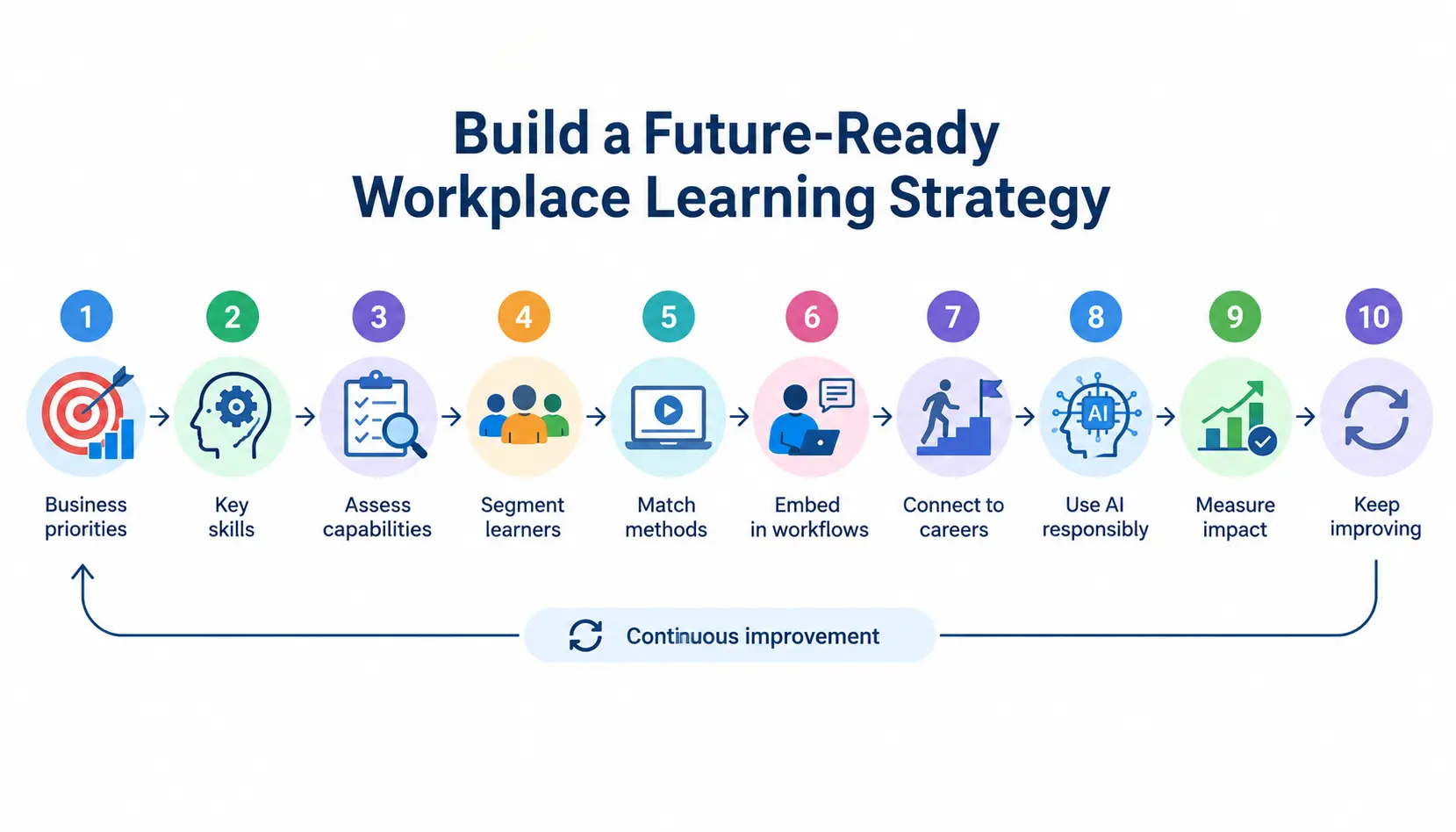
Step 1: Start with business priorities
Ask leaders what the company must achieve this year. Learning that doesn’t connect to those goals will struggle to win support.
Step 2: Identify critical skills
List the skills that most affect those priorities. Keep the list short, so focus is possible.
Step 3: Assess current capabilities
Use assessments, work samples and manager input to see where people stand today.
Step 4: Segment learners
Group learners by role, experience and need. A new hire, a frontline supervisor and a senior engineer should not follow the same path.
Step 5: Match learning methods to the skill
Choose formats that fit the objective, as covered in the blended learning section above. For a practical framework covering training design, delivery methods and implementation, see our guide to building an effective employee training program.
Step 6: Embed learning into workflows
Place guidance, job aids and coaching where the work happens. Make learning easy to reach in the moment.
Step 7: Connect learning to career development
Show employees how each skill opens doors. Tie learning paths to real roles and projects.
Step 8: Introduce AI responsibly
Set clear rules on data, privacy and review. Start with a small pilot, gather feedback and keep humans in charge of key decisions.
Step 9: Measure skill and business outcomes
Track skill growth and business results, not just completions.
Step 10: Continuously update the strategy
Review the plan every quarter. Retire what isn’t working, and adjust as skills and tools change.
Workplace Learning Trends: Traditional vs. Future Model
| Area | Traditional approach | Future workplace learning |
| Focus | Courses | Capabilities |
| Planning | Annual | Continuous |
| Personalization | Limited | AI-assisted |
| Skills | Role-based | Skills-based |
| Delivery | Classroom | Multimodal |
| Timing | Scheduled | In the flow of work |
| Content | Static | Dynamic |
| Learning | Individual | Social + AI-supported |
| Career | Separate from training | Connected to learning |
| Measurement | Completion | Business impact |
| AI | Occasional topic | Core workplace capability |
Workplace Learning Trends by Organization Type
The right priorities depend on your size and resources.
Small businesses
Focus on what is practical and affordable:
- Practical skills
- Microlearning
- Manager-led development
- Affordable digital resources
Mid-sized organizations
Build structure as you grow:
- Skills frameworks
- LMS/LXP (a learning management system or learning experience platform)
- Career paths
- Analytics
- AI adoption
Large enterprises
Focus on coordination and governance at scale:
- Skills intelligence
- Internal mobility
- AI governance
- Enterprise learning ecosystems
- Workforce planning
Challenges of Implementing Future Workplace Learning Trends
These ideas look good on paper. In practice, you will face obstacles.
Employee resistance
People resist when learning feels like extra work or a threat to their job. Explain the purpose, involve employees early and show quick wins.
Limited L&D budgets
Start small. Pick one high-value problem, solve it well and use the results to justify more investment.
Outdated content
Audit your library. Remove or refresh what is stale, and assign owners with review dates.
Poor skills data
Skills data goes stale quickly and is often self-reported. Combine several sources and refresh them regularly.
AI privacy and security
Learning data can reveal sensitive information. Involve legal, IT and HR early, and be clear about what data you collect and why.
Lack of manager support
Without managers, learning rarely sticks. Give managers time, simple tools and recognition for developing their teams.
Difficulty measuring ROI
Perfect measurement is rare. Use a mix of skill and business indicators and be transparent about limits.
Technology overload
Too many platforms confuse employees. Consolidate where you can and favor tools that fit into existing workflows.
FAQs About Workplace Learning Trends
1. What are the biggest workplace learning trends?
The biggest workplace learning trends are AI-powered personalization, skills-based development, AI literacy, learning in the flow of work, continuous learning and career-connected learning. Microlearning, experiential learning, blended learning and data-driven L&D round out the list.
2. What is the future of workplace learning?
The future of workplace learning is continuous, personalized and tied to real work. Employees will build skills through a mix of AI support, peer learning and on-the-job practice, with progress measured by business impact rather than course completions.
3. How is AI changing employee training?
AI personalizes learning paths, powers adaptive assessments, answers questions on demand and speeds up content creation. It also creates a new training need: teaching employees to use AI well and responsibly.
4. Why is skills-based learning important?
Skills-based learning focuses on what people can do rather than their job title. It helps organizations spot gaps faster, build targeted development plans and move people into new roles more easily.
5. What is learning in the flow of work?
Learning in the flow of work means employees receive help, guidance or practice inside their normal tasks. Examples include in-app tips, AI assistants and searchable knowledge bases.
6. Is microlearning effective for employee training?
Yes, for the right purpose. It works well for reinforcement, quick reference and single-topic skills. It is not enough for complex skills that need practice, coaching and feedback.
7. What skills will employees need in the future?
Employees will need AI literacy, data and technology skills, and strong human skills such as analytical thinking, creativity, communication and resilience. The WEF lists AI and big data, networks and cybersecurity, and technological literacy among the fastest-growing skills.
8. How can companies measure workplace learning effectiveness?
Measure at three levels: learning activity (completion, scores), skill growth (proficiency, time to proficiency) and business outcomes (productivity, errors, retention). Link them by choosing one business goal and tracing the skills behind it.
9. What is the difference between upskilling and reskilling?
Upskilling means building new skills to do your current job better or to meet changing demands. Reskilling means learning different skills to move into a new role.
10. How can organizations create a continuous learning culture?
Make learning part of the weekly routine, protect time for it, have leaders model it and reward managers who develop their people. Short, regular reinforcement works better than occasional long programs.
11. Will AI replace traditional employee training?
Not entirely. AI will take over parts of delivery, such as personalization and Q&A. But human coaching, practice, judgment-building and culture still need people.
12. How should companies prepare employees for AI agents?
Teach employees to delegate clear tasks, review agent output carefully and know when to step in. Pair that with clear policies on data use and accountability. Practice with real scenarios works better than theory.
Conclusion
The workplace learning trends covered here point in one direction. Learning is shifting from isolated courses to continuous capability building that is tied to skills, careers and business results.
You do not need to adopt everything at once. Start with a clear business priority, identify the skills behind it, and choose the learning methods that fit. Add AI carefully, keep people in the loop, and measure what actually changes.
Organizations that treat learning as an everyday part of work will adapt faster when skills and tools shift again. That is the real advantage of staying current with workplace learning trends.