

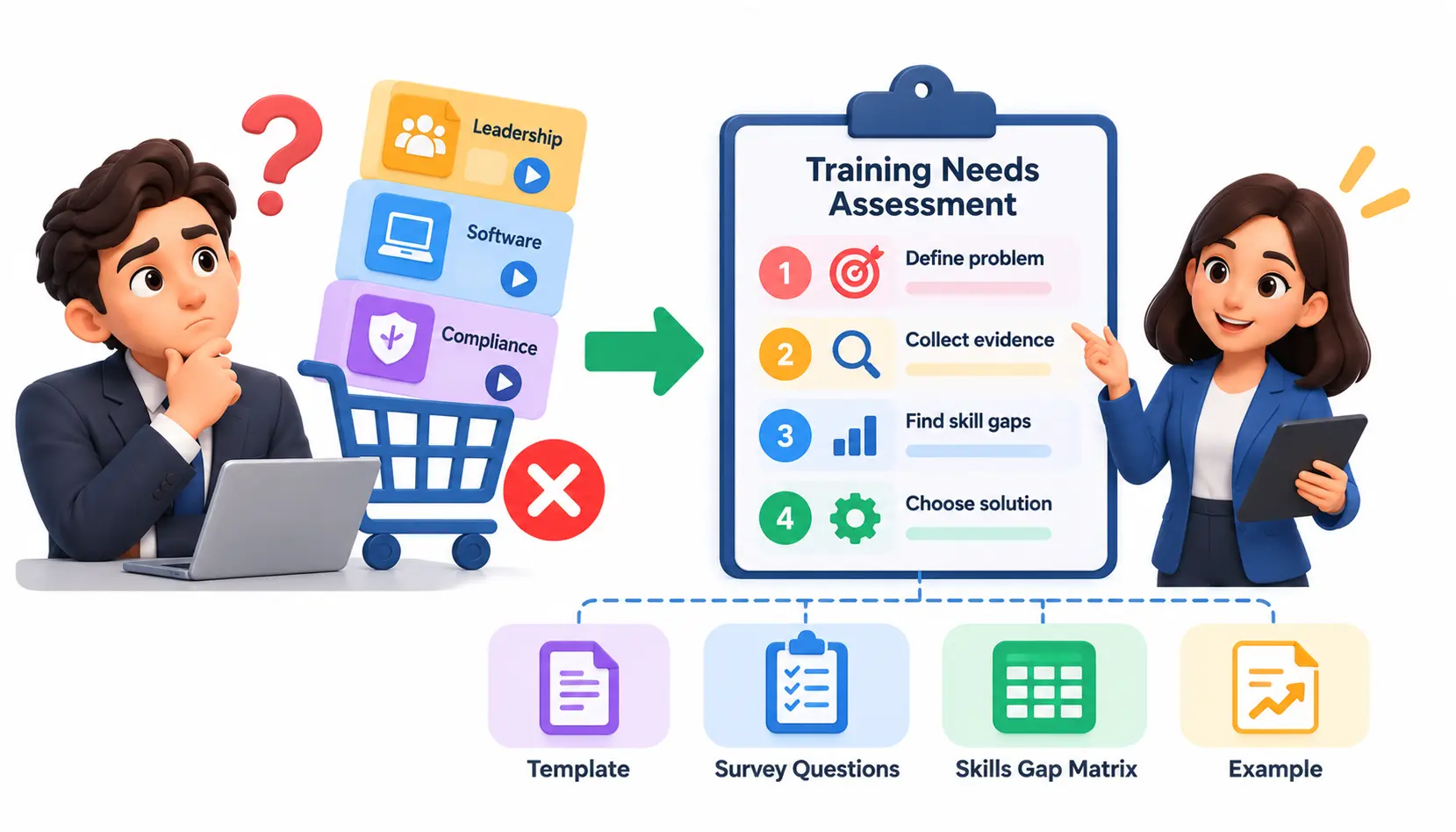
A corporate training needs assessment is a structured way to find out what skills your employees lack, why the gap exists, and whether training is the right fix. It turns “we need a course” into “we have a specific problem, and here is the best way to solve it.”
Too many companies still start with a course catalog. They buy a leadership program or a software workshop, then wonder why results don’t change. A good assessment flips that order. You start with the business problem, collect evidence, and only then choose the intervention.
This guide walks you through the full process. You’ll get a 7-step method, a comparison of data collection methods, a skills gap matrix, a worked (hypothetical) example, a reusable template and sample survey questions.
What Is a Corporate Training Needs Assessment?
Think of it as a diagnosis before a prescription. You look at what the business needs, what people can do today, and what stands in between.
Training Needs Assessment Definition
A training needs assessment (TNA) is a systematic review of the gap between the performance a business needs and the performance it gets, followed by a decision about which gaps training can close. The broader field of needs assessment uses the same logic: define the desired state, measure the current state, and analyze the difference.
What Is the Purpose of a TNA?
The purpose is to make sure training money and time go toward problems that training can actually solve. It also gives you a baseline, so you can show later whether anything improved.
What Does a Training Needs Assessment Produce?
A solid TNA produces a short, usable set of outputs:
- A clear problem statement tied to a business goal
- A list of required skills, knowledge and behaviors
- A prioritized list of gaps with evidence
- Root causes, including non-training causes
- Recommended interventions with owners, costs and timelines
- Success measures and review dates
Training Needs Assessment vs. Training Needs Analysis
In practice, most people use these terms interchangeably. When teams do separate them, “assessment” usually means collecting data, and “analysis” means interpreting it and recommending action. Pick one term, define it in your report, and stay consistent.
Training Needs Assessment vs. Skills Gap Analysis
A skills gap analysis compares current skills to required skills. A TNA is wider. It also asks about root causes, business impact and whether training is the right answer. Skills gap analysis is one step inside a good TNA.
Training Needs Assessment vs. Learning Needs Assessment
A learning needs assessment looks at what people want or need to learn, often at the individual level. A TNA starts from organizational goals and works down. The two overlap, but a TNA is more tied to business results.
Why Is a Training Needs Assessment Important?
Without an assessment, training becomes guesswork. With one, you can defend every dollar you spend.
Align Employee Development With Business Goals
Training should move a number the business cares about: fewer errors, faster onboarding, higher customer satisfaction, better compliance. An assessment forces you to name that number first.
Identify Skill Gaps Before Investing in Training
I’ve seen teams roll out a company-wide communication course when only one department struggled. Assessment finds the real gap so you can target it.
Improve Employee Performance and Productivity
When training matches a real need, people apply it. When it doesn’t, they sit through it and go back to old habits.
Prioritize Training Budgets and Resources
You will never have budget for every request. A ranked list of gaps tells you where the first dollar should go.
Support Upskilling, Reskilling and Workforce Planning
Assessment shows which skills you have, which you’ll need in two years, and whether to build them internally or hire.
Measure Training Value and Business Impact
Because you record a baseline, you can compare before and after. That makes it far easier to show leadership what the investment delivered.
What Are the Three Levels of Training Needs Assessment?
The classic framework looks at three levels: the organization, the task or job, and the person. Researchers McGehee and Thayer described this structure in the early 1960s, and Goldstein and Ford later built on it. It remains the standard way to organize a TNA.
Organizational-Level Assessment
This level asks where the business is going and what capabilities it needs to get there. You look at strategy, workforce plans, performance trends and culture.
Team, Department and Job-Level Assessment
Here you study what a role requires: tasks, standards, team KPIs and operational gaps. Job descriptions, task analysis and process maps are your main sources.
Individual-Level Assessment
This level checks what each person knows, can do and wants to develop. Evidence includes skills tests, manager observations, performance reviews and development conversations.
How the Three Levels Work Together
Use all three. Organizational data tells you what matters, job data tells you what good looks like, and individual data tells you who needs help.
| Level | Scope | Key questions | Typical evidence | Typical output |
| Organizational | Whole company or business unit | What capabilities do our goals require? | Strategy documents, workforce plans, company KPIs | Priority capability areas |
| Team / job | Department or role | What must this role do, and where does performance fall short? | Task analysis, job descriptions, team metrics | Required competencies and team-level gaps |
| Individual | Single employee | What can this person do today? | Skills tests, reviews, manager input | Personal development needs |
When Should a Company Conduct a Training Needs Assessment?
Do one whenever a change or a problem makes you ask, “Do our people have what they need to succeed?”
Before Launching a New Training Program
Run a TNA before you design or buy anything. It prevents building content nobody needs.
When Performance or Quality Declines
Rising errors, longer handle times or dropping customer scores are common triggers. The assessment tells you whether skills are the cause.
During Technology Adoption or Digital Transformation
New systems create new skill requirements overnight. Assess readiness before go-live, not after complaints start.
When Roles, Regulations or Business Goals Change
A new regulation, a merger or a shift in strategy all change what people must know. Reassess when they happen.
During Onboarding, Promotion and Succession Planning
Assessment helps you set realistic ramp-up plans for new hires and spot readiness gaps for people moving into bigger roles.
How Often Should a TNA Be Repeated?
There is no universal schedule. A common approach is a light review once a year and a full assessment when a major trigger occurs. Fast-changing roles, such as those tied to software or regulation, may need more frequent checks.
How to Conduct a Corporate Training Needs Assessment in 7 Steps
Here is the process I use. It works for a single team or a whole company.
Step 1. Define the Business Problem and Desired Outcome
Write one sentence that states the problem, the baseline, the target and the deadline. For example: “Reduce repeat customer contacts from 18% to 12% within six months.” If you can’t write this sentence, you’re not ready to assess.
Step 2. Define the Scope and Identify Stakeholders
Decide which departments, roles and locations are in scope. List who sponsors the work, who owns the metrics, and who will approve any recommended changes. Bring managers in early. They know where the real problems live.
Step 3. Identify Required Skills, Knowledge and Behaviors
Describe what excellent performance looks like. Pull from job descriptions, competency frameworks, task analysis and interviews with your best performers. Keep each item observable, such as “explains refund policy without escalating,” rather than vague, such as “good communication.”
Step 4. Collect Data on Current Performance and Employee Capabilities
Use more than one source. Combine surveys, interviews, observations, skills tests and operational data. Self-reported data alone can mislead, so always pair it with something objective.
Step 5. Compare Current and Required Performance
Place the required standard next to what you found. Document each gap clearly, with the evidence behind it. This is your gap list.
Step 6. Diagnose Root Causes and Prioritize the Gaps
For each gap, ask why it exists. Use simple root cause analysis such as “five whys.” Separate knowledge and skill problems from process, staffing, tools, incentive and leadership problems. Then rank the gaps (see the prioritization section below).
Step 7. Recommend Interventions and Define Success Measures
For each priority gap, recommend a fix, an owner, a cost estimate, a timeline, a success measure and a review date. Keep it short enough that a busy executive will read it. Once you have identified and prioritized the skill gaps, the next step is to build an effective employee training program with clear learning objectives, suitable delivery methods, and measurable outcomes.
Which Training Needs Assessment Methods Should You Use?
No single method tells the whole story. Mix them.
Employee Surveys and Questionnaires
Surveys reach many people quickly and are good for confidence levels and perceived barriers. Keep them short and specific.
Manager and Employee Interviews
Interviews uncover the “why” behind the numbers. Ask for real examples, not opinions in general.
Focus Groups and Workshops
Group sessions surface shared pain points and let people build on each other’s ideas. Watch for dominant voices.
Skills Tests and Competency Assessments
Tests give you objective proficiency data. Use them when you need to rank or compare skill levels.
Job Observation and Task Analysis
Watching work happen shows what people actually do versus what the procedure says. It is often the most revealing method.
Performance Reviews and Operational KPIs
Existing data such as quality scores,KPIs and error rates costs little to gather and ties the assessment to results.
Customer Feedback and Quality Reports
Customer complaints and audit findings show where skills gaps hurt the business most.
Learning Management System and HRIS Data
Your LMS and HR information system show completion history, certifications and tenure. Treat completion as a starting point only. It doesn’t prove anyone can do the job. For organizations that need to centralize employee learning, manage training delivery, and monitor progress across teams, a corporate training platform can help organize learning activities and make training data easier to access.
How to Choose the Right Data Collection Method
Match the method to your question, time and budget.
| Method | Useful evidence | Advantages | Limitations |
| Surveys | Confidence, perceived needs | Fast, scalable, low cost | Self-reported, can be shallow |
| Interviews | Context, root causes | Rich detail | Time-consuming |
| Focus groups | Shared issues, ideas | Efficient for themes | Group dynamics can skew input |
| Skills tests | Measured proficiency | Objective | Needs good test design |
| Observation | Real behavior | Shows actual practice | Observer effect, resource-heavy |
| KPIs and reviews | Performance trends | Already available | May not show cause |
| LMS / HRIS data | Training history, certifications | Easy to pull | Doesn’t show competence |
How to Identify and Prioritize Employee Skill Gaps
Once you have data, turn it into a ranked list.
Define the Required Proficiency Level
Use a simple scale, such as 1 (novice) to 4 (expert), and set the target level for each skill by role. Not every role needs expert-level everything.
Measure Current Proficiency
Rate each person or team on the same scale using tests, observations and manager input. Use at least two sources per skill.
Calculate or Rate the Skills Gap
Subtract current from required. A target of 4 and a current level of 2 gives a gap of 2. Larger gaps and gaps shared by many people deserve more attention.
Rank Gaps by Business Impact, Urgency, Risk and Cost
Score each gap on four questions: How much does it affect the business goal? How soon does it matter? What is the risk if we ignore it? What will it cost to close? A simple 1–5 score on each, then a total, is enough to start.
Build a Skills Gap Matrix
A skills gap matrix lists skills down one side and teams or roles across the top, with required and current levels in each cell. Color-code the largest gaps. It gives leaders a one-page view of where to act.
Validate Findings With Employees and Managers
Share draft findings before finalizing. People will correct errors and trust the results more because they saw them.
How to Determine Whether Training Is the Right Solution
This is the question that separates a good assessment from a course-ordering exercise. The idea goes back to performance consultants such as Robert Mager and Peter Pipe, who asked a simple question: could the person do it if their life depended on it? If yes, it’s probably not a training problem.
Knowledge or Skill Deficits
If people genuinely don’t know how, training fits. This is the cleanest case.
Unclear Expectations or Role Responsibilities
If people don’t know what’s expected, clarify the role. A workshop won’t fix confusion about who owns what.
Inefficient Processes or Workflows
If a broken process forces workarounds, fix the process. Training people to cope with a bad process wastes everyone’s time.
Inadequate Tools, Systems or Resources
Slow software, missing data or poor equipment limit performance no matter how skilled people are.
Leadership, Motivation and Change-Readiness Barriers
If good behavior isn’t rewarded, or managers undermine new practices, training won’t stick. Address incentives and leadership first.
Match Each Root Cause to the Right Intervention
| Root cause | Better-fit intervention |
| Missing knowledge or skill | Training, practice, simulations |
| Skill exists but needs support on the job | Coaching, mentoring |
| Hard-to-remember steps | Job aids, checklists |
| Broken workflow | Process redesign |
| Poor tools | Better systems or resources |
| Unclear expectations or weak reinforcement | Management support, clearer goals |
Corporate Training Needs Assessment Example
This is a hypothetical example for illustration. The numbers are invented to show the method, not real-world results.
Business Problem: Rising Customer Support Escalations
A software company’s support team escalates 30% of tickets to senior staff. Leadership wants that down to 20% in six months. A manager suggests “more product training.”
Evidence Collection and Baseline Metrics
The assessor reviews ticket data, listens to sample calls, surveys agents and interviews team leads. Baseline: a 30% escalation rate. Ticket data shows most escalations involve billing disputes and one specific product module.
Required vs. Current Competencies
| Competency | Required level | Current level | Gap |
| Troubleshooting the product module | 3 | 2 | 1 |
| Handling billing disputes | 3 | 1 | 2 |
| De-escalating upset customers | 3 | 3 | 0 |
Root-Cause Diagnosis
Interviews show two causes. Agents lack billing knowledge, which is a training need. But agents also lack permission to issue small refunds, so they escalate even when they know the answer. That is a policy barrier, not a skills gap.
Prioritized Intervention Plan
- Policy change: let agents approve refunds up to a set amount. Owner: support director.
- Targeted billing training: a short module with practice cases. Owner: L&D.
- Job aid: a one-page troubleshooting guide for the product module. Owner: team leads.
How to Measure Results After the Intervention
Track the escalation rate monthly against the 30% baseline. Watch leading indicators such as billing-ticket resolution time and agent confidence. Review at 90 days and adjust.
Notice what happened here: training was only one of three fixes. That is typical.
Corporate Training Needs Assessment Template
A template keeps your work consistent across departments and easy to compare.
Essential Fields to Include
- Business problem and goal
- Baseline, target and deadline
- Scope (roles, teams, locations)
- Required skills and behaviors
- Current performance evidence
- Gap and priority score
- Root cause
- Recommended intervention
- Owner, cost and timeline
- Success measure and review date
Sample Completed Assessment Table
| Gap | Evidence | Priority (1–5) | Root cause | Intervention | Owner | Success measure | Review date |
| Billing dispute handling | Ticket data, agent survey | 5 | Knowledge gap | Training module | L&D | Escalation rate | Day 90 |
| Refund authority | Interviews | 4 | Policy limit | Policy change | Support director | Repeat contacts | Day 60 |
How to Use the Template Across Departments
Keep the fields the same, but let each department fill in its own competencies and metrics. Consistent structure lets you compare priorities across the company.
What to Include in the Final TNA Report
Open with a one-page summary: problem, key findings, recommendations and expected impact. Follow with method, evidence, the gap matrix, root causes and the action plan. Put raw data in an appendix.
How to Present Findings to Leadership
Lead with the business problem and the decision you need. Show two or three priority gaps, not twenty. Be honest about what training won’t fix. Executives trust assessors who admit when the answer isn’t a course.
Training Needs Assessment Survey Questions
Use a mix of rating scales and open-ended questions. Keep each survey under ten minutes.
Questions for Employees
- How confident are you performing [task] on a scale of 1 to 5?
- Which part of your job takes the most effort or causes the most mistakes?
- What tools, information or support would help you most?
- Have you received training for this task? Did it help?
- What skills do you want to build in the next year?
Questions for Managers and Team Leaders
- Which tasks does your team struggle with most?
- Where do you see errors, rework or delays?
- What do your strongest performers do differently?
- Are there barriers other than skills, such as tools, process or workload?
- Which skills will your team need in the next 12 months?
Questions for HR and L&D Teams
- What training have these roles already completed?
- Where do we see turnover, long ramp-up or compliance issues?
- What does the data show about training participation and results?
Questions for Business Leaders
- Which business goals matter most this year?
- What capabilities will we need to reach them?
- What happens if these gaps stay open?
How to Interpret Responses and Validate Findings
Look for patterns, not single answers. Compare what people say with what the data shows. Where the two disagree, follow up with interviews. Remember that people tend to rate themselves generously on some skills and harshly on others, so never rely on self-ratings alone.
How to Measure Training Needs Assessment Success
Your assessment succeeds if the right problems get fixed and you can show it.
Establish a Baseline Before the Intervention
Record the starting metric before anything changes. Without it, you can’t prove improvement.
Track Leading Indicators and Early Progress
Business results take time. Early signals, such as quiz scores, practice quality or manager observations, tell you whether you’re on track.
Measure Learning and Workplace Behavior
Check both what people learned and whether they apply it on the job. Behavior change is where most programs fail.
Connect Outcomes to Business KPIs
Link results back to the goal in Step 1. If the goal was fewer escalations, report on escalations. To monitor whether employees are developing the required skills, learn how to track employee training progress using assessment scores, skill improvement, completion records, and workplace performance data.
Calculate Training ROI When Financial Attribution Is Credible
The common formula, associated with Jack Phillips, is return on investment as net benefits divided by costs, times 100. Only use it when you can credibly separate the training’s effect from other changes. If you can’t, report the improvement without a dollar claim.
Use the Kirkpatrick Model to Evaluate Training Outcomes
The Kirkpatrick model evaluates training at four levels: reaction, learning, behavior and results. It is a practical checklist for what to measure at each stage. You can find more on the model from Kirkpatrick Partners.
Set Review Dates and Update the Assessment
Schedule check-ins at 30, 90 and 180 days. Update your gap list as roles and goals change.
Best Practices for an Effective Training Needs Assessment
Use Multiple Evidence Sources
Triangulate. Two or three sources pointing the same way beat one source every time.
Involve Employees and Managers
People support what they help create. Include them from the start.
Align Assessment With Business Priorities
If a finding doesn’t connect to a business goal, drop it or park it.
Account for Remote, Hybrid and Frontline Workers
Frontline staff often can’t complete long online surveys at a desk. Offer short, mobile-friendly formats, shift-time interviews and on-site observation. Make sure remote workers are heard too.
Protect Employee Data and Reduce Assessment Bias
Explain how you’ll use the data and who will see it. Where possible, report in aggregate. Use consistent criteria so ratings don’t depend on who the manager is.
Keep Findings Actionable and Review Them Regularly
Every finding should lead to a decision. Revisit the assessment on a schedule so it stays current.
If you want to see how practitioners handle tricky cases, the instructional design are good places to read real-world discussion. Treat them as peer perspectives, not as authoritative sources.
Common Training Needs Assessment Mistakes to Avoid
Choosing Courses Before Identifying the Problem
This is the most common error. Start with the problem, not a vendor’s catalog.
Relying Only on Employee Self-Assessment
Self-ratings are useful but biased. Back them up with tests, observation or performance data.
Confusing Training Completion With Improved Performance
A 100% completion rate says people attended. It doesn’t say they can do the job better.
Ignoring Operational and Management Barriers
If tools, processes or managers block good performance, training alone won’t help.
Failing to Prioritize Needs
A list of 40 needs is a list of none. Rank them and pick the top few.
Collecting Data Without an Action Plan
Surveys without follow-up damage trust. Only ask questions you plan to act on.

Frequently Asked Questions About Corporate Training Needs Assessment
1. What Is a Corporate Training Needs Assessment?
It is a structured process for identifying the gap between the performance a business needs and what employees currently deliver, then deciding whether training or another solution can close that gap.
2. What Are the Three Levels of Training Needs Assessment?
The three levels are organizational (business goals and capabilities), job or task level (what roles require) and individual (each employee’s current skills and development needs).
3. How Do You Conduct a Training Needs Assessment?
Define the business problem, set scope, identify required skills, collect performance data, compare current to required performance, diagnose root causes and prioritize gaps, then recommend interventions with success measures.
4. What Methods Are Used to Identify Training Needs?
Common methods include surveys, interviews, focus groups, skills tests, job observation, performance reviews, customer feedback and LMS or HRIS data. Combining several methods gives the most reliable picture.
5. What Should a TNA Template Include?
Include the business problem, baseline and target, scope, required skills, evidence, gaps, priority score, root cause, recommended intervention, owner, cost, timeline, success measure and review date.
6. Who Is Responsible for Conducting a TNA?
L&D or HR teams usually lead it, but managers, subject-matter experts and business leaders must contribute. Leadership should sponsor it and approve the recommendations.
7. How Often Should a TNA Be Conducted?
Review it at least annually and run a full assessment after major changes, such as new technology, regulations, strategy shifts or sustained performance problems.
8. How Do You Prioritize Training Needs?
Score each gap on business impact, urgency, risk and cost, then rank them. Focus first on high-impact, high-urgency gaps that training can realistically fix.
9. Is Training Always the Answer to a Performance Gap?
No. Performance gaps often come from unclear expectations, poor processes, weak tools or lack of reinforcement. Training only fixes missing knowledge or skills.
10. How Do You Measure TNA Success?
Compare results to the baseline you set before the intervention. Track the business KPI named in the goal, along with learning, on-the-job behavior and, where credible, ROI.
Conclusion
A corporate training needs assessment keeps you honest. It asks what the business needs, what people can do today and what is really causing the gap. Sometimes the answer is training. Often it’s a mix of training, tools, process and management support.
Start small. Pick one business problem, follow the seven steps, and use the template to document what you find. Once leaders see a decision backed by evidence, they’ll ask for the next assessment themselves.