


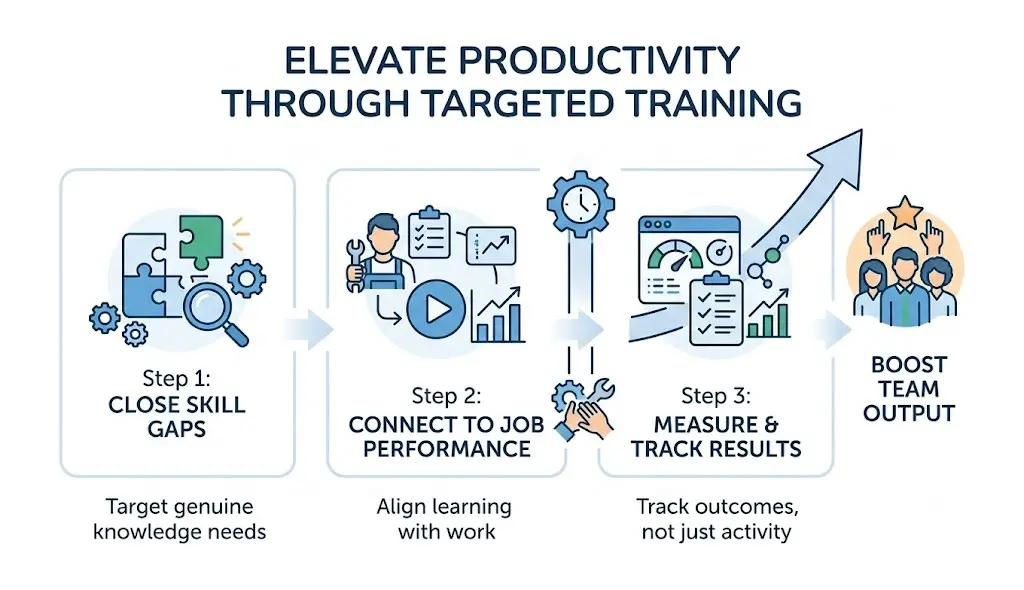
If you’ve ever watched a talented team miss deadlines, make the same mistakes twice, or struggle with a new tool, you already know that ability alone doesn’t guarantee output. What usually separates a productive team from a stalled one is whether people have the right skills, at the right time, applied to the right problems. That’s the whole idea behind workforce productivity through training: you close real skill gaps, connect learning to actual job performance, and measure whether it worked.
Training isn’t a cure-all. It won’t fix broken workflows, chronic understaffing, or bad management. But when it targets a genuine skill or performance gap, and you give people room to practice and a way to track results, training is one of the most reliable levers you have for lifting output without adding headcount.
This guide walks through what workforce productivity through training actually means, why it works, and the specific, practical steps you can take to build a training program that moves the needle, not just one that keeps people busy.
What Is Workforce Productivity Through Training?
1. Workforce Productivity Explained
Workforce productivity is a simple ratio at heart: how much value a team produces relative to the time, effort, and resources it uses to produce it. Workforce productivity is generally used to describe the amount of goods or services workers produce within a given period. A support team that resolves 40 tickets a day with the same staff and quality as before is more productive than one resolving 25.
Productivity isn’t only about speed. Quality, accuracy, and consistency matter just as much: a fast worker who creates rework for someone else downstream hasn’t actually added value.
2. How Training Influences Employee Productivity
Training influences productivity by closing the distance between what an employee currently knows how to do and what the job actually requires. When that gap shrinks, people work faster, make fewer errors, and need less supervision.
Think of a new hire who’s never used your CRM. Without training, they’ll fumble through menus, ask coworkers constant questions, and probably enter data incorrectly. A focused two-hour walkthrough can eliminate most of that friction on day one.
3. Training Gap vs Productivity Gap
These two terms get used interchangeably, but they’re not the same thing, and mixing them up is where a lot of training budgets get wasted.
A training gap is missing knowledge or skill: an employee genuinely doesn’t know how to do something. A productivity gap is any shortfall in output, which might stem from a skill gap, but could just as easily come from unclear priorities, outdated equipment, or poor workload distribution. Diagnosing which one you’re facing is step one, before any course gets built.
4. Why Training Alone Cannot Fix Every Productivity Problem
This is the part a lot of training vendors won’t tell you: training is only the right answer when a skill gap is actually the root cause. If your team already knows how to do the job but is stuck fighting broken software or unclear instructions, more training just adds frustration on top of the existing problem.
A well-known discussion on the r/humanresources community regularly surfaces this exact tension: HR practitioners describing how leadership defaults to “let’s train them” when the real issue is process or staffing. Instructional designers call this a training needs analysis, and it belongs before, not after, you commit a budget to a course.
How Does Training Increase Workforce Productivity?
This is the section people usually search for, so let’s answer it directly: training increases workforce productivity by building job-specific skills, reducing errors, improving decision-making, and helping employees adapt faster to new tools and expectations, all of which shorten the time it takes to produce quality work.
Here’s how that plays out in practice.
Builds job-specific skills. Generic training rarely moves the needle. Training tied directly to the tasks someone performs every day gives them tools they’ll actually use that afternoon.
Reduces errors and rework. An employee who understands a process correctly the first time doesn’t need a manager or teammate to catch and fix their mistakes later. Fewer errors means less time spent redoing work that should have been done right the first time.
Improves employee confidence. People who feel prepared take initiative instead of waiting for approval on every small decision. That confidence alone speeds up daily work.
Speeds up task completion. Familiarity with a process, tool, or system removes hesitation. Trained employees simply move through tasks faster because they’re not guessing.
Improves decision-making. Training that includes real scenarios, not just theory, helps employees judge situations correctly without escalating every question to a manager.
Strengthens communication and collaboration. Teams that share a common vocabulary and process understanding waste less time clarifying misunderstandings.
Helps employees adapt to technology. New software rollouts are notorious productivity killers if nobody explains how to use them. Structured training shortens that adjustment period significantly.
Supports employee engagement and retention. According to Gallup and SHRM research widely cited across HR communities on LinkedIn, employees who feel invested in are more likely to stay and put in discretionary effort, and turnover is one of the biggest hidden productivity costs a company can have.
Creates a culture of continuous improvement. When learning is normal rather than exceptional, teams adopt new methods faster and resist change less.
Ways to Increase Workforce Productivity Through Training
1. Identify Employee Skill Gaps
You can’t close a gap you haven’t measured. Start with skills assessments that test actual job tasks, not generic knowledge quizzes. Pair that with performance data (error rates, output volume, missed deadlines) to see where the numbers and the self-reported skills disagree.
Manager and employee feedback rounds out the picture. Employees often know exactly where they’re struggling; they just aren’t always asked directly.
2. Create Role-Based Training Programs
A one-size-fits-all training library sounds efficient but usually wastes time. Map training content to actual job responsibilities so a salesperson isn’t sitting through content designed for an operations analyst.
Personalizing by skill level also matters. A five-year veteran and a new hire shouldn’t be in the identical onboarding module.
3. Improve Employee Onboarding
The first weeks on a job set the tone for months of productivity. A structured learning path with clear early milestones, such as “by week two, you should be able to independently process X,” gives new employees a target instead of a vague hope they’ll “figure it out.”
4. Use Continuous Employee Training
Skills decay, tools update, and markets shift, so training can’t be a one-time event. Regular skill development sessions and scheduled refreshers keep knowledge current instead of letting it quietly go stale.
5. Use Microlearning
Long training sessions pull people away from their desks for hours and often overload them with more than they can retain. Microlearning breaks topics into short, focused lessons, five to ten minutes at a time, that employees can absorb without losing a full afternoon of output.
Reinforcing skills right at the point of need, like a short refresher video linked inside the tool someone’s using, tends to stick better than a course completed weeks before it’s needed.
6. Train Employees on New Tools and Technologies
Software rollouts, automation, and AI tools are only productivity boosts if people know how to use them. Dedicated training on new systems, general digital skills, and increasingly, AI and automation literacy, prevents a new tool from becoming a new source of confusion.
7. Develop Managers and Team Leaders
Productivity problems often trace back to the people managing the work, not just the people doing it. Investing in manager training (leadership, coaching, communication, delegation, and conflict resolution) has a multiplying effect, because one well-trained manager influences the output of an entire team.
8. Strengthen Communication and Collaboration
Training focused on team communication, cross-functional collaboration, and knowledge sharing reduces the friction that slows projects down. A lot of “productivity problems” are really communication problems wearing a disguise.
9. Use Practical, Hands-On Training
Simulations, role-playing, and realistic workplace scenarios teach people to apply knowledge, not just recognize it on a quiz. On-the-job practice, ideally with a mentor or coach nearby, cements skills faster than passive instruction ever will.
10. Measure Training Effectiveness and Productivity
Establish a baseline before training starts, set clear productivity KPIs, and compare performance before and after. This is also where a recognized framework helps: the Kirkpatrick Model, one of the most widely used training evaluation frameworks in corporate learning and development, breaks evaluation into four levels (reaction, learning, behavior, and results) so you’re not just asking “did people like the training,” but “did it actually change what they do and produce.” Use what you find to continuously refine the program rather than treating it as finished.
Types of Training That Can Improve Workforce Productivity
Different productivity problems call for different training types. The most common categories organizations use include:
- Technical skills training
- Soft skills training
- Leadership and management training
- Communication training
- Time management training
- Digital skills training
- Customer service training
- Compliance and safety training
- Onboarding training
- Problem-solving and decision-making training
- AI and automation training
Most productivity-focused programs blend several of these rather than relying on just one.
Which Training Method Is Best for Workforce Productivity?
There’s no single “best” method. The right choice depends on the topic, the audience, and how much time away from work you can afford.
| Training Method | Best Use Case | Productivity Benefit |
| Instructor-led training | Complex topics | Immediate clarification |
| eLearning | Scalable learning | Flexible access |
| Microlearning | Skill reinforcement | Less time away from work |
| Coaching | Performance improvement | Personalized feedback |
| On-the-job training | Practical skills | Immediate application |
| Blended learning | Complex programs | Combines multiple methods |
For organizations looking to deliver flexible, scalable learning, online employee training can be an effective option alongside blended learning.
Most mature training programs use blended learning: a short instructor-led session for context, followed by microlearning reinforcement and on-the-job coaching.
How to Build a Productivity-Focused Workforce Training Program
- Assess current workforce performance. Know your starting point before designing anything.
- Identify skills and competency gaps. Use assessments, performance data, and feedback, as covered above.
- Connect training goals to business goals. If a training objective can’t be tied to a business metric, such as output, quality, or retention, question whether it belongs in the program.
- Select the right training methods. Match the method to the content and audience using the table above as a starting point.
- Create role-based learning paths. Avoid generic, one-size-fits-all courses.
- Give employees time to practice. Training without practice time rarely transfers to the job.
- Involve managers in reinforcement. Managers who follow up on training make it stick; managers who ignore it let it fade.
- Measure results. Compare pre- and post-training performance against your KPIs.
- Update training based on performance data. Treat the program as a living system, not a one-time project.
For a more detailed framework, see our guide on how to build an effective employee training program. This sequence mirrors the logic behind the ADDIE model (analysis, design, development, implementation, and evaluation), a framework instructional designers have used for decades to build training that’s grounded in an actual needs analysis rather than guesswork.
How to Measure the Impact of Training on Workforce Productivity
Measuring impact means looking past attendance and satisfaction scores toward outcomes that actually reflect performance:
- Employee output
- Task completion time
- Error and rework rate
- Quality scores
- Time to proficiency
- Customer satisfaction
- Employee engagement
- Employee retention
- Training completion and assessment results
- Training ROI
No single metric tells the whole story. A combination gives you a much more honest read on whether training worked.
Training KPIs: What Should You Track?
| KPI | What It Measures | Why It Matters |
| Productivity per employee | Output | Workforce efficiency |
| Error rate | Mistakes | Training effectiveness |
| Time to proficiency | Skill development speed | Onboarding effectiveness |
| Task completion time | Efficiency | Workflow improvement |
| Quality score | Work quality | Performance |
| Training assessment score | Knowledge | Learning effectiveness |
| Employee retention | Workforce stability | Long-term impact |
| Training ROI | Financial return | Business value |
How to Calculate Training ROI
The standard formula is straightforward:
Training ROI = (Benefits from Training − Training Costs) ÷ Training Costs × 100
What Counts as Training Costs?
- Course development
- Training platforms
- Instructor costs
- Employee training time
- Learning materials
- Technology
What Counts as Training Benefits?
- Increased output
- Reduced errors
- Lower rework
- Faster onboarding
- Reduced turnover
- Improved customer outcomes
Some of these benefits, like faster onboarding or reduced turnover, are easier to quantify than others, such as improved decision-making. Be honest about which numbers you can defend with data and which are reasonable estimates.
How an LMS Can Improve Workforce Productivity
A learning management system turns training from something manually tracked in spreadsheets into a measurable, repeatable process. Centralized training content, role-based learning paths, and automated assignments mean employees get the right course at the right time without an administrator chasing people down.
As LMS platforms evolve, features such as AI, personalized learning, skills tracking, and analytics are becoming increasingly important. Learn more about future LMS trends and how they are shaping workplace learning.
Features like microlearning delivery, built-in assessments and certifications, and progress tracking give you real visibility into who’s trained and who isn’t. Skills-gap identification and learning analytics turn that visibility into decisions, showing you exactly where to focus the next training cycle.
An LMS can turn workforce training from a manually managed activity into a measurable, repeatable process. SkillForceLMS, for example, currently positions automated learning paths, assessments, analytics, skill-gap identification, and AI-powered content capabilities as core LMS features, which reflects where most modern platforms in this space are heading.
How Managers Can Reinforce Training After the Course
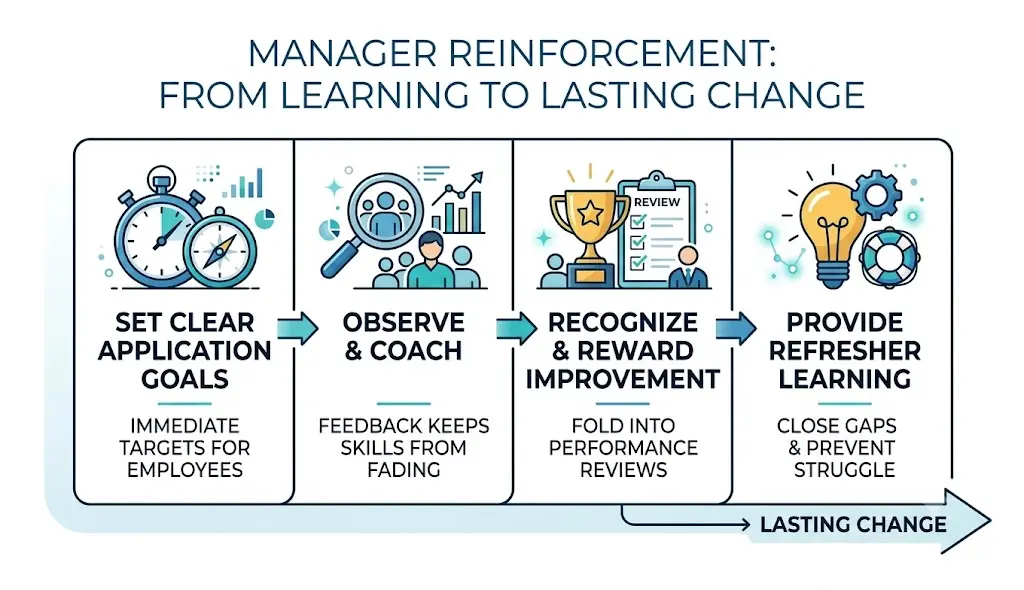
Training that ends the moment the course does rarely produces lasting change. Managers play a bigger role in reinforcement than most organizations give them credit for.
Setting clear application goals right after training gives employees something concrete to work toward. Observing employees applying new skills, and following up with coaching and feedback, keeps the learning from fading within a few weeks, which is how most untouched training does fade.
Folding new skills into performance reviews and openly recognizing improvement signals that the training mattered. When gaps remain, offering refresher learning closes the loop instead of leaving employees to struggle quietly.
Common Workforce Training Mistakes That Reduce Productivity
Even well-intentioned training programs can backfire. Some of the most common mistakes include:
- Training without identifying a real skill gap
- Using the same training for every employee
- Focusing on completion instead of performance
- Overloading employees with training
- Using outdated training content
- Ignoring manager involvement
- Not giving employees time to practice
- Failing to measure results
- Ignoring employee feedback
Any one of these can quietly turn a training investment into a productivity drain instead of a boost.
Best Practices for Productivity-Focused Employee Training
- Connect learning to business objectives
- Keep training relevant to the job
- Use real workplace examples
- Combine learning with practice
- Personalize training
- Make learning continuous
- Use data to improve training
- Keep training content updated
- Make managers part of the learning process
These aren’t complicated ideas, but consistently applying all of them is what separates training programs that actually raise productivity from ones that just check a compliance box.
Practical Examples of Training Improving Workforce Productivity
Sales Team Example Skill gap → product training → better product knowledge → faster sales conversations → improved conversion rate.
Customer Service Example Skill gap → communication and troubleshooting training → faster issue resolution → improved customer satisfaction.
IT Team Example Skill gap → software and automation training → faster workflows → fewer technical errors.
Operations Team Example Skill gap → process and safety training → fewer mistakes → less downtime and rework.
New Employee Example Structured onboarding → faster knowledge acquisition → shorter time to proficiency → earlier productivity.
Training vs Other Causes of Low Productivity
Not every productivity problem is a training problem, and pretending otherwise wastes budget and employee patience.
| Problem | Is Training the Solution? |
| Employee lacks a required skill | Yes |
| Employee does not understand a process | Usually |
| Outdated software | Not by itself |
| Excessive workload | No |
| Poor management | Not by itself |
| Unclear responsibilities | Partially |
| Broken workflow | Not by itself |
| Lack of motivation | Sometimes |
| Insufficient staffing | No |
This distinction matters more than almost anything else in this guide. Training is a powerful tool, but treating it as the answer to every dip in output is one of the fastest ways to burn through a training budget without fixing the actual problem.
How to Create a Continuous Learning Culture
- Make learning part of daily work, not a separate event
- Encourage knowledge sharing between teams
- Support peer learning and mentorship
- Provide career development opportunities
- Reward skill development, not just task completion
- Use learning analytics to guide what comes next
Organizations that treat learning as a constant, low-key part of work, rather than an occasional interruption, tend to adapt to change faster and see productivity gains compound over time.
Frequently Asked Questions
1. How does training increase workforce productivity?
Training increases workforce productivity by closing real skill gaps, which reduces errors, speeds up task completion, and improves decision-making, so employees can produce more accurate work in less time.
2. What are the best ways to improve workforce productivity through training?
The most effective ways to increase workforce productivity through training include identifying real skill gaps, building role-based learning paths, using microlearning for reinforcement, involving managers in follow-up, and measuring results against clear KPIs.
3. What type of employee training improves productivity the most?
Job-specific, hands-on training tends to have the biggest immediate impact, though leadership and communication training often produces broader, longer-lasting gains across a whole team.
4. How can companies identify productivity-related skill gaps?
Companies typically combine skills assessments, performance data analysis, and direct feedback from managers and employees to pinpoint where a skill gap, rather than another issue, is limiting output.
5. How can training reduce employee errors?
Training reduces errors by making sure employees fully understand correct procedures and tools before they perform tasks independently, cutting down on the guesswork that leads to mistakes.
6. How often should employees receive training?
Training should be continuous rather than a single event. Regular refreshers, microlearning updates, and training tied to new tools or role changes keep skills current.
7. How can businesses measure the productivity impact of training?
Businesses measure impact by comparing pre- and post-training performance data, such as output, error rates, and task completion time, against a clear baseline and defined KPIs.
8. What KPIs should be used to measure training effectiveness?
Common KPIs include productivity per employee, error rate, time to proficiency, task completion time, quality scores, training assessment results, employee retention, and training ROI.
9. How does an LMS support workforce productivity?
An LMS supports productivity by centralizing training, automating assignments, tracking progress, and surfacing skill gaps through analytics, making training easier to manage and measure at scale.
10. Does online employee training improve productivity?
Yes, when it’s well designed and relevant to the job. Online training gives employees flexible access to learning without pulling them away from work for extended periods, though it works best combined with hands-on practice.
11. What is the difference between training completion and training effectiveness?
Training completion measures whether employees finished a course; training effectiveness measures whether that course actually changed their on-the-job performance and results.
12. Can training solve every workforce productivity problem?
No. Training only helps when a genuine skill or knowledge gap is the root cause. Problems like excessive workload, broken workflows, or insufficient staffing need operational fixes, not more courses.
Conclusion
Workforce productivity through training isn’t about running more courses or filling more calendar hours with learning content. It’s about correctly identifying real skill gaps, building training that connects directly to the job, giving employees room to practice what they’ve learned, and measuring the results against KPIs that actually matter to the business.
Done well, training becomes one of the most cost-effective ways to raise output without expanding headcount. Done carelessly, without a needs analysis, without manager reinforcement, without measurement, it becomes an expense that never quite proves its worth.
If you’re ready to move from occasional training events to a structured, measurable system, a learning management system is usually the next logical step. It gives you the infrastructure to assign role-based learning paths, track skill gaps, and tie every training dollar back to a productivity outcome you can actually see.