


If you have ever tried to schedule a classroom training session for fifty employees spread across three time zones, you already know the problem. Someone always misses it. Someone always asks for a repeat session. And by the time everyone is trained, half the material feels outdated.
This is exactly why online employee training has moved from a “nice to have” to a core part of how businesses build skilled, capable teams. It is not just about moving PDFs to a screen. Done right, online training changes how fast people learn, how well they retain what they learn, and how much it costs a company to keep its workforce sharp.
In this article, we will walk through what online employee training actually is, why organizations are adopting it so quickly, and how it delivers measurable business results, not just convenience.
What Is Online Employee Training?
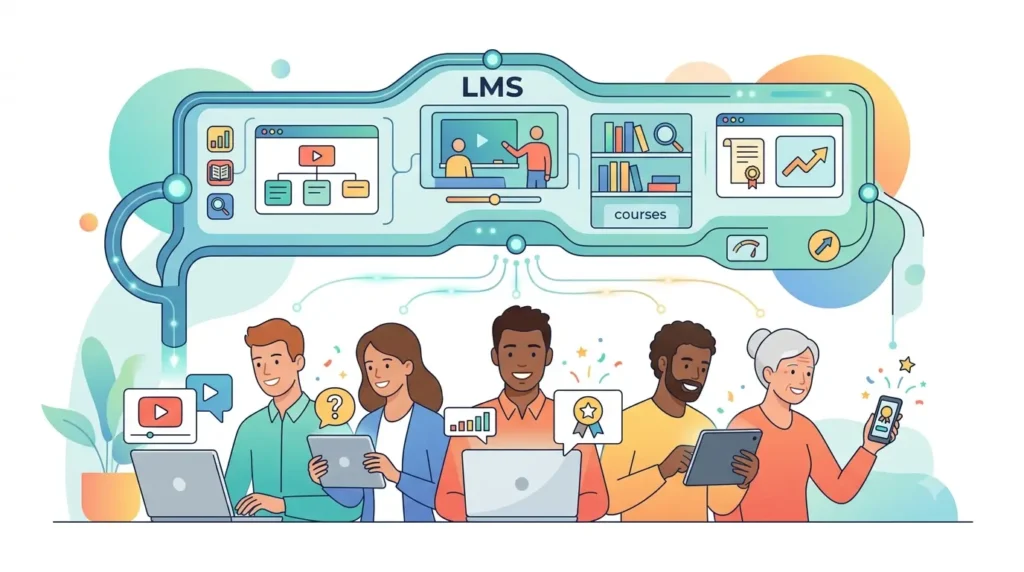
Online employee training is the delivery of workplace learning through digital platforms instead of in-person classrooms. It includes videos, interactive modules, quizzes, simulations, and self-paced courses that employees can access from a laptop, tablet, or phone.
Most organizations deliver this training through a Learning Management System, commonly called an LMS. Think of an LMS as the digital classroom, the gradebook, and the course library rolled into one system.
How It Works
An employee logs into the platform, picks up a course (or is assigned one automatically), and works through the material at their own pace. Progress is tracked automatically, assessments are graded instantly, and managers can see completion rates in a dashboard instead of chasing sign-in sheets.
Some platforms add live sessions through tools like Zoom or Microsoft Teams for topics that benefit from real-time discussion, blending the flexibility of self-paced learning with the value of human interaction.
Why Businesses Are Adopting Online Training
Work has changed. Teams are distributed, hiring is faster, and skills go out of date quicker than they used to. According to the Association for Talent Development and various L&D communities on LinkedIn, companies now treat continuous learning as a retention strategy, not just a compliance checkbox.
Online employee training gives businesses a way to keep up with that pace without doubling their training budget.
Why Modern Organizations Need Online Employee Training
Changing Workforce Expectations
Employees, especially younger ones, expect learning to be available on demand. Waiting three months for the next in-person workshop does not fit how people consume information anymore. They are used to searching, watching, and learning in short bursts.
Remote and Hybrid Work Environments
A hybrid team cannot always gather in one room. Online employee training solves this by making learning location-independent. Whether someone works from a home office or a regional branch, they get the same course, the same quality, and the same assessment standard.
Continuous Learning and Upskilling
Skills gaps are widening faster than most HR teams can address them with annual workshops. Online training supports what L&D professionals call continuous learning, where employees build skills in small, regular increments instead of one big annual push.
Top Benefits of Online Employee Training
Reduces Training Costs
There is no venue rental, no printed workbooks, and no travel reimbursement. A single course, once built, can be reused for hundreds or thousands of employees without additional cost per session. For growing companies, this is often the single biggest financial argument for switching.
Flexible Learning Anytime, Anywhere
Employees can complete a module during a quiet hour instead of stepping away from their desk for a half-day workshop. This flexibility matters even more for shift workers, field teams, and remote staff who cannot always attend scheduled sessions.
Faster Employee Onboarding
New hires can start learning company policies, tools, and role-specific skills on day one, even before their manager is available to walk them through everything manually. This shortens the time it takes for a new employee to become productive.
Improves Employee Engagement
Modern online training uses interactive elements like scenario-based questions, short videos, and gamified progress tracking. This tends to hold attention far better than a long lecture or a static slide deck.
Increases Knowledge Retention
Short, focused lessons (often called microlearning) are easier for the brain to absorb than a single long session. Employees can also revisit material anytime, which reinforces learning instead of relying on a one-time exposure.
Delivers Consistent Training Across Teams
Every employee, regardless of location or manager, receives the exact same content and assessment. This removes the inconsistency that comes from different trainers explaining the same policy in slightly different ways.
Supports Compliance Training
Industries like healthcare, finance, and manufacturing rely on documented compliance training. Online platforms make it easy to prove who completed what training and when, which matters during audits.
Enables Personalized Learning
A good LMS can assign different learning paths based on an employee’s role, skill level, or performance gaps. A new sales hire and a senior account manager do not need the same course, and online systems can reflect that automatically.
Tracks Employee Progress in Real Time
Managers and HR teams can see completion rates, quiz scores, and time spent on each module without manually collecting reports. This visibility helps identify who needs extra support before it becomes a performance problem.
Scales Easily as Your Business Grows
Whether a company has 50 employees or 5,000, the training system does not need to be rebuilt. New hires simply get added to the platform and start the same structured learning journey.
Benefits for Employers vs Employees
| Benefits for Employers | Benefits for Employees |
|---|---|
| Lower training costs at scale | Learn at their own pace |
| Consistent training across locations | Access courses anytime, anywhere |
| Easier compliance tracking and reporting | Personalized learning paths |
| Faster onboarding of new hires | Clear visibility into their own progress |
| Data on skill gaps across teams | Opportunities for career growth and upskilling |
| Higher retention through better L&D | Less time away from actual work |
How Online Employee Training Improves Business Performance
Higher Productivity
When employees are properly trained on their tools and processes, they waste less time figuring things out on their own or asking colleagues for help. That time adds up quickly across a whole team.
Better Employee Performance
Well-structured training closes skill gaps directly tied to job performance, whether that is a sales rep learning a new pitch or a support agent learning a new product feature.
Lower Turnover
Employees are more likely to stay at a company that invests in their growth. A discussion thread on Reddit’s r/humanresources community frequently points to lack of development opportunities as one of the top reasons employees leave, which lines up with what most L&D research shows.
Stronger Learning Culture
When learning is built into daily work instead of treated as an occasional event, employees start to see growth as normal, not exceptional. This shapes a culture where people are more open to feedback and change.
Higher Return on Training Investment
Because online training costs less to deliver and scale, the return on investment is easier to justify and easier to measure compared to traditional classroom programs.
Industry Use Cases
Healthcare
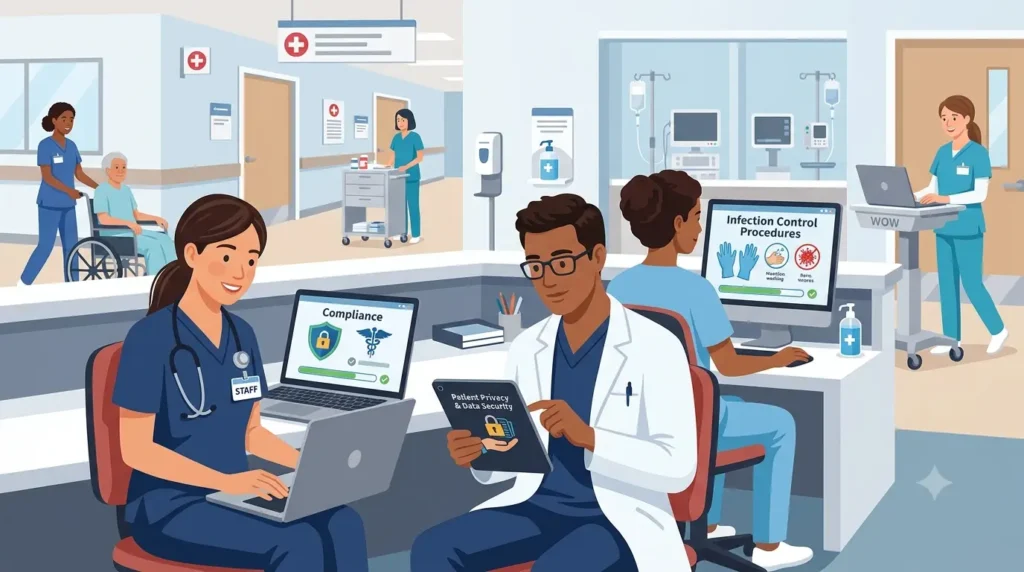
Hospitals and clinics use online training for compliance topics like patient privacy (HIPAA in the US), infection control, and new equipment procedures, often with strict documentation requirements.
Retail
Retail chains use short, mobile-friendly modules to train seasonal and part-time staff quickly, especially useful when hundreds of new hires need to be trained before a busy season.
Manufacturing
Safety training, machine operation, and quality control procedures are commonly delivered online, often paired with hands-on practical assessments on the shop floor.
IT
Technical teams use online training to keep up with fast-changing tools, certifications, and security practices, since in-person sessions cannot keep pace with how quickly technology changes.
Financial Services
Banks and financial firms rely heavily on online compliance training for regulations, anti-money laundering procedures, and data security, where audit trails matter as much as the training itself.
Hospitality
Hotels and restaurants use online modules for customer service standards and brand consistency, especially across multiple locations with different local managers.
Best Practices for Successful Online Employee Training
Set Clear Learning Objectives
Before building any course, define what the employee should be able to do differently afterward. Vague goals lead to vague training that nobody remembers a month later.
Create Interactive Content
Passive video watching has limits. Add quizzes, branching scenarios, and real workplace examples to keep employees actively engaged with the material.
Use Microlearning
Break large topics into short, focused lessons of five to ten minutes. Employees are far more likely to complete and retain short modules than a ninety-minute course.
Encourage Continuous Learning
Make learning an ongoing part of work, not a once-a-year event. Regular short courses keep skills current and make training feel less like a burden.
Measure Training Outcomes
Track completion rates, assessment scores, and, where possible, changes in actual job performance. Training without measurement is just a guess about whether it worked.
Common Challenges and How to Overcome Them
Low Engagement
Employees sometimes treat online courses as a checkbox to click through. Combat this with interactive content, real-world scenarios, and keeping courses genuinely short and relevant.
Technology Adoption
Not every employee is comfortable with new software right away. Offer a short orientation session and simple, mobile-friendly platforms to reduce friction.
Content Overload
Cramming too much information into one course overwhelms learners. Break content into smaller modules spread over time instead of one long session.
Lack of Participation
Without manager involvement, training often gets deprioritized. Set clear deadlines, send reminders, and have managers reinforce the importance of completing assigned courses.
How an LMS Makes Online Employee Training More Effective
Course Management
An LMS centralizes all training content in one place, making it easy to update courses, retire outdated material, and assign new content without starting from scratch.
Learning Paths
Structured learning paths guide employees through a logical sequence of courses based on their role or career goals, rather than leaving them to figure out what to learn next.
Reporting & Analytics
Detailed dashboards show completion rates, quiz results, and time spent per module, giving HR and managers real data instead of guesswork.
Certifications
Many platforms issue certificates automatically upon course completion, which is useful for compliance records and employee recognition alike.
AI-Powered Learning Recommendations
Newer LMS platforms use AI to recommend courses based on an employee’s role, past performance, or identified skill gaps, making learning more personalized without extra manual work from HR.
Measuring the Success of Online Employee Training
Course Completion Rates
The most basic metric: how many employees actually finished the assigned training within the expected timeframe.
Assessment Scores
Quiz and test results show whether employees actually understood the material, not just clicked through it.
Employee Feedback
Post-course surveys reveal whether employees found the training useful and relevant, which helps improve future courses.
Productivity Improvements
Comparing performance metrics before and after training (like error rates, sales numbers, or support ticket resolution times) shows real business impact.
Training ROI
Calculating training ROI generally means comparing the cost of the training program against measurable gains like reduced errors, faster onboarding, or lower turnover.
The Future of Online Employee Training
AI-Powered Learning
AI is increasingly used to personalize course recommendations, generate quiz questions, and even summarize long documents into digestible training material.
Personalized Learning
Training is moving away from one-size-fits-all courses toward paths tailored to an individual’s role, skill level, and even preferred learning pace.
Mobile Learning
More employees are completing training on their phones, especially in industries like retail and hospitality where desk access is limited.
Skills-Based Training
Organizations are shifting focus from generic training completion toward building specific, measurable skills tied directly to business needs.
Frequently Asked Questions
1. What are the benefits of online employee training?
Online employee training reduces costs, offers flexible learning schedules, speeds up onboarding, improves engagement, and delivers consistent training across an entire organization, regardless of location.
2. Is online employee training effective?
Yes, when designed well with interactive content, microlearning, and clear objectives, online training is often more effective than traditional classroom training because employees can learn at their own pace and revisit material as needed.
3. How does an LMS improve online training?
A Learning Management System centralizes course content, automates progress tracking, personalizes learning paths, and provides analytics that help HR teams measure training effectiveness.
4. What is the difference between online training and traditional training?
Traditional training happens in person at a scheduled time and place, while online training is delivered digitally and can usually be completed on the employee’s own schedule.
5. How can businesses measure training effectiveness?
Businesses can track course completion rates, assessment scores, employee feedback, and performance changes before and after training to gauge overall effectiveness and ROI.
6. Which industries benefit most from online employee training?
Healthcare, retail, manufacturing, IT, financial services, and hospitality all rely heavily on online training for compliance, onboarding, and skills development.
7. What are the challenges of online employee training?
Common challenges include low engagement, resistance to new technology, content overload, and lack of manager-driven participation, all of which can be addressed with better course design and clear expectations.
8. How does AI improve employee training?
AI can recommend personalized courses based on an employee’s role and performance, generate assessment questions, and help identify skill gaps that need to be addressed.
Conclusion
Online employee training is no longer just a cost-saving alternative to classroom sessions. It has become a strategic tool that helps organizations onboard faster, close skill gaps, and build a workforce that keeps learning as the business changes.
The companies getting the most value from it are not the ones simply moving old training materials online. They are the ones treating online employee training as an ongoing system, backed by a capable LMS, clear learning objectives, and real measurement of results.
If your organization is still relying on occasional classroom sessions, it may be time to explore how a modern corporate training platform like SkillForce LMS can help you deliver training that is engaging, scalable, and genuinely tied to business outcomes.