


Most companies know their people need training. Fewer know where to start, what to teach first, or how to tell if it worked. That is where a training roadmap for employees helps.
A good roadmap links what your people learn to what your business needs to achieve. It shows who learns what, by when, and how you will measure progress. Without it, training turns into a pile of random courses that nobody connects to real results.
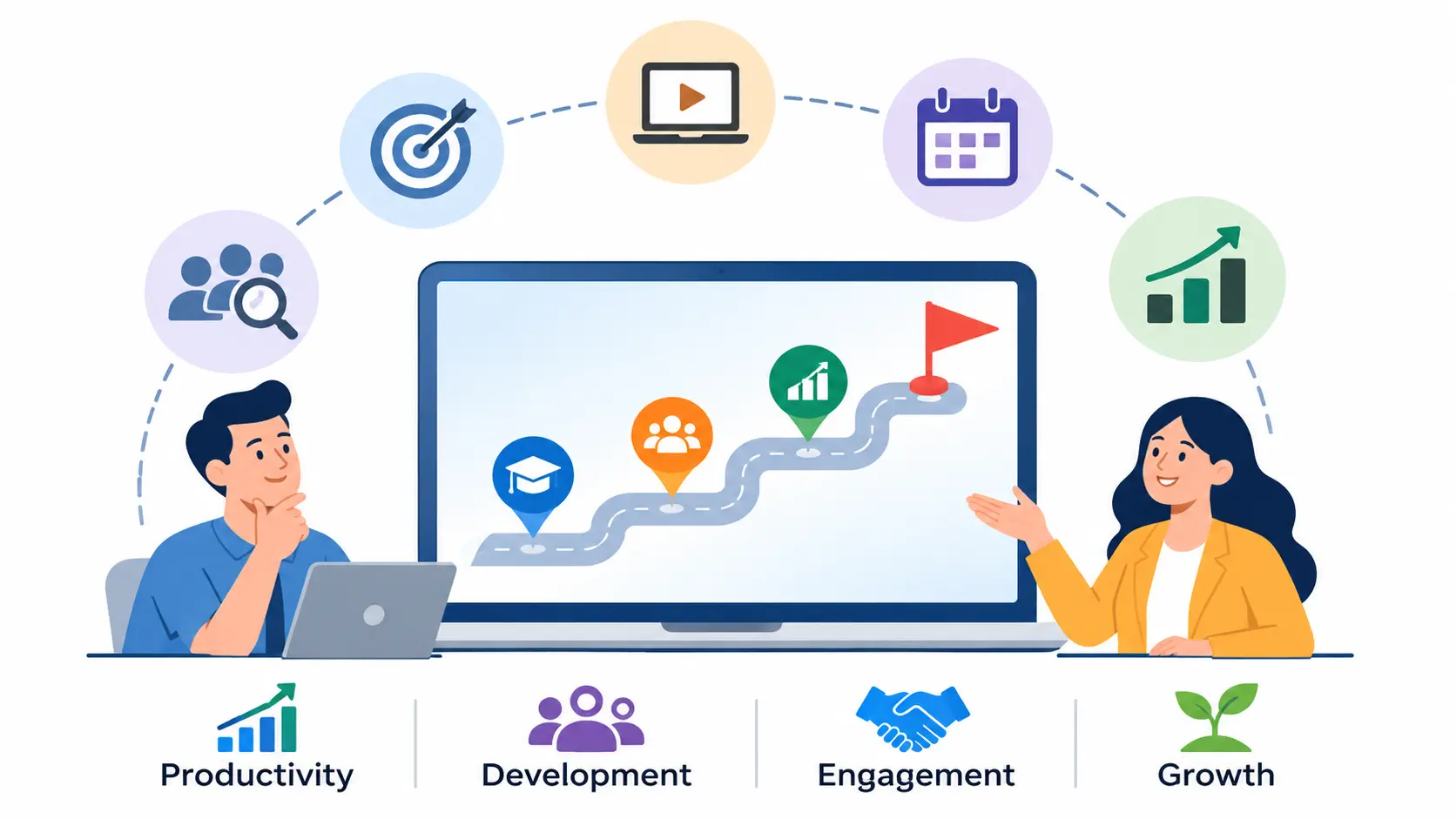
In this guide, you will learn what a training roadmap is, why it matters, and the nine steps to build one. You will also get a 12-week example, a role-based plan, tool suggestions, KPIs, common mistakes, and answers to frequent questions. Done well, a roadmap supports productivity, employee development, and long-term company growth.
What Is an Employee Training Roadmap?
An employee training roadmap is a structured plan that shows what skills employees need, how they will learn them, and when. It connects training activities to business goals and sets clear milestones, owners, and ways to measure progress.
Think of it as a map for learning. It does not only list courses. It explains the destination (the skills and results you want), the route (the activities), and the checkpoints along the way.
Key Components of an Employee Training Roadmap
A solid roadmap includes these six parts:
- Training goals and objectives: What the training should achieve, in measurable terms.
- Employee skill requirements: The skills each role needs now and in the near future.
- Learning activities and resources: Courses, workshops, mentoring, reading, and practice tasks.
- Timelines and milestones: Start dates, deadlines, and review points.
- Assigned responsibilities: Who designs, delivers, supports, and tracks the training.
- Performance evaluation methods: Tests, observations, KPIs, and feedback that show whether learning worked.
Training Roadmap vs. Training Plan vs. Learning Path
These terms are often mixed up. They are related, but they are not the same.
| Feature | Training Roadmap | Training Plan | Learning Path |
| Purpose | Aligns training with long-term business and skill goals | Details how a specific training will be delivered | Guides one learner through a sequence of courses |
| Scope | Company, department, or role level | One program, team, or project | One individual or role |
| Duration | Several months to a year or more | Days to a few months | Flexible, often tied to a role or career step |
| Typical use | Strategic workforce development | Running a defined program | Career growth and role progression |
In short, the roadmap is the big picture. The plan covers the details of one program. The learning path is one person’s route through the content.
Why Is an Employee Training Roadmap Important?
A training roadmap turns training from a cost into a planned investment. Here is what it does for your organization.
Aligns Employee Skills With Business Goals
If the company plans to launch a new product or enter a new market, someone has to be ready for it. A roadmap starts from those goals and works backward to the skills required. That keeps training relevant.
Identifies Workforce Skill Gaps
You cannot fix gaps you have not found. Building a roadmap forces you to compare the skills you have with the skills you need. Often, the results surprise managers.
Improves Employee Productivity and Performance
People who know exactly what to do, and have the skills to do it, work faster and make fewer mistakes. Focused training reduces trial and error on the job.
Supports Employee Retention and Engagement
Employees tend to stay where they see a path to grow. LinkedIn’s Workplace Learning Report is a useful source for current research on how learning opportunities connect with career satisfaction. A visible roadmap shows people you are investing in them.
Encourages Continuous Learning and Career Development
A roadmap makes learning a habit, not a one-time event. It gives employees clear next steps, which builds a culture where growth is expected.
Prepares Employees for Future Business Challenges
Technology and customer needs keep changing. A roadmap lets you plan for skills you will need next year, not only the ones you lack today.
Different Types of Employee Training Roadmaps
Not every roadmap serves the same purpose. Most organizations use several.
Employee Onboarding Training Roadmap
This covers the first days, weeks, and months of a new hire. It includes company culture, tools, role expectations, and early skill building. A clear onboarding roadmap helps new employees become productive sooner. See the Wikipedia overview of onboarding for background.
Technical Skills Training Roadmap
This focuses on job-specific skills such as software, data analysis, coding, or equipment use. It usually has levels, from beginner to advanced, with hands-on practice.
Soft Skills Training Roadmap
Soft skills include communication, teamwork, time management, and problem-solving. These are harder to measure, so use observation, peer feedback, and real scenarios.
Leadership and Management Training Roadmap
This prepares new and future managers. Topics include coaching, giving feedback, managing conflict, and planning. It is often paired with mentoring.
Compliance and Safety Training Roadmap
This covers legal, regulatory, and safety requirements. It has fixed deadlines and renewal cycles, so tracking is essential.
Continuous Learning and Development Roadmap
This supports ongoing growth for everyone, not just new hires. It may include stretch projects, certifications, and time set aside for learning.
How to Create a Training Roadmap for Employees: 9 Essential Steps
Here is the process in short. Then we will go through each step in detail.
- Identify organizational training needs
- Conduct an employee skills gap analysis
- Define training goals and measurable objectives
- Prioritize training requirements
- Choose suitable training methods
- Develop training materials and learning resources
- Create a timeline and assign responsibilities
- Implement the roadmap
- Measure effectiveness and improve
A well-structured employee training program helps organizations organize learning activities, establish clear objectives, and develop employees’ job-specific skills.
Step 1: Identify Organizational Training Needs
Start with the business, not with courses. Ask what the company needs to achieve in the next six to twelve months.
- Review current business priorities and strategic plans.
- Identify which departments will be most affected.
- List the skills needed to reach those objectives.
- Talk to department heads and team managers. They see problems you may not.
For example, if a company plans to move its customer data into a new CRM, the sales and support teams will need training on that system first.
Step 2: Conduct an Employee Skills Gap Analysis
A skills gap analysis compares the skills employees have with the skills the business needs. Learn more about the concept on Wikipedia’s skills management page.
- Evaluate current competencies through assessments, manager input, and work samples.
- Identify missing technical and soft skills.
- Use performance reviews as one input, not the only one.
- Build a skills gap matrix: list employees or roles in rows, skills in columns, and mark each as none, basic, proficient, or expert.
The matrix makes patterns visible. You may find that one gap affects an entire team, which suggests group training instead of individual courses.
Step 3: Define Training Goals and Measurable Objectives
Vague goals like “improve communication” are hard to measure. Use SMART criteria: specific, measurable, achievable, relevant, and time-bound.
- Set short-term goals (30 to 90 days) and long-term goals (6 to 12 months).
- Tie each learning objective to a business result.
- Define the competency you expect employees to show afterward.
A weak goal: “Train the support team on tickets.” A stronger goal: “Within 60 days, all support agents will resolve Tier 1 tickets using the new system with at least 90% accuracy in quality reviews.”
Step 4: Prioritize Training Requirements
You will likely find more needs than you can handle at once. Rank them.
- Identify the most critical skill gaps.
- Weigh business impact against urgency.
- Put compliance and role-critical training first.
- Match your budget and time to the highest-value needs.
A simple method is to score each need from 1 to 5 for impact and for urgency. Start with the highest totals.
Step 5: Choose Suitable Employee Training Methods
The right method depends on the skill, the audience, and your budget. Most roadmaps mix several.
Instructor-Led Training
A trainer teaches a group, in person or virtually. It works well for complex topics and live discussion, but it takes scheduling effort.
Online and E-Learning Programs
Courses delivered through a platform. They scale easily and let people learn from anywhere. They work best when paired with practice.
On-the-Job Training
Employees learn by doing real tasks with guidance. This is highly practical. See on-the-job training for a general overview.
Mentoring and Coaching
An experienced colleague guides the learner over time. It builds judgment and confidence, especially for leadership and career growth. Read more on mentorship.
Blended Learning
This combines online and in-person methods. For example, employees complete e-learning first, then practice in a live workshop. See blended learning.
Microlearning and Self-Paced Learning
Short lessons, often under ten minutes, that people can finish between tasks. They suit busy teams and refreshers. Here is a short explainer on microlearning.
Step 6: Develop Training Materials and Learning Resources
Now build or buy the content.
- Create a structured curriculum with a clear order of topics.
- Develop modules, guides, and job aids.
- Add practical assignments and assessments so people apply what they learn.
- Choose the platforms and resources that fit your team.
You do not always need to build from scratch. Existing courses, internal experts, and vendor documentation can cover a lot.
Step 7: Create a Training Timeline and Assign Responsibilities
A plan without owners rarely gets done.
- Set training schedules that fit around real workloads.
- Define milestones, such as “module one complete by week three.”
- Assign roles to HR, trainers, and managers.
- Allocate budget and resources.
- State what is expected of employees, including time commitments.
Step 8: Implement the Employee Training Roadmap
Launch with clear communication.
- Explain the roadmap to employees, including why it matters to them.
- Organize sessions and give people protected learning time.
- Track participation and completion.
- Offer feedback, coaching, and practical support.
- Keep engagement up with recognition, discussion, and real examples.
In my experience, rollouts struggle most when managers are not briefed first. Brief them before everyone else.
Step 9: Measure Training Effectiveness and Improve the Roadmap
Training is not finished when the last session ends.
- Test knowledge and skills.
- Track your KPIs (covered below).
- Gather feedback from employees and managers.
- Compare performance before and after training.
- Update the roadmap based on what you learn.
A well-known framework for this is the Kirkpatrick model, which looks at reaction, learning, behavior, and results. It is a useful way to structure your evaluation.
Employee Training Roadmap Example: A Practical 12-Week Plan
Here is a realistic example for a mid-sized company launching a new training program. Timelines will vary by size and complexity.
| Timeline | Activity | Expected outcome |
| Weeks 1–2 | Training needs and skills gap analysis | Identify development priorities |
| Weeks 3–4 | Goal setting and training design | Establish learning objectives |
| Weeks 5–6 | Training material development | Prepare learning resources |
| Weeks 7–8 | Pilot training program | Test training effectiveness |
| Weeks 9–10 | Full training implementation | Develop employee competencies |
| Weeks 11–12 | Assessment and evaluation | Measure results and identify improvements |
The pilot in weeks 7 and 8 is worth the effort. Running the program with a small group first lets you fix confusing content before it reaches everyone.
Example of a Role-Based Employee Training Roadmap
Different teams need different skills. This table shows how a roadmap can be split by department.
| Department | Training focus | Expected skills |
| Human Resources | Recruitment and employee management | Talent acquisition and HR operations |
| Marketing | SEO, content marketing, and analytics | Digital marketing and campaign management |
| Sales | CRM and sales communication | Lead management and negotiation |
| IT | Cybersecurity and software development | Technical and security skills |
| Customer Support | Communication and problem-solving | Customer service and issue resolution |
Best Tools to Create and Manage Employee Training Roadmaps
You can start with a spreadsheet. As your program grows, tools make tracking much easier.
Learning Management Systems (LMS)
A learning management system hosts courses, tracks completion, and reports results.
- Moodle: An open-source platform that is highly customizable. It suits teams with technical support.
- TalentLMS: A cloud-based system known for being easy to set up and use.
- Docebo: A larger platform with AI-driven features, often chosen by bigger organizations.
Features and pricing change, so check each vendor’s site before deciding.
Project Management and Collaboration Tools
Tools like Microsoft Teams and Trello help you manage the roadmap itself. Use them to assign tasks, set deadlines, share files, and keep discussions in one place. Asana and Notion work well too.
Employee Performance and Learning Analytics Tools
Analytics tools show who is progressing, where people get stuck, and how training connects to performance. Many LMS platforms include dashboards. Others connect to HR or performance systems for deeper reporting.
How to Choose the Right Training Management Tool
Consider these factors:
- Ease of use: If people find it confusing, they will avoid it.
- Reporting and analytics: Make sure it reports what you actually need.
- Integration capabilities: Check that it works with your HR and communication tools.
- Scalability: Can it grow with your headcount?
- Budget requirements: Count setup, licenses, and support costs.
- Employee accessibility: Look for mobile access and support for remote teams.
Key Metrics to Measure Employee Training Roadmap Success
Choose a few metrics that match your goals. Tracking everything leads to tracking nothing. Using an LMS can help organizations track employee training progress, monitor assessment results, and identify employees who need additional support.
| KPI | How to measure | Why it matters |
| Training completion rate | Completed trainings divided by assigned trainings | Shows participation and commitment |
| Employee assessment scores | Test or practical assessment results | Shows knowledge gained |
| Skill improvement rate | Skill ratings before versus after training | Shows real growth |
| Time to competency | Time from start to meeting role standards | Shows how fast people become productive |
| Productivity and performance | Output, quality, or error rates before and after | Links training to work results |
| Engagement and retention | Survey results and turnover rates | Shows impact on morale and loyalty |
| Training ROI | (Benefits minus costs) divided by costs | Shows financial value |
For background on the formula, see return on investment. Training ROI is hard to calculate precisely, since many factors affect results. Use reasonable estimates and be clear about your assumptions.
Common Challenges When Creating an Employee Training Roadmap
Unclear training goals. Without clear goals, you cannot judge success. Fix this with SMART objectives.
Inaccurate skills gap assessment. Relying on guesses leads to the wrong training. Combine assessments, manager input, and performance data.
Limited training budgets and resources. Prioritize high-impact needs, use internal experts, and mix low-cost methods such as mentoring and microlearning.
Low employee participation. People skip training that feels irrelevant or poorly timed. Explain the benefit, protect learning time, and keep content practical.
Poor manager involvement. Employees follow what their managers value. Give managers a clear role and the information they need.
Difficulty measuring training outcomes. Decide on metrics before training starts, and collect baseline data.
Outdated training materials. Set review dates for content, especially for fast-changing topics like software and regulations.
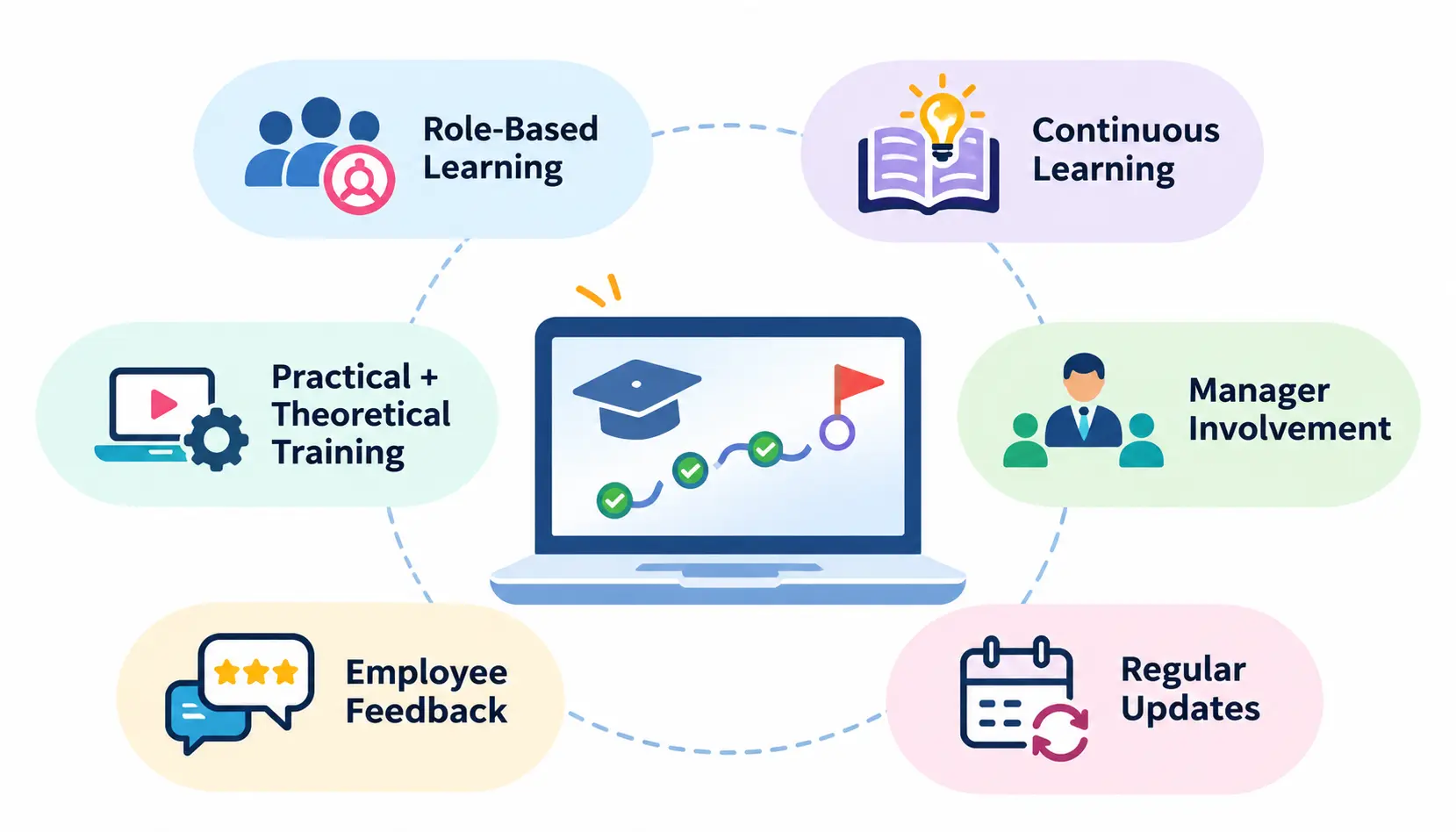
Best Practices for Maintaining an Effective Employee Training Roadmap
Personalize Learning Based on Employee Roles
A one-size-fits-all program wastes time. Tailor content to each role and experience level. Creating personalized employee learning paths allows organizations to align training content with individual skills, job responsibilities, and career development goals.
Encourage Continuous Learning
Give people time and recognition for learning. Share what employees learn so others benefit.
Involve Managers in Employee Development
Managers should discuss growth goals regularly and support practice on the job.
Combine Practical Training With Theoretical Learning
People remember what they use. Pair concepts with real tasks, simulations, or projects.
Collect Regular Employee Feedback
Short surveys and quick check-ins show what is working. Communities such as human resources and instructional design on Reddit are also useful for seeing what practitioners struggle with and how they solve it. Treat advice there as opinion, not proven fact.
Review and Update Training Priorities
Business needs change. Review your roadmap at least once or twice a year, and sooner after major changes.
Frequently Asked Questions About Employee Training Roadmaps
1. What Is an Employee Training Roadmap?
It is a structured plan that outlines the skills employees need, how they will learn them, and the timeline for doing so, all tied to business goals.
2. How Do You Create a Training Roadmap for Employees?
Identify business needs, run a skills gap analysis, set SMART goals, prioritize, choose methods, build materials, set timelines and owners, implement, and measure results.
3. What Should an Employee Training Roadmap Include?
Training goals, skill requirements, learning activities, timelines and milestones, assigned responsibilities, and evaluation methods.
4. What Are the Different Types of Employee Training?
Common types include onboarding, technical skills, soft skills, leadership, compliance and safety, and continuous learning. Delivery methods include instructor-led, e-learning, on-the-job, mentoring, blended, and microlearning.
5. How Long Does It Take to Create an Employee Training Roadmap?
It depends on company size and scope. A focused roadmap for one team may take a few weeks. A company-wide roadmap can take two to three months, as the 12-week example shows.
6. How Do You Identify Employee Training Needs?
Review business goals, run skills assessments, analyze performance data, and talk to managers and employees. A skills gap matrix helps organize the findings.
7. How Do You Measure the Effectiveness of Employee Training?
Track completion rates, assessment scores, skill improvement, time to competency, performance changes, and feedback. Compare results before and after training.
8. What Is the Difference Between a Training Roadmap and a Training Plan?
A roadmap is a long-term, strategic view across roles or departments. A training plan details how one specific program will be delivered.
9. How Often Should an Employee Training Roadmap Be Updated?
Review it at least every six to twelve months, and update it whenever business goals, technology, or regulations change significantly.
Conclusion
A training roadmap for employees gives your organization direction. It connects learning to business goals, shows where skills are missing, and gives everyone a clear path forward.
You do not need a perfect system on day one. Start with one department, run a small pilot, measure what happens, and improve. Over time, the roadmap becomes a living tool that grows with your people and your business.
If you take one action today, make it this: list your top three business goals and the skills each one requires. That is the first step toward a roadmap that works.