


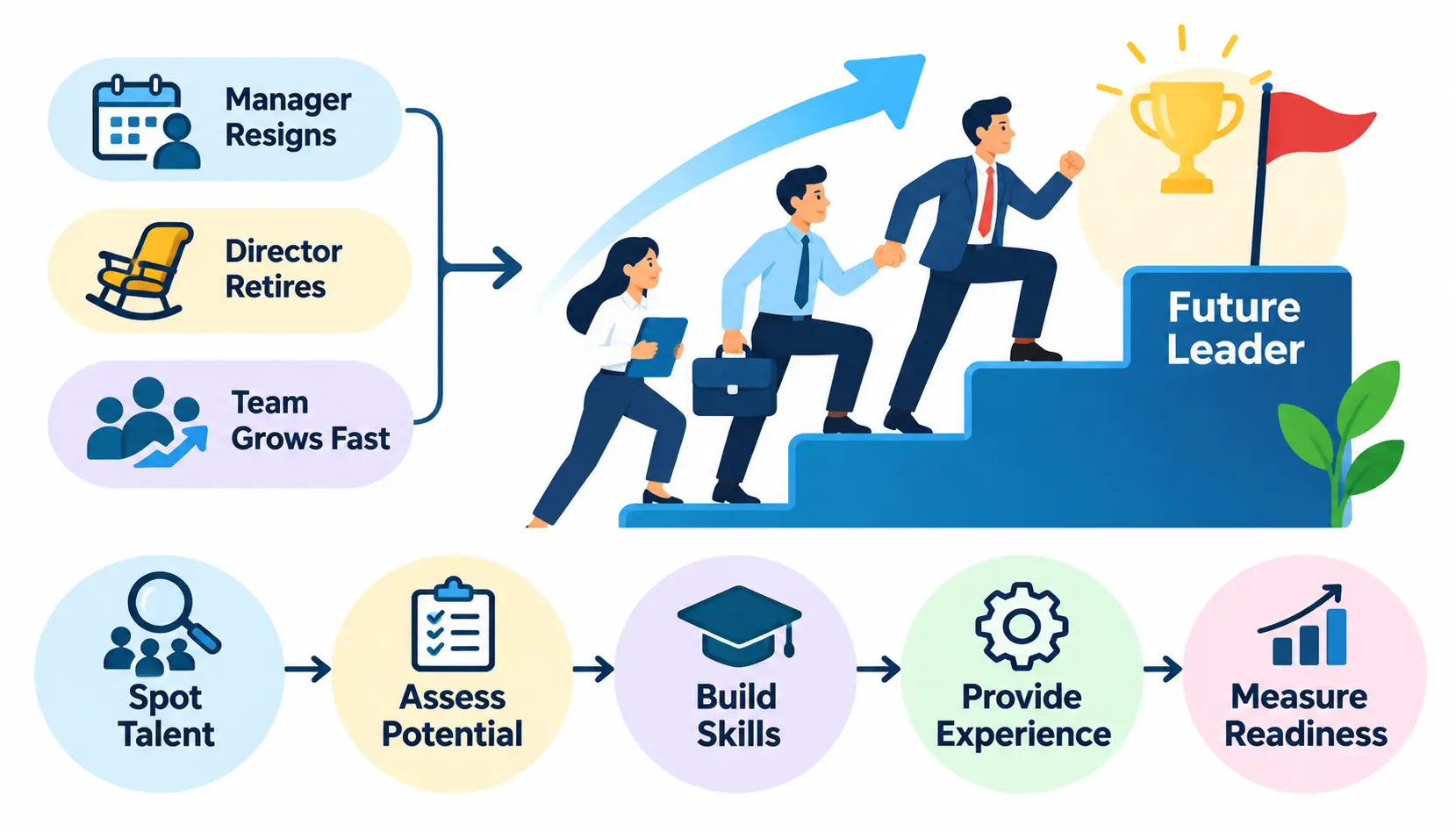
Every organization hits the same moment sooner or later. A senior manager resigns, a director retires, or a fast-growing team suddenly needs a new head. Someone has to step up, and fast.
Companies that planned for this moment fill the role calmly. Companies that did not scramble, hire in a hurry, or promote the best performer without checking if they can lead. That is why it pays to develop future leaders within your organization long before you need them.
Internal leadership development ties directly to succession planning and business continuity. Succession planning names who could take key roles. Leadership development makes sure those people are actually ready when the time comes.
This guide walks through the practical journey: how to spot the right people, assess their potential, build their skills, give them real leadership experience, and measure how ready they are.
Why Is It Important to Develop Future Leaders Within Your Organization?
Developing future leaders means deliberately preparing employees to take on bigger leadership roles. It is a planned effort, not a hope that talent will somehow appear. The payoff shows up in five areas.
Ensures Business Continuity
When a senior person leaves, work does not stop, but decisions slow down and teams lose direction. If you have already prepared successors, the handover is smooth. They know the team, the customers, and the priorities.
Without that preparation, a single resignation can stall a project for months.
Builds a Strong Leadership Pipeline
A leadership pipeline is a steady flow of people being prepared for each level of responsibility. Think of it as a staircase. Individual contributors become team leads, team leads become managers, and managers become directors.
When each step has someone preparing for it, you never face a gap at the top.
Improves Employee Engagement and Retention
Good employees leave when they cannot see where they are going. A clear growth path tells them you are investing in their future.
People who get development opportunities are more likely to stay, and more likely to put in extra effort. Providing relevant learning opportunities and career development support can improve employee engagement through training while helping employees see a future within the organization.Replacing a strong employee is also costly in time and lost know-how, so keeping them is usually the better deal.
Preserves Organizational Knowledge
Experienced employees carry knowledge that is rarely written down: why a process works the way it does, which client needs special care, how to get a stalled approval moving.
Pairing them with emerging leaders moves that knowledge to the next generation before it walks out the door.
Supports Long-Term Business Growth
Strong leaders make better decisions, adapt faster to change, and build teams that innovate. As a company grows, it needs more people who can lead, not just do the work.
Leadership capability is what lets a business scale without losing quality or direction.
How to Identify Future Leaders in Your Organization
Before you can build leaders, you need to find them. Many companies skip this step and simply promote their top performers. That is a common and costly mistake.
Look Beyond Current Job Performance
Excelling at a job and leading others are different skills. A brilliant analyst may be a poor manager, and a quiet team member with average output may be great at bringing people together.
Look at how someone works with others, not just at their personal results.
Identify Employees Who Take Initiative
Future leaders take ownership. They spot a problem and fix it without being asked. They follow through, admit mistakes, and care about outcomes beyond their own task list.
Ask yourself: who raises their hand when something is broken?
Evaluate Communication and Interpersonal Skills
Leaders move work forward through other people. Notice who explains ideas clearly, who listens well, and who colleagues turn to for advice.
Also watch how they handle disagreement. Someone who can resolve a conflict calmly and keep relationships intact has a real leadership edge.
Assess Problem-Solving and Decision-Making
Look for people who think before they act, weigh options, and still make a call when information is incomplete. Uncertainty is part of every leadership job.
A candidate who freezes without perfect data will struggle. One who decides, explains why, and adjusts when needed is showing the right habits.
Consider Learning Agility and Adaptability
Learning agility is the ability to learn from experience and apply it in new situations. It matters because leadership roles keep changing. What worked for a team of five will not work for a team of fifty.
People who ask for feedback, try new approaches, and bounce back from setbacks usually grow fastest.
Understand Employees’ Career Aspirations
Not everyone wants to lead, and that is fine. Some prefer to become deep experts. Forcing a reluctant person into management helps no one.
Hold regular career conversations and ask directly: where do you want to be in three to five years, and what would you like to learn?
Use Multiple Assessment Methods
No single tool shows the full picture. Combining several methods reduces bias and gives you a fairer view:
- Performance reviews: show track record and consistency.
- 360-degree feedback: collects views from peers, direct reports, and managers.
- Behavioral interviews: ask people to describe how they handled real situations.
- Leadership assessments: structured tools that measure leadership traits and styles.
- Manager observations: capture day-to-day behavior that reviews miss.
- Practical assignments: test how someone performs on a real leadership task.
Essential Skills to Develop in Future Leaders
Once you know who your emerging leaders are, decide what to build. These ten skills cover most of what a new leader needs.
Communication and Active Listening
Leaders set direction, give feedback, and keep people informed. Active listening means giving full attention, asking follow-up questions, and checking that you understood. Many leadership problems start with a message that was never really heard.
Emotional Intelligence
Emotional intelligence is the ability to recognize your own emotions and those of others, and to manage them well. Leaders with this skill stay steady under pressure and build trust more easily.
Strategic Thinking
Strategic thinking means looking beyond today’s tasks to see where the business is heading. Leaders need to connect daily work to long-term goals and spot risks and opportunities early.
Problem-Solving and Critical Thinking
Leaders face problems with no obvious answer. Critical thinking helps them question assumptions, gather the right facts, and choose a sensible path.
Decision-Making and Accountability
Good decisions are timely, well-reasoned, and owned. Accountability means standing behind a decision, including when it goes wrong, and learning from it instead of shifting blame.
Conflict Resolution and Negotiation
Disagreements are normal in any team. Leaders must listen to both sides, find shared interests, and reach agreements that people can live with.
Delegation and Team Management
New leaders often try to do everything themselves. Delegation means giving the right task to the right person, with clear expectations and enough support. It frees the leader for bigger work and grows the team at the same time.
Adaptability and Change Management
Change is constant. Leaders need to explain why change is happening, listen to concerns, and help people move through it without losing momentum.
Coaching and Employee Development
Coaching means helping others find their own answers through questions and feedback, rather than just giving instructions. Leaders who coach build stronger teams and create more leaders.
Digital Literacy and Technology Awareness
Leaders do not need to be technical experts. They do need to understand the tools, data, and digital trends that affect their business so they can ask smart questions and make informed choices.
Skills Summary Table
| Competency | Why it matters | Practical way to develop it |
| Communication and active listening | Prevents misunderstandings and builds trust | Lead team meetings and practice summarizing others’ points |
| Emotional intelligence | Improves relationships and stress management | Use 360-degree feedback and reflect on the results |
| Strategic thinking | Links daily work to long-term goals | Join business planning sessions |
| Problem-solving and critical thinking | Leads to better solutions | Assign a real operational problem to solve |
| Decision-making and accountability | Speeds up work and builds credibility | Give ownership of a small project |
| Conflict resolution and negotiation | Keeps teams productive | Role-play difficult conversations |
| Delegation and team management | Scales the leader’s impact | Have them manage a short project with a small team |
| Adaptability and change management | Helps teams handle shifts | Put them on a change initiative |
| Coaching and employee development | Grows more leaders | Have them mentor a newer colleague |
| Digital literacy | Supports informed decisions | Pair them with a technology project lead |
How to Develop Future Leaders Within Your Organization
Here is a ten-step process you can follow. You do not need to do everything at once. Start with the first few steps and build from there.
Step 1: Identify Your Organization’s Future Leadership Needs
Start with the business, not the people. Which roles are critical to keep running? Where will you grow in the next three to five years? Which leaders are likely to retire or move on?
Then list the skills each of those roles will need. A sales director in a growing company may need different strengths than a finance director in a stable one.
Step 2: Create Individual Leadership Development Plans
A development plan is a simple document agreed between an employee and their manager. It lists the person’s strengths, the skills they need to build, specific activities, and a timeline.
Keep it realistic. Two or three focus areas at a time work better than a long wish list.
Step 3: Provide Leadership Training and Education
Formal learning gives people a shared language and fresh ideas. Options include leadership workshops, management courses, communication training, and decision-making exercises.
Training works best when employees can use what they learn within weeks, not months. A structured employee training program helps organizations combine leadership workshops, practical exercises, and skill assessments to prepare employees for greater responsibilities.
Step 4: Introduce Mentoring and Coaching Programs
These two are often confused. Mentoring is a relationship with an experienced person who shares advice and guidance from their own career. Coaching is more structured and focused on specific skills or goals, often using questions to help the person find their own answers.
Match employees with mentors outside their direct reporting line when possible. It encourages honest conversation and exposes them to different parts of the business.
Step 5: Give Employees Stretch Assignments
A stretch assignment is a task slightly beyond someone’s current ability. Examples include leading a cross-team project, running a client presentation, or launching a small initiative.
These assignments teach what a classroom cannot. People learn to lead by actually leading, with a safety net nearby.
Step 6: Encourage Job Rotation and Cross-Functional Learning
Spending time in another department shows how the whole business fits together. A marketing specialist who works with operations for three months will make better decisions later.
Rotations can be short. Even a few weeks on a joint project builds useful understanding.
Step 7: Delegate Responsibilities and Decision-Making Authority
Real accountability develops when people have real authority. Let emerging leaders manage a project, a small budget, or a small team, with appropriate supervision.
Set clear boundaries first: what they can decide alone and when to check in. Then step back and let them work.
Step 8: Provide Regular Feedback and Performance Reviews
Annual reviews are not enough. Short, regular feedback conversations help people see their progress and fix problems early.
Be specific. “You handled the client concern calmly, and your summary was clear” teaches far more than “good job.”
Step 9: Encourage Networking and Executive Exposure
Emerging leaders benefit from seeing how senior people think. Invite them to observe leadership meetings, present to stakeholders, or join cross-company groups and professional networks.
These experiences build confidence and relationships that help later in their careers.
Step 10: Review Progress and Adjust Development Plans
Check progress every quarter or so. What has the person learned? What is still weak? Are their goals the same?
If someone is ready for more, raise the challenge. If they are struggling, add support or change the approach.
Leadership Development Methods That Help Prepare Future Leaders
Different methods suit different skills. A good program mixes several.
On-the-Job Leadership Training
This means learning while doing real work: leading a task force, covering for a manager on leave, or running a project. It is usually the most powerful method because the lessons are real and immediate.
Mentoring and Executive Coaching
Mentoring passes on experience. Executive coaching, usually with a trained coach, sharpens specific behaviors such as influencing others or handling pressure. Together they give emerging leaders both wisdom and focused practice.
Leadership Workshops and Formal Courses
Workshops introduce frameworks and give people a safe space to practice. They work best when followed by on-the-job application, so the learning sticks.
Job Shadowing and Executive Exposure
Shadowing lets an employee follow a senior leader for a day or a project. They see how decisions are made, how meetings are run, and how tough conversations are handled.
Cross-Functional Projects and Job Rotation
Working across teams builds empathy and broader business knowledge. It also reveals how well a person adapts to unfamiliar settings.
Peer Learning and Leadership Communities
Peers can learn a lot from each other. Leadership circles, discussion groups, and internal communities let emerging leaders share challenges and solutions.
Simulation-Based Leadership Exercises
Simulations recreate realistic leadership situations, such as a crisis, a budget cut, or a team conflict. Participants practice decisions in a low-risk setting and get feedback afterward.
E-Learning and Personalized Learning Paths
Online courses let people learn at their own pace. Personalized paths match content to each person’s gaps, which saves time and keeps people engaged. Organizations can make leadership development more effective by creating personalized employee learning paths based on individual skill gaps, career goals, and future leadership responsibilities.
A useful reference point is the 70-20-10 model, which suggests that most leadership learning comes from experience, a smaller share from relationships such as mentors and peers, and the smallest share from formal courses. Treat the numbers as a rough guide, not a strict rule. The takeaway is simple: do not rely on classroom training alone.
How to Build a Leadership Development Program
Once you have tried individual development plans, you may want a structured program. A leadership development program is a planned set of learning experiences that prepare employees for leadership roles. Build it in seven stages.
Define Leadership Development Goals
Start with the result you want. For example: “Fill most senior management openings from within,” or “Prepare every new team lead in their first six months.” Clear goals make it easier to choose activities and measure success.
Identify Target Employees and Leadership Levels
Decide who the program is for. You might run separate tracks for first-time managers, mid-level managers, and senior leaders. Each group has different needs, so one program rarely fits all.
Establish a Leadership Competency Framework
A competency framework is a list of the skills and behaviors expected at each leadership level. Keep it short and practical, perhaps six to ten competencies with clear descriptions. It gives everyone the same definition of good leadership and keeps assessments fair.
Select Training Methods and Learning Resources
Match methods to competencies. Communication may call for workshops and practice. Strategic thinking may call for exposure to planning sessions. Balance formal training with real assignments.
Assign Mentors and Development Coaches
Choose mentors who model the behaviors you want, and give them a brief guide on how to mentor well. Good intentions are not enough. Mentors need to know what is expected of them and how much time to commit.
Create a Development Timeline
Set a realistic schedule, often 12 to 24 months for a full program, with milestones along the way. Leadership growth takes time, so avoid cramming it into a few weeks.
Establish Progress Reviews and Success Measures
Decide up front how you will know it is working. Schedule regular check-ins and agree on measures such as feedback scores, project outcomes, and readiness ratings.
Sample Leadership Development Plan
Here is a simple example you can adapt.
| Development area | Example activity | Success measure |
| Communication | Lead weekly team meetings | Clearer team communication |
| Decision-making | Manage a small project | Decisions made within agreed guidelines |
| Delegation | Assign tasks to team members | Improved task ownership |
| Strategic thinking | Participate in business planning | Quality of recommendations |
| People management | Mentor a junior employee | Feedback from mentee and manager |
How Leadership Development Supports Succession Planning
Succession planning is the process of identifying and preparing people to fill key roles when they open up. You can read a general overview in this Wikipedia article on succession planning. Leadership development is what makes the plan work. A name on a succession chart means little if that person has never been tested or trained.
Identify Critical Leadership Positions
Start by listing the roles that would hurt the business most if they were vacant. These are not always the most senior jobs. A single specialist leader who holds key customer relationships can be just as critical as a director.
Map Potential Successors
For each critical role, name one to three people who could realistically take it on. Look across departments, not just within the same team. Having more than one candidate protects you if someone leaves or changes direction.
Assess Leadership Readiness
Compare each candidate with the competencies the role requires. Use the assessment methods covered earlier, and involve more than one manager so that a single opinion does not decide the outcome.
Prepare Ready-Now and Future Successors
Sort successors by how soon they could step in, then plan development accordingly.
| Readiness category | Meaning |
| Ready now | Can take on the role with minimal additional preparation |
| Ready in 1–2 years | Needs further experience and development |
| Long-term potential | Requires more substantial development before promotion |
Ready-now successors may only need executive exposure. Others need stretch assignments or rotations to close specific gaps.
Monitor Succession Plans Regularly
People change, and so does the business. Review your succession plans at least once a year. Update names, readiness ratings, and development actions, and remove anyone who no longer wants or fits the path.
How to Measure the Success of Leadership Development
What gets measured gets managed. Without clear indicators, a leadership program is hard to defend when budgets get tight.
Leadership Competency Improvement
Compare assessment results before and after development. Repeat 360-degree feedback or manager ratings over time and look for progress in the specific skills you targeted.
Internal Promotion and Mobility Rates
Track how many leadership openings are filled from within, and how many employees move into new roles or departments. A rising internal fill rate often signals that your pipeline is working.
Employee Retention and Engagement
Watch turnover among participants and high-potential employees. Engagement surveys can show whether people feel they have a future with you.
Leadership Role Readiness
Re-rate successors regularly. Are more people moving from “long-term potential” to “ready now”? That movement shows development is paying off.
Team Performance and Productivity
Good leaders improve the results of their teams. Look at team goals, quality, and output, and compare teams led by program participants with your own past results.
Succession Coverage for Critical Roles
This shows how many critical roles have at least one ready successor. If the number is low, you have a risk to fix.
Leadership Development ROI
Return on investment compares the benefits of the program with its costs. Benefits might include lower hiring costs, fewer vacancies, or improved retention. It is not always easy to calculate exactly, so use reasonable estimates and be clear about your assumptions.
KPI Summary Table
| KPI | What it measures | Review frequency |
| Competency improvement | Growth in targeted leadership skills | Every 6–12 months |
| Internal promotion rate | Share of leadership roles filled internally | Annually |
| Retention and engagement | Whether high-potential staff stay and feel motivated | Quarterly or twice a year |
| Role readiness | Number of successors who are ready now or soon | Twice a year |
| Team performance | Results of teams led by program participants | Quarterly |
| Succession coverage | Critical roles with at least one ready successor | Annually |
| Program ROI | Benefits compared with program costs | Annually |
Common Challenges in Developing Future Leaders
Every organization runs into obstacles. Knowing them in advance makes them easier to handle.
Difficulty Identifying Leadership Potential
Potential is hard to see, especially if you rely only on performance ratings. Use several assessment methods and gather input from more than one person.
Lack of Senior Management Support
Programs fade quickly when executives treat them as an HR project. Ask senior leaders to sponsor the program, mentor participants, and speak about it openly.
Limited Training Budgets and Resources
You do not need a large budget to start. Stretch assignments, internal mentoring, job shadowing, and peer groups cost little. Spend the money you do have on the people and roles that matter most.
Employee Reluctance to Take on Leadership Roles
Some employees worry about stress, extra hours, or leaving work they enjoy. Talk openly about what the role involves. Offer short trial assignments so they can test leadership before committing.
Bias in Leadership Selection
Managers often favor people who are similar to themselves or who are most visible. Use structured criteria, include several evaluators, and review who is being selected to check for patterns.
Insufficient Practical Leadership Experience
Training without practice rarely works. If employees never get chances to lead, create them through projects, acting roles, and delegated responsibility.
Lack of Consistent Feedback and Follow-Up
Many programs start strong and then fade. Put check-ins in the calendar, assign someone to own the program, and make follow-up a regular part of every manager’s role.
Best Practices for Building a Strong Leadership Pipeline
These habits separate programs that last from those that fade away.
Make Leadership Development an Ongoing Process
Leadership development is not a one-time course. People need new challenges at each career stage, so treat it as a continuing part of how you run the business.
Provide Equal Development Opportunities
Open opportunities fairly, with clear criteria. When only a few favored employees get access, you miss talent and damage trust.
Encourage a Culture of Learning and Feedback
People grow faster when it is safe to ask questions and admit mistakes. Leaders can set the tone by sharing what they are learning and asking for feedback themselves.
Involve Senior Leaders in Employee Development
When senior leaders mentor, teach, and give feedback, development carries more weight. It also helps them stay connected to emerging talent.
Balance Leadership Training with Practical Experience
Courses give people ideas. Real assignments turn those ideas into skills. Pair every learning event with a chance to apply it within a few weeks.
Update Development Plans as Business Needs Change
A plan written last year may not fit your strategy today. Review it often and adjust skills, roles, and timelines as priorities shift.
The Future of Leadership Development
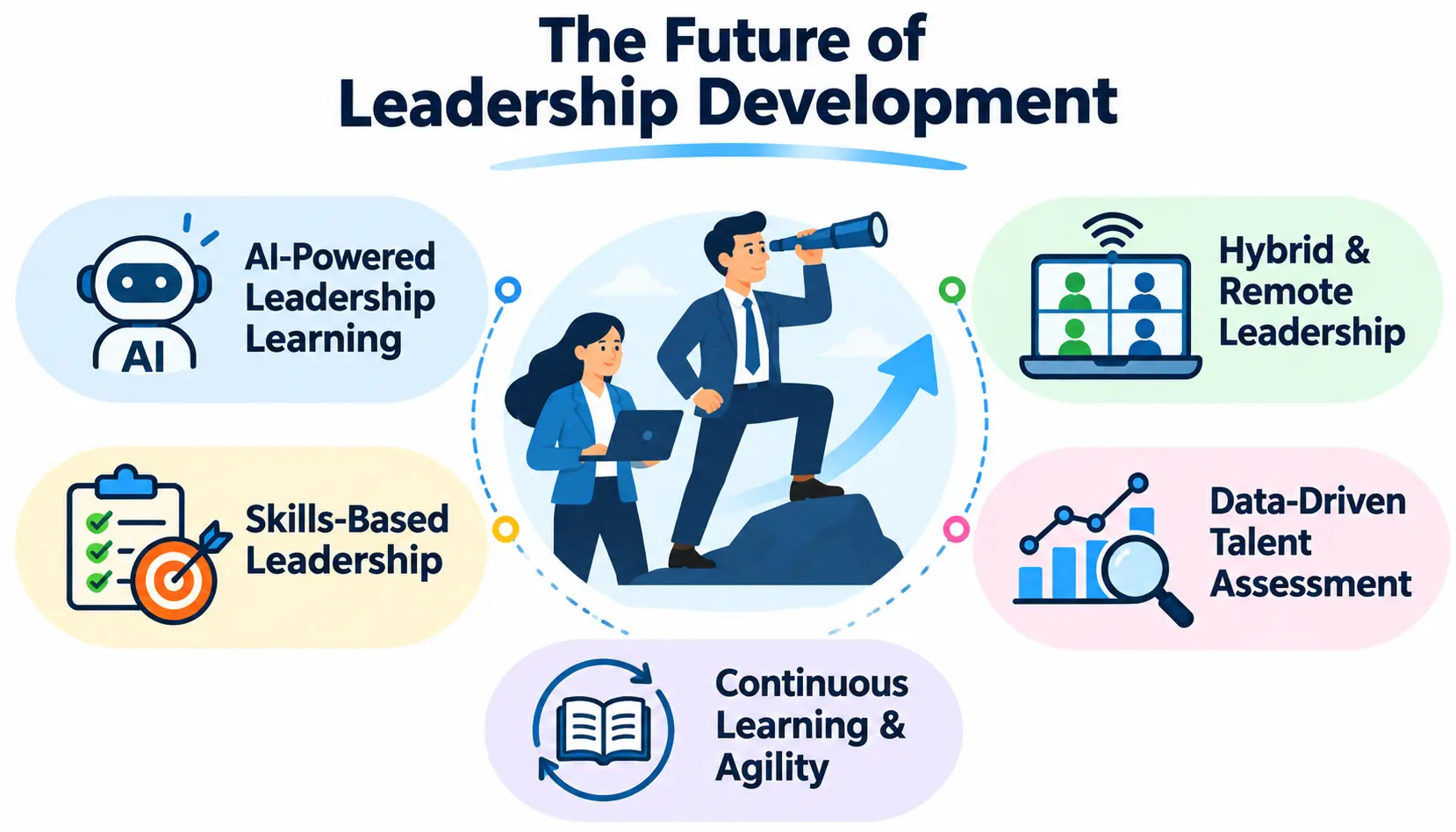
Leadership development is changing as technology and work patterns change. A few trends are worth watching.
AI-Powered Leadership Learning
AI tools can suggest learning content, offer practice scenarios, and give instant feedback on skills like writing or presentation. They work best as a support for human mentoring, not a replacement for it.
Skills-Based Leadership Development
More organizations now focus on the specific skills a role needs rather than job titles alone. This makes it easier to spot hidden talent and build targeted learning paths.
Hybrid and Remote Leadership Skills
Leading people you rarely see in person takes extra effort. Leaders need to build trust through clear communication, regular check-ins, and fair treatment of remote and office-based staff.
Data-Driven Talent Assessment
People analytics can reveal patterns in promotion, retention, and performance. Used carefully and fairly, this data helps you make better talent decisions. It should support human judgment, not replace it.
Continuous Learning and Leadership Agility
Business conditions change quickly, so leaders must keep learning. Organizations that build agility into their culture adapt faster when the unexpected happens.
Frequently Asked Questions About Developing Future Leaders
1. How do you identify future leaders in an organization?
Look beyond job performance. Watch for initiative, strong communication, sound decision-making, and the ability to learn quickly. Combine performance reviews, 360-degree feedback, manager input, and career conversations to get a balanced view.
2. What are the five qualities of a future leader?
Common qualities include initiative, communication skills, emotional intelligence, decision-making ability, and learning agility. Different organizations may add others, such as integrity or strategic thinking, depending on their needs.
3. How can organizations develop leadership skills in employees?
Use a mix of methods: stretch assignments, mentoring, coaching, training, job rotation, and regular feedback. Real experience combined with guidance usually works better than courses alone.
4. What should a leadership development program include?
A strong program includes clear goals, a competency framework, defined target groups, mixed learning methods, mentors or coaches, a realistic timeline, and regular progress reviews with measurable success indicators.
5. What is the 70-20-10 model of leadership development?
It is a reference model suggesting that most development comes from on-the-job experience, a smaller share from learning through other people, and the least from formal training. The exact split is a guide rather than a rule, but it reminds organizations to prioritize hands-on learning.
6. How does leadership development support succession planning?
It prepares the people named in your succession plans so they are ready when roles open. Development closes skill gaps, builds experience, and moves successors from “future potential” to “ready now.”
7. How long does it take to develop future leaders?
It depends on the person and the role. A first-time team lead may be ready after several months of focused support, while senior leadership roles often take several years of varied experience. Plan in stages and review often.
8. How do you measure leadership development success?
Track competency improvement, internal promotion rates, retention, role readiness, team performance, succession coverage, and return on investment. Review these on a regular schedule and compare them with your starting point.
9. Should organizations promote internal employees or hire external leaders?
Both have a place. Internal promotion keeps knowledge, rewards loyalty, and shortens the learning curve. External hires can bring fresh ideas or skills you lack. A strong internal pipeline gives you the choice rather than forcing a rushed hire.
10. What is the difference between leadership training and leadership development?
Training teaches specific skills in a short, structured format, such as a workshop on feedback. Development is a longer process that includes training, experience, mentoring, and reflection, aimed at growing a person’s overall leadership ability.
Conclusion
Organizations that develop future leaders within the organization are better prepared for change, loss of key people, and growth. The process is practical: find people with real potential, build the skills they need, give them chances to lead, and measure how ready they are.
You do not need a large program to begin. Choose two or three critical roles, name possible successors, and create a simple development plan for each. Add mentoring, one stretch assignment, and a quarterly check-in.
Then build from there. Over time, you will have a pipeline of capable people ready to take the next step, and a business that keeps moving no matter who leaves.