

Every business depends on the people doing the work. When employees know their jobs well, feel confident, and keep learning, the whole organization runs better. When they don’t, mistakes pile up, customers get frustrated, and good people leave.
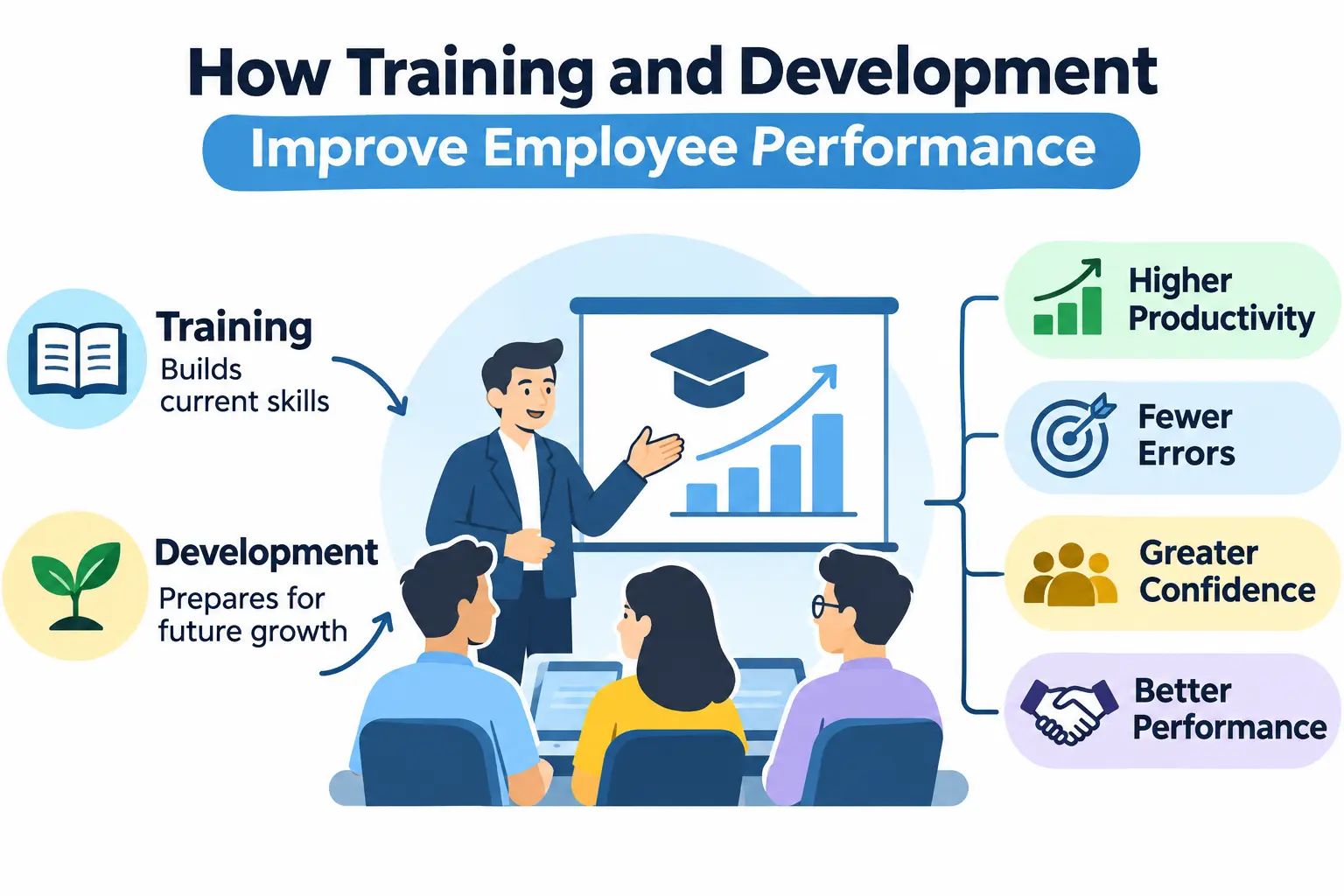
That is why so many employers want to understand how training and development improve employee performance. In short, training gives people the knowledge and skills they need now. Development prepares them for what comes next. Together, they raise the quality of work, speed up tasks, and help teams respond to change.
The link is easy to see in daily work. A new hire who learns the system properly makes fewer errors. A manager who learns to delegate frees up time for strategy. A support agent who learns to handle angry customers keeps more accounts.
In this guide, you will learn what training and development mean, how they lift performance, which programs and methods work best, how to build a program step by step, and how to measure the results. You will also see practical examples and common mistakes to avoid.
What Is Employee Training and Development?
People often use “training” and “development” as if they mean the same thing. They overlap, but they serve different goals. Knowing the difference helps you plan the right activities for the right people.
For a broader academic overview, see the Wikipedia entry on training and development.
What Is Employee Training?
Employee training is a structured effort to teach employees the specific knowledge and skills they need to do their current jobs well. It is usually short-term, focused, and tied to a clear task or tool.
The goal is simple: close the gap between what an employee can do today and what the role requires.
Common examples include:
- Learning a new accounting or CRM system
- Completing a workplace safety course
- Practicing a sales call script
- Following a step-by-step process for operating machinery
- Attending an onboarding session in the first week
What Is Employee Development?
Employee development is a longer-term effort to help people grow their abilities, career paths, and potential beyond their current roles. I look forward to today’s task list.
Development matters because people want to see a future at work. When a company invests in growth, employees are more likely to think about building a career there.
Typical development activities include:
- Mentoring from a senior colleague
- Leadership programs for future managers
- Stretch assignments outside someone’s usual duties
- Professional certifications and degree support
- Career planning conversations with a manager
Difference Between Employee Training and Development
Think of training as learning how to do the job you have. Think of development as learning how to grow into the job you want. Both support performance, but they work on different timelines.
| Factor | Employee Training | Employee Development |
| Purpose | Build skills for the current role | Prepare for future roles and growth |
| Duration | Short-term, often days or weeks | Long-term, often months or years |
| Learning objectives | Specific and task-based | Broad and career-focused |
| Skills developed | Technical and job-specific skills | Leadership, judgment, strategic thinking |
| Expected outcomes | Immediate performance improvement | Stronger talent pipeline and readiness |
| Examples | Software workshop, safety course | Mentoring, leadership program, rotations |
Most strong organizations use both. Training fixes today’s gaps, and development builds tomorrow’s leaders.
How Does Training and Development Improve Employee Performance?
Training and development improve employee performance by building job knowledge, sharpening skills, reducing mistakes, boosting confidence, and preparing people to take on bigger responsibilities. When employees know what to do and how to do it well, their output rises in both speed and quality.
Below are the main ways this happens. Each one connects directly to results you can observe at work.
Improves Job-Related Knowledge and Skills
This is the most direct benefit. Employees cannot perform well at tasks they do not fully understand. Training fills the gaps.
A customer success rep might know the product at a basic level but struggle with advanced features. A short, focused training program can turn that weak spot into a strength. The employee then answers questions faster and with more accuracy.
Over time, stronger skills also make people more independent. They ask fewer basic questions and need less supervision.
Increases Workplace Productivity
Skilled employees work faster because they waste less time guessing, searching for answers, or redoing tasks. Practical experience also helps them spot shortcuts and better ways to organize their day.
Imagine two employees using the same project management tool. One has been trained on automation features and templates. The other only knows the basics. The trained employee may finish routine updates in minutes while the other spends an hour.
Multiply that across a team, and the productivity gain becomes significant.
Reduces Errors and Improves Work Quality
Most workplace mistakes come from unclear procedures, missing knowledge, or rushed habits. Training addresses all three. It teaches employees what “correct” looks like and why it matters.
Fewer errors mean less rework, fewer customer complaints, and lower stress for everyone. In fields like healthcare, finance, and manufacturing, accuracy is not optional, so this benefit is especially important.
Good training also builds a quality mindset. Employees begin to double-check their own work because they understand the impact of mistakes.
Strengthens Problem-Solving and Decision-Making
Training does more than teach tasks. It teaches thinking. Case studies, simulations, and scenario practice help employees learn how to size up a situation and choose a sensible response.
For example, a team lead who has practiced handling scheduling conflicts will stay calmer and decide faster when a real conflict appears. Better judgment reduces escalations and keeps work moving.
Improves Communication and Team Collaboration
Many performance problems are really communication problems. Unclear requests, missed handoffs, and unresolved tension all slow teams down.
Communication and teamwork training helps employees give clearer instructions, listen better, give feedback respectfully, and resolve disagreements early. Teams that coordinate well waste less time and trust each other more.
Builds Employee Confidence and Motivation
Confidence has a real effect on performance. People who feel capable take initiative, speak up with ideas, and handle challenges with less fear.
Learning opportunities also send a message: the company believes you are worth investing in. That recognition can raise motivation, though it works best when training is relevant and paired with fair management.
Helps Employees Adapt to New Technologies
Workplaces change quickly. New software, automation tools, and AI-assisted systems appear all the time. Employees who are not trained on them often avoid them or use them poorly.
Training reduces that resistance. When people understand how a new tool saves time, they are more likely to adopt it. This protects the company’s technology investment and keeps teams from falling behind.
Prepares Employees for Greater Responsibilities
Development programs help employees move up with fewer growing pains. A strong individual contributor does not automatically become a strong manager. Leadership training teaches skills such as delegation, coaching, and giving feedback.
When companies prepare people before promotion, new managers start with more confidence and fewer costly mistakes. It also builds an internal pipeline, so the organization depends less on external hiring.
Key Benefits of Employee Training and Development for Organizations
The previous section looked at what improves for individual employees. This section looks at what the business gains as a whole.
Higher Operational Efficiency
When employees understand processes and tools, workflows run more smoothly. Handoffs improve, bottlenecks shrink, and fewer tasks stall while people wait for help.
Efficiency gains often show up quietly. Projects finish closer to deadlines, and managers spend less time putting out fires.
Better Customer Satisfaction
Customers feel the quality of your team in every interaction. Trained employees know the product, communicate clearly, and handle concerns without passing the customer around.
Even small improvements, such as resolving an issue in one conversation instead of three, can change how customers feel about your brand.
Improved Employee Retention and Engagement
People are more likely to stay and care about their work when they see room to grow. Professional development is one of several factors that support engagement and commitment.
To be fair, training alone does not guarantee retention. Pay, management quality, workload, and culture matter just as much. Learning opportunities help most when the rest of the employee experience is also healthy.
Stronger Organizational Competitiveness
Markets shift, and customer expectations rise. Companies with capable, adaptable workforces respond faster to those changes.
A team that regularly builds new skills can adopt new tools, enter new markets, and solve new problems without starting from scratch each time.
Better Workplace Safety and Compliance
Safety and compliance training protects both people and the business. Employees learn how to use equipment correctly, follow standard operating procedures, and recognize risks early.
It also helps companies meet legal and industry requirements. In the United States, for example, the Occupational Safety and Health Administration (OSHA) publishes standards and training resources for workplace safety. You can also read a general overview of occupational safety and health on Wikipedia.
Reduced Operational Costs
Training costs money, but poor performance costs more. Mistakes lead to rework, waste, refunds, and sometimes legal trouble.
When employees work accurately and use resources wisely, costs go down. Fewer accidents, fewer errors, and less turnover all contribute to savings over time.
Different Types of Employee Training and Development Programs
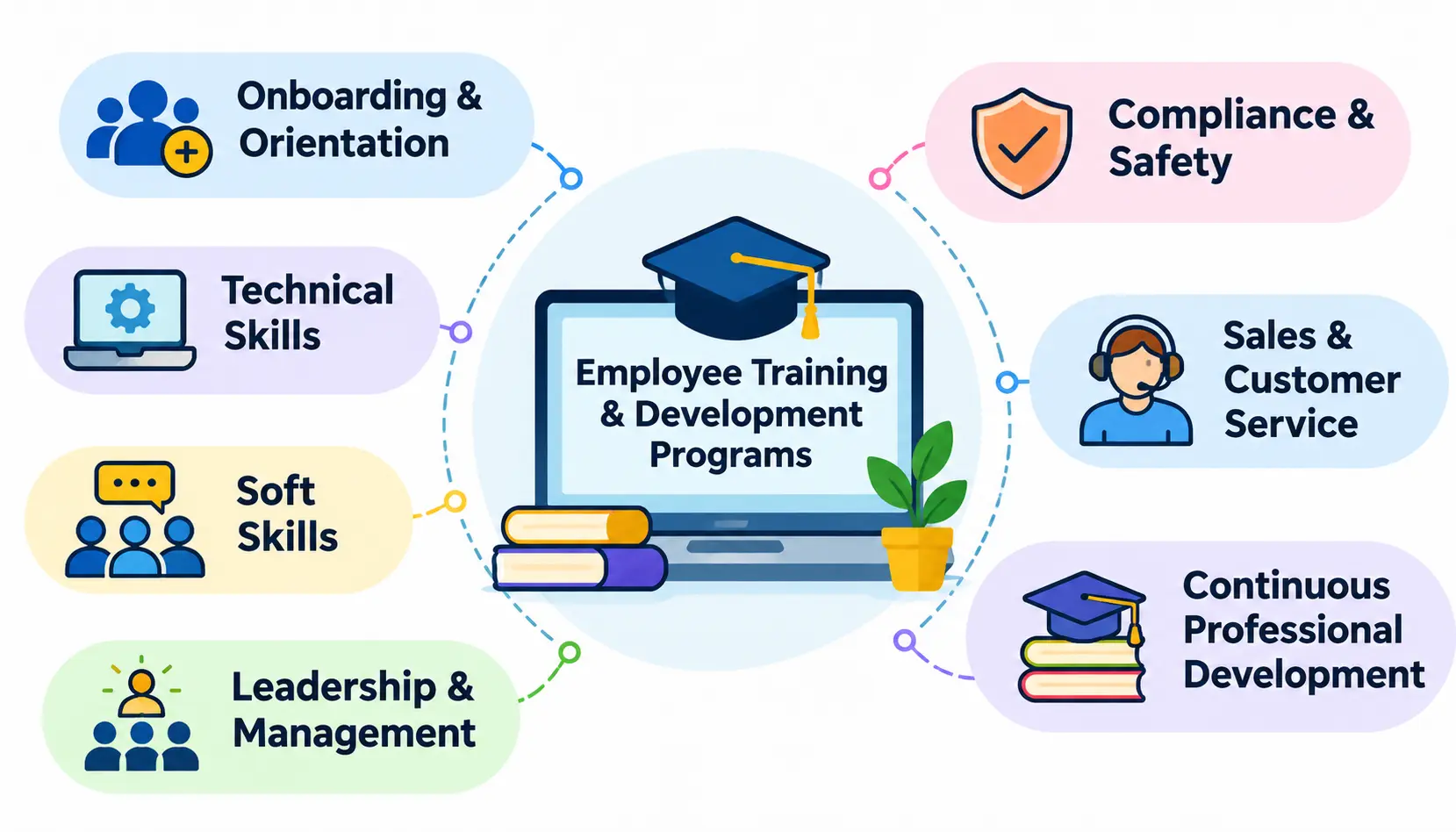
No single program fits every organization. The best choice depends on the role, the skill gap, and the business goal. Here are the most common types.
Onboarding and Orientation Training
Onboarding helps new hires understand company policies, tools, expectations, and culture. A good program goes beyond paperwork. It introduces people to their team, explains how success is measured, and gives them early practice with real tasks.
Strong onboarding shortens the time it takes for a new employee to become productive. You can read more about the concept on Wikipedia’s onboarding page.
Technical Skills Training
Technical training covers software, equipment, systems, and job-specific methods. Examples include learning a data analysis tool, operating a CNC machine, or using a new inventory system.
It is especially valuable when tools change or when employees move into new roles.
Soft Skills Training
Soft skills include communication, teamwork, time management, adaptability, and problem-solving. They are harder to measure than technical skills, but they affect nearly every part of work.
Practice-based formats, such as role-play and group exercises, tend to work better than lectures for these skills.
Leadership and Management Training
This training helps current and future managers lead people well. Topics include delegation, giving feedback, running effective meetings, managing conflict, and strategic thinking.
It is one of the best investments for organizations because a manager’s behavior affects the whole team.
Compliance and Safety Training
These programs cover workplace regulations, employee safety, data protection, and industry-specific rules. They are often required by law or by company policy.
The best compliance training uses real examples so employees remember it, rather than only clicking through slides.
Sales and Customer Service Training
Sales training covers negotiation, product knowledge, and customer communication. Customer service training adds listening skills, complaint handling, and staying calm under pressure.
These programs have a direct link to revenue and customer loyalty, which makes results easier to track.
Continuous Professional Development
This includes ongoing learning through certifications, workshops, conferences, and courses. It keeps employees current as their fields change.
Professional bodies such as the Association for Talent Development (ATD) and the Society for Human Resource Management (SHRM) offer research, certifications, and learning resources for professionals in this space.
Most Effective Employee Training and Development Methods
Choosing the right method matters as much as choosing the right topic. A great course delivered in the wrong format can still fall flat. Match the method to the skill, the learner, and your budget.
On-the-Job Training
Employees learn by doing real work with guidance from a supervisor or experienced colleague. It is practical, low-cost, and fast.
It works best when the trainer is prepared and the steps are clear. Without structure, on-the-job training can turn into “watch me and figure it out.” Read more about the approach on Wikipedia.
Instructor-Led Training
This includes classroom sessions, workshops, and expert-led seminars. It allows live questions, discussion, and hands-on exercises.
It suits complex topics and group skills like communication and leadership. The trade-off is scheduling and cost.
E-Learning and Online Training
E-learning uses digital courses, videos, and virtual sessions. Employees can learn at their own pace and revisit lessons when needed.
It scales well across locations and time zones. To keep completion rates healthy, keep modules short and relevant.
Coaching and Mentoring
The two are related but different. Coaching is usually short-term and focused on improving a specific skill or performance goal. Mentoring is a longer relationship where an experienced person shares career guidance and perspective.
Both give employees personal attention that courses cannot match. See Wikipedia’s page on mentorship for background.
Job Rotation and Cross-Training
In job rotation, employees move between roles or departments for a set time. In cross-training, they learn tasks from other roles while staying on their own.
Both build broader understanding and give teams flexibility when someone is absent. Learn more about job rotation.
Blended Learning
Blended learning mixes online lessons with live sessions and hands-on practice. For example, employees might complete an online module first, then practice the skill in a workshop.
This mix often keeps learners more engaged than any single format. See the overview of blended learning.
Microlearning and Personalized Learning
Microlearning delivers short lessons, often just a few minutes long, focused on one idea. Personalized learning builds custom paths based on each person’s role, skills, and goals.
These approaches respect busy schedules and avoid teaching people what they already know. More on microlearning.
How to Create an Effective Employee Training and Development Program
Many training programs fail because they start with a course instead of a problem. The steps below keep your program tied to real business needs. A well-structured employee training program should include clear objectives, relevant learning methods, practical activities, and measurable outcomes.
Step 1: Identify Employee Skill Gaps
Start by finding out what people actually need. Look at performance reviews, customer complaints, error reports, and job requirements. Then ask employees and managers directly.
A short skills assessment or a few conversations can reveal gaps that data alone will miss. Write the gaps down clearly, such as “agents struggle to explain billing changes.”
Step 2: Set Clear Training Objectives
Good objectives are specific and measurable. “Improve communication” is vague. “Reduce average ticket escalations by 15% in three months” is something you can track.
Tie each objective to a role and a business result. This also makes it easier to prove the value of the program later.
Step 3: Choose the Right Training Methods
Pick formats based on the skill, the audience, and your resources. Technical software skills may suit e-learning plus practice. Leadership skills often need coaching and group discussion.
If you have a small budget, combine free internal knowledge, such as peer sessions, with a few targeted external courses.
Step 4: Develop Training Materials and Resources
Prepare guides, exercises, videos, checklists, and real examples from your own workplace. Materials built around actual tasks feel relevant, and employees notice that.
Keep the content simple. If a lesson needs a long manual to explain, it is probably too complicated.
Step 5: Deliver the Training Program
Set realistic schedules that do not clash with peak work periods. Choose trainers who know the subject and can teach it clearly. Subject experts are not always good teachers.
Create a comfortable learning environment where people can ask questions without feeling judged.
Step 6: Provide Practical Learning Opportunities
Learning fades quickly if people cannot use it. Give employees projects, assignments, or real tasks soon after training so they can apply what they learned.
A short follow-up chat with a manager a week later can make a big difference.
Step 7: Collect Feedback and Evaluate Results
Ask participants what worked and what didn’t. Then check whether performance actually changed using assessments, work samples, and key metrics.
Compare results to the objectives you set in Step 2. We cover measurement in more detail in the next section.
Step 8: Improve the Program Continuously
Update content when tools, policies, or customer needs change. Remove modules that nobody finds useful. Add new ones when new gaps appear.
Treat your training program as a living system, not a one-time project.
How to Measure the Effectiveness of Employee Training and Development
If you cannot show that training works, it is hard to defend the budget. Measurement also tells you what to fix. Use a mix of the methods below rather than relying on one number. Using an LMS to track employee training progress makes it easier to monitor course completion, assessment scores, certifications, and overall learning outcomes.
Measure Employee Productivity
Look at output per employee, task completion time, and number of tasks handled. Compare results before and after training.
For instance, if an order processing team handled 40 orders per person per day before training and 48 after, that is a measurable gain. Keep in mind that other factors, such as seasonality, can also affect numbers.
Evaluate Employee Skill Improvement
Use pre-training and post-training assessments. A quiz, practical test, or observed task can show what changed. The size of the gap between the two scores shows how much was learned.
Track Workplace Performance
Review performance ratings, work quality, error rates, and goal achievement over several months. Real improvement shows up in daily work, not only on test scores.
Monitor Employee Engagement and Feedback
Use surveys, participation rates, and open comments. Look for patterns, such as many people saying a session was too basic or not relevant to their role.
Engagement alone does not prove performance gains, but low engagement is an early warning sign.
Measure Training ROI
Return on investment (ROI) compares what the training cost with the value it created. Costs include trainer fees, materials, software, and employee time. Benefits can include saved time, reduced errors, higher sales, or lower turnover costs.
The standard formula is:
ROI (%) = (Benefits − Costs) ÷ Costs × 100
Here is a simple example. Suppose a program costs $10,000 and leads to $16,000 in measurable benefits.
- Benefits − Costs = $6,000
- $6,000 ÷ $10,000 = 0.6
- 0.6 × 100 = 60% ROI
The hardest part is putting a fair dollar value on benefits. Be honest about your assumptions, and only count gains you can reasonably connect to the training.
Use the Kirkpatrick Four-Level Training Evaluation Model
The Kirkpatrick Model, created by Donald Kirkpatrick, is one of the most widely used frameworks for evaluating training. It looks at four levels, from first reactions to business results.
| Level | What It Asks | What to Measure |
| 1. Reaction | Did participants find the training useful and engaging? | Feedback forms, satisfaction ratings, comments |
| 2. Learning | Did they gain the intended knowledge and skills? | Pre/post tests, practical assessments, certifications |
| 3. Behavior | Are they applying it on the job? | Manager observation, performance reviews, work samples |
| 4. Results | Did it improve business outcomes? | Productivity, quality, customer satisfaction, cost, turnover |
Many organizations stop at Levels 1 and 2 because they are easy to collect. The real value appears at Levels 3 and 4, so plan for them from the start.
Practical Examples of How Training Improves Employee Performance
The examples below are illustrative scenarios based on common workplace situations. Your own results will vary depending on your team, goals, and context.
Sales Team Improving Customer Conversion
A sales team notices that many prospects stop responding after the first demo. Managers review recorded calls and see that reps talk about features but rarely ask about the customer’s problems.
They run a workshop on needs-based questioning, negotiation, and product positioning, followed by weekly call reviews. Over the next quarter, reps hold better conversations, and more demos move to a second meeting.
Customer Service Team Handling Complaints Better
A support team struggles with repeat complaints and long calls. Training focuses on active listening, empathy statements, and de-escalation steps.
Agents practice with role-play, then get feedback from team leads. Customers feel heard sooner, and agents spend less time on tense calls.
IT Employees Adapting to New Technologies
A company moves to a new cloud platform. Instead of leaving the IT team to learn on their own, it provides hands-on labs and a sandbox environment.
Staff practice common tasks and troubleshooting before the live switch. The result is a smoother rollout and fewer support tickets after launch.
Manufacturing Employees Improving Workplace Safety
A plant sees repeated near-miss incidents around one machine. The team introduces equipment handling training, regular safety drills, and clearer standard operating procedures.
Employees learn why each step matters, not just what to do. Over time, near-misses drop, and workers feel more comfortable reporting risks.
Managers Improving Team Performance Through Leadership Development
A newly promoted manager is overwhelmed and does everything personally. A leadership program teaches delegation, one-on-one meetings, and giving clear feedback.
With coaching support, the manager starts assigning work more effectively. The team gains clarity, and the manager gains time to plan ahead.
Common Challenges in Employee Training and Development
Even good programs hit obstacles. Knowing them early helps you plan around them.
Limited Training Budgets
You do not need to train everyone on everything. Focus on the skills that affect key business results first. Use internal experts, peer learning, and low-cost online resources to stretch the budget.
Lack of Employee Participation
People skip training that feels irrelevant or burdensome. Explain why the training matters, give employees time during working hours, and let them have a say in topics. Recognition and visible manager support also help.
Poorly Designed Training Programs
Generic courses rarely solve specific problems. If the content does not match real skill gaps, employees tune out. Start with needs analysis, then design around it.
Difficulty Applying Learned Skills at Work
This is called the training transfer problem. Employees may enjoy a course but return to a workplace where old habits continue. Give them time, tools, and encouragement to use new skills right away.
Lack of Management Support
If managers treat training as a distraction, employees will too. Managers should discuss goals before training, check in afterward, and reward good use of new skills.
HR professionals often share real-world experiences about this in communities like human resources and managers. These threads are anecdotal, so treat them as perspective rather than research.
Difficulty Measuring Training Results
Training benefits can be hard to isolate. Set measurable objectives up front, collect baseline data, and track changes over time. Even imperfect measurement is better than none.
The Future of Employee Training and Development
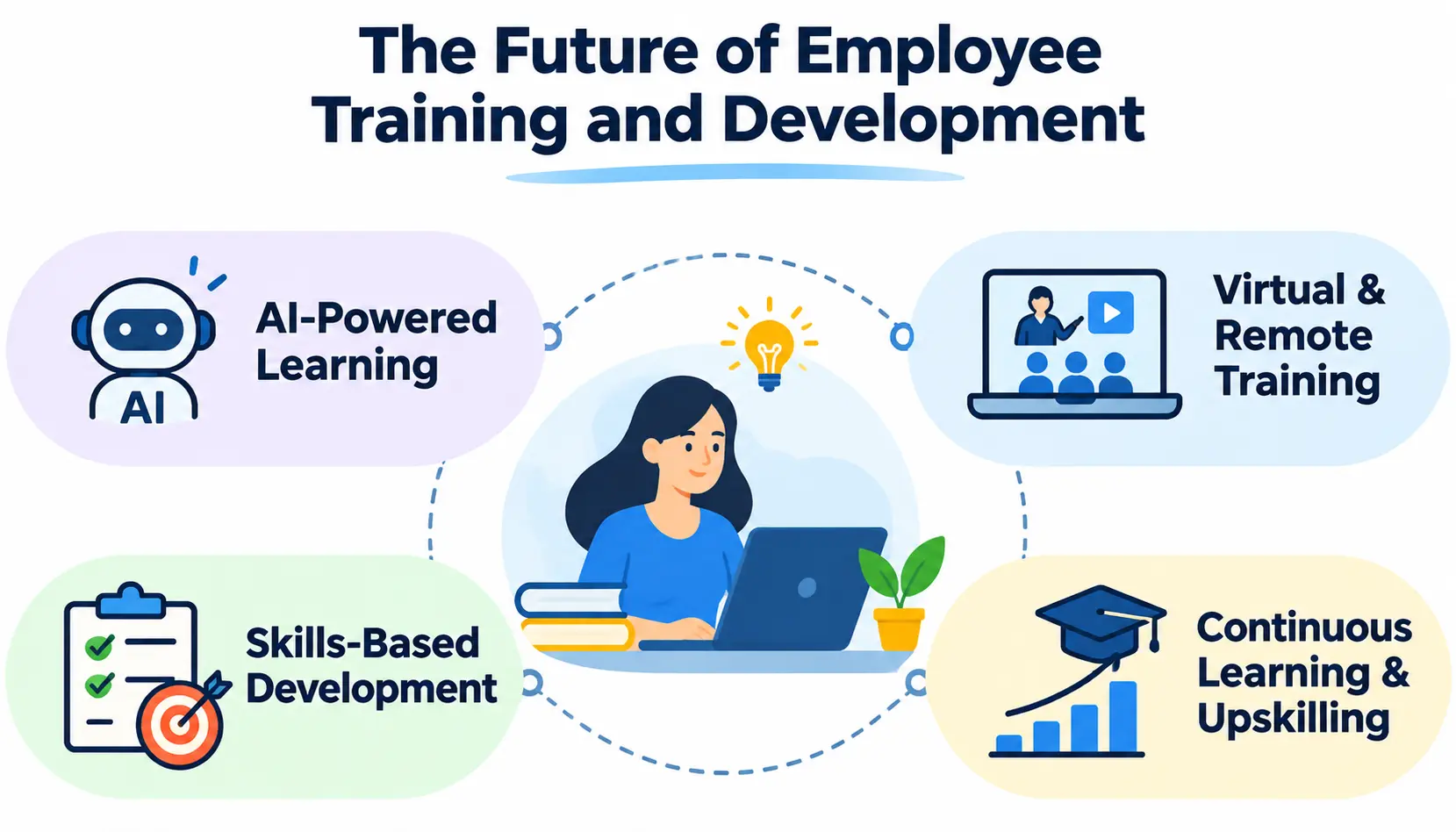
Training is changing as technology and work patterns shift. Four trends stand out.
AI-Powered Personalized Learning
AI tools can suggest learning paths, adjust difficulty, and give instant feedback. This helps employees focus on the skills they actually need. Human oversight still matters, especially for quality and fairness. Organizations can make this approach more effective by creating personalized employee learning paths based on individual roles, existing skills, and development goals.
Virtual and Remote Employee Training
Virtual classrooms and online simulations make it easier to train remote and global teams. The challenge is keeping people engaged, so interaction and practice remain important.
Skills-Based Workforce Development
More organizations are looking at specific skills rather than only job titles. This makes it easier to spot gaps, plan training, and move people into new roles.
Continuous Learning and Upskilling
Jobs change faster than they used to. Ongoing upskilling and reskilling help employees stay useful and help companies stay flexible. LinkedIn’s Workplace Learning Report is a good place to follow current thinking on this topic, and Wikipedia has a short page on upskilling.
Frequently Asked Questions About Employee Training and Development
How does training and development improve employee performance?
Training and development improve employee performance by strengthening skills, reducing mistakes, increasing confidence, and preparing people for bigger roles. Employees work faster and more accurately, and they make better decisions.
Why is employee training important in the workplace?
Training helps employees understand their roles, use tools correctly, follow safety and compliance rules, and adapt to change. Without it, errors, delays, and turnover tend to rise.
What are the five benefits of employee training and development?
Five common benefits are:
- Better job skills and knowledge
- Higher productivity
- Fewer errors and better quality
- Stronger employee engagement and confidence
- Improved customer satisfaction and organizational competitiveness
What are the most effective employee training methods?
The best method depends on the skill and audience. Popular options include on-the-job training, instructor-led sessions, e-learning, coaching and mentoring, job rotation, blended learning, and microlearning. Combining methods often works best.
What is the difference between training and development?
Training builds skills for a person’s current job and is usually short-term. Development focuses on long-term growth and future roles. Both support performance in different ways.
How can organizations measure employee training effectiveness?
Use a mix of productivity data, pre- and post-training assessments, performance reviews, employee feedback, and ROI calculations. The Kirkpatrick Model (reaction, learning, behavior, results) offers a clear structure.
How does employee development improve productivity?
Development helps employees build broader skills, stay motivated, and handle more complex work. They become more capable and more independent, which saves time for both them and their managers.
How often should employees receive training?
There is no single rule. New hires need intensive training early on. After that, schedule training when roles change, tools update, regulations shift, or skill gaps appear. Many organizations also offer ongoing learning throughout the year.
What is the role of HR in employee training and development?
HR helps identify skill gaps, design or source programs, coordinate delivery, track participation, and measure results. HR also works with managers so that learning connects to business goals.
How does technology improve employee training?
Technology makes training more flexible and scalable. Online courses, simulations, mobile learning, and AI-based recommendations let employees learn at their own pace and give organizations better data on progress.
Conclusion
So, how do training and development improve employee performance? They give people the knowledge to do their jobs, the confidence to act, and the skills to grow. In turn, that means better quality, higher productivity, happier customers, and a stronger business.
The biggest gains come when learning is connected to real needs. Start with clear skill gaps, choose practical methods, and give employees chances to apply what they learn. Then measure results and keep improving.
Here is a simple takeaway for employers and managers: pick one performance problem this month, design a small targeted training plan for it, and track the change. Small, consistent steps build a workforce that keeps getting better.