


Most companies do not struggle with a lack of training content. They struggle with delivering it consistently, tracking who actually learned something, and proving that any of it moved the needle. A corporate training platform is the tool that solves this gap, and if you have ever tried to onboard 50 new hires with a folder of PDFs and a shared spreadsheet, you already know why it matters.
This guide walks through what a corporate training platform actually is, the benefits it brings, the features worth paying for, and how to choose and implement one without wasting six months on a bad fit. It is written for HR leaders, L&D managers, and business owners who need a practical answer, not another vendor pitch dressed up as an article.
What Is a Corporate Training Platform?
A corporate training platform is software that lets organizations create, deliver, track, and measure employee training in one place. Think of it as the central hub where onboarding modules, compliance courses, skill-building content, and performance data all live together, instead of being scattered across email threads and shared drives.
Some people use the terms “corporate training platform” and “learning management system” interchangeably. There is overlap, but a corporate training platform usually goes further, combining course delivery with skills tracking, certification management, and sometimes even integrations with HR systems. We break down the exact difference in a later section.
How It Works
At a basic level, the platform works in three stages. First, an admin or instructional designer builds or uploads training content, which can be videos, quizzes, SCORM packages, or live sessions. Second, employees access this content through a portal or app, often on their own schedule. Third, the platform tracks completion, scores, and engagement, then reports that data back to managers and HR.
Most modern platforms also support role-based learning paths. A new sales hire and a new warehouse employee will not see the same dashboard, because their training needs are completely different.
Why Businesses Need One
Without a centralized system, training tends to happen inconsistently. One manager runs a thorough onboarding process, another skips half the steps because they are busy. A corporate training platform standardizes the experience so every employee, regardless of location or manager, gets the same quality of training.
This matters even more for companies with remote or hybrid teams. According to workforce research widely cited on Wikipedia’s overview of corporate learning, structured employee development programs are increasingly tied to retention and productivity outcomes, not just compliance checkboxes.
Common Corporate Training Challenges
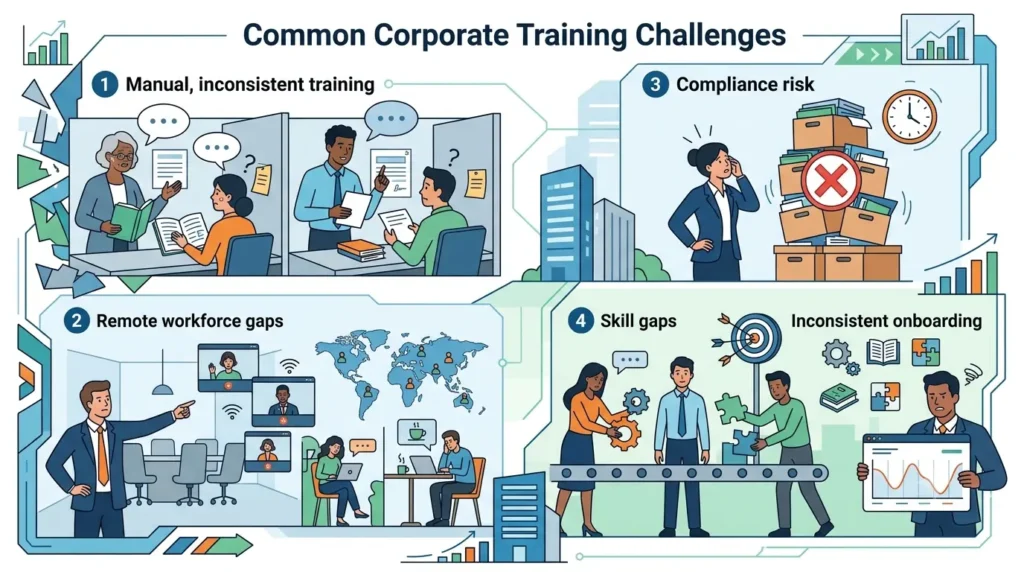
Before picking a platform, it helps to be honest about what is actually broken. The most common pain points we see across industries include:
- Manual, inconsistent training. Content lives in scattered documents with no single source of truth.
- Remote workforce gaps. Distributed teams cannot attend the same in-person sessions.
- Inconsistent onboarding. New hires get wildly different experiences depending on who trains them.
- Compliance risk. Without tracking, companies cannot prove employees completed mandatory training.
- Skill gaps. Managers cannot easily see where employees are falling behind on core competencies.
If two or more of these sound familiar, a corporate training platform is likely worth the investment.
Benefits of a Corporate Training Platform
Faster Employee Onboarding
New hires reach full productivity faster when training is structured and self-paced. Instead of shadowing a coworker for two weeks, employees can complete guided modules on day one and start contributing sooner.
Improved Employee Performance
When training is tied to clear learning objectives, employees know exactly what skills they need and how to build them. Managers get visibility into who needs support before performance issues show up in a review.
Consistent Training
Every employee gets the same core material, regardless of shift, location, or manager. This is especially important for multi-location businesses like retail chains or healthcare networks, where consistency directly affects customer experience and patient safety.
Better Compliance
Industries like finance, healthcare, and manufacturing face strict regulatory training requirements. A platform automatically tracks completions, sends reminders, and generates audit-ready reports, which removes a huge amount of manual HR work.
Reduced Training Costs
Once content is built, it can be reused indefinitely. Companies save on travel, printed materials, and instructor time compared to repeated in-person sessions.
Higher Employee Engagement
Modern platforms use interactive formats like microlearning and gamification, which tend to hold attention better than a 90-minute lecture. Employees who feel invested also tend to stay longer, a point often discussed in HR communities on humanresources, where practitioners regularly compare notes on what actually improves retention.
Easier Progress Tracking
Dashboards show completion rates, quiz scores, and time spent per module. Instead of guessing whether training worked, managers can look at the data.
Key Features Every Corporate Training Platform Should Have
Not every platform needs every feature below, but this list covers what genuinely matters for most mid-size to large organizations.
Course Management
The ability to build, organize, and update courses without needing a developer. Look for drag-and-drop authoring tools and support for multiple content formats.
Learning Paths
Sequenced courses tailored to a role, department, or skill level. A learning path for a new manager should look nothing like one for a frontline retail associate.
Assessments
Quizzes and knowledge checks that confirm employees actually absorbed the material, not just clicked through it.
Certification Management
Automated tracking of expiration dates and renewal requirements, which is critical for compliance-heavy industries.
Reporting and Analytics
Real-time dashboards showing completion rates, engagement, and skill gaps across teams. This is where training data turns into business decisions.
AI Features
AI-generated course outlines, automated content updates, and adaptive learning paths that adjust based on individual performance are becoming standard rather than optional.
Mobile Learning
Employees, especially frontline and field workers, need access to training from a phone, not just a desktop.
Integrations
Look for native connections to tools your team already uses, such as Microsoft Teams, Slack, Zoom, and your HRMS or ERP system. Support for standards like SCORM and xAPI ensures content portability if you ever switch platforms.
Security
Single sign-on (SSO), data encryption, and role-based access controls protect sensitive employee and business data.
Corporate Training Platform vs Learning Management System (LMS)
This is one of the most common points of confusion, so here is a straightforward comparison.
| Aspect | LMS | Corporate Training Platform |
|---|---|---|
| Primary focus | Course delivery and tracking | Full employee development lifecycle |
| Typical users | Schools, universities, basic corporate training | Businesses managing onboarding, compliance, and skills |
| Skills tracking | Limited or none | Often includes skills matrices and competency mapping |
| HR integration | Rare | Common, connects with HRMS, payroll, performance systems |
| Learning paths | Basic | Role-based and adaptive |
| Reporting | Course completion focused | Business-outcome focused, tied to KPIs |
In short, every corporate training platform functions like an LMS, but not every LMS is built for the broader needs of a growing business. If your only need is delivering courses to a small team, a basic LMS might be enough. If you need onboarding, compliance, and skills development under one roof, a full corporate training platform is the better fit.
Industries That Use Corporate Training Platforms
Corporate training platforms are not limited to one type of business. Some of the heaviest adopters include:
- Healthcare, for compliance, patient safety protocols, and continuing education
- Manufacturing, for safety training and equipment certification
- IT, for technical upskilling and security awareness training
- Retail, for consistent customer service standards across locations
- Finance, for regulatory compliance and anti-fraud training
- Hospitality, for service standards and seasonal staff onboarding
- Government, for policy training and public sector compliance
Department-Wise Corporate Training Examples
Training needs differ sharply by department, which is why generic, one-size-fits-all courses often underperform.
Sales: Product knowledge refreshers, objection-handling scenarios, and CRM training tied to actual deal stages.
HR: Onboarding workflows, policy updates, and manager training on handling difficult conversations.
Customer Support: Scripted response training, tone guidelines, and product update briefings delivered as microlearning.
Operations: Standard operating procedures, safety protocols, and equipment-specific certification.
Compliance: Mandatory annual courses on data privacy, workplace conduct, and industry-specific regulations.
Leadership: Coaching frameworks, performance review training, and decision-making simulations for new managers.
How to Choose the Right Corporate Training Platform
Picking a platform is easier when you evaluate it against a few concrete criteria instead of just comparing feature lists.
- Business goals. Are you solving onboarding speed, compliance risk, or skill gaps? The priority changes which features matter most.
- Budget. Understand pricing per user versus flat licensing, and factor in implementation and content creation costs.
- Features. Match the feature list against your actual challenges, not a generic checklist.
- Scalability. Will the platform still work if your headcount doubles next year?
- Support. Check response times and whether onboarding support is included or billed separately.
- Integrations. Confirm it connects with your existing HR, communication, and productivity tools.
A quick gut check that professionals often recommend on platforms like LinkedIn’s professional articles section is to request a trial period with real employees, not just a sales demo, before committing to an annual contract.
Corporate Training Implementation Roadmap
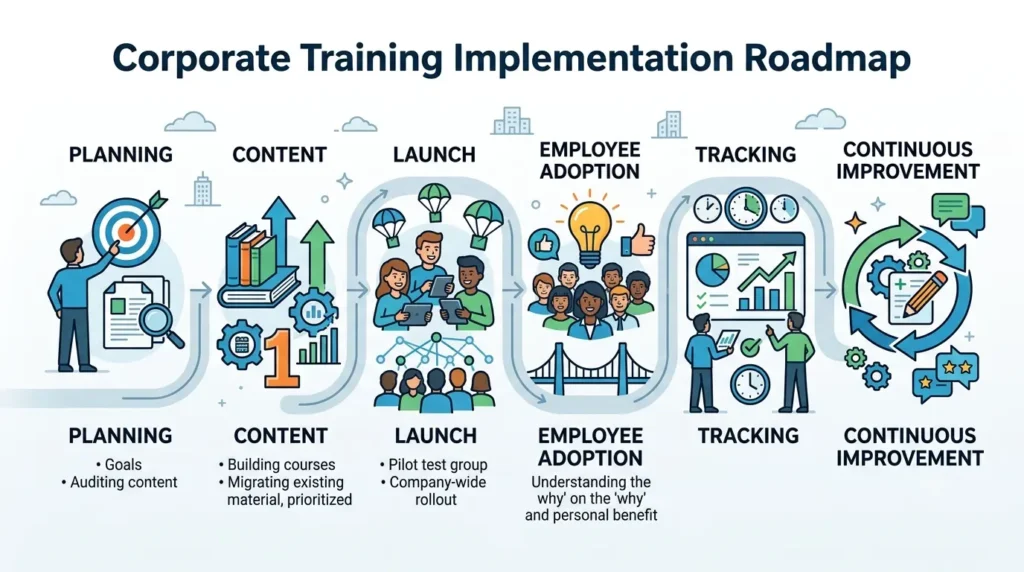
Rolling out a new platform is where many companies stumble, usually because they treat it as a one-time IT project instead of a change management process. Here is a realistic roadmap.
- Planning. Define goals, identify stakeholders, and audit existing training content that can be reused.
- Content. Build or migrate courses, starting with the highest-priority training like onboarding and compliance.
- Launch. Roll out to a pilot group first, gather feedback, then expand company-wide.
- Employee Adoption. Communicate the “why” clearly. Employees adopt tools faster when they understand the benefit to them, not just the company.
- Tracking. Monitor completion rates and engagement in the first 90 days to catch friction points early.
- Continuous Improvement. Update content quarterly based on performance data and employee feedback.
Companies that skip the pilot phase often see low adoption rates in the first few months, simply because employees were never given a reason to care.
Measuring Corporate Training Success
A platform is only as good as the outcomes it produces. Track these metrics to know if your training program is actually working.
- Completion rates, which show whether employees are finishing assigned courses
- Assessment scores, which indicate whether knowledge is being retained
- Employee performance, measured through on-the-job KPIs before and after training
- Training ROI, calculated by comparing training costs against measurable business outcomes like reduced errors or faster ramp-up time
- Employee feedback, gathered through post-course surveys
- Business KPIs, such as reduced turnover, fewer compliance incidents, or improved customer satisfaction scores
A simple way to calculate training ROI is to compare the cost of the program against the value of the improvement it produced, whether that is reduced onboarding time, fewer errors, or lower turnover. It will not be perfectly precise, but even a rough estimate gives leadership something concrete to evaluate.
Future of Corporate Training Platforms
Corporate training is shifting quickly, and a few trends are worth watching over the next few years.
AI is moving from a nice-to-have to a core part of course creation, automatically generating draft content and updating outdated material.
Adaptive learning adjusts course difficulty and pacing based on individual performance, rather than forcing everyone through the same fixed path.
Microlearning breaks training into short, focused segments that fit into a busy workday instead of demanding a full hour away from work.
Skills-based learning is replacing generic course completion as the main measure of success, with companies tracking actual competencies instead of just certificates.
Learning analytics is becoming more predictive, flagging skill gaps before they turn into performance problems.
Frequently Asked Questions
1. What is a corporate training platform?
A corporate training platform is software that helps organizations create, deliver, and track employee training in one centralized system, covering everything from onboarding to compliance to skills development.
2. How does a corporate training platform work?
It works by letting admins build or upload training content, giving employees access through a portal or app, and then tracking completion, scores, and engagement through built-in analytics.
3. Why do companies use corporate training platforms?
Companies use them to standardize training across locations, reduce onboarding time, meet compliance requirements, and get clear visibility into employee skill gaps.
4. What is the difference between an LMS and a corporate training platform?
An LMS typically focuses on course delivery and tracking, while a corporate training platform usually adds skills tracking, HR system integration, and broader employee development features.
5. What features should a corporate training platform have?
Look for course management, learning paths, assessments, certification tracking, reporting and analytics, mobile access, and integrations with tools like HRMS and Microsoft Teams.
6. How much does a corporate training platform cost?
Pricing varies widely based on company size and features, typically ranging from a few dollars per user per month for basic plans to custom enterprise pricing for larger organizations.
7. Which industries use corporate training platforms?
Healthcare, manufacturing, IT, retail, finance, hospitality, and government are among the heaviest users, largely due to compliance and safety training requirements.
8. Can small businesses use corporate training platforms?
Yes, many platforms offer scaled-down pricing tiers designed specifically for small teams that still need structured onboarding and compliance tracking.
9. How do corporate training platforms improve employee performance?
By providing clear learning objectives, consistent content, and progress tracking, employees know exactly what skills to build and managers can identify gaps before they affect performance.
10. How do you measure corporate training success?
Track completion rates, assessment scores, employee performance changes, training ROI, and business KPIs like turnover and compliance incident rates.
Conclusion
A corporate training platform is no longer a nice-to-have for growing businesses. It is the difference between training that happens by accident and training that actually drives measurable results, from faster onboarding to stronger compliance to a workforce that keeps improving instead of stagnating.
If you are ready to move past scattered spreadsheets and inconsistent onboarding, platforms like SkillForce LMS are built to help organizations streamline employee training, onboarding, compliance, and workforce development in one place. The right corporate training platform will not just deliver courses, it will give you the visibility to prove your training is actually working.