


If you’ve sat in a budget meeting this year and been asked to justify every training dollar, you’re not alone. L&D leaders everywhere are being asked the same question: is this actually working? The good news is that the data now backs up what practitioners have suspected for years training isn’t a cost center, it’s one of the clearest levers a company has for retention, productivity, and staying ahead of the AI-driven skills shift.
This guide pulls together the corporate training statistics that matter most in 2026 market size, AI adoption, budgets, retention outcomes, upskilling data, and ROI benchmarks so you can make the case for your programs with numbers, not gut feel. I’ve drawn on market research firms (Grand View Research, Technavio, SkyQuest), industry bodies (ATD, LinkedIn Learning, the World Economic Forum), and vendor benchmark reports, and flagged where estimates diverge so you know how confident you are in any given figure.
Corporate Training Statistics at a Glance
Top 25 Key Statistics
Here’s the quick-reference version of the numbers worth memorizing before your next stakeholder meeting.
- The global corporate training market is valued at roughly $450–490 billion in 2026, depending on methodology.
- The market is forecast to grow at a compound annual rate of around 7.8% through the early 2030s.
- North America holds the largest regional share, at just under 38% of global revenue.
- Asia-Pacific is the fastest-growing region, driven by mass upskilling needs.
- The global LMS (learning management system) market is worth about $34 billion in 2026, growing over 20% a year.
- Technical training is the single largest training category by spend.
- Compliance training dominates in heavily regulated sectors like healthcare and finance.
- Roughly half of the global workforce completed some form of formal training in the past year, up from about 41% in 2023.
- 88% of organizations say retention is a top concern, and learning is their number one lever for it.
- Companies with a strong learning culture report meaningfully higher retention than those with a weak one.
- 59% of the global workforce will need reskilling or upskilling by 2030, per the World Economic Forum.
- 39% of core job skills are expected to change by 2030.
- AI tools are now used in learning content creation by a majority of L&D teams roughly 57% actively, with another 30% piloting.
- 72% of L&D leaders plan to increase AI investment in their programs.
- Average annual training spend per employee in the U.S. sits in the $1,000–1,400 range, varying by industry.
- Tech companies spend well above the cross-industry average on training.
- 85% of employers plan to prioritize upskilling their existing workforce through 2030.
- Skills are becoming obsolete faster than what once took about 15 years now takes roughly five.
- Microlearning (short, 5–10 minute modules) shows measurably better knowledge retention than long-form sessions.
- Mobile-based training delivery shows faster completion and better retention than desktop-only delivery.
- Employees have very little unstructured time for learning, often cited around 1% of the work week.
- Widely cited ROI benchmarks put returns on well-run training programs at several dollars back per dollar spent.
- Only about a third of organizations see the majority of their employees actively engaging with the upskilling programs they’ve built.
- Skills gaps, not headcount shortages, are increasingly the top workforce challenge cited by employers.
- Career development is now treated by leading organizations as a retention tool on par with pay and benefits.
Executive Summary
Corporate training is changing in two ways in 2026. First, the market for training is getting bigger and bigger. This is because companies are using tools instead of having employees sit in a classroom. Second, artificial intelligence is changing what companies teach their employees and how they teach it to them.
There is a problem behind these changes. Companies are spending money on corporate training and they are using a lot of new technology. The people in charge of companies say that skills are very important.. Not as many employees are taking part in the training as companies would like.
Also companies are having trouble measuring whether the training is actually helping the business. A lot of companies have the tools they need for training but not as many employees are using them.. Even fewer companies can show that the training is making a big difference in a way that the chief financial officer will believe. Corporate training is still a deal and companies are trying to figure out how to make it work better.
What Is Corporate Training?
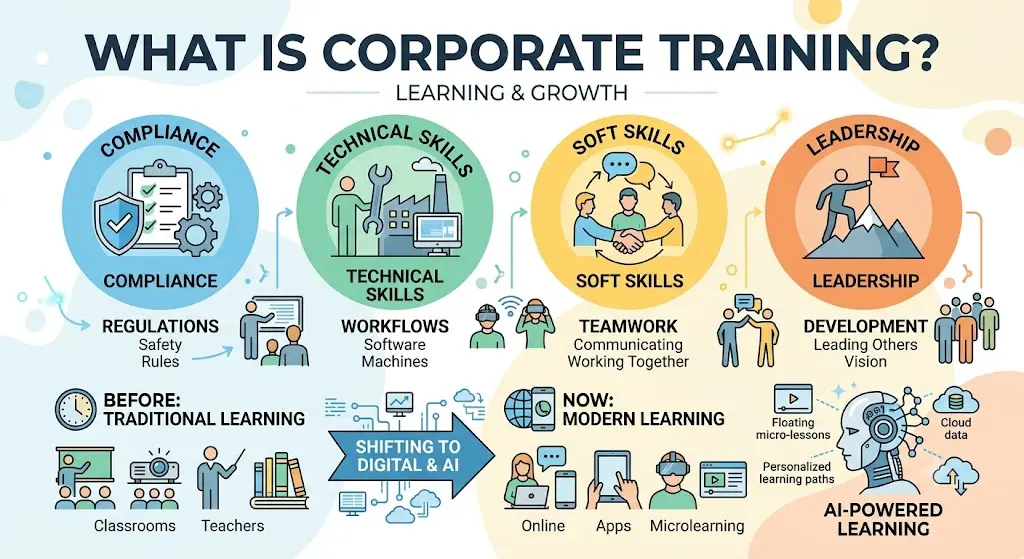
Corporate training is something that a company does to help its employees learn things and get better at their jobs. This can be a lot of things like a short class on following the rules or a long program to help people become leaders. It can also include teaching employees about the company, showing people how to use computers and machines, helping people work well with others and making sure everyone knows how to stay safe at work. Now companies are even teaching people about intelligence.
The way companies teach their employees has changed a lot in the last ten years. Before, people used to go to a classroom and listen to a teacher. Now most of the time people learn things on computers and phones. They use websites and programs, watch videos and use apps that teach them new things in short lessons. Sometimes they also use tools that help them learn with the help of artificial intelligence.. For things like leadership and working with others, companies still like to have people meet in person to learn.
Why These Statistics Matter
These numbers are not things you put on a slide to make a presentation look good. They show you where the market is going, how money your competitors are spending and what really makes a difference in keeping people and doing a good job.
If you are a person in charge of resources or learning and development this information helps you see how your own program is doing compared to what other companies are doing. If you are an executive it helps you decide if you are spending the right amount of money on training considering the risk of not having the right skills.. If you are someone who provides training it shows you where people want to learn the most and where you can help them.
Global Corporate Training Market Statistics
Market Size
Estimates of the global corporate training market vary by scope and methodology, which is normal for a market this fragmented; some analysts count only software and platforms, others include content, services, and instructor-led delivery. Grand View Research puts the market at roughly $427 billion in 2025, growing to about $459 billion in 2026 and $778 billion by 2033, at a compound annual growth rate near 7.8%. Other firms, including SkyQuest and Technavio, land in a similar $400–460 billion range for 2026, with CAGRs clustering between 7.7% and 9%.
The takeaway: regardless of which specific report you cite, the corporate training market is a several-hundred-billion-dollar industry growing at a high-single-digit pace faster than most mature B2B services categories.
Growth Forecast
Most analysts agree the market will roughly double by the early 2030s. Grand View Research’s forecast of $777.5 billion by 2033 and SkyQuest’s $808.89 billion by 2033 both imply the market nearly doubling from its 2025 base over eight years.
Software and digital platforms are the biggest growth driver. Grand View Research notes software already accounts for about two-thirds of market revenue, and that share is expected to keep expanding as AI-native platforms take share from legacy systems.
Regional Trends
North America remains the largest regional market, holding around 37–38% of global revenue in 2025, according to Grand View Research. The U.S. alone represents a market estimated at roughly $11.8 billion in 2025, rising to about $12.6 billion in 2026, per Market Data Forecast and that’s before counting content and services bundled into broader market estimates.
Asia-Pacific is the fastest-growing region by a clear margin. Technavio pegs APAC growth at roughly 9% annually, versus about 7.7% in North America, driven by large-scale upskilling needs and strong demand for mobile-first, microlearning-style content. European markets, by contrast, tend to emphasize soft skills and diversity and inclusion training over pure technical upskilling.
Employee Learning & Development Statistics
1. Training Participation
Participation in formal training has climbed noticeably. According to the World Economic Forum’s Future of Jobs Report 2025, about half of the global workforce completed formal training as part of a long-term learning strategy, up from 41% in 2023 a meaningful jump in just two years.
Still, participation isn’t universal. Some employee-side surveys put the share of U.S. workers who’ve never received any formal workplace training at around 60%, which suggests the gains are concentrated in larger, better-resourced organizations rather than spread evenly across the labor market.
2. Learning Preferences
Employees consistently say they want training that fits into small windows of time. Estimates of available learning time during a normal work week are strikingly low, often cited around 1% of total working hours, or roughly 24 minutes in a 40-hour week.
That’s a big part of why bite-sized, on-demand formats are winning. Employees also increasingly expect personalization: a large share of workers commonly cited around 80% in LMS usage research say they want learning paths tailored to their specific role and skill gaps, rather than generic, one-size-fits-all courses.
3. Skills Development
The skills employees are prioritizing have shifted toward technology. AI and data-related skills, cybersecurity, and technological literacy top the World Economic Forum’s list of fastest-growing skills through 2030. At the same time, human-centered skills, judgment, leadership, creativity, and adaptability are becoming more valuable, not less, as AI absorbs more routine technical work.
This dual demand is a real planning challenge. L&D teams can’t just pivot fully to AI tool training; they also need to keep investing in the human skills that AI can’t replicate.
AI Corporate Training Statistics
1. AI Adoption
AI has moved from pilot projects to standard practice in L&D. Synthesia’s 2026 report on AI in learning and development found 57% of L&D teams are actively using AI in their programs today, with another 30% running early pilots meaning nearly 90% have moved past pure experimentation.
Separately, industry surveys commonly report that around 72% of training leaders plan to increase AI investment further, and a majority of L&D professionals now use AI tools for at least some content creation. Adoption is uneven, though security concerns, accuracy worries, and unclear internal governance remain common blockers, cited by roughly half of L&D teams surveyed by Synthesia.
2. Personalized Learning
AI-driven personalization is one of the clearest use cases in corporate training right now. AI-based platforms are increasingly used to adapt learning paths, content difficulty, and pacing to individual employees, rather than pushing the same course to everyone.
Vendors and analysts widely cite improved completion and retention rates from adaptive, AI-personalized paths compared with static course catalogs, though exact percentage gains vary by study and should be treated as directional rather than precise.
3. AI Coaching
A newer but fast-growing use case is AI-powered coaching chat-based or voice-based tools that give employees real-time feedback on skills like sales conversations, management scenarios, or customer service. These tools let employees practice repeatedly without needing a live coach or role-play partner for every session.
Managers are also being repositioned as “AI adoption coaches” inside their teams, according to elearningtrendz’s 2026 analysis, rather than simply directing employees to a training catalog a shift that reflects how much of AI skill-building now happens in the flow of work, not in a separate course.
4. Generative AI in L&D
Generative AI is now embedded in how training content itself gets made, drafting course scripts, generating quiz questions, translating content for global teams, and producing training videos without a full production crew. This is compressing content development timelines that used to take weeks into days.
The open question L&D leaders are wrestling with, as several 2026 industry reports note, isn’t whether generative AI can produce content faster it clearly can but whether faster content is actually better content. Governance, accuracy review, and instructional design quality are becoming as important as the AI tools themselves.
Corporate Training Budget Statistics
Average Spend
U.S. per-employee training spend estimates generally fall in the $1,000–1,400 range annually, depending on the source and year. ATD-linked research cites figures around $1,254 per employee, while other benchmark reports put the average closer to $1,071–1,420.
The spread reflects real differences in what’s counted; some figures include only direct training costs, others fold in technology, staff time, and content licensing.
Investment Trends
Spending isn’t distributed evenly across industries. Tech companies consistently spend well above the cross-industry average; some estimates put tech spend at more than double the typical per-employee figure reflecting the pace at which technical skills need refreshing in that sector.
Healthcare and manufacturing also tend to invest more heavily than average, largely due to compliance and safety requirements rather than discretionary skill-building.
Budget Benchmarks
A useful rule of thumb cited in ATD benchmarking research: training and development spend typically runs about 1–2% of total payroll costs for organizations with mature L&D functions. That’s a helpful starting point for HR leaders trying to sanity-check their own budget against the broader market.
The L&D technology market, specifically LMS, learning experience platforms (LXP), and content tools is itself a multi-billion-dollar category, with AI-native platforms reportedly growing several times faster than legacy systems.
Employee Engagement & Retention Statistics
1. Productivity
Well-designed training programs are consistently linked to productivity gains, though the size of the effect varies by study and industry. Mobile-first and microlearning delivery in particular is associated with faster skill application, since employees can access relevant content closer to the moment they actually need it on the job.
2. Retention
This is where the data is most consistent across sources. LinkedIn’s 2025 Workplace Learning Report found 88% of organizations are concerned about retention, and providing learning opportunities is their number one strategy for addressing it. Separately, companies with a strong learning culture are widely cited as seeing meaningfully higher retention commonly reported around 57%, versus roughly 27% at companies with only a moderate learning culture.
Career progression, not just skill-building for its own sake, appears to be the real driver. LinkedIn’s research frames career progress as employees’ top motivation to keep learning when people don’t see a path forward, they leave and take their skills with them.
3. Employee Satisfaction
Employees repeatedly tell researchers that learning opportunities affect their loyalty to an employer. Surveys commonly find that a large majority of workers say they’d stay longer at a company that visibly invests in their development a pattern that shows up consistently enough across independent surveys (LinkedIn, ATD-affiliated research, and others) that it’s one of the more reliable findings in this space, even though the exact percentage varies by survey.
Upskilling & Reskilling Statistics
1. Skills Gap
The World Economic Forum’s Future of Jobs Report 2025 is the most authoritative source here. It finds that 59% of the global workforce of roughly 120 million people will need reskilling or upskilling by 2030. Breaking that down: 41 out of every 100 workers won’t need significant retraining, 29 can be upskilled while staying in their current role, 19 will need to be reskilled into a new role, and 11 are unlikely to receive the training they need at all, putting them at real risk of displacement.
Separately, 63% of employers in that same WEF survey named skills gaps not funding, culture, or regulation as their primary barrier to business transformation. That finding held across the large majority of the 55 economies and 22 sectors surveyed.
2. Workforce Transformation
Employers say they’re serious about closing the gap: 85% plan to prioritize upskilling their existing workforce through 2030, 70% plan to hire externally for new skill needs, and 51% plan to move existing staff into new roles internally, per the WEF report.
The harder problem is data, not intent. Research cited by Gartner found only about 8% of organizations have reliable, current data on what skills their own workforce actually has which makes it difficult to target upskilling investment accurately, no matter how good the intentions are.
3. Future Skills
Skills are also aging faster than they used to. Research from Fuel50 finds that what once took roughly 15 years to become outdated now takes closer to five, and more than half of organizations say critical skills in their industry become obsolete within three years or less.
AI, big data, cybersecurity, and technological literacy top the WEF’s list of fastest-growing skills through 2030, while employers expect roughly 39% of workers’ core skills to change by then a figure that has actually eased slightly from 44% cited in the 2023 edition of the same report, suggesting some stabilization as reskilling programs mature.
LMS & Digital Learning Statistics
1. LMS Adoption
Learning management systems have become close to a default piece of corporate infrastructure. Grand View Research values the global LMS market at $28.6 billion in 2025, growing to roughly $34.1 billion in 2026 and $123.8 billion by 2033 with a compound annual growth rate above 20%, notably faster than the broader training market.
Adoption is especially high in large enterprises and tech companies, where near-universal LMS use is common, versus lower though still substantial adoption among small and mid-sized businesses.
2. Mobile Learning
Mobile delivery outperforms desktop-only training on several commonly cited measures, including faster completion rates and better knowledge retention, largely because it lets employees train in short windows rather than requiring a dedicated desk session. The corporate mobile learning market itself is a multi-billion-dollar and fast-growing category, with SkyQuest estimating it at roughly $66 billion in 2025, expanding at a CAGR above 13%.
3. Microlearning
Microlearning training broken into short, focused modules, often 5–10 minutes long is one of the clearest wins in the data. Multiple industry reports find bite-sized content improves knowledge transfer compared with hour-long sessions, and completion rates for well-designed microlearning modules are frequently reported in the 80–90% range, well above typical completion rates for longer-form courses.
4. Blended Learning
Even with the shift to digital, blended learning combining self-paced digital modules with live instructor-led sessions hasn’t disappeared. It remains the preferred model for leadership development and soft-skills training specifically, where practice, feedback, and group discussion are harder to replicate in a purely asynchronous format.
Industry-Specific Corporate Training Statistics
1. Healthcare
Healthcare consistently reports the highest training hours per employee of any major industry commonly cited around 50 hours a year driven by continuing education requirements, clinical certification, and patient-safety compliance. In the U.S. specifically, healthcare and pharma made up close to half of the domestic corporate training market by one industry estimate, reflecting how compliance-heavy this sector is relative to others.
2. Manufacturing
Manufacturing training spend tends to run above the cross-industry average, driven by safety compliance and, increasingly, AI-related reskilling. Some estimates suggest roughly two million manufacturing workers will need AI-related reskilling in the near term, as predictive maintenance, quality control automation, and supply chain tools become standard on the shop floor.
3. Technology
Tech companies are the heaviest per-employee spenders in corporate training, reflecting how quickly technical skills age in that sector. LMS adoption in tech is also reported as close to universal, and the industry is typically an early adopter of AI-native learning platforms before other sectors follow.
4. Retail
Retail sits at the other end of the spectrum, with reported average annual training hours per employee well below the cross-industry norm often cited under 25 hours a year. High turnover and thin margins make sustained training investment harder to justify economically in this sector, even though frontline training is directly tied to customer experience.
5. Financial Services
Financial services organizations invest heavily in compliance training specifically, reportedly spending meaningfully more on compliance content than the average across industries, driven by regulatory requirements around conduct, anti-money-laundering rules, and data privacy. This sector was also an early and heavy adopter of AI-driven learning analytics to track training completion against audit requirements.
Corporate Training ROI Statistics
1. Business Performance
Structured training pathways are associated with stronger competitive positioning. Some industry benchmark research links having a structured professional training pathway to a higher likelihood of being a market share leader with above-average profit margins, a pattern consistent with the broader idea that skills capability is a competitive differentiator, not just an HR nicety.
2. Revenue Impact
ROI figures for corporate training vary widely by methodology, and you should treat any single number with some skepticism. That said, some of the most frequently cited historical benchmarks including IBM’s reported returns of up to $30 for every $1 spent on eLearning continue to be referenced in 2026 industry reports as a ceiling for what’s achievable under ideal conditions, rather than a typical result.
More conservative, broadly cited estimates put realistic average returns closer to a few dollars back per dollar invested for well-run programs, still a strong business case, just far short of the outlier figures that get repeated without context.
3. Cost Reduction
Digital delivery itself drives meaningful cost savings versus classroom-based training. Dow Chemical’s often-cited case, still referenced in 2026 industry write-ups, reported training cost reductions in the 50–70% range after shifting from in-person to digital delivery largely from cutting travel, venue, and instructor time.
4. Productivity Improvements
Beyond direct cost savings, well-targeted training is linked to measurable productivity gains, particularly when paired with mobile and microlearning formats that let employees apply new skills quickly rather than waiting for the next scheduled session. The gap between ROI-measurement intent and ROI-measurement capability remains large, though a notable share of organizations, by some estimates over 80%, still say they can’t reliably connect training spend to business outcomes.
Emerging Corporate Training Trends
1. Skills-Based Organizations
More companies are shifting from job titles and tenure toward skills as the core unit of workforce planning. Fuel50’s research finds a large majority of HR teams cited around 90% now use skills data in workforce decisions, though actual employee engagement with the programs built on that data still lags well behind the infrastructure investment.
2. Learning Analytics
Real-time learning analytics tracking not just course completion but actual skill application on the job is becoming standard among larger organizations. This is part of a broader shift from measuring training activity (completions, hours) toward measuring training outcomes (performance change, retention, internal mobility).
3. VR & AR Training
Virtual and augmented reality are moving beyond novelty use cases into practical applications, particularly for hands-on technical and safety training where mistakes in the real world are costly, think equipment operation, hazardous environments, or complex procedural work. Adoption is still concentrated in manufacturing, healthcare, and industrial sectors rather than being widespread across all industries.
4. Continuous Learning
Perhaps the biggest mindset shift in 2026 is the move away from training as a periodic event, an annual compliance module, a one-time onboarding course toward continuous learning built into daily workflows. LinkedIn’s research frames this clearly: 91% of L&D professionals now agree continuous learning is more important for career success than it used to be, reflecting how fast skills requirements are moving.
How Businesses Can Use These Statistics
1. HR Leaders
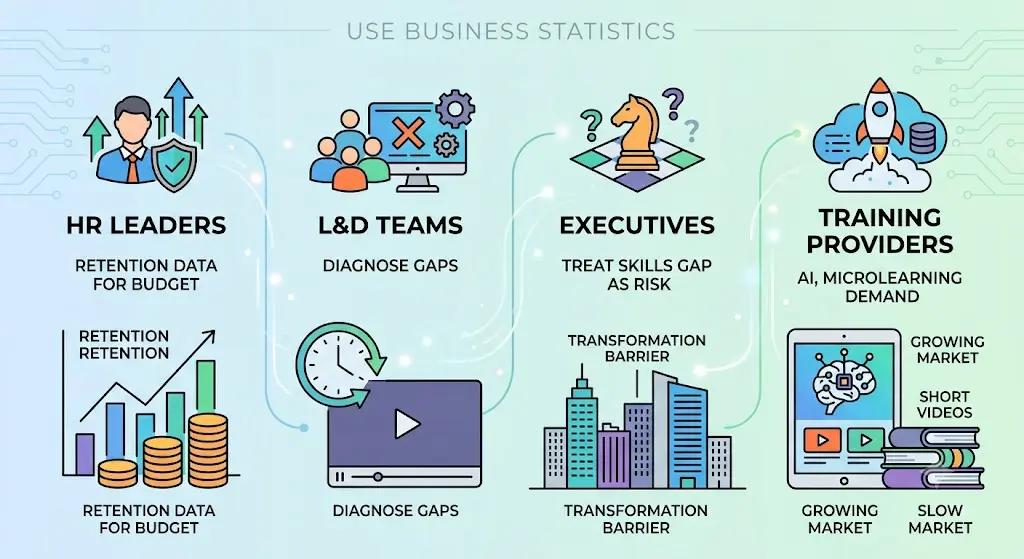
Use retention data to make the internal case for the L & D budget. The link between strong learning cultures and retention is one of the most consistently replicated findings across independent surveys, which makes it a solid anchor point in budget conversations with finance and executive leadership.
2. L&D Teams
Use the participation and engagement gaps the fact that many organizations built training infrastructure that a majority of employees still don’t actively use as a diagnostic tool. If your completion rates lag industry benchmarks, the fix is more often about time constraints and content format (think microlearning) than about content quality.
3. Executives
Treat the skills-gap data as a genuine business risk, not an HR line item. With 63% of employers citing skills gaps as their top transformation barrier, this is a strategic planning issue that belongs in the same conversations as market expansion and capital allocation.
4. Training Providers
The fastest-growing segments AI-native LMS platforms, microlearning content, and AI coaching tools represent where buyer demand is heading. Providers still selling primarily static, long-form course catalogs are competing in the slower-growing part of the market.
Frequently Asked Questions
1. How big is the corporate training market in 2026?
Estimates generally range from about $400 billion to $490 billion globally, depending on what the researcher counts as “corporate training” (software only, versus software plus content and services). Grand View Research’s estimate of roughly $459 billion is a reasonable mid-range figure to cite.
2. What percentage of companies use AI in training?
Around 87% of L&D teams have moved beyond pure experimentation with AI split roughly between 57% actively using it and 30% running pilots, according to Synthesia’s 2026 report.
3. How much do companies spend on training per employee?
Typically $1,000–1,400 per employee per year in the U.S., though this varies significantly by industry, tech and healthcare tend to spend well above average, retail tends to spend below it.
4. Does training actually improve employee retention?
The data says yes, consistently. Companies with strong learning cultures report notably higher retention than those with weak ones, and 88% of organizations now name learning as their top retention strategy.
5. How many workers will need reskilling by 2030?
59% of the global workforce, or roughly 120 million people, according to the World Economic Forum’s Future of Jobs Report 2025 though 11 out of every 100 workers globally are at risk of not receiving the training they’ll need.
6. What’s the ROI of corporate training?
It varies widely by program quality and measurement method. Some frequently cited historical benchmarks reach as high as $30 back per $1 spent, but more typical, broadly cited figures for well-run programs are more modest, still positive, but nowhere near the outlier numbers that circulate without context.
Conclusion
Corporate training is becoming a key driver of business success as organizations invest more in employee development, AI-powered learning, and continuous upskilling. The latest statistics show that companies with strong learning cultures are better equipped to improve productivity, retention, and long-term growth.
At the same time, businesses face growing skills gaps and rapidly changing job requirements. Investing in modern training strategies such as microlearning, personalized learning, and digital platforms helps employees adapt faster while keeping organizations competitive in a changing market.
As workplace demands continue to evolve, using reliable corporate training statistics can help HR leaders, executives, and L&D teams make smarter decisions, optimize training budgets, and build a future-ready workforce.