


Most companies say that people are their asset.. The truth is, not many companies actually put their money where their mouth is and invest in their people in a serious way. This is why corporate learning and development is now something that CEOs talk about, rather than just something that the human resources department handles.
This guide will tell you what corporate learning and development really is. It will explain why it is more important now than it was five years ago.. It will show you how to create a plan that will actually work when things get tough, not just a plan that sounds good when you are making it. As you read this guide you will get some tools you will learn about common mistakes that people make and you will get a clear plan of action that you can start using this quarter. Corporate learning and development is something that companies need to take and this guide will show you how to do that.
What Is Corporate Learning and Development?
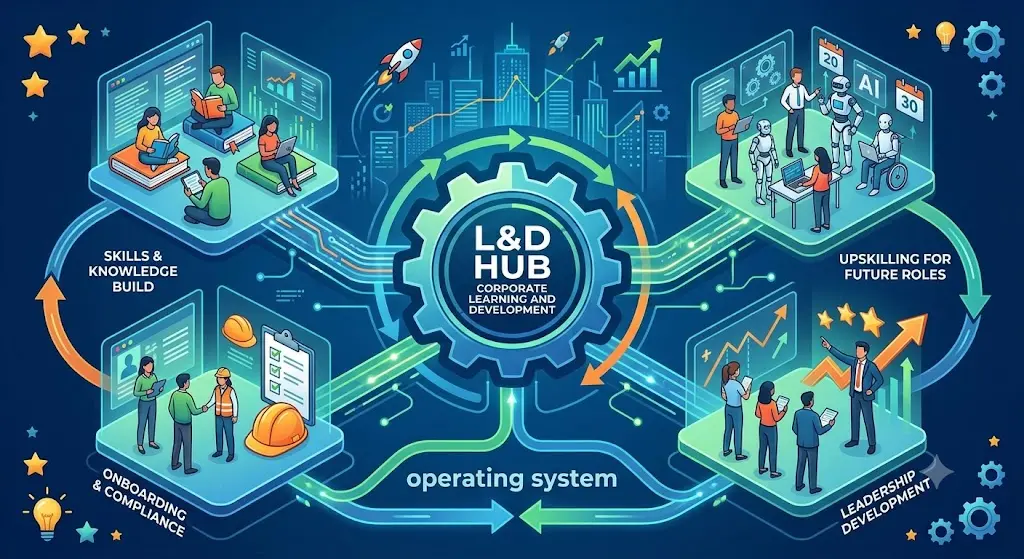
Corporate learning and development is what helps a company make its employees better at their jobs. It is the things a company does to teach its employees skills and give them the knowledge they need to do their jobs well. This includes things like teaching employees the basics and making sure everyone knows the rules. It also includes helping people become leaders and getting them ready for new jobs.
Think of learning and development as the thing that makes sure the people who work for a company have the skills the company needs to succeed. Corporate learning and development is, like the system that helps a company’s employees keep up with what the company needs to do to compete with companies.
Corporate Learning vs Employee Training
People often use the terms training and corporate learning to mean the thing but that is not correct. Training is something that happens once like a class, a workshop or a test to get a certificate. This teaches you how to do one thing.
Corporate learning is a system that includes training. It is what the company uses to help people learn and grow. For example when a new employee has to take a course to learn the rules that are training.. When a company has a plan to help people get better at their jobs over several years and this plan includes helping them find a mentor and move to a different job inside the company that is corporate learning. One is like a step the other is, like a whole plan. Corporate learning is what training is a part of.
Learning vs Development
Learning is about acquiring knowledge or skill, how to use a new tool, how to run a difficult conversation, how to read a financial statement. Development is about growth over time building the judgment, experience, and capability to take on bigger responsibility. You can also think of this as part of broader human resource development, which focuses on developing people and their capabilities within organizations. A good L&D program does both. It teaches skills for today’s job and builds capability for tomorrow’s.
A good L&D program does both. It teaches skills for today’s job and builds capability for tomorrow’s.
Why Modern Organizations Prioritize Continuous Learning
Skills become outdated faster than they used to. Technology changes, around AI and automation are making the time that technical skills stay useful shorter in many areas. According to the World Economic Forum’s Future of Jobs research a lot of skills are going to change during this decade.
That has made organizations stop using training events and instead focus on continuous learning, the idea that people should be gaining skills as a normal part of their work not as something that happens only once in a while.
Why Corporate Learning Matters
Learning and development is really important. When learning and development is done well it has an impact on the success of the company. On the other hand when learning and development is neglected it can cause a lot of problems like employees leaving the company, not growing and losing to other companies. Learning and development is essential for any company that wants to succeed.
Business Growth
When companies build their skills and abilities quickly they are able to enter markets and start selling new products and services more quickly than other companies. The key to making a business plan work is learning. Learning is what makes it possible for the people who work at a company to actually do what the plan says they should do. Companies that learn things quickly are usually the ones that’re able to build their skills and abilities the fastest.
Employee Retention
People leave jobs that feel like dead ends. Career growth and learning opportunities consistently rank among the top reasons employees stay with or leave an employer, a pattern well documented in workforce research shared on platforms like <a href=”https://www.linkedin.com/business/learning” target=”_blank”>LinkedIn Learning</a>. Investing in development is one of the more cost-effective retention levers a company has.
Productivity
Employees who understand their tools, processes, and role expectations simply work faster and make fewer costly mistakes. Good L&D shortens the time it takes for someone to go from “new” to “fully productive.”
Innovation
People come up with ideas when they have some knowledge and they feel confident.
Teams that keep learning are always asking questions. They are more willing to try new things because they trust that they have the skills to fix things if something does not work out with the new ideas and the new things that the teams try.
Leadership Pipeline
Every organization eventually needs managers, directors and executives. Companies that include leadership development in their learning and development strategy are not panicking to find people every time a top position becomes available. They are promoted from a group they have already prepared.
The Evolution of Corporate Learning
Corporate learning and development has changed shape several times over the past few decades, and each shift has raised expectations for what “good” looks like.
Traditional Training
For a long time, learning meant classroom sessions, printed manuals, and instructor-led workshops. It worked, but it was slow, expensive to scale, and hard to measure.
Digital Learning
E-learning modules and learning management systems (LMS) made training scalable. Employees could complete courses on their own schedule, and companies could finally track completion at scale though “completed” didn’t always mean “learned.”
AI-Powered Learning
AI has introduced personalization at a level that wasn’t practical before recommending content based on role, skill gaps, and even how someone is progressing through a course. It’s also enabled AI coaching and real-time feedback that used to require a human facilitator.
Skills-Based Learning
The latest shift is away from job titles and toward skills. Instead of asking “what course does a marketing manager need,” organizations are asking “what skills does this specific role require, and who already has them.” This approach underpins a lot of modern workforce planning, a concept explored in depth on <a href=”https://en.wikipedia.org/wiki/Skills-based_hiring” target=”_blank”>Wikipedia’s overview of skills-based hiring</a>.
15 Best Practices for Corporate Learning and Development
These are the practices that consistently separate L&D programs that move the needle from ones that just generate completion certificates.
1. Align Learning with Business Goals
Every major learning initiative must connect back to a business objective, a revenue target, a quality metric, a cap out where the company’s abilities are not matching what is required. You need to know where the problem is before you can do anything about it. This helps show the difference between what’s happening and what should be happening. It is important to look at all these things to get a picture. Then can you start to make improvements.
3. Build Personalized Learning Paths
You can’t close a gap you haven’t measured. A junior analyst and a senior manager don’t need the training even if they’re in the same department. A structured employee training program can turn these identified skill gaps into role-specific learning paths that employees can follow over time. Personalized paths based on role, role, skill level, skill level and career goals get engagement, then generic, one-size-fits-all curricula. Use skills assessments, use skills assessments, manager input, manager input and performance data, performance data to figure out where the organization’s current capabilities fall short of what’s needed.
4. Use Microlearning
Long courses often make people lose interest before they finish. Microlearning splits information into parts that take five to ten minutes. These short pieces fit easily into the schedule of someone who has a busy workday. Long courses often make people lose interest before they finish. Microlearning splits information into parts that take five to ten minutes. These short pieces fit easily into the schedule of someone who has a busy workday.
5. Create a Continuous Learning Culture
Learning should not be something that only happens when we have a training week. It should be something we do every day. The best companies make learning a part of their routine. They talk about learning during meetings. When they are working on projects. They also talk about learning when they give each feedback. Learning is something that the strongest companies do every day with their meetings and projects and conversations, about how they’re doing.
6. Support Social Learning
People learn a huge amount from watching and talking to each other, not just from formal courses. Peer learning groups, internal communities, and even informal Q&A threads (similar in spirit to how professionals swap advice on forums like <a href=”https://www.reddit.com/r/humanresources/” target=”_blank”>r/humanresources</a>) can be as valuable as structured content.
7. Offer Coaching and Mentorship
When you pair employees with mentors or coaches it really helps them learn and grow. This is something that classes by themselves can not do. The employee gets to see how things work in the world and they have someone to answer to, which makes a big difference. Mentors or coaches give employees life experience and help them make good decisions, which is not something you can easily teach in a class. Pairing employees with mentors or coaches makes a lot of sense because it gives them the kind of help that they can not get from a class.
8. Develop Leadership Programs
Leadership is not something that happens by chance. A planned approach to developing leadership skills that includes communication, making decisions and managing people needs to begin before someone takes on a managerial role. Leadership is not something that happens by chance. A planned approach to developing leadership skills that includes communication, making decisions and managing people needs to begin before someone takes on a managerial role.
9. Invest in AI-Powered Learning
Artificial intelligence tools can make the content more personal, create practice situations and provide employees with feedback. When you use these tools correctly they can really help a small learning and development team do more than they normally could.
10. Use Learning Analytics
We need to use data to figure out what kind of content is actually working and what is not working. Data should drive our decisions about what content works and what does not work. We should also use data to see where people are getting stuck.
When we use analytics it helps us make Learning and Development a precise thing. Analytics turn Learning and Development from a situation where we are just guessing into a situation where we can actually measure what is happening.
11. Enable Mobile Learning
A large share of the workforce doesn’t sit at a desk all day. Mobile-friendly learning makes training accessible to frontline, field, and remote employees who’d otherwise be left out.
12. Encourage Self-Directed Learning
Give employees the freedom and the tools to pursue learning on their own terms. Self-directed learners tend to retain more because they’re solving a problem they actually care about.
13. Reward Learning Achievements
Recognition, badges, career credit, or even small incentives can meaningfully boost participation. People engage more with programs that visibly count for something.
14. Measure Learning Outcomes
Completion isn’t the same as capability. Measure whether people can actually do the thing they were trained to do through assessments, manager observation, or on-the-job performance.
15. Continuously Improve Programs
Treat every program as a draft, not a finished product. Regularly review feedback, outcomes, and business relevance, and be willing to retire content that isn’t working.
How to Build an Effective Corporate Learning Strategy
A strategy is more than a list of best practices, it’s a sequence. Here’s a practical path from idea to organization-wide rollout.
1. Assess Organizational Needs
Let us take a look at where the business is going and what skills the business will need in the future. The business usually figures this out by looking at plans for the future, how the business is doing now and talking to the leaders of the business.
2. Identify Stakeholders
Learning strategy touches HR, department leaders, finance, and frontline managers. Identify who needs to be involved early so the program has real organizational buy-in, not just HR sponsorship.
3. Create Competency Frameworks
A competency framework is really important because it shows what is expected of someone in a role. It is like a guide that says what skills and behaviors are needed to do a job at each level. This framework is very useful because it helps people learn and grow in their careers. It is the foundation for things, like training programs and evaluations that help people move forward in their jobs.
4. Choose Learning Technologies
Pick tools based on what the organization actually needs, not what’s trending. A 200-person company doesn’t need the same LMS stack as a 20,000-person enterprise.
5. Launch Pilot Programs
Test new learning initiatives with a smaller group before rolling them out company-wide. Pilots surface problems: unclear content, bad timing, low engagement while the cost of fixing them is still low.
6. Scale Organization-Wide
Once a pilot proves out, expand deliberately. Build in support for managers, communication plans, and enough infrastructure to handle the larger audience.
7. Optimize Continuously
Strategy isn’t a one-time document. Revisit it at least annually, and adjust based on what the data and the business actually need next.
Building a Learning Culture
Programs and platforms only go so far. The organizations that get the most out of L&D have built learning into how the company actually operates.
1. Leadership Support
When executives visibly participate in learning, not just approve budgets for it it signals that development matters. Employees take cues from what leaders actually do, not just what they say.
2. Psychological Safety
People won’t admit skill gaps or ask questions if they’re afraid it’ll be held against them. A learning culture requires an environment where not knowing something yet is treated as normal, not a liability.
3. Knowledge Sharing
Encourage teams to document and share what they learn, not just consume content passively. Internal wikis, brown-bag sessions, and cross-team demos all compound an organization’s collective knowledge over time.
4. Recognition Programs
Publicly recognizing people who grow, mentor others, or complete significant learning milestones reinforces that the culture actually values it not just in theory.
Learning Technologies Every Company Should Consider
The right technology stack depends on company size, industry, and workforce structure, but most L&D strategies draw from the same core categories.
1. LMS
A Learning Management System is the foundation for most formal training hosting courses, tracking completion, and managing compliance requirements. For organizations looking to centralize these functions, a corporate training platform can bring course delivery, skills tracking, reporting, and employee development into one system.
2. LXP
A Learning Experience Platform goes further than an LMS by curating and recommending content the way a streaming service recommends shows, based on role, interest, and behavior.
3. AI Learning Platforms
These platforms use AI to personalize content, generate practice exercises, and sometimes simulate coaching conversations for skills like sales or leadership communication.
4. Virtual Classrooms
Live, instructor-led sessions delivered remotely useful for content that benefits from real-time discussion, like leadership workshops or complex technical training.
5. Learning Experience Platforms
(Closely related to LXPs above.) These systems emphasize a consumer-style, self-directed experience over rigid, assigned coursework.
6. Skills Intelligence Platforms
These tools map the skills an organization actually has against the skills it needs, often pulling data from performance systems, project history, and self-assessments to build a live skills inventory.
AI in Corporate Learning
AI has moved from an experimental add-on to a core part of how leading L&D teams operate.
1. Personalized Learning
AI can adjust content difficulty, pacing, and format based on how an individual learner is actually performing something that was impractical to do manually at scale.
2. AI Coaches
Conversational AI tools can now run practice scenarios: a difficult performance review, a sales objection, a customer complaint and give employees feedback without needing a live coach every time.
3. Content Recommendations
Much like a media platform, AI systems can recommend the next course or resource based on role, recent activity, and skill gaps, keeping learning relevant instead of generic.
4. Learning Analytics
AI can process far more learning data than a human team could manually spotting patterns like which content correlates with better on-the-job performance.
5. Future Trends
Expect AI’s role in L&D to keep expanding into predictive skill planning, automated content generation, and increasingly realistic simulation-based practice.
Corporate Learning Metrics That Matter
If you can’t measure it, you can’t improve it and you definitely can’t defend the L&D budget in a tough year.
1. Completion Rates
Useful as a baseline engagement signal, but a weak measure on its own. High completion with no behavior change usually means the content or delivery needs work.
2. Skill Improvement
Pre- and post-training assessments show whether people actually gained the skill the program was designed to teach.
3. Engagement
Time spent, return visits, and voluntary participation in optional content all indicate whether people find the learning genuinely useful.
4. usiness KPIs
Tie learning initiatives to metrics the business already tracks sales performance, error rates, customer satisfaction, time-to-productivity for new hires.
5. Learning ROI
Compare the cost of a program against its measurable business impact. This is the metric that ultimately determines whether an L&D investment gets renewed or cut.
Common Mistakes to Avoid
Even well-intentioned L&D programs fail for predictable reasons.
1. One-Size-Fits-All Training
Generic content that ignores role, level, and context tends to get low engagement and even lower retention. Personalization isn’t a luxury, it’s what makes training stick.
2. Ignoring Skills Gaps
Building programs based on assumptions instead of data almost always means solving the wrong problem.
3. No Measurement
Without clear metrics, it’s impossible to know whether a program is working or to justify its budget when priorities get squeezed.
4. Poor Leadership Support
If managers don’t reinforce or model the behaviors being taught, training rarely translates into real workplace change.
5. Outdated Learning Content
Stale content erodes trust fast. Employees notice when a course still references tools, policies, or processes the company retired two years ago.
Real-World Examples of Successful Corporate Learning Programs
While every organization’s program looks different, some patterns show up consistently across industries.
1. Technology Company
Fast-growing tech companies often lean heavily on skills-based learning paths tied to specific engineering or product competencies, paired with internal mentorship to accelerate onboarding for technical roles.
2. Healthcare Organization
Healthcare systems typically prioritize compliance and clinical skill certification, layered with leadership development for clinical staff moving into management where patient safety and regulatory accuracy are non-negotiable.
3. Manufacturing Business
Manufacturers frequently invest in hands-on, mobile-accessible microlearning for frontline workers, combined with safety training that has to be refreshed on a strict schedule.
4. Remote-First Company
Distributed organizations tend to rely more heavily on asynchronous digital learning and strong documentation, since live, in-person training isn’t practical across time zones.
Corporate Learning Trends for 2026 and Beyond
L&D keeps evolving, and a few trends are shaping where it’s headed next.
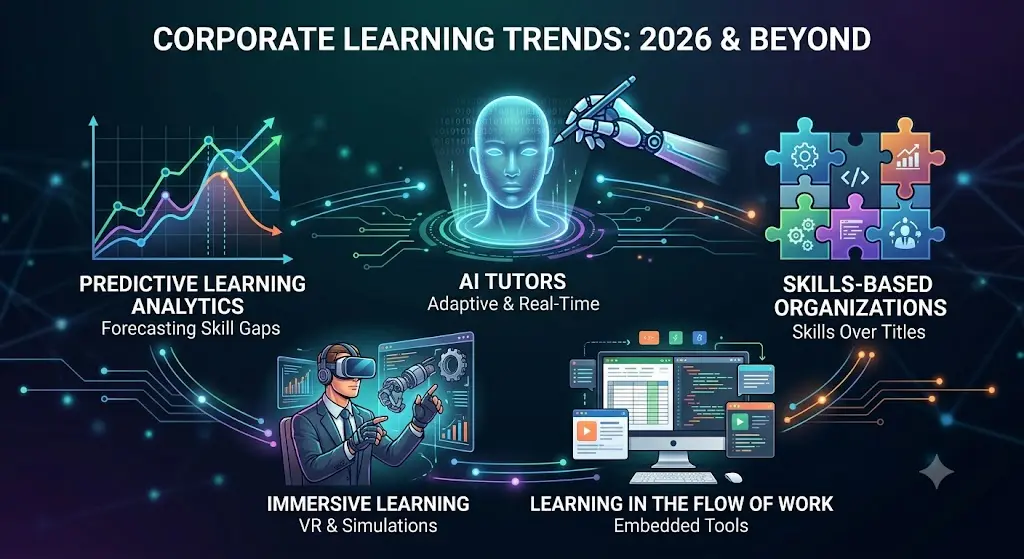
1. AI Tutors
Expect more one-on-one, AI-driven tutoring experiences that adapt in real time to an individual’s pace and knowledge gaps, rather than relying solely on pre-built courses.
2. Skills-Based Organizations
More companies are restructuring around skills rather than job titles, which changes how hiring, promotion, and learning all get planned.
3. Learning in the Flow of Work
Rather than pulling people away from their jobs to learn, more tools are embedding learning directly into the software and workflows employees already use.
4. Immersive Learning
VR and simulation-based training are becoming more practical for high-stakes scenarios like safety drills or difficult customer conversations where mistakes in real life are costly.
5. Predictive Learning Analytics
Organizations are starting to use data to predict skill gaps before they become critical, rather than reacting after performance already suffers.
Frequently Asked Questions
1. What is corporate learning and development?
It’s the set of programs and systems organizations use to build employee skills and capabilities in support of business goals, covering everything from onboarding to leadership development.
2. Why is corporate learning and development important?
It drives measurable outcomes like retention, productivity, innovation, and a stronger leadership pipeline while its absence shows up as turnover and stalled growth.
3. What’s the difference between training and L&D?
Training is a single event aimed at a specific skill. L&D is the broader, ongoing strategy that training sits inside.
4. What technology do companies use for L&D?
Most rely on a combination of an LMS, an LXP, AI-powered learning tools, and increasingly, skills intelligence platforms.
5. How do you measure L&D success?
Through a mix of completion rates, skill improvement, engagement, and most importantly the impact on business KPIs and ROI.
6. What are the biggest L&D mistakes companies make?
Generic, one-size-fits-all training, no measurement, weak leadership support, and content that goes stale without regular updates.
Conclusion
Corporate learning and development isn’t a department task anymore, it’s a business capability that shows up directly in growth, retention, and competitive advantage. The organizations getting this right aren’t necessarily spending the most money. They’re the ones treating learning as a system tied to real business needs, measured honestly, and reinforced by leadership at every level.
If you’re starting from scratch, don’t try to build everything at once. Here’s a practical next-steps roadmap:
- Audit your current skills gaps against where the business is headed over the next 12–24 months.
- Pick one high-priority program leadership development, a critical technical skill, or onboarding and build it well before expanding.
- Choose technology that fits your size and needs, not the most feature-heavy option on the market.
- Pilot before you scale, and build in a feedback loop from day one.
- Define your success metrics up front, tied to business KPIs, so you can prove and improve the program’s impact over time.
Corporate learning and development are well compounded. Every skill built today makes the next one easier to develop, and that’s ultimately what turns a training budget into a real competitive advantage.