


Every company says it cares about growing its people. Far fewer actually have a plan for it. A learning and development strategy is what turns that good intention into something real: a system that helps employees build skills, do their jobs better, and grow into bigger roles, while quietly moving the business forward at the same time.
If you have ever tried to run employee training without a strategy behind it, you already know the problem. Courses get assigned but never finished. Managers cannot say which skills their teams are missing. Leadership cannot tell if any of it is working. A clear L&D strategy fixes that by connecting learning to actual business outcomes instead of treating training as a box to check.
This guide walks through what a learning and development strategy actually is, why it matters, and how to build one step by step, along with the tools and metrics that make it work in practice.
What Is a Learning and Development Strategy?
L&D Strategy Definition
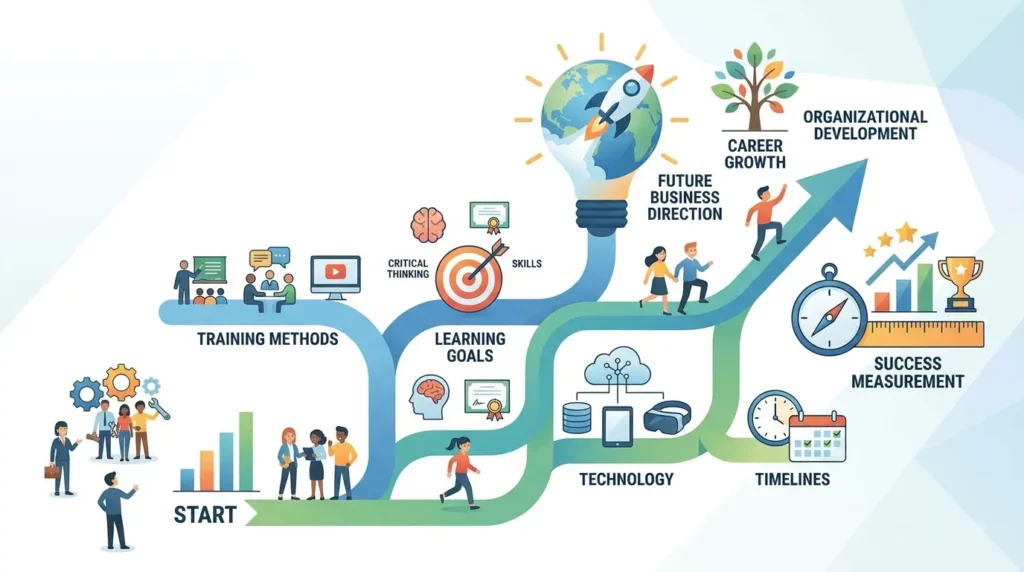
A learning and development strategy is a structured plan that outlines how an organization will help employees build the knowledge and skills they need, both for their current role and for where the business is headed. It usually covers training methods, learning goals, technology, timelines, and the way success gets measured.
According to overview of training and development, the field has evolved from simple skills based instruction into a much broader practice that includes career development, organizational development, and performance management. That shift is exactly why a strategy matters more today than it used to.
Why L&D Matters for Businesses
Skills go out of date faster than most people expect, especially in industries touched by technology. A business that is not actively developing its people is quietly falling behind, even if nobody notices right away. L&D is how organizations stay adaptable instead of scrambling to catch up later.
L&D Strategy vs Employee Training Program
These two terms get used interchangeably, but they are not the same thing. A training program is a single initiative, maybe an onboarding course or a compliance module. An L&D strategy is the bigger picture that decides which programs get built, why they exist, and how they tie back to business goals. Think of training as the individual bricks and the strategy as the blueprint.
Why Businesses Need an L&D Strategy
Close Employee Skill Gaps
Every team has gaps between the skills employees currently have and the skills the job actually demands. A strategy gives you a way to spot those gaps early and address them before they turn into performance problems.
Improve Employee Performance
Employees who receive relevant, well timed training tend to work more efficiently and make fewer mistakes. Performance improvement is rarely about hiring different people. It is usually about developing the ones you already have.
Increase Employee Engagement
People want to feel like they are growing, not standing still. A recurring theme in career discussions on careerguidance on Reddit is how quickly employees disengage when they feel their employer has stopped investing in them. A visible L&D strategy signals the opposite.
Read more: How to Improve Employee Engagement Through Online Training
Support Employee Retention
Replacing an employee is expensive, and losing institutional knowledge costs even more than the hiring bill suggests. Employees who see a real path to growth inside the company are far less likely to look for it somewhere else.
Prepare Employees for Future Roles
A good strategy does not just fix today’s gaps. It also builds a pipeline of employees who are ready to step into leadership and specialized roles as the business grows, instead of forcing you to hire that expertise from outside every time.
Align Employee Development With Business Goals
Training that has no connection to business priorities tends to get deprioritized the moment things get busy. When learning is clearly tied to revenue, retention, or strategic goals, it earns a permanent seat at the table instead of being the first budget line cut.
How to Build a Successful Learning and Development Strategy
1. Understand Business Goals
Start by identifying what the business is actually trying to achieve over the next year or two. That might mean entering a new market, improving customer satisfaction, or scaling a technical team. Once those priorities are clear, map employee development directly against them so learning has a purpose beyond general improvement.
2. Identify Employee Skill Gaps
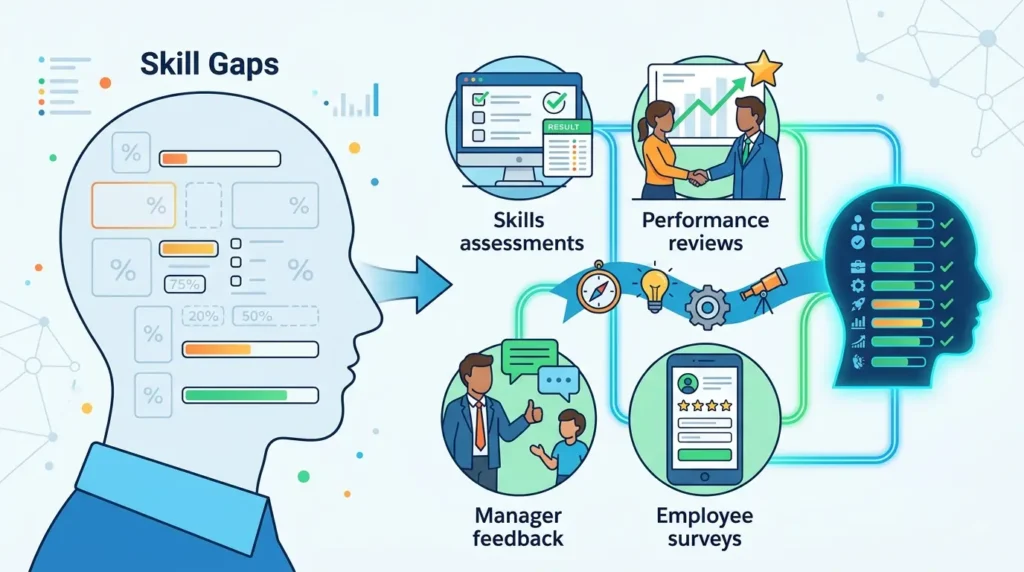
You cannot close a gap you have not measured. A few reliable ways to find out where employees actually stand include:
- Skills assessments
- Performance reviews
- Manager feedback
- Employee surveys
Using more than one of these together usually gives a far more accurate picture than relying on a single source.
3. Define Learning Objectives
Vague goals like “improve skills” do not give anyone a way to measure progress. Set objectives that are specific and measurable, and match them to the responsibilities of each role so employees can see exactly why a course applies to them.
4. Identify the Right Training Methods
Not every skill is best taught the same way. A well rounded strategy usually draws from a mix of formats, such as:
- Online learning
- Instructor led training
- Blended learning
- Microlearning
- Self paced learning
The right mix depends on the skill being taught, the size of the team, and how much time employees realistically have to dedicate to learning.
5. Create Role Based Learning Paths
A single generic training track rarely works for an entire organization. Different roles need different skills, so learning paths should be built around the people who will actually use them, for example:
- New employees
- Managers
- Technical teams
- Sales teams
- Customer service teams
6. Choose the Right Learning Technology
Technology is what makes an L&D strategy scalable instead of something managed through spreadsheets and email reminders. When evaluating a platform, look closely at:
- A learning management system, or LMS
- Learning analytics
- Assessments
- Progress tracking
- Reporting
- AI powered learning features
For a deeper look at how learning management systems work under the hood, Wikipedia’s entry on learning management systems is a solid starting point.
7. Launch the L&D Program
A strong launch is about clear communication as much as it is about the training content itself. Before rolling anything out:
- Communicate the goals of the program to employees
- Make sure everyone has access to the training
- Set realistic timelines and expectations
8. Measure and Improve the Strategy
An L&D strategy is never really finished. Track progress consistently, collect honest feedback from employees and managers, review performance data, and update the training itself based on what the results are actually telling you.
Key Components of an Effective L&D Strategy
A handful of elements show up in almost every successful strategy, regardless of company size or industry:
- Clear learning goals
- Skills gap analysis
- Role based training
- Personalized learning
- Continuous learning, not a one time event
- Performance tracking
- Training evaluation
How to Measure L&D Strategy Success
Numbers tell you whether the strategy is actually working, not just whether it looks good on paper. Here are the metrics worth tracking:
| Metric | What It Measures |
| Course completion | Training participation |
| Assessment scores | Knowledge gained |
| Skill improvement | Employee development |
| Employee engagement | Learning participation |
| Employee retention | Impact on workforce stability |
| Performance improvement | Workplace impact |
| Training ROI | Business value |
Common L&D Strategy Challenges and How to Solve Them
Lack of Employee Engagement
Make training relevant to each person’s actual job instead of generic. Short, focused content tends to hold attention far better than long mandatory modules.
Limited Training Budget
Start with the highest impact skill gaps rather than trying to cover everything at once. Free or low cost resources and internal knowledge sharing can stretch a small budget surprisingly far.
Difficulty Identifying Skill Gaps
Combine data from performance reviews, manager input, and direct employee feedback rather than guessing. The more sources you pull from, the more accurate the picture becomes.
Lack of Management Support
Show managers how development directly benefits their own team’s output. Once they see the connection, buy in tends to follow naturally.
Outdated Training Content
Set a recurring schedule to review and refresh materials, ideally tied to major changes in tools, processes, or industry standards.
Difficulty Measuring Results
Choose a small set of metrics that connect clearly to business outcomes and track them consistently, rather than drowning in data that does not answer any real question.
Different Learning Needs Across Teams
Role based learning paths solve most of this on their own, since they are built around what each team actually needs rather than a one size fits all curriculum.
How an LMS Supports an L&D Strategy
A learning management system is what turns a strategy on paper into something employees actually experience day to day. Here is what a capable LMS typically handles:
Centralized Training Management
All courses, materials, and records live in one place instead of being scattered across drives, emails, and spreadsheets.
Personalized Learning Paths
Employees see training that is relevant to their role instead of a generic list of courses that may not apply to them at all.
Employee Progress Tracking
Managers and L&D teams can see exactly who has completed what, and who might need a nudge or extra support.
Assessments and Certifications
Built in testing confirms that knowledge was actually retained, not just that a video was played to the end.
Reporting and Analytics
Clear dashboards make it far easier to spot trends and prove the value of training to leadership.
Automated Training Assignments
New hires and role changes can trigger the right training automatically, without anyone having to remember to assign it manually.
AI Powered Learning
Increasingly, platforms use AI to recommend content, personalize learning paths, and flag skill gaps before they become visible in performance reviews.
This is exactly where a platform like SkillForce LMS fits in. It brings centralized course management, role based learning paths, real time progress tracking, and AI powered recommendations together in one system, so an L&D strategy does not stay a document nobody looks at again. It becomes something the whole organization actually runs on.
Best Practices for a Successful L&D Strategy
Make Learning Continuous
Treat development as an ongoing habit rather than a single course employees complete once and forget.
Personalize Employee Development
Tailor content to individual roles, skill levels, and career goals wherever possible, instead of pushing the exact same material to everyone.
Encourage Manager Involvement
Managers who actively support learning, rather than simply approving it, tend to see far better completion and retention rates on their teams.
Use Employee Feedback
Ask employees what is actually working and what is not, then act on what they tell you. Feedback that goes nowhere stops getting given honestly.
Connect Learning With Career Growth
Show employees how specific skills connect to promotions, new responsibilities, or lateral moves. That link is often what turns training from an obligation into something people genuinely want to do.
This idea comes up constantly in professional discussions on LinkedIn Learning’s blog on workplace learning trends, where career development is consistently ranked as one of the top reasons employees stay with, or leave, an employer.
Review the Strategy Regularly
Business goals shift, and an L&D strategy needs to shift with them. Revisit it at least once or twice a year to keep it aligned with where the company is actually headed.
L&D Strategy Checklist
A quick reference for putting everything above into motion:
☐ Identify business goals
☐ Assess employee skills
☐ Identify skill gaps
☐ Set learning objectives
☐ Create role based learning paths
☐ Choose training methods
☐ Select the right learning platform
☐ Launch training
☐ Track employee progress
☐ Measure results
☐ Improve the strategy
Frequently Asked Questions
What is a learning and development strategy?
It is a structured plan that defines how a company will build employee skills and knowledge, using clear objectives, training methods, and ways to measure whether it is working.
Why is an L&D strategy important?
It connects employee growth to real business results, rather than letting training happen randomly without any clear purpose or way to measure impact.
How do you create an L&D strategy?
Start with business goals, identify skill gaps, define measurable objectives, choose the right training methods and technology, then launch and continually measure the results.
What are the key components of an L&D strategy?
Clear goals, a skills gap analysis, role based training, personalization, continuous learning, performance tracking, and ongoing evaluation.
How do you measure L&D success?
Through metrics such as course completion, assessment scores, skill improvement, engagement, retention, performance improvement, and training ROI.
What is the difference between L&D and employee training?
Employee training refers to individual programs or courses. An L&D strategy is the broader plan that decides which programs to build and why.
How does an LMS support learning and development?
It centralizes training, personalizes learning paths, tracks progress, manages assessments, and provides the reporting needed to prove the strategy is working.
How can AI improve learning and development?
AI can recommend relevant content, personalize learning paths automatically, and flag emerging skill gaps before they start affecting performance.
Conclusion
A learning and development strategy is not a nice to have anymore. It is what separates companies that keep pace with change from those that fall behind while wondering what happened. When employee growth is tied directly to business goals, and measured consistently over time, everybody wins: employees grow into stronger versions of themselves, and the business grows right along with them.
Getting there does take structure, though, and that is exactly where the right tools make the difference. SkillForce LMS was built to help L&D teams manage training, personalize learning paths, track real progress, and measure results, all in one place, so a strategy like the one outlined above can actually run day to day instead of sitting in a document that nobody opens again.