


Most companies don’t fail at training because they lack courses. They fail because nobody linked the training to a real business problem.
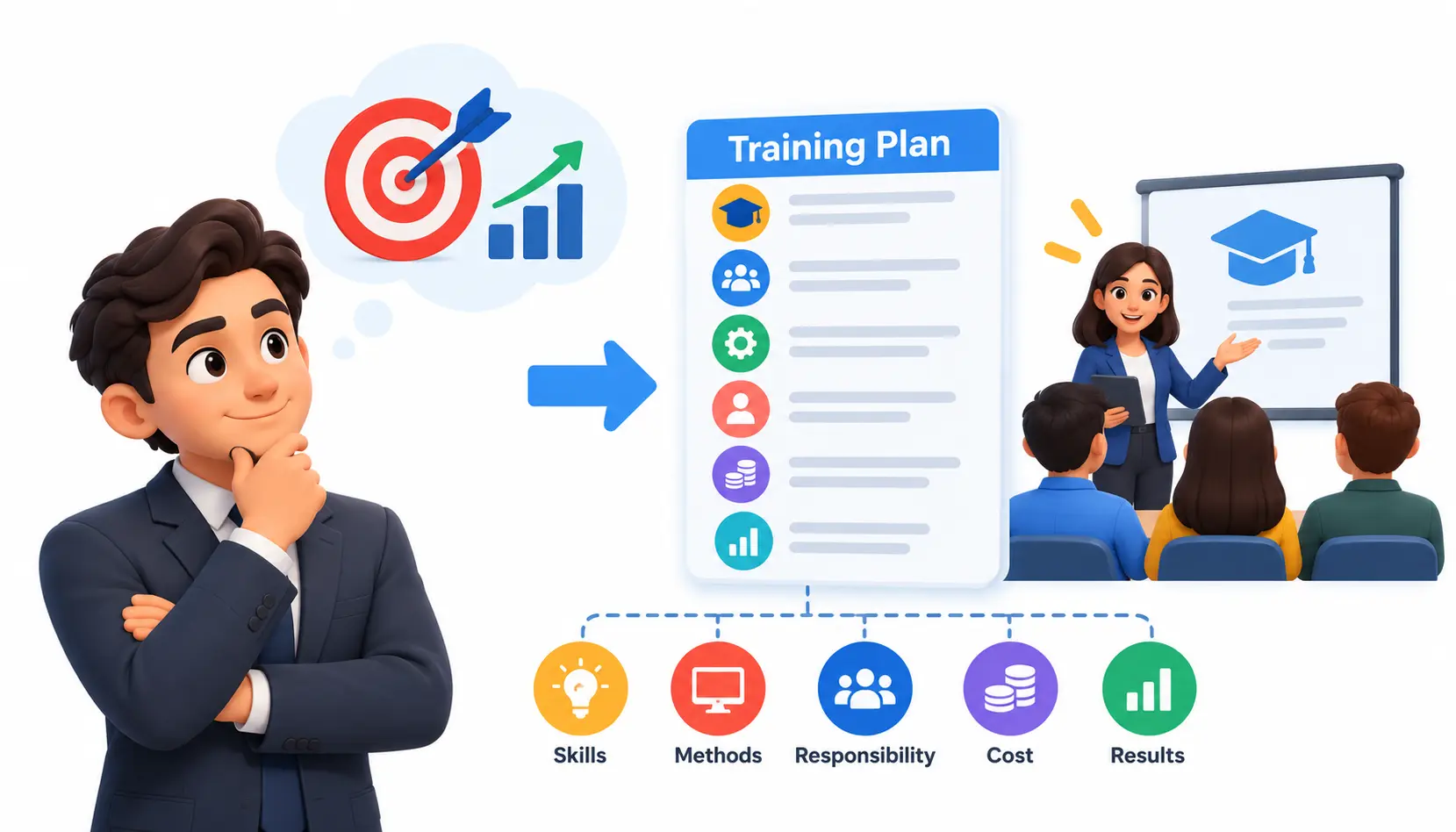
A corporate training plan fixes that. It is a written roadmap that shows which skills your employees need, how you will teach them, who is responsible, what it costs, and how you will know it worked. This guide walks you through the full process, step by step, and includes a template and a hypothetical example you can copy.
If you remember one thing, make it this: start with the business result you want, then work backward to the training. That one habit separates useful plans from forgotten PDFs.
What Is a Corporate Training Plan?
A corporate training plan is a documented strategy that outlines what training employees will receive, why it is needed, how it will be delivered, when it will happen, who owns it, and how success will be measured. It connects employee development to specific business goals.
Think of it as the difference between buying random gym equipment and following a workout schedule. The equipment (courses, tools, workshops) matters, but the schedule and the goal give it direction.
Corporate Training Plan vs. Training Program
A training plan is the blueprint. A training program is one of the things the blueprint organizes.
For example, a plan might say: “Reduce customer escalations in Q3 by training all support agents in de-escalation.” The de-escalation workshop, the practice role-plays, and the manager coaching sessions are the program. One plan can include several programs.
Corporate Training Plan vs. Learning and Development Strategy
A learning and development (L&D) strategy looks at the long term. It asks where the workforce needs to be in the next three to five years, and which capabilities the company must build.
A corporate training plan is more operational. It covers the specific training activities, dates, budgets, and owners that carry out that strategy. If L&D strategy is the destination, the training plan is the route. You can read more about the wider field on training and development.
Why Is a Corporate Training Plan Important?
A good plan keeps training focused, funded, and measurable. Without one, training tends to be reactive. A manager asks for a course after a problem has already hurt the business, and no one checks whether the course helped.
Identify and Address Employee Skill Gaps
A plan forces you to compare the skills people have with the skills the work requires. That comparison shows you where training will actually make a difference, and where it won’t.
Improve Employee Performance and Productivity
When training targets a specific task or behavior, people can apply it right away. Generic training rarely changes how someone works on Monday morning. Targeted training often does.
Support Employee Development and Retention
People tend to stay longer when they see a path to grow. A plan shows employees that the company is investing in their careers, not just filling a compliance checklist.
Maintain Compliance and Workplace Standards
Some training is required by law or by industry rules, such as workplace safety, data protection, or harassment prevention. A plan helps you schedule it, track completion, and keep records ready for audits.
Prepare Employees for New Technologies and Business Changes
New software, new processes, and reorganizations all create skill gaps. Planning ahead means your team is trained before the change goes live, not weeks afterward.
What Should a Corporate Training Plan Include?
Every solid plan answers the same core questions. Here is a quick view of the essential components.
| Component | The question it answers |
| Business need | Why are we doing this training? |
| Target audience | Who needs it? |
| Learning objectives | What should people be able to do afterward? |
| Content and methods | What will we teach, and how? |
| Timeline and budget | When will it happen, and what will it cost? |
| Owners | Who is responsible for each part? |
| Assessment and metrics | How will we know it worked? |
Business Needs and Training Priorities
State the problem in business terms, such as rising error rates, slow onboarding, or missed sales targets. Then rank your needs. You rarely have the time or money to fix everything at once.
Target Employees and Learning Objectives
Name the roles or teams involved, and describe what success looks like for each. Good objectives describe behavior you can observe, not just things people “will understand.”
Training Content and Delivery Methods
List the topics, formats, and materials. Match the method to the content. A hands-on skill needs practice, not just slides.
Timeline, Budget, and Resources
Set start dates, end dates, and milestones. Estimate costs for trainers, platforms, materials, and the time employees spend away from regular work.
Owners, Assessments, and Success Metrics
Every piece of the plan needs one named owner. Every objective needs at least one measure, set before training starts, so you can compare results against a baseline.
How to Create a Corporate Training Plan in 8 Steps
Here is the short version for quick reference:
- Identify the business need.
- Conduct a training needs assessment.
- Set SMART training objectives.
- Define the target audience and learning path.
- Choose the right training methods.
- Develop the curriculum and materials.
- Create the training calendar and budget.
- Implement, evaluate, and improve.
Now let’s go through each step in detail.
Step 1. Identify the Business Need
Don’t start with “we need a leadership course.” Start with a problem, such as “new managers are losing team members within a year.”
Then define the outcome you want, in plain terms. For example: “Lower first-year team turnover under new managers.” Finally, pull whatever data you already have to set a baseline. This might be turnover reports, error logs, customer complaints, or sales numbers.
Without a baseline, you can’t prove the training made a difference later.
Step 2. Conduct a Training Needs Assessment
A training needs assessment is a structured way of finding out what skills or knowledge are missing and who is missing them. It is a standard step in instructional design, and you can see how it is described on Wikipedia’s needs assessment page.
Use several sources, not just one:
- Interviews or short surveys with managers and employees
- Performance reviews and skills assessments
- Quality issues, error reports, and customer feedback
- Observation of how work is actually done
Be careful here. Not every performance problem is a training problem. If agents are slow because the software crashes, a course won’t help. If a team is understaffed, a workshop won’t fix it either. Separate the training gaps from process, staffing, and technology issues before you spend a dollar.
Finally, rank the gaps. Focus on the ones with the biggest business impact first.
Step 3. Set SMART Training Objectives
SMART objectives are Specific, Measurable, Achievable, Relevant, and Time-bound. The SMART criteria give you a simple test for any goal.
Compare these two:
- Vague: “Improve customer service skills.”
- SMART: “By the end of Q3, 90% of support agents will resolve escalated calls using the new de-escalation method, as rated in manager observations.”
The second version tells everyone what to do, how it will be checked, and by when. It also ties learning to workplace behavior, which is what the business actually cares about.
Step 4. Define the Target Audience and Learning Path
Not everyone needs the same training. Group employees by role, current skill level, and responsibilities.
Then map out a learning path. Identify what people should already know, and arrange modules in a logical order, from basic to advanced. If a few employees already have the skills, let them skip ahead. Forcing experienced people through beginner material wastes time and hurts morale.
Step 5. Choose the Right Training Methods
No single method is best. Pick based on the skill, the audience, and your budget. Here are the main options and when each one fits. hoosing the right delivery method is only one part of the process. Learn how to build an effective employee training program that connects employee skill gaps with structured learning activities and measurable outcomes.
Instructor-Led Training
A trainer teaches in a classroom or live online session. It works well for complex topics, discussion, and role-play. The trade-off is cost and scheduling, since everyone has to be available at the same time.
E-Learning and Self-Paced Courses
Employees complete online modules on their own schedule. This scales easily and suits knowledge-based topics such as policies. The downside is lower engagement, so completion rates can be weak without follow-up.
Blended Learning
Blended learning combines online content with live sessions or practice. It often gives you the flexibility of e-learning and the interaction of a classroom, though it takes more effort to design.
On-the-Job Training, Coaching, and Mentoring
People learn by doing, with support from an experienced colleague. This is strong for practical, role-specific skills. It depends heavily on the quality and availability of the coach, so choose and prepare them carefully.
Microlearning and Practical Exercises
Microlearning delivers short lessons, often just a few minutes long. It fits busy schedules and works well for reinforcement. It is less suited to deep, complex topics on its own.
Step 6. Develop the Curriculum and Training Materials
Map every module to a learning objective. If a module doesn’t support an objective, cut it.
Include practice and assessment in each module, not just information. People remember what they use. Decide whether your own subject-matter experts will build the content or whether you’ll hire an outside provider. Internal experts know your business best, but they are often short on time. External providers bring design skill, but they need clear briefing.
Before launch, check that materials are accurate, current, and accessible to people with different needs, such as captions for video and readable layouts.
Step 7. Create the Training Calendar and Budget
Assign a date, duration, and owner to every activity. Schedule around busy periods. Sending the accounting team to a workshop during year-end close is a recipe for low attendance.
Estimate costs honestly. Include trainer or course fees, software, materials, and the cost of employee time. Decide who approves the budget and who runs delivery.
Step 8. Implement, Evaluate, and Improve the Plan
Tell employees and their managers what is coming and why it matters. If you can, run a small pilot first. A pilot with one team will reveal problems before you roll the training out to the whole company.
Then track results at four levels: participation, learning, workplace behavior, and business outcomes (more on that below). Use what you find to update the plan. A training plan is a living document, not a one-time project.
Corporate Training Plan Template
You can copy this table into a spreadsheet and fill in one row per training initiative.
| Field | What to enter |
| Training initiative | Name of the training activity |
| Business need | Problem or skill gap being addressed |
| Target audience | Employees or departments involved |
| Learning objective | Measurable expected outcome |
| Training method | Classroom, online, coaching, or blended |
| Owner | Person responsible for delivery |
| Timeline | Start date, end date, and milestones |
| Budget | Estimated training costs |
| Success metrics | Measures of learning and workplace impact |
| Review date | When results will be assessed |
Example of a Completed Training Plan
This is a hypothetical example for illustration only.
Imagine a customer support department where many calls are escalated to supervisors. Here is how one row of the plan might look.
| Field | Example entry |
| Training initiative | De-escalation skills program |
| Business need | Too many calls escalate to supervisors, which slows resolution times |
| Target audience | 25 frontline support agents |
| Learning objective | Agents resolve difficult calls without escalation using a defined method |
| Training method | Blended: a short online module, live role-play workshop, and manager observation |
| Owner | Support training lead |
| Timeline | Online module in week 1, workshop in week 2, observation in weeks 3 to 8 |
| Budget | Facilitator time, role-play materials, and agent hours (to be estimated) |
| Success metrics | Escalation rate versus baseline, observation scores, customer satisfaction |
| Review date | Eight weeks after the workshop |
Notice what makes this work. There is a baseline escalation rate, a practice component, manager follow-up, and a planned review. The training doesn’t end when the workshop does.
Annual Corporate Training Calendar Example
A yearly calendar helps you spread the load so that employees aren’t overwhelmed in any single quarter. Here is one simple way to arrange it. Adjust it to fit your industry and busy seasons.
| Quarter | Focus areas |
| Q1 | New-hire onboarding refresh, annual compliance training |
| Q2 | Technical and role-specific skills, software updates |
| Q3 | Leadership and management development |
| Q4 | Review of results, advanced skills, planning for next year |
Onboarding runs all year for new hires, so treat the quarter listing as the main push, not the only one.
How to Develop a Corporate Training Budget
A training budget turns your plan into something leadership can approve. Keep it simple and transparent.
Identify Direct and Indirect Costs
Direct costs are the bills you pay: trainer fees, course development, learning platform licenses, printed or digital materials, and travel if needed.
Indirect costs are easy to forget. The biggest is employee time. If 30 people spend four hours in training, that is 120 hours not spent on their normal work. Include it in your estimate so the real cost is visible.
Prioritize Training Within a Limited Budget
Most teams can’t fund everything. Rank each initiative by four things:
- Business impact: How much does the problem hurt results?
- Urgency: Does it need to happen now?
- Risk: What happens if we skip it, such as a compliance failure?
- Cost: What will it take to do it well?
Fund the high-impact, high-risk items first. Lower-priority training can wait, or use cheaper methods like peer coaching.
Calculate Training ROI
Return on investment (ROI) compares what you gained with what you spent. The basicreturn on investment formula is:
ROI (%) = (Benefits − Costs) ÷ Costs × 100
Here is a simple example. Suppose a program costs $20,000 and you estimate it produced 30,000inbenefits,suchasreducedrework.TheROIis(30,000 − $20,000) ÷ $20,000 × 100, which equals 50%.
A word of caution. The hard part is estimating benefits fairly. Many factors affect results at the same time, so be honest about how much of the improvement you can credit to the training. Not every outcome, such as better teamwork, can be turned into a reliable dollar figure. Use ROI where it is credible, and use other measures where it isn’t.
How to Measure Corporate Training Effectiveness
To measure training effectiveness, check four things: whether people took part, whether they learned, whether they changed how they work, and whether the business improved. Each one tells you something different.
Track Participation and Completion
Attendance and completion rates show whether training was delivered. They do not show whether it worked. Someone can click through a course and learn nothing, so treat these as delivery metrics only. To make these measurements easier to manage, learn how to track employee training progress using completion records, assessment results, progress dashboards, and certification tracking.
Measure Learning Outcomes
Use quizzes, practical exercises, and skill demonstrations to check whether people can actually do what the training taught. Compare scores before and after when you can.
Evaluate Workplace Application
This is where many programs fall short. Ask managers to observe behavior, review work samples, and check operational indicators a few weeks after training. Learning only matters if it shows up on the job.
Measure Business Results
Pick metrics linked to your original business need. Examples include error rates, customer escalations, sales conversion, time to proficiency for new hires, or compliance outcomes. Compare them with your baseline from Step 1.
Use the Kirkpatrick Model to Structure Evaluation
The Kirkpatrick model is a widely used framework for evaluating training. It has four levels:
- Reaction: How did participants feel about the training?
- Learning: What knowledge or skills did they gain?
- Behavior: Are they applying it at work?
- Results: Did it improve business outcomes?
The four levels line up neatly with the four measures above. Using them together gives you a fuller picture than any single number. Government and public-health agencies, including the U.S. Centers for Disease Control and Prevention, also publish training-development resources that use similar evaluation thinking.
Best Practices for a Successful Corporate Training Plan
Align Training With Business Priorities
If leadership can’t see how training supports company goals, it will be the first thing cut. Tie every initiative to a result the business cares about.
Involve Managers Before and After Training
Managers shape whether new skills stick. Brief them before training so they know what to expect. Afterward, ask them to coach, observe, and reinforce. Without that support, employees often slip back into old habits.
Make Training Relevant to Real Work
Use examples, tools, and scenarios from your own workplace. A salesperson will pay more attention to a role-play based on a real customer objection than to a generic case study.
Build in Practice and Reinforcement
People forget much of what they hear once. Add practice sessions, short refreshers, and job aids so the learning is repeated over time.
Review Results and Update the Plan Regularly
Set a review date for each initiative. Ask what worked, what didn’t, and what has changed in the business. Then adjust.
Use an LMS or Other Tools When They Solve a Real Need
A learning management system (LMS) can help you assign courses, track completion, and report on results. It makes the most sense when you have many learners or heavy compliance needs. For a small team, a shared spreadsheet may be enough. Buy the tool to fix a problem you actually have. For organizations that need a centralized way to deliver courses, manage employee learning, and monitor training results, a corporate training LMS can help organize learning activities and track workforce progress.
Common Corporate Training Planning Mistakes to Avoid
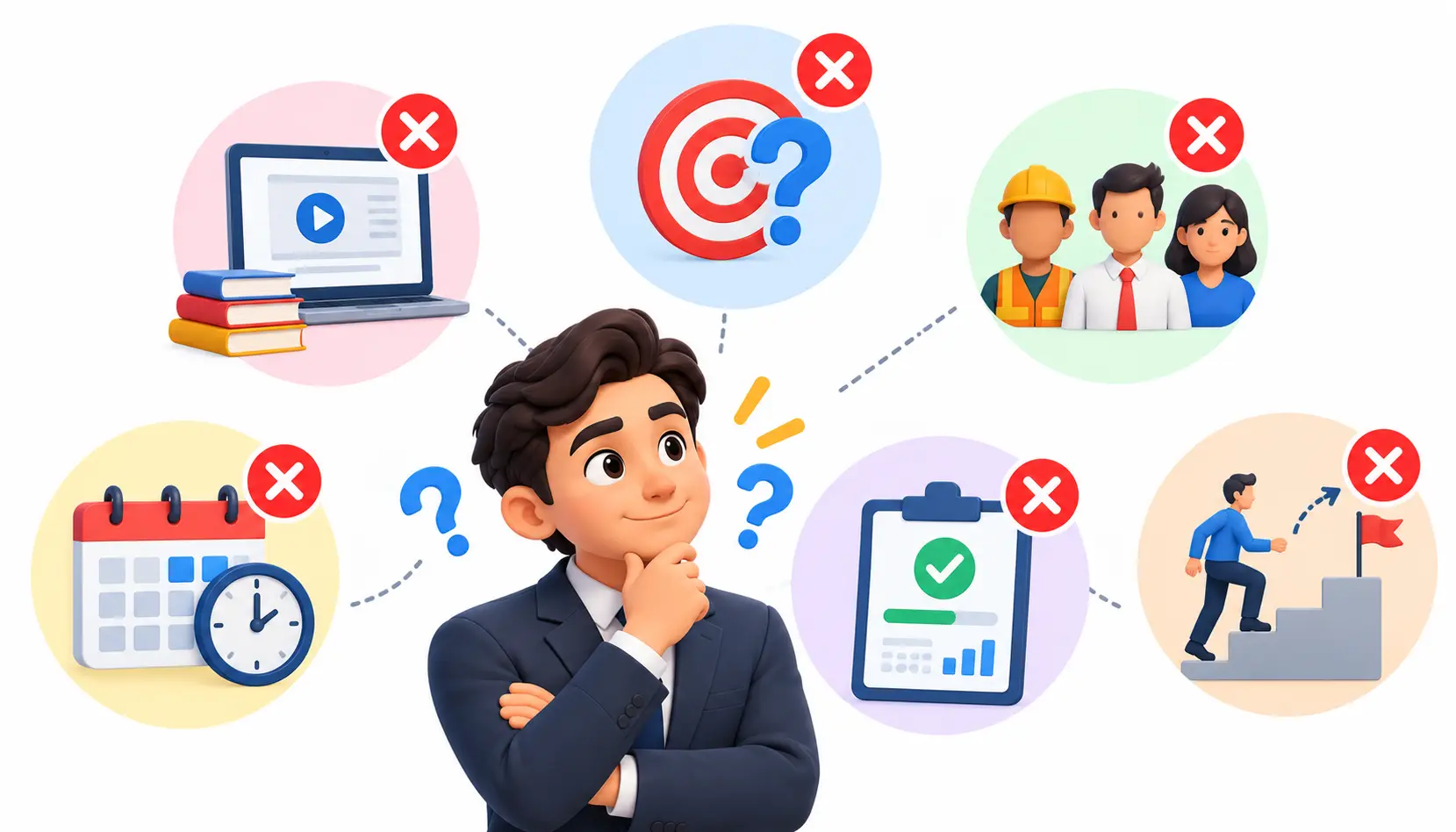
Creating Courses Before Identifying the Problem
Building content first feels productive, but it often solves the wrong problem. Do the needs assessment before you write a single slide.
Setting Vague or Unmeasurable Objectives
Goals like “improve communication” can’t be checked. Rewrite them so someone could observe or measure the result.
Choosing Methods Without Considering the Audience
A long self-paced course may flop with field staff who don’t have a desk or much free time. Consider where, when, and how your people actually work.
Ignoring Employee Workloads and Scheduling
Training that competes with deadlines will lose. Plan around busy seasons and give people protected time to learn.
Measuring Completion Instead of Performance
A 100% completion rate can hide a 0% change in behavior. Track what people do afterward, not just whether they finished.
Failing to Follow Up After Training
The real learning happens when people apply the skills. Plan check-ins, coaching, and refreshers for the weeks after the formal training ends.
Frequently Asked Questions About Corporate Training Plans
1. How Do You Create a Corporate Training Plan?
Start by identifying a business need, then assess skill gaps, set SMART objectives, define your audience, choose methods, build the content, schedule and budget the work, and finally implement and evaluate. The eight steps above walk through this in order.
2. What Are the Main Components of a Corporate Training Plan?
The main components are the business need, target audience, learning objectives, content and delivery methods, timeline, budget, owners, and success metrics.
3. How Long Does It Take to Create a Corporate Training Plan?
It depends on the scope. A focused plan for one team or one skill can come together in a few weeks. A company-wide plan, which needs more data gathering and approvals, usually takes longer. The needs assessment is often the most time-consuming part.
4. What Is the Difference Between a Training Plan and a Training Program?
A training plan is the overall roadmap covering goals, audiences, schedules, budgets, and measures. A training program is a specific set of learning activities, such as a workshop series, that the plan includes.
5. What Are the Best Methods for Corporate Training?
There is no single best method. Instructor-led training suits complex or interactive topics. E-learning suits scalable, knowledge-based content. Coaching and on-the-job training suit practical skills. Many organizations combine them through blended learning.
6. How Do You Measure the Success of Employee Training?
Compare results against a baseline at four levels: participation, learning, on-the-job behavior, and business outcomes. The Kirkpatrick model offers a useful structure for this.
7. How Often Should a Training Plan Be Updated?
Review it at least once a year, and sooner when something major changes, such as new technology, new regulations, or a shift in strategy. Individual initiatives should have their own review dates.
8. Which Tools Can Help Manage a Corporate Training Plan?
Spreadsheets work well for small teams. Larger organizations often use a learning management system to assign courses and track completion. Project management and survey tools can also help with scheduling and feedback.
Conclusion
A strong corporate training plan starts with a business problem, not a course catalog. It sets clear objectives, matches the method to the audience, gives every task an owner, and measures results beyond attendance.
Start small if you need to. Pick one high-impact need, fill in one row of the template, run a pilot, and review the results. Each cycle will make your next corporate training plan sharper.