


Most employee development plans end up in a shared folder. A manager writes one during review season, the employee nods along, and nobody opens the file again until next year.
Knowing how to create an employee development plan that people actually use comes down to a simple loop: find the skill gap, set a goal the employee cares about, choose how they will learn, and check in on a schedule. This guide covers that loop in ten steps, with a skills gap matrix, a fill-in template, role-based examples, and a way to measure results beyond course completions. It works for an HR team of ten and for a manager with a team of six.
What is an employee development plan?
An employee development plan is a structured document that records an employee’s goals, current skills, skill gaps, and the actions, resources, and deadlines for closing those gaps. It connects what the person wants to learn with what the business needs, and it builds in regular reviews so the plan stays alive.
In plain English, it is a map from where this person is now to where they need to be next.
What an employee development plan includes
| Component | Purpose |
| Employee information | Names the employee, role, and manager |
| Development objectives | States the outcome the employee is working toward |
| Skills assessment | Shows strengths and gaps against the role |
| Development activities | Lists the learning actions to take |
| Resources | Covers budget, tools, mentors, and protected time |
| Timeline | Sets deadlines and milestones |
| Success metrics | Defines how progress will be judged |
| Review schedule | Keeps both sides accountable |
Employee development plan vs. career development plan
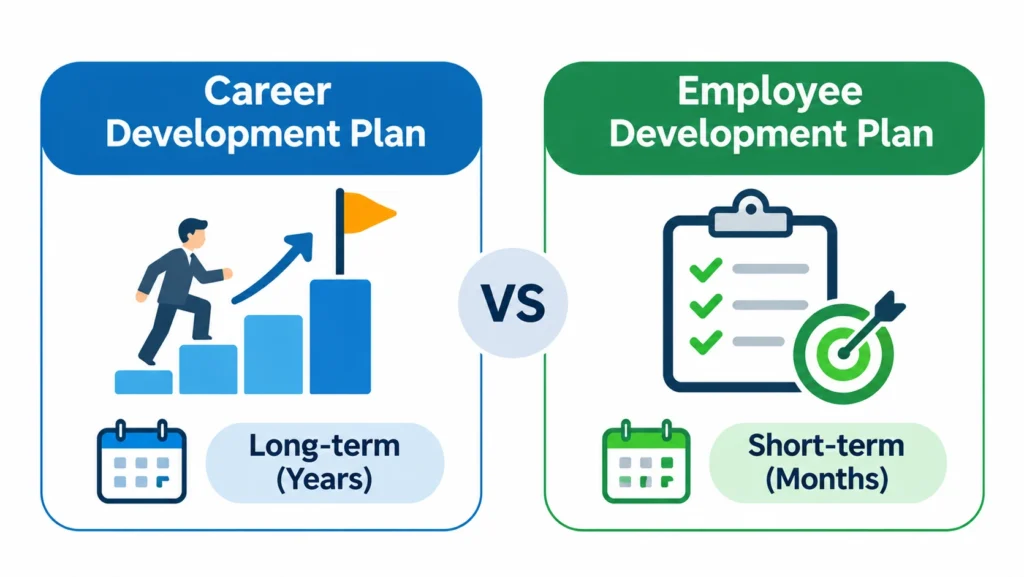
A career development plan looks several years ahead and asks where someone wants their career to go, sometimes beyond the current company. An employee development plan is narrower. It covers the skills needed for the current role or the next one, usually over months rather than years.
The two work well together. The career plan sets the direction, and the development plan lists this year’s steps. You will also see “individual development plan” (IDP) used for the same document, and most organizations treat the two terms as interchangeable. A training plan is smaller again: it lists courses but does not set goals or assign ownership.
Employee development plan vs. performance improvement plan
The two documents have different jobs, and mixing them up damages trust.
| Employee development plan | Performance improvement plan |
| Aimed at growth | Aimed at fixing a specific performance problem |
| Usually proactive | Usually corrective |
| Covers skills for future responsibilities | Covers defined expectations the employee is not currently meeting |
| Employee helps shape it | Manager and HR typically define it |
If an employee hears “development plan” and later learns it was a formal warning, they will stop believing the next one. Keep the two separate and name each honestly.
Why employee development plans matter
- They close skill gaps on purpose. Without a plan, training tends to follow whatever course was available. With one, it targets what the work requires.
- They give managers a structure for career talks. Many managers avoid these conversations because they don’t know where to start. The plan supplies the agenda.
- They can raise engagement. People put more effort into learning that connects to their own goals and daily tasks.
- They support retention. An employee who can see a next step inside the company has a reason to stay. It is no guarantee, but a visible path beats a vague promise.
- They feed your leadership pipeline. Plans for future managers are the practical side of succession planning, because they show who is ready for which role and what is still missing.
Types of employee development plans
Pick the type that matches the person’s situation. Many employees will need a blend of two.
- Skills-based plan. Targets specific technical or soft skills for the current role. It pairs naturally with a skills-based training approach where progress is judged by what someone can do.
- Career development plan. Prepares an employee for a promotion or a move into a new function.
- Leadership development plan. Builds people-management skills in future team leads and managers.
- Performance-based plan. Responds to review feedback with targeted growth, without the disciplinary tone of a PIP.
- Cross-functional plan. Gives someone exposure to another department through projects or rotations.
- New employee plan. Covers the first 30, 60, and 90 days so a new hire reaches full productivity faster.
- Succession-focused plan. Prepares a named person for a specific critical role.
How to create an employee development plan: 10 steps
Here is the full process at a glance:
- Identify organizational and employee development needs.
- Assess current skills and competencies.
- Discuss career aspirations with the employee.
- Establish SMART development goals.
- Choose learning and development activities.
- Create an action plan.
- Set timelines and milestones.
- Provide resources and management support.
- Monitor progress and measure outcomes.
- Review and update the plan.
To keep this concrete, we will follow one illustrative employee through all ten steps. Maya is a marketing executive, and both she and her company are made up for this guide.
Step 1: Identify organizational and employee development needs
Start with the business, not the course catalog. Ask leaders what the company needs to achieve in the next 12 months, then list the skills those goals depend on. Guidance on how to tie training to business goals can help you turn vague priorities into measurable ones.
Example: Maya’s company wants to stop wasting ad spend. That means every campaign needs someone who can read the numbers and change course.
Outcome: A short list of two or three skills the business needs more of.
Step 2: Assess current skills and competencies
Compare what the role requires with what the employee can do today. This is a skills gap analysis. If your company has a competency framework (a list of skills each role needs at each level), map the employee against it. That process is called competency mapping.
Use more than one source. Self-ratings run high or low, and managers only see part of the work. Combine a self-assessment, a manager rating, and a sample of real work.
Here is Maya’s matrix. The ratings are illustrative, not an industry benchmark.
| Skill | Current (1-5) | Required (1-5) | Priority |
| Campaign analytics | 2 | 4 | High |
| Presenting results | 3 | 4 | Medium |
| Project management | 3 | 4 | Medium |
| Copywriting | 4 | 4 | None |
Outcome: A ranked list of gaps, so the plan focuses on one or two skills instead of ten.
Step 3: Discuss career aspirations with the employee
A plan built only from the company’s needs feels like homework. Ask what the employee wants, then look for the overlap. A few questions that work:
- What part of your job do you want to do more of?
- Where would you like to be in two years?
- Which skill, if you had it tomorrow, would change your work the most?
- What has got in the way of learning so far?
Listen for three different things: interest (they want it), potential (they could do it), and readiness (they can do it now). A person can have the first two and still need a year of practice.
Example: Maya says she wants to lead campaigns within 18 months.
Outcome: Both sides agree on a direction.
Step 4: Establish SMART development goals
SMART goals are specific, measurable, achievable, relevant, and time-bound. The test is simple: could a stranger tell whether the goal was met?
Weak: “Get better at analytics.”
Stronger: “Within six months, build and present a monthly campaign performance report without help from the analytics team.”
Trace every goal back to a skill gap from Step 2 and a business need from Step 1. If you can’t draw both lines, rework the goal.
Outcome: One to three goals, each with a visible finish line.
Step 5: Choose learning and development activities
Match the method to the skill. Knowledge gaps suit courses. Judgment and people skills need practice and feedback.
The 70-20-10 model offers a useful starting point. It suggests that roughly 70% of development comes from on-the-job experience, 20% from other people, and 10% from formal courses. The numbers came from a 1996 survey of executives, and critics note that they are not a scientific rule. Use it as a reminder that courses alone rarely change how someone works.
A balanced mix for most plans:
- On the job: a stretch assignment or a small project with real stakes.
- From people: mentoring, coaching, or shadowing a colleague.
- Formal: an online course, workshop, or certification.
If you manage a large team, sequencing these into personalized learning paths keeps the plan from becoming a spreadsheet nobody maintains.
Example: Maya will take an analytics course, shadow a data analyst for an hour a week, and run one campaign from brief to results.
Outcome: Each skill gap has at least one learning activity and one practice activity.
Step 6: Create an action plan
Turn the goals and activities into a plan someone can follow. For each goal, write down the actions, who does what, and what support is needed. Be explicit about both sides. The employee owns the learning and the effort. The manager owns time, feedback, and removing obstacles.
The template in the next section shows how to lay this out.
Outcome: A single page that answers “what happens next, and who is responsible?”
Step 7: Set timelines and milestones
A goal without dates drifts. Split the plan into checkpoints, for example at 30, 90, and 180 days, and attach one observable result to each.
Example: For Maya, day 30 is the course finished, day 90 is a first draft report reviewed by the analyst, and day 180 is a solo report accepted without major rewrites.
Outcome: The employee can see progress, and the manager knows when to step in.
Step 8: Provide resources and management support
Most plans fail here. Employees are told to develop but given no time to do it. Protect learning hours on the calendar, even if it is only an hour or two a week. Confirm what budget exists for courses and tools. If it is small, lean on free material, internal experts, and stretch assignments.
Managers should also agree on how they will help: reviewing drafts, giving feedback after the first attempt, and checking in without hovering.
Outcome: The plan has the time, access, and backing it needs to move.
Step 9: Monitor progress and measure outcomes
Completion shows attendance, not skill. Check whether the employee can now do the task. Compare their work before and after, and ask the manager what has changed. If you use a learning system, tracking progress in an LMS saves time on the administrative side.
Outcome: Evidence of skill change, not just activity.
Step 10: Review and update the plan
How often should a development plan be reviewed? Monthly or quarterly check-ins work for most plans, with a formal review at the end of the plan period. Each review should cover progress, obstacles, and whether the goals still fit the business.
Business priorities change. If the company drops a project, adjust the plan rather than force an employee through irrelevant goals. When goals are met, set the next ones.
Outcome: A plan that stays relevant instead of aging in a folder.
Employee development plan template
Copy this structure into a document or spreadsheet. The third column shows Maya’s illustrative entries.
| Field | What to write | Example (Maya) |
| Employee and role | Name, job title, manager | Maya, Marketing Executive |
| Skill gap | Skill, current level, required level | Campaign analytics, 2 to 4 |
| Development objective | One SMART goal | Present a monthly campaign report independently within six months |
| Learning activities | Courses, projects, mentoring | Analytics course, weekly analyst shadowing, one campaign run end to end |
| Employee responsibility | What the employee will do | Finish modules, draft each report |
| Manager responsibility | What the manager will do | Review drafts, give feedback within a week |
| Resources | Budget, tools, protected time | Course access, dashboard login, two hours a week |
| Milestones | Dates and checkpoints | Day 30, day 90, day 180 |
| Success indicator | Observable result | Report accepted without major rewrites |
| Review schedule | Dates for check-ins | Monthly check-in, formal review at six months |
Fill it in together, not alone. Employees who help write the plan are more likely to follow it.
Here is the before-and-after view for Maya. The “after” column is the expected result if the plan works, not a guarantee.
| Skill | Before | Required | Expected after six months |
| Campaign analytics | 2 | 4 | 4 |
| Presenting results | 3 | 4 | 4 |
| Project management | 3 | 4 | 3 to 4 |
Employee development plan examples for different roles
These examples are illustrative. Adjust the activities and timelines to your own company.
- New employee. A junior support agent in the first 90 days. Objective: resolve routine tickets without escalation. Activities: product walkthroughs, shadowing two senior agents, a buddy for questions. Success indicator: handles the common ticket types unaided by day 90, confirmed by the manager’s checklist.
- Existing employee. Maya’s plan, shown above. It focuses on one high-priority skill and uses a real campaign as the practice ground.
- Future manager. Daniel is a senior accountant who may lead a team of four within a year. His gaps are delegation, giving feedback, and budget ownership. His plan includes a management fundamentals course, regular conversations with his current manager about how they handle team decisions, and leading one small cross-team project. Timeline: 12 months, with a quarterly review. Success indicator: positive feedback from project teammates and a budget plan he prepares himself.
- Technical employee. A developer with strong coding skills and little cloud experience. Objective: deploy an internal service to the cloud with a security review in six months. Activities: certification study, pairing with a senior engineer, a small internal project. Success indicator: the service passes review.
- Employee changing career paths. An operations coordinator who wants to move into data analysis. Gaps: SQL and dashboards. Activities: an SQL course, shadowing an analyst, a project using real operations data. Timeline: nine months. Success indicator: a dashboard the operations team uses weekly.
How to measure the success of an employee development plan
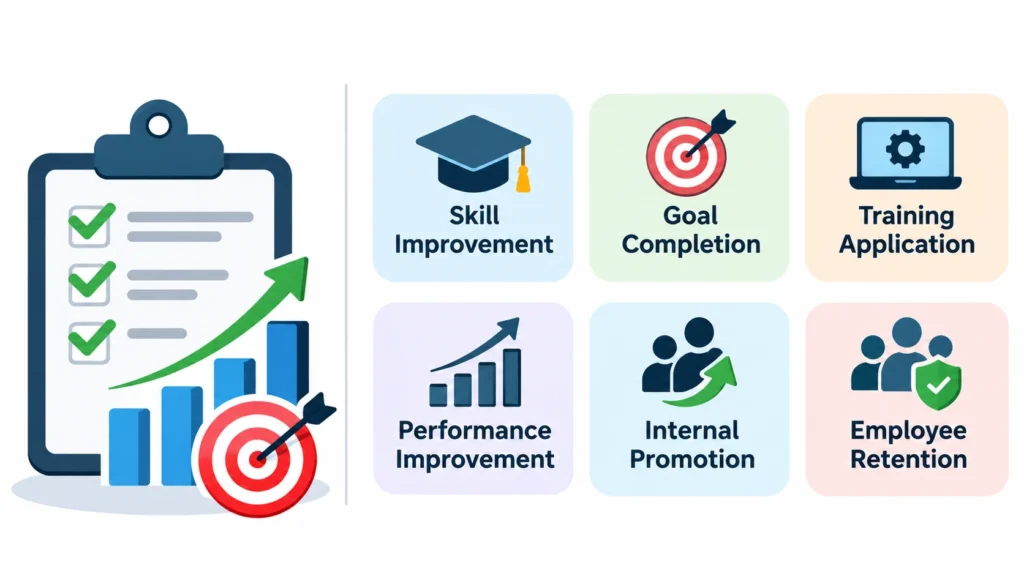
Start with the goals in the plan. If the goal was to present reports independently, measure that. Choose a few indicators tied to your actual objectives instead of tracking everything.
| KPI | What it measures |
| Skill proficiency improvement | Change in rated skill level over time |
| Goal completion rate | Share of development goals achieved |
| Training application rate | Whether learned skills show up in daily work |
| Performance improvement | Changes in job-related results |
| Internal promotion rate | Employees moving up inside the company |
| Employee retention rate | Whether people in plans stay longer |
Skill, goal, and application measures show results within months. Promotion and retention take longer, and many other factors affect them, so avoid giving the plan all the credit. The Kirkpatrick model is a common framework for judging training at four levels: reaction, learning, behavior, and results. Most plans should aim for the last two.
Common employee development planning challenges and how to fix them
- Vague goals. Rewrite them using the SMART test and attach a finish line.
- Low motivation. Revisit the career conversation. The goal may be the company’s, not the employee’s.
- Small budgets. Use stretch assignments, internal mentors, job shadowing, and free learning resources. Experience costs less than courses.
- Weak manager support. Give managers a short guide and ask for a 15-minute monthly check-in as a minimum.
- Unclear skill gaps. Add a work sample or a second rater to the assessment.
- No time for development. Block hours on the calendar and trim something else from the workload.
- Plans that never get updated. Put review dates in the calendar when you create the plan.
Best practices for effective plans
- Personalize. Two people in the same job can have different gaps.
- Build it together. The employee writes the first draft, and the manager edits.
- Balance both sides. Aim for goals where the employee’s interests and the company’s needs overlap.
- Favor practice. Pair every course with a real task.
- Stay flexible. Change the plan when the work changes.
Tools that can support your plan
A spreadsheet is enough to start. As the number of plans grows, software can handle assignments and reminders. Check current features and pricing before choosing.
- LinkedIn Learning. Courses on professional and technical skills.
- Coursera. University and industry courses and certificates.
- Moodle. An open-source learning management system for delivering training.
- Workday. HR software that includes talent and learning features.
- 360Learning. A platform built around collaborative learning.
Frequently asked questions about employee development plans
1. What is an employee development plan?
It is a document that lists an employee’s goals, skill gaps, learning activities, timelines, and review dates.
2. What are the five steps in employee development?
A short version: assess needs, set goals, choose activities, support and monitor, then review and update.
3. What should an employee development plan include?
Employee details, objectives, a skills assessment, activities, resources, a timeline, success metrics, and a review schedule.
4. How do you create an employee development plan?
Assess skills, discuss goals with the employee, write SMART objectives, choose learning activities, set milestones, and review on a schedule.
5. What are some examples of employee development goals?
Present a monthly report independently, lead a small project, earn a relevant certification, or deploy a service with a security review.
6. How long should an employee development plan last?
Many plans run six to twelve months. Leadership plans often run longer.
7. Who is responsible for creating an employee development plan?
The employee and manager build it together, with HR or L&D providing the template and resources.
8. How often should an employee development plan be reviewed?
Monthly or quarterly check-ins work for most plans, with a formal review at the end of the period.
9. How do you measure the success of an employee development plan?
Track skill improvement, goal completion, and whether new skills show up in daily work.
10. What is the difference between an employee development plan and a performance improvement plan?
A development plan supports growth. A PIP corrects a defined performance problem.
11. Can small businesses create employee development plans without a large training budget?
Yes. Use mentoring, shadowing, stretch assignments, and free online resources.
12. What tools can help manage employee development plans?
A shared spreadsheet works at first. Larger teams often move to a learning management system or HR platform.
Conclusion
Learning how to create an employee development plan is mostly about discipline. Assess the skills honestly, set goals the employee wants, choose activities that include real practice, give people time and manager support, and review progress on a schedule.
Start small. Pick one employee, one clearly defined objective, and one measurable action plan. Once you can show that person’s work improved, building the next plan will be much easier to justify.