

Employee career development is the ongoing work of helping people build the skills and experience they need for their next step, inside your company. Businesses do it through training, mentoring, career planning, internal moves, and personalized development plans. Done well, it keeps your best people and prepares them for roles you will need filled next year.
The pressure to get this right is growing. The World Economic Forum’s Future of Jobs Report 2025 found that employers expect about 39% of workers’ core skills to change by 2030, and 63% named skills gaps as their biggest barrier to business transformation. Hiring your way out of that is slow and expensive. Growing the people you already employ is usually faster.
This guide shows what employee career development looks like in practice. You will get ten strategies, a six-step build process, four sample plans, the technology that supports it, and the KPIs that tell you whether it works.
What Is Employee Career Development?
Employee career development is the process of helping employees plan, build, and move through their careers within an organization. It covers learning, feedback, mentoring, new assignments, and clear routes to bigger or different roles. The employee owns the ambition. The business supplies the structure, time, and opportunities.
Think of it as a long game. A training course fixes a skill today. Career development asks where a person could be in three years and what they need to get there.
Career Development vs. Employee Development vs. Professional Development
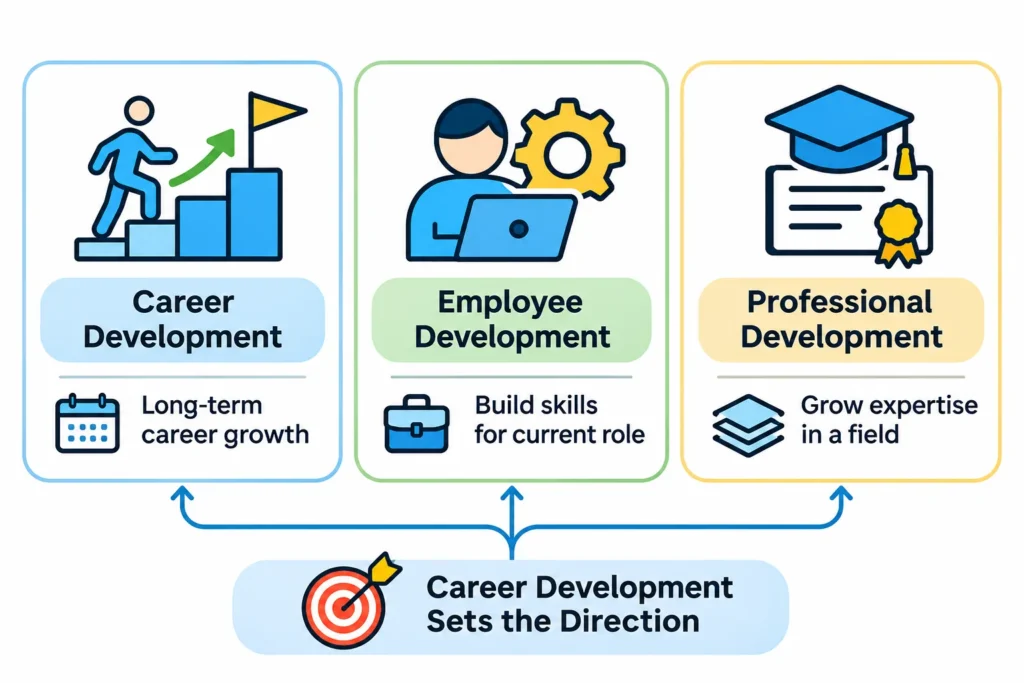
These terms overlap, and people use them loosely. Here is a simple way to separate them.
| Concept | Primary focus | Example |
| Career development | Long-term progression within and across roles | A career conversation that maps a path from analyst to team lead |
| Employee development | Improving capabilities for the current role and nearby roles | A reporting-tool course for an operations coordinator |
| Professional development | Building expertise in a field, often beyond one employer | An industry certification or conference |
Career development sets the direction. Employee and professional development supply much of the learning that gets someone there.
Key Components of Employee Career Development
- Career goals and planning
- Skills assessment
- Training and continuous learning
- Mentorship and coaching
- Career pathways
- Performance feedback
- Internal mobility
Why Is Employee Career Development Important for Businesses?
It matters because it affects who stays, how fast skills grow, and how ready you are when a key role opens. Here are the main business benefits.
1. Improves Employee Retention
People leave when they cannot see a next step. Gallup lists opportunities to learn and grow among the 12 workplace dimensions that track with retention, productivity, and profitability.
Internal moves also show up in the data. LinkedIn’s analysis of career pathing and retention found that at the two-year mark, employees who had advanced internally were almost 20% more likely to still be with the company.
2. Increases Employee Engagement and Motivation
Employees put in more effort when the work connects to something they want. A clear path from today’s tasks to tomorrow’s role gives them that link. Training tied to personal goals is also a reliable way to build engagement through training rather than treating it as a box to tick.
3. Improves Workforce Skills and Productivity
If nearly two-fifths of core skills are changing, the question is who will build the new ones. Career development lets you point learning at the skills the business will need, not just the ones it needed last year. Technical skills and people skills both belong in the plan.
4. Strengthens Leadership and Succession Planning
Succession planning means developing people inside the company so they can fill key roles later. Career development is how that happens. Employees who have led projects, been coached, and tried stretch work are ready when a manager moves on.
5. Reduces Recruitment and Replacement Costs
Gallup estimates that replacing a frontline worker costs about 40% of their salary, a technical role about 80%, and a leader or manager about 200%. Those figures come from Gallup’s retention research and exclude hidden losses such as lost knowledge. Promoting from within also shortens the time a new person needs to become productive.
6. Builds a Stronger Employer Brand
Candidates ask about growth in interviews. LinkedIn’s Workplace Learning Report 2025 describes “career development champions,” organizations that use at least 33% more career development tactics than others, including internal mobility and leadership programs. A visible growth culture gives recruiters something real to talk about.
10 Effective Employee Career Development Strategies for Businesses
You do not need all ten on day one. Start with the first three, then add the rest as the program matures.
1. Create Personalized Career Development Plans
Start with a conversation, not a form. Ask each employee where they want to be in two to three years, then write down short-term and long-term goals with milestones. Check every goal against what the business will need. A plan that only serves the employee gets shelved, and one that only serves the business feels like a quota. When the plan calls for learning, build a personalized learning path for each employee so goals turn into scheduled actions.
2. Establish Clear Career Pathways
Publish what each role requires for the next level: skills, experience, and a typical timeline. Employees stop guessing, and managers stop giving vague answers. Offer more than one type of route.
| No. | Path type | What it looks like |
| 1 | Vertical | Promotion to a role with more scope, such as analyst to senior analyst |
| 2 | Lateral | A move to a similar level in another team to build new skills |
| 3 | Specialist | Deeper technical expertise without people management |
| 4 | Cross-functional | A shift into a related function, such as support to business analysis |
SHRM’s coverage of horizontal career paths explains why lateral moves can keep people engaged when promotions are scarce.
3. Invest in Continuous Learning and Development
Mix formats. Short online lessons, workshops, certifications, and on-the-job practice each suit different skills. Protect learning time on the calendar, because learning that happens only “when things calm down” does not happen. Then turn the plan into a training roadmap that sequences courses and practice over the year.
4. Implement Mentorship and Coaching Programs
Pair a developing employee with someone a few steps ahead, ideally outside their reporting line. Agree on two or three goals at the start and meet every few weeks. Cycles of about three months keep the relationship focused. Add coaching for new managers, since the jump from individual contributor to leader is where many careers stall.
5. Encourage Job Rotation and Cross-Functional Learning
Let employees spend time in another team through shadowing days, short rotations, or shared projects. They come back with a wider view of the business and a better sense of where they want to go. Rotation also exposes hidden talent that a single manager might never see.
6. Conduct Regular Career Development Conversations
Hold a short career conversation every quarter, separate from performance reviews. Three questions are enough to start: What do you want to do more of? Which skill would open your next door? What is getting in your way? Write down the answers and review them next time. Managers should lead these talks without waiting to be asked.
7. Identify Skill Gaps and Provide Targeted Development
Compare the skills a role needs with what people can do today. You can run a training needs analysis to find those gaps, then split them into upskilling (deepening current skills) and reskilling (learning new ones). Tackle the gaps that block the most important roles first. Re-check after training to confirm the skill improved.
8. Provide Stretch Assignments and Leadership Opportunities
Give people work slightly beyond their comfort zone: leading a small project, presenting to executives, or covering for a manager. Experience does most of the teaching here. The 70/20/10 model is often cited for this idea, with most development coming from on-the-job experience. It started as a 1996 survey of about 200 executives and critics point to weak empirical evidence, so treat it as a rough guide, not a formula.
9. Promote Internal Mobility and Career Advancement
Post openings internally first. Publish promotion criteria so the rules are visible. Make it normal for a manager to support a direct report who applies for a role on another team. If managers feel punished for losing talent, they will hoard it.
10. Build a Culture of Continuous Career Growth
Culture is what managers do when nobody is checking. Make career conversations part of manager goals, recognize people who grow others, and let leaders talk openly about their own learning.
How to Build an Effective Employee Career Development Program
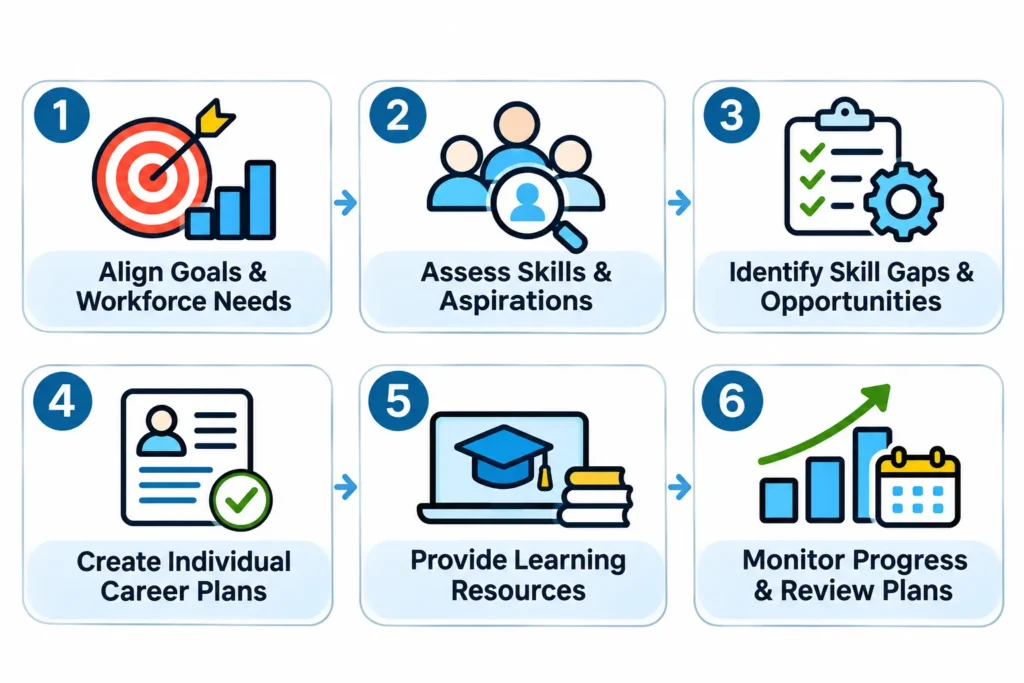
The ten strategies above are the menu. This is the process for putting them together, in order.
Step 1: Identify Business Goals and Workforce Requirements
Start with where the company is heading. List the roles and skills you will need in the next one to three years, and flag the positions that would hurt most if they sat empty. It helps to tie training to business goals from the first meeting so leaders see the purpose.
Step 2: Assess Employee Skills and Career Aspirations
Use more than one source: self-assessments, manager input, recent performance reviews, and a short interest survey. People often rate themselves too high or too low, so a mix gives a fairer picture. Ask what they want next, not only what they can do now.
Step 3: Identify Skills Gaps and Development Opportunities
Place current skills beside future role requirements and rank the gaps by business impact. A simple 1-to-4 rating scale (beginner to expert) is enough. Then match each gap to the right fix: a course, a mentor, a project, or a move.
Step 4: Develop Individual Career Development Plans
Turn the findings into a one-page plan for each employee. Use SMART goals (specific, measurable, achievable, relevant, time-bound). “Get better at presenting” is weak. “Present the quarterly report to leadership twice in six months, with feedback from my mentor” is a goal someone can check.
Step 5: Provide Learning and Development Resources
Fund the plan with real time and tools. That can include courses, mentors, job shadowing, and cross-team projects. If your gaps cluster around specific competencies, build skills-based training around the biggest gaps so the content maps to what people actually need.
Step 6: Monitor Progress and Review Development Plans
Review plans every quarter and refresh them at least once a year. Business needs change, and a plan written in January can be wrong by June. Recognize milestones when people hit them, and update goals when roles shift.
Examples of Employee Career Development Plans
The four plans below are illustrative examples, not real case studies. Adjust the activities and timelines to your own roles and budget.
1. Example: A Junior Employee Moving Toward Team Leader
- Current role: Junior analyst
- Goal: Team leader within 18 months
- Gaps: Leadership, communication, project management
- Activities: A mentor who leads a team, a leadership fundamentals course, and ownership of one small project
- Success measures: Project delivered on time, peer feedback on communication, and a leadership readiness check with the manager
2. Example: An Experienced Employee Becoming a Senior Specialist
- Current role: Software developer
- Goal: Senior technical specialist, no people management
- Gaps: System design, advanced architecture skills
- Activities: Advanced technical training, a relevant certification, an architecture project, and peer mentoring of newer developers
- Success measures: Technical assessment, project outcomes, and knowledge-sharing sessions delivered
3. Example: A Future Manager
- Current role: Top-performing senior team member
- Goal: First-time manager
- Gaps: Giving feedback, delegating, handling conflict
- Activities: A mentor who is a current manager, coaching on one-to-ones, and a stretch assignment covering a manager’s leave
- Success measures: Team feedback, goal-setting quality, and manager’s assessment after a trial period
4. Example: An Employee Changing Departments
- Current role: Customer support representative
- Goal: Business analyst
- Gaps: Data analysis, reporting, business communication
- Activities: Excel and SQL training, job shadowing an analyst, and a cross-functional project using support data
- Success measures: A completed analysis presented to stakeholders and readiness for an internal application
A Reusable Career Development Plan Template
| Element | Example |
| Current role | Junior analyst |
| Career objective | Senior analyst |
| Skills to develop | Data analysis, reporting, communication |
| Learning activities | Training, mentoring, project assignments |
| Timeline | 6 to 12 months |
| Success measures | Competency assessment and project performance |
How Technology Supports Employee Career Development
Spreadsheets work for a pilot. Once you pass a few dozen people, you need systems that track skills, learning, and movement without constant manual work.
1. Learning Management Systems (LMS)
An LMS keeps courses, learning paths, assessments, and progress records in one place. Employees see what to learn next, and managers see who has finished what. It is the base layer for most career development programs.
2. AI-Powered Personalized Learning
AI tools can suggest courses from a person’s role, skills, and past activity, and some adapt difficulty as the learner progresses. Treat the output as a starting point. A manager should still review suggestions, especially those that affect promotion or access to opportunities.
3. Employee Performance and Skills Tracking
Competency tracking shows skill growth over time, not just course completion. Pair it with performance data so you can see whether new skills show up in the work.
4. Career Development and Talent Management Platforms
These platforms add internal job listings, skills profiles, career path views, and succession planning. They help employees see opportunities they would otherwise miss.
Popular Learning and Talent Tools
The tools below are widely used. Match them to your needs and test with a pilot group before committing.
- LinkedIn Learning: online courses for professional skills
- Coursera for Business: professional courses and certifications for workforce upskilling
- Udemy Business: a large library of courses for scalable employee learning
- Cornerstone OnDemand: learning, talent development, and skills management in one platform
Common Challenges in Employee Career Development and How to Overcome Them
Career development programs have limits. They cannot replace fair pay or good management, and they will not keep everyone. These are the problems most teams meet, with practical fixes.
1. Limited Training Budgets
Use what you already have: internal mentors, peer teaching, stretch projects, and shadowing cost little. You can also bring training costs down by reusing content and focusing spend on the highest-priority roles.
2. Lack of Employee Interest or Participation
If people do not engage, the plan probably does not reflect what they want. Ask more, prescribe less, and let employees choose among options.
3. Limited Promotion Opportunities
Offer lateral moves, specialist tracks, and expanded responsibilities. A flat structure can still give people growth if you define what growth looks like.
4. Insufficient Manager Support
Train managers to hold career conversations and include development in their own goals. Many managers avoid the topic because they do not know what to say.
5. Difficulty Measuring Development Outcomes
Set measurable goals at the start and record a baseline. You cannot show improvement without a starting point.
6. Balancing Career Development With Daily Responsibilities
Use microlearning and set aside protected time, even two hours a week. If workloads never allow it, the program is not real.
How to Measure the Success of Employee Career Development Programs
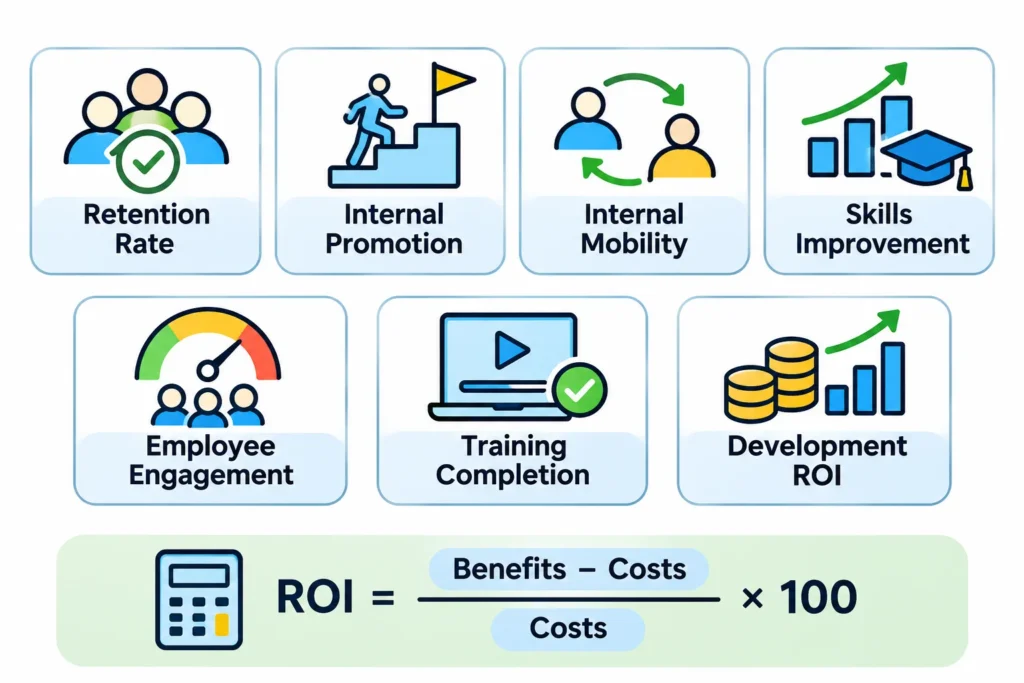
Pick three to five metrics and track them from a baseline. Too many numbers hide what matters.
| KPI | What it shows | How to track it |
| Employee retention rate | Whether people stay | HR turnover data, compared by group |
| Internal promotion rate | Career progression | Share of openings filled internally |
| Internal mobility rate | Movement across roles | Lateral and vertical moves per year |
| Skills improvement | Competency growth | Pre- and post-assessments |
| Employee engagement | Motivation and satisfaction | Surveys and career conversation feedback |
| Training completion | Learning participation | LMS reports |
| Development ROI | Business value created | Program costs compared with measurable benefits |
For ROI, use this formula: (benefits minus costs) divided by costs, multiplied by 100. Costs include content, tools, and employee time. Benefits might include lower turnover costs or time saved. Be honest that many factors affect these results, and avoid claiming that a program alone caused a change.
Best Practices for Building a Sustainable Career Development Culture
- Make career development available to all employees, not just high performers.
- Tie employee goals to company priorities so each plan serves both sides.
- Treat managers as career partners and give them time and training for it.
- Give everyone fair access to learning, mentors, and stretch work, with transparent criteria.
- Review pathways and plans regularly as roles change.
- Recognize progress, including lateral moves and new skills, not only promotions.
Frequently Asked Questions About Employee Career Development
1. What is employee career development?
It is the ongoing process of helping employees build skills and experience for their next career step. Businesses support it through training, mentoring, career planning, and internal mobility.
2. Why is career development important for businesses?
It improves retention, builds needed skills, prepares future leaders, and lowers replacement costs.
3. What are the best employee career development strategies?
The most effective ones include personalized development plans, clear career pathways, mentoring, job rotation, regular career conversations, skill gap analysis, stretch assignments, and internal mobility.
4. How can companies create career development programs?
Identify business needs, assess employee skills and goals, find gaps, build individual plans, provide resources, and review progress regularly.
5. What should an employee career development plan include?
A current role, a career objective, skills to develop, learning activities, a timeline, and success measures.
6. How can managers support employee career growth?
Hold regular career conversations, give honest feedback, assign stretch work, and support internal moves.
7. How does career development improve employee retention?
Employees who see a path forward are less likely to look elsewhere. Research from Gallup and LinkedIn links growth opportunities with retention, though pay and management quality also matter.
8. How can businesses measure career development success?
Track retention, internal promotion and mobility rates, skills improvement, engagement, training completion, and ROI against a baseline.
9. Can employees develop their careers without promotions?
Yes. Lateral moves, specialist tracks, new responsibilities, and cross-functional projects all build skills and open doors.
10. What role does an LMS play in employee career development?
An LMS organizes courses and learning paths, tracks progress, and gives managers data to support career conversations.
Conclusion: Make Employee Career Development a Business Priority
Employee career development works best when it is treated as a business process, not a perk. Start with where the company is heading, learn what your people want, and build plans that serve both. Small steps, such as quarterly career conversations and a published pathway for one role, are enough to begin.
The companies that keep strong teams tend to be the ones that make growth visible. Pick one team, run a pilot, track a few KPIs against a baseline, and improve from there. A measurable, long-term approach to employee career development gives people a reason to stay and gives the business the skills it will need.