


If you’ve ever scrambled to pull together training records before an audit, you already know why organizations invest in compliance training software. Spreadsheets and email reminders work for a while, until someone misses a renewal deadline and the whole company feels the consequences.
Compliance training software solves that problem by automating the entire process, from assigning courses to tracking certifications to generating audit-ready reports. In this guide, we’ll walk through what this software actually does, the features worth paying for, and how leading platforms like SkillForce LMS, Docebo, and TalentLMS compare, so you can choose a system that fits your organization’s risk profile and budget.
What Is Compliance Training Software?
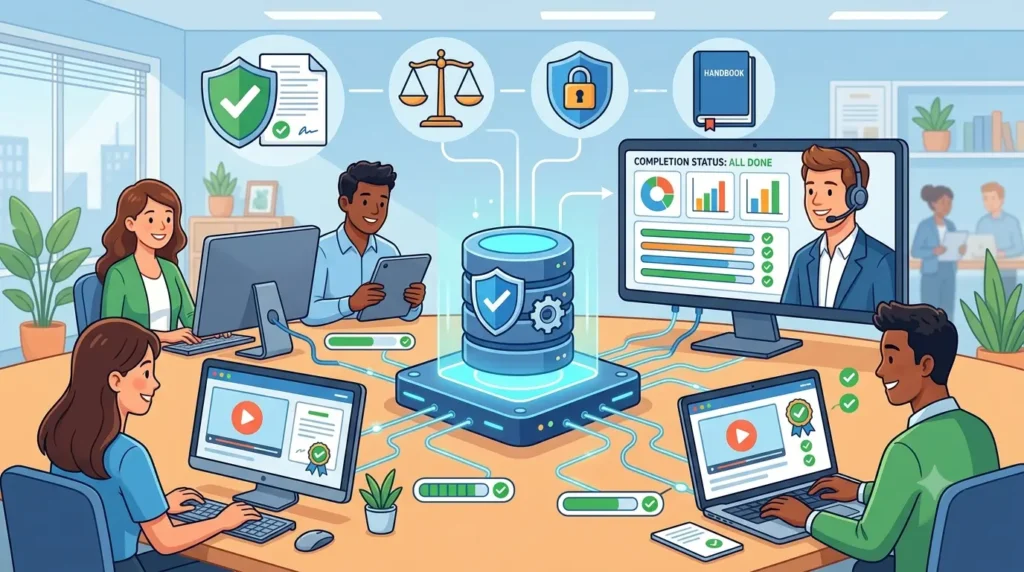
Compliance training software is a digital platform that helps organizations deliver, track, and document mandatory employee training tied to laws, industry regulations, or internal policies. It automates course assignments, monitors completion, manages certification renewals, and produces the records auditors expect to see.
How Compliance Training Software Works
Here’s the basic flow. An administrator assigns a course to an employee or a group based on their role. The employee completes the training and any required assessment, and the system logs the result automatically. When a certification is close to expiring, the platform sends a reminder and reassigns the course, so nothing slips through the cracks.
That entire chain, assignment, completion, certification, and renewal, happens without anyone manually updating a spreadsheet.
Why Businesses Need It
Manual compliance tracking works fine when you have twenty employees. It falls apart fast once you’re managing hundreds of people across multiple departments, each with different regulatory requirements. A single missed renewal can mean a failed audit, a fine, or worse, an actual workplace incident that could have been prevented.
Compliance Training Software vs Manual Compliance Training
| Aspect | Manual Tracking | Compliance Training Software |
|---|---|---|
| Record keeping | Spreadsheets, paper files | Centralized digital records |
| Renewal tracking | Manual calendar reminders | Automated alerts and reassignment |
| Audit prep | Days of gathering documents | Reports generated in minutes |
| Scalability | Breaks down with growth | Scales across departments and locations |
| Accuracy | Prone to human error | Consistent, timestamped logs |
Why Compliance Training Matters
Reduce Legal and Financial Risks
Regulatory bodies don’t accept “we forgot” as an excuse. Fines for non-compliance in industries like healthcare and finance can run into the hundreds of thousands of dollars, and that’s before accounting for legal fees and reputational damage.
Meet Industry Regulations
Most industries operate under a specific set of rules, whether that’s OSHA for workplace safety, HIPAA for healthcare data, or GDPR for handling personal information in the EU. Compliance training software helps you map training content directly to the regulations your business is actually subject to.
Improve Workplace Safety
In manufacturing, construction, and logistics, compliance training isn’t just paperwork. It’s the difference between an employee knowing how to operate machinery safely and an employee who’s guessing.
Build an Ethical Workplace Culture
Ongoing training on topics like anti-bribery, harassment prevention, and code of conduct reinforces the values a company claims to hold. Employees notice when training feels like a genuine part of the culture rather than a box-ticking exercise.
Key Features of Compliance Training Software
Course Management
A good platform lets you organize courses by department, role, or regulation, so employees only see training that’s actually relevant to their job.
Automated Course Assignments
New hires and role changes trigger automatic course assignments based on rules you set once, removing the need for HR to manually enroll every employee.
Certification Management
The system tracks who’s certified, when certifications expire, and what’s needed for renewal, all in one dashboard.
Automated Renewal Reminders
Instead of relying on someone to remember expiration dates, the platform sends reminders to employees and managers well before a certification lapses.
Learning Paths
Role-based learning paths bundle related courses together, so a new warehouse employee gets safety training while a finance hire gets anti-fraud and data privacy modules.
Assessments & Quizzes
Built-in quizzes confirm that employees actually understood the material, not just clicked through slides.
Reporting & Audit Trails
Detailed, timestamped reports show exactly who completed what training and when, which is exactly what auditors ask for.
AI-Powered Learning
Newer platforms use AI to personalize learning paths, flag knowledge gaps, and even help generate quiz questions from existing training content.
Mobile Learning
Frontline and remote employees need access to training from a phone or tablet, not just a desktop computer in an office.
HRMS & SSO Integrations
Integration with your HR system and single sign-on (SSO) setup means employee data stays in sync and login stays simple.
Benefits of Compliance Training Software
Improves Regulatory Compliance
Automated tracking means fewer gaps between what’s required and what’s actually completed.
Automates Mandatory Training
Recurring training, like annual harassment prevention or data security refreshers, gets reassigned automatically instead of relying on someone to remember.
Simplifies Audit Preparation
Instead of spending days pulling together records, you can generate a compliance report in a few clicks.
Reduces Administrative Work
HR and L&D teams spend less time chasing down completion status and more time on strategic training initiatives.
Improves Employee Accountability
When employees know their training status is visible and tracked, completion rates tend to improve.
Enhances Reporting & Visibility
Leadership gets a real-time view of compliance status across the organization, not a quarterly snapshot pieced together after the fact.
Top Compliance Training Software Solutions
SkillForce LMS
Best for: AI-powered compliance training combined with corporate learning and onboarding
SkillForce LMS brings compliance training, employee onboarding, and broader corporate learning into a single platform. Its standout strength is combining AI-assisted course recommendations with straightforward certification tracking, so compliance doesn’t feel disconnected from the rest of an employee’s learning journey. For organizations that want one system handling both “must-do” compliance training and “nice-to-have” skill development, SkillForce LMS is worth evaluating directly with their team for a demo tailored to your regulatory needs.
TalentLMS
TalentLMS is a cloud-based LMS known for fast setup and an easy-to-use interface, which makes it a popular pick for small and mid-size organizations. It handles core compliance needs well, including automated certificates, expiration-based renewals, and straightforward audit reports, though organizations with more complex, multi-step compliance workflows sometimes find its reporting depth limited compared to enterprise-grade platforms.
Docebo
Docebo is an AI-first learning platform built for larger organizations that need to train employees, partners, and customers from one system. It offers strong reporting and analytics, automated certification renewal workflows, and integrations with tools like Salesforce, Microsoft Teams, and BambooHR, which makes it a solid fit for enterprises managing compliance across multiple audiences and regions.
Valamis
Valamis positions itself as a learning experience platform (LXP) with a strong focus on skills development alongside compliance, using AI to connect training content to individual skill gaps rather than treating compliance as a standalone checklist item.
Benchmark Gensuite
Benchmark Gensuite focuses heavily on environmental, health, and safety (EHS) compliance, making it a common choice for manufacturing and industrial companies that need to manage safety training alongside broader EHS management processes.
KnowBe4 Compliance Plus
KnowBe4 Compliance Plus is an add-on to KnowBe4’s security awareness platform, offering a large library of short, regularly updated compliance modules covering topics like data privacy, anti-bribery, and workplace conduct. It’s a strong fit for organizations that already use KnowBe4 for security training and want compliance content in the same ecosystem.
BizLibrary
BizLibrary offers a large off-the-shelf content library covering compliance, safety, and professional development, which appeals to organizations that would rather license ready-made courses than build compliance content from scratch.
SHRM Vendor Directory
If you’re still building your shortlist, the SHRM vendor directory is a useful starting point for comparing HR and compliance training vendors reviewed by HR professionals.
Other Enterprise Solutions
Larger enterprises with highly specialized regulatory needs, such as pharmaceutical or financial services companies, often also evaluate industry-specific compliance platforms alongside general LMS providers.
Compliance Training Software Comparison
| Software | Best For | Compliance Training | AI Features | Certification Tracking | Integrations |
|---|---|---|---|---|---|
| SkillForce LMS | AI-powered compliance + corporate learning | Yes | Yes | Yes | HRMS, SSO |
| TalentLMS | Fast setup for SMBs | Yes | Limited | Yes | HRIS, webinar tools |
| Docebo | Enterprise multi-audience training | Yes | Yes | Yes | Salesforce, Teams, BambooHR |
| Valamis | Skills-based learning with compliance | Yes | Yes | Yes | HR systems |
| Benchmark Gensuite | EHS-focused industries | Yes | Limited | Yes | EHS management tools |
| KnowBe4 Compliance Plus | Security-adjacent compliance content | Yes | Limited | Yes | KnowBe4 KSAT platform |
| BizLibrary | Off-the-shelf compliance content | Yes | Limited | Yes | HRIS |
Industries That Benefit from Compliance Training Software
Healthcare
HIPAA training, patient safety protocols, and infection control certifications need to be tracked precisely, since healthcare audits are frequent and thorough.
Read more on: Healthcare LMS
Manufacturing
OSHA-mandated safety training and equipment certifications directly affect worker safety on the floor, not just paperwork in an office.
Finance
Anti-money laundering, fraud prevention, and data security training are standard requirements, often tied to SOC 2 or PCI DSS obligations.
Retail
High employee turnover makes automated onboarding and compliance training essential, since manual tracking simply can’t keep pace with constant hiring.
IT
Data security and privacy training, often mapped to standards like ISO 27001, protect both the company and its customers.
Government
Public sector agencies typically need to document training completion for audits tied to public accountability requirements.
Hospitality
Food safety certifications, workplace safety, and harassment prevention training are common requirements across hotel and restaurant chains with distributed locations.
How to Choose the Right Compliance Training Software
Identify Compliance Requirements
Start by listing every regulation your organization is actually subject to. A healthcare company and a manufacturing plant have very different compliance training needs, and your software choice should reflect that.
Evaluate Essential Features
Match the feature list, certification tracking, automated reminders, reporting, against what you identified as must-haves versus nice-to-haves.
Check Reporting Capabilities
Ask vendors to show you an actual audit report, not just a demo dashboard. You want to know exactly what auditors will see.
Review Integration Options
Confirm the platform connects cleanly with your existing HRMS and any single sign-on setup, since manual data entry between systems creates the same errors you’re trying to eliminate.
Consider Scalability
Choose a platform that can handle your organization’s growth, not just its current headcount.
Compare Pricing and Support
Look beyond the sticker price. Factor in implementation support, customer service responsiveness, and whether pricing scales predictably as you add users.
Best Practices for Implementing Compliance Training Software
Create Role-Based Learning Paths
Assign training based on job function so employees aren’t wasting time on content that doesn’t apply to them.
Automate Recurring Training
Set renewal cycles once and let the system handle reassignment, rather than relying on manual follow-up.
Monitor Completion Rates
Check dashboards regularly rather than waiting until an audit forces you to look.
Keep Content Up to Date
Regulations change. Review and update training content on a set schedule so employees aren’t learning outdated rules.
Review Compliance Reports Regularly
Make report review part of a monthly or quarterly routine, not a once-a-year scramble before an audit.
READ MORE ON: Compliance Training Best Practices
Common Compliance Training Mistakes to Avoid
- One-time training only: Treating compliance training as a single event instead of an ongoing cycle leaves knowledge gaps as regulations and roles change.
- Ignoring renewal deadlines: Missed renewals are one of the most common reasons organizations fail audits.
- Poor record keeping: Incomplete or inconsistent records make it hard to prove compliance even when training actually happened.
- Generic training for all employees: A one-size-fits-all course wastes time and misses role-specific risks.
- Failing to measure completion and effectiveness: Tracking completion alone doesn’t tell you whether employees actually retained the material.
The Future of Compliance Training Software
AI-Powered Compliance Monitoring
AI is increasingly used to flag training gaps before they become compliance failures, rather than simply reporting on what already happened.
Adaptive Learning
Platforms are starting to adjust course difficulty and content based on how an individual employee performs, rather than delivering the same material to everyone.
Skills-Based Compliance
Compliance training is being tied more closely to broader skills frameworks, connecting regulatory requirements to an employee’s overall development.
Predictive Analytics
Some platforms now use historical data to predict which departments or employees are at higher risk of falling behind on compliance requirements.
Automated Audit Readiness
The goal for many vendors now is a system that’s essentially always audit-ready, with reports generated on demand rather than assembled under deadline pressure.
Frequently Asked Questions
What is compliance training software?
It’s a digital platform that automates the delivery, tracking, and documentation of mandatory employee training tied to regulations or company policy.
Which industries nld compliance training software include?
Course management, automated assignments, certification tracking, renewal reminders, reporting and audit trails, and integrations with HR systems are the core features to look for.
Can an LMS handle compliance training?
A general LMS can deliver compliance courses, but dedicated compliance training software typically adds stronger certification tracking, automated renewals, and audit-ready reporting built specifically for regulatory needs.
How do you track employee compliance?
Compliance training software tracks it automatically through completion logs, certification status, and reporting dashboards, rather than relying on manual spreadsheets.
How often should compliance training be renewed?
It depends on the regulation and industry. Many certifications require annual renewal, though some, like certain safety certifications, may require more frequent refreshers.
What is the difference between compliance training software and an LMS?
A general LMS is built for broad learning and development, while compliance training software is purpose-built around certification tracking, regulatory mapping, and audit documentation, though many modern platforms, including SkillForce LMS, combine both capabilities in one system.
Conclusion
Choosing the right compliance training software comes down to matching your organization’s specific regulatory requirements with a platform that can automate the busywork, course assignments, renewal tracking, and audit reporting, so your team can focus on actually building a compliant, accountable workplace culture.
Platforms like Docebo and TalentLMS each bring real strengths depending on your organization’s size and complexity, while SkillForce LMS stands out for organizations that want compliance training, employee onboarding, and broader corporate learning working together in a single, AI-powered platform. Whichever system you choose, the goal stays the same: fewer missed deadlines, faster audits, and a workforce that actually understands the rules it’s expected to follow.