


Compliance training is not about showing people some rules once a year. It is a lot more than that now. Companies have to deal with complicated laws and people trying to hack into their computers rules to keep people safe at work and what is considered ethical is always changing. So now compliance training is a part of how a company does business, not just something the human resources department has to do.
The hard part is not just giving people training, it is making sure they actually understand it and remember it. Can use it in real life.
Companies that do compliance training in a way are less likely to get in trouble with the law. They have a better work environment, their employees feel more confident and they show everyone, including customers and people who make rules that they are responsible.
If you are starting a compliance program, from the beginning or trying to make an existing one this guide will show you ways to make compliance training more interesting, effective and something you can measure to see how well it is working.
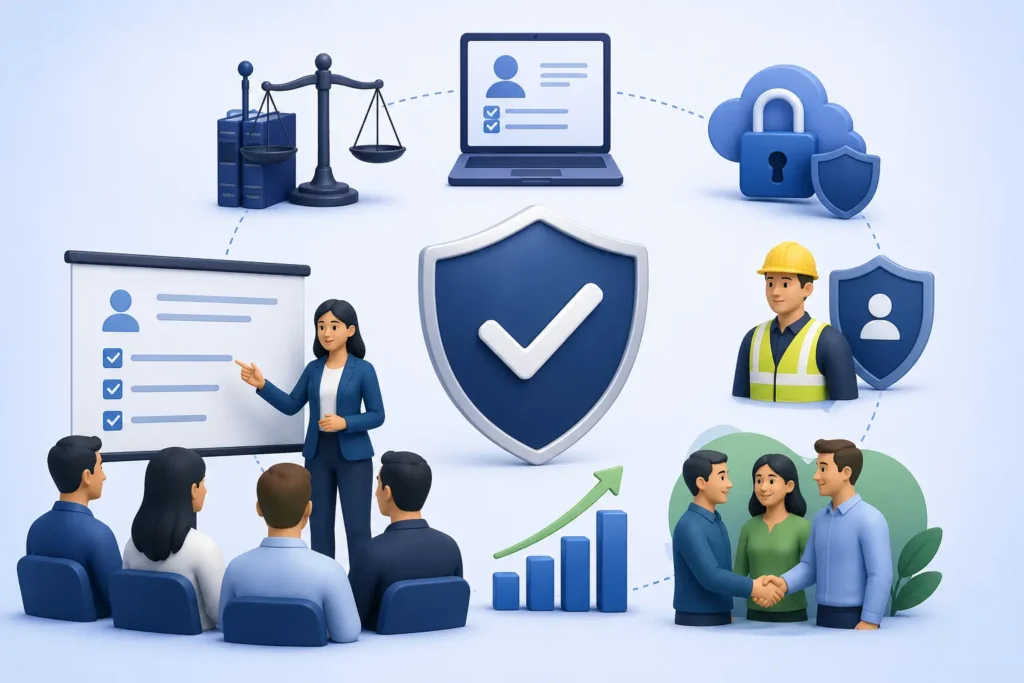
What Is Compliance Training?
Compliance training is what helps employees learn about the laws and rules that they need to follow at work.
This includes things like company policies and ethical standards.The main idea of compliance training is to help reduce the risk of something going wrong in the company.
Compliance training does this by teaching employees how to make decisions and behave in an ethical way.
This is important for every person in the company from the top to the bottom. It helps make sure that everyone follows the same rules and laws.
Compliance training is really about making sure that employees know what they are supposed to do and how they are supposed to do it so they can do their jobs the way they want.
Compliance training commonly covers:
- Workplace harassment prevention
- Data privacy and GDPR compliance
- Information security
- Cybersecurity awareness
- Anti-bribery and anti-corruption
- Workplace health and safety
- Diversity, equity, and inclusion
- Industry-specific regulations
- Code of conduct
- Financial compliance
Rather than treating compliance as a yearly obligation, successful organizations integrate learning into everyday work.
Why Compliance Training Matters
Compliance failures can lead to significant financial, operational, and reputational consequences.
Effective compliance training helps organizations:
- Reduce legal and regulatory risk
- Prevent workplace misconduct
- Protect sensitive business data
- Improve employee awareness
- Strengthen ethical workplace culture
- Increase customer trust
- Avoid costly fines and lawsuits
- Support audit readiness
- Demonstrate corporate responsibility
More importantly, employees become confident about making the right decisions—even when policies aren’t immediately available.
Compliance Training Best Practices
The most successful compliance programs share several characteristics. They focus on engagement, relevance, continuous improvement, and measurable outcomes.
1. Start with a Comprehensive Risk Assessment
Not every organization faces the same compliance risks.
Before developing training content, identify:
- Industry regulations
- Organizational policies
- Department-specific risks
- Geographic compliance requirements
- Past compliance incidents
- Audit findings
For example:
A healthcare provider prioritizes HIPAA training.
A financial institution emphasizes anti-money laundering regulations.
A manufacturing company focuses heavily on workplace safety.
Risk-based training ensures employees receive information that directly applies to their responsibilities.
2. Customize Training for Different Roles
One-size-fits-all compliance training often results in low engagement.
Different employees encounter different compliance challenges.
Examples include:
HR Teams
- Harassment prevention
- Hiring compliance
- Employee privacy
Sales Teams
- Anti-bribery
- Ethical selling
- Customer data handling
IT Teams
- Cybersecurity
- Password management
- Data protection
Managers
- Workplace investigations
- Reporting obligations
- Ethical leadership
Personalized learning makes compliance more relevant and memorable.
3. Keep Training Short and Focused
Employees rarely retain information from hour-long compliance presentations.
Instead, use microlearning.
Examples include:
- Five-minute videos
- Interactive scenarios
- Quick quizzes
- Infographics
- Short simulations
Breaking training into smaller modules improves knowledge retention while minimizing disruption to daily work.
4. Make Learning Interactive
Passive learning leads to poor retention.
Interactive compliance training encourages employees to think critically rather than memorize policies.
Interactive methods include:
- Branching scenarios
- Decision-making exercises
- Gamification
- Polls
- Case studies
- Knowledge checks
- Simulations
For example:
Instead of explaining phishing emails, present realistic email examples and ask employees to identify suspicious elements.
Learning through experience significantly improves recall.
5. Use Real-World Examples
Employees connect better with situations they may actually encounter.
Examples could include:
- Receiving confidential customer information
- Identifying workplace harassment
- Reporting unethical behavior
- Handling conflicts of interest
- Recognizing cybersecurity threats
Realistic examples transform abstract policies into practical workplace decisions.
6. Reinforce Learning Regularly
Compliance is not a one-time event.
People naturally forget information over time.
Continuous reinforcement may include:
- Monthly reminders
- Quarterly refresher courses
- Short compliance newsletters
- Scenario-based discussions
- Team meetings
- Knowledge quizzes
Frequent reinforcement strengthens long-term retention and keeps regulations top of mind.
7. Encourage a Speak-Up Culture
Employees should feel comfortable reporting concerns without fear of retaliation.
Training should clearly explain:
- Reporting channels
- Anonymous reporting options
- Investigation processes
- Whistleblower protections
- Leadership responsibilities
Organizations with strong reporting cultures often identify issues before they become major legal problems.
8. Make Compliance Training Mobile-Friendly
Today’s workforce learns from multiple devices.
Mobile-compatible compliance training enables employees to learn:
- During travel
- On job sites
- In remote locations
- Between meetings
- From home
Mobile accessibility is especially valuable for distributed and frontline workforces.
9. Measure More Than Course Completion
Completion rates alone don’t indicate learning effectiveness.
Instead, monitor:
- Quiz scores
- Knowledge retention
- Behavioral improvements
- Incident trends
- Audit performance
- Reporting activity
- Employee feedback
Meaningful analytics reveal whether training is changing workplace behavior.
10. Update Content Frequently
Regulations evolve continuously.
Outdated compliance training creates unnecessary organizational risk.
Review content whenever:
- Laws change
- Internal policies change
- Industry regulations evolve
- Security threats emerge
- Business operations expand
- New technologies are introduced
Current training reflects current expectations.
Common Compliance Training Topics Every Organization Should Cover
While requirements vary by industry, most organizations should address:
1. Workplace Ethics
Employees should understand expected standards of professional behavior.
Topics include:
- Integrity
- Respect
- Fair treatment
- Conflict of interest
- Confidentiality
2. Cybersecurity Awareness
Human error remains one of the biggest security risks.
Training should include:
- Phishing awareness
- Password security
- Multi-factor authentication
- Device protection
- Social engineering
3. Data Privacy
Organizations handling customer information should educate employees about:
- Personal data handling
- Consent
- Secure storage
- Data sharing
- Privacy regulations
4. Workplace Harassment Prevention
Training should help employees recognize:
- Harassment
- Discrimination
- Bullying
- Inappropriate behavior
- Reporting procedures
5. Health and Safety
Safety training reduces workplace accidents and supports regulatory compliance.
Topics may include:
- Emergency procedures
- Equipment safety
- Hazard reporting
- Ergonomics
- Personal protective equipment
How Technology Improves Compliance Training

Modern learning technology has transformed compliance education.
Organizations increasingly use learning management systems (LMS) to deliver, manage, and track compliance programs efficiently.
Key capabilities include:
- Automated course assignments
- Learning paths
- Certification tracking
- Expiration reminders
- Reporting dashboards
- Assessment management
- Mobile learning
- Integration with HR systems
Artificial intelligence is also improving compliance training by recommending personalized learning, identifying knowledge gaps, and supporting adaptive learning experiences.
Common Compliance Training Mistakes to Avoid
Even well-intentioned compliance programs can fail if they’re poorly designed.
Avoid these common mistakes:
1. Treating Compliance as a One-Time Event
Annual training alone rarely changes behavior.
2. Using Generic Content
Employees disengage when examples don’t relate to their roles.
3. Ignoring Employee Feedback
Learners often identify confusing policies or ineffective training methods.
4. Overloading Employees with Information
Large amounts of information reduce retention.
4. Focusing Only on Regulations
Employees should understand why compliance matters—not just the rules themselves.
How to Measure Compliance Training Success
Successful compliance programs combine learning metrics with business outcomes.
Useful performance indicators include:
- Training completion rates
- Assessment scores
- Certification completion
- Policy acknowledgment
- Incident reduction
- Audit findings
- Employee confidence surveys
- Time to complete required training
- Compliance reporting activity
Tracking these metrics helps organizations continuously improve their programs.
AEO: Quick Answers About Compliance Training
What are compliance training best practices?
Compliance training best practices include role-based learning, microlearning, interactive content, continuous reinforcement, regular updates, mobile accessibility, real-world scenarios, and performance measurement.
How often should compliance training be conducted?
Most organizations provide annual mandatory training while reinforcing key topics throughout the year with quarterly refreshers, microlearning modules, and ongoing awareness campaigns.
Why is compliance training important?
Compliance training reduces legal and regulatory risks, protects employees and customers, strengthens workplace ethics, improves decision-making, and supports organizational accountability.
What should compliance training include?
Effective compliance training should cover workplace ethics, cybersecurity, data privacy, harassment prevention, workplace safety, organizational policies, reporting procedures, and industry-specific regulations.
How do you make compliance training engaging?
Organizations improve engagement by using short learning modules, interactive scenarios, videos, gamification, real-life examples, quizzes, and personalized learning paths.
Frequently Asked Questions
1. What is the main purpose of compliance training?
The primary purpose is to educate employees about legal, regulatory, ethical, and organizational requirements so they can perform their responsibilities responsibly while minimizing business risk.
2. Who needs compliance training?
Every employee should get training on following the rules. The training should be different for each person based on their job, the department they work in, the type of industry they are in and how much they are responsible for. The compliance training is important for every employee to learn.
3. What industries require compliance training?
Compliance training is really helpful for every type of business. It is good for healthcare and finance companies. It is also good for people who work in manufacturing and retail. Schools and government offices need compliance training too. The technology and construction industries benefit from it. So do people who work in hospitality and logistics. Compliance training is good for healthcare companies. It is also good for finance and manufacturing businesses.
4. How long should compliance training be?
Short, focused modules of 5–20 minutes are generally more effective than lengthy sessions. Complex topics can be delivered as structured learning paths made up of multiple bite-sized lessons.
5. Can compliance training be delivered online?
Yes. Online compliance training allows organizations to deliver consistent learning, automate assignments, monitor completion, issue certifications, and generate audit-ready reports through a learning management system.
6. How can organizations improve compliance training completion rates?
Organizations can improve completion rates by sending automated reminders, offering mobile access, simplifying course navigation, personalizing content, and ensuring leadership actively supports compliance initiatives.
conclusion
Compliance training is not about following rules anymore. It’s about making sure employees make choices at work.
This means moving from one-time training to regular learning that’s specific to each job.By doing this companies can reduce problems, build a culture of compliance and make their business more stable.
The best compliance programs are useful, interesting and trackable.They give employees the information, keep teaching them over time and use data to make things better.
Whether you’re dealing with security, workplace ethics, data protection or industry rules, using the best compliance training methods is a good investment for your company’s future.
As rules and regulations keep changing businesses that focus on learning, use technology and encourage responsibility will be better prepared to adjust, stay compliant and build trust, with employees, customers and stakeholders.
They will be able to adapt to situations and keep their business running smoothly.Compliance training helps companies do the thing and make good decisions.
It also helps build a work environment.Companies that invest in compliance training show that they care about their employees and customers.