


To make training really work for your employees you need to do key things. The training needs to be relevant to what the employees do every day. It has to be practical so they can actually use what they learn. You should also try to personalize the training for each person because everyone is different. Make sure the training is easy for them to get to and make sure it is connected to opportunities for them to move up in their careers.. After the training is over managers should remind them of what they learned and help them use it. If you miss any of these things the training will not be very effective even if it is well designed.
The main point of this guide is to help you make training work for your employees. Training should help employees do their jobs better now and it should also help them see what they can do next. When employees feel like they are getting better at their jobs and they have an idea of what is next they will be more engaged in their work. This is because they can see how the training is helping them and that makes them more interested in what they’re doing.
How Does Training Improve Employee Engagement?
Training improves engagement because it changes how people feel about their work, not just what they know. Skills, confidence, growth, and recognition are all tied together, and training touches all four.
Training Builds Confidence and Competence
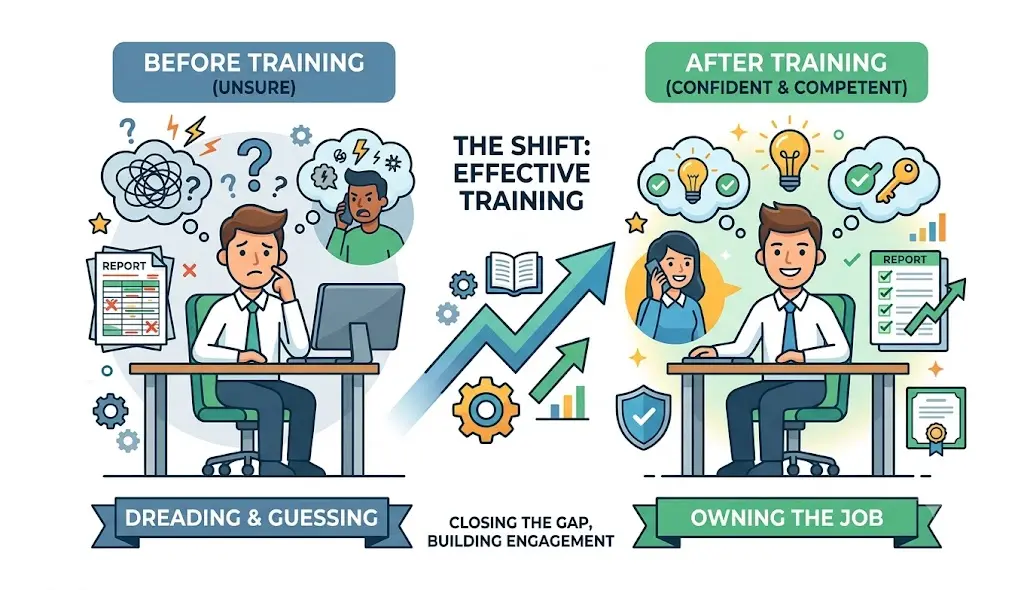
Nobody feels engaged when they’re constantly unsure whether they’re doing their job right. Good employee training programs close that gap.. Once someone knows how to handle a difficult customer call or run a report without guessing, they stop dreading that part of the job and start owning it.
That shift from “I hope I get this right” to “I know how to handle this” is where real engagement starts.
Learning Creates Career Growth Opportunities
Employees who believe there is a future with the company usually stay longer and work harder. Training is usually the sign of that future: a new certificate, a skill that gets someone ready for a bigger assignment or a class that gets them ready for a job they really want.
Learning things and improving old skills do the same thing. They show an employee “there is a step here, for you ” instead of letting them guess what comes next on their own.
Training Gives Employees More Autonomy
Competence and independence are connected. An employee who has been trained well does not need to ask a supervisor for every choice. They understand the process, they believe in their judgment and they can work quicker. That freedom is a reason why work feels interesting instead of tiring.
A well-designed employee training program gives employees more than individual courses. It creates a structured learning path that helps people build the skills they need for their current responsibilities while preparing for future roles. When training is organized around real skill gaps and career goals, employees can see how learning fits into their long-term development.
Development Shows Employees They Are Valued
Training costs a company time and money. When employees see that investment, they read it as a signal: the organization thinks I’m worth developing. That perception matters more than most people realize. According to research summarized on employee engagement overview, perceived organizational support is one of the strongest predictors of engagement.
Learning Helps Employees Connect Their Work to Business Goals
Training is not about doing tasks. When done properly it shows why a task is important, how a customer service script keeps the brand safe or how correct data entry influences a company- report. That kind of information changes work into meaningful work.
Why Employees Disengage From Training
Not all training helps. Some of it actively pushes people away from wanting to learn at all. Here’s where it usually goes wrong.
Training Is Too Generic
One-size-fits-all courses rarely fit anyone well. A generic compliance module that ignores role differences feels like a formality, not something worth paying attention to.
Content Is Too Long or Passive
Hour-long videos with no interaction lose people fast. Attention drops, and so does retention.
Training Does Not Match the Employee’s Role
If a warehouse employee sits through a course built for office staff, the examples won’t land. Relevance is what makes people lean in instead of tune out.
Employees Cannot See the Value
If nobody explains why the training matters, employees assume it doesn’t. “Because it’s mandatory” is not a reason people find motivating.
Learning Is Difficult to Access
Clunky logins, outdated learning platforms, or training only available on a desktop computer during work hours all create friction. Friction kills participation.
There Is No Follow-Up After Training
A course that ends with no practice, no check-in, and no application fades from memory within days. Without reinforcement, the investment is mostly wasted.
Managers Do Not Reinforce New Skills
If a manager never asks about the training or never gives employees a chance to apply what they learned, the message is clear: this didn’t really matter.
How to Improve Employee Engagement Through Training
Now for the practical part the specific changes that make training something employees actually want to be part of.
Make Training Relevant to the Employee’s Role
Relevance is the single biggest engagement lever available. Training that speaks directly to someone’s daily responsibilities gets attention that generic content never will.
Use real workplace scenarios
Base examples on situations employees actually face a real objection from a customer, a real data error, a real scheduling conflict. Recognition builds engagement faster than abstract theory.
Adapt examples to departments and job responsibilities
The same leadership course can use different case studies for a sales manager versus an operations manager. Small adjustments like this go a long way.
Personalize Learning Paths
Not everyone needs the same training at the same time. Personalization respects that.
Role-based learning
Content built around the specific tasks and tools of a job function.
Skill-based learning
Training targeted at a gap someone actually has, rather than a generic curriculum everyone repeats.
Career-based learning
Courses aligned with where an employee wants to go next, not just where they are today.
Make Training Practical and Interactive
People remember what they do far more than what they hear. Interaction turns passive viewers into active participants.
Simulations
Low-risk environments to practice high-stakes skills, like a mock sales call or a simulated system outage.
Scenario-based exercises
Branching decisions that mimic real judgment calls, with different outcomes depending on the choice made.
Quizzes and knowledge checks
Short, frequent checks that reinforce learning without turning it into a formal exam.
Hands-on activities
Role-plays, live demos, and guided practice sessions that mirror the actual job.
Use Microlearning for Continuous Development
Microlearning is great for people who want to learn something. For example, it is good for reminders. To practice a skill again. The employee can do this in a few minutes like between meetings.
Microlearning is really good for things that people need to hear at times like when a product is updated or when we need to remember a safety rule.
Microlearning is not good for everything. Some things like learning how to negotiate or how to be a leader need more time and a more structured way of learning. Microlearning should be used to help people remember what they already learned, not to teach them something, from the start. We should use microlearning to reinforce what people learned, not to replace the training that they need to do first.
Give Employees More Choice and Autonomy
When people have a choice they are more likely to be invested in what they’re doing. So it is an idea to let employees choose how they want to learn. This means they get to pick the format of their learning, how they want to go and which topics they want to focus on. They should be able to prioritize topics based on what they want to achieve with their learning goals. When employees have control over how they learn they tend to remember more of what they learned. Choice and autonomy over learning is really important because it helps employees retain information.
Connect Training With Career Development
Map training directly to the skills needed for promotions, the skills needed for moves or the skills needed for specialized roles. When an employee can see, in specific ways, that finishing a course brings them closer to a role they want or a raise they want, engagement no longer feels optional.
Build Manager Support Into the Training Process
Managers are often the deciding factor in whether training sticks or gets forgotten.
Manager check-ins
Short conversations after training to ask what was learned and how it applies.
Coaching conversations
One-on-one guidance to help employees work through applying new skills on the job.
Feedback after training
Specific, timely feedback on how someone is using what they learned.
Recognition for applying new skills
Public or private acknowledgment when an employee successfully applies something new.
Encourage Social and Peer Learning
People learn a lot from each other, not just from formal courses. Mentoring relationships, peer discussion groups, and internal communities of practice all build engagement through connection, not just content.
Make Learning Easy to Access
Mobile-friendly platforms, flexible scheduling, and learning built into the flow of work all remove barriers to participation. If employees have to jump through hoops to start a course, many simply won’t.
Use Technology to Increase Participation
LMS
A learning management system centralizes courses, tracks progress, and manages compliance requirements.
LXP
A learning experience platform focuses more on personalized, employee-driven discovery of content.
AI-powered personalization
Adaptive systems that recommend content based on role, skill gaps, or past learning behavior.
Interactive video
Branching video content that responds to viewer choices, closer to a simulation than a lecture.
Learning analytics
Data on completion, engagement, and performance that helps L&D teams refine what’s working.
Best Training Methods for Employee Engagement
| Training Method | Engagement Benefit | Best Use Case |
| Microlearning | Convenient, continuous learning | Quick skill reinforcement |
| Scenario-based learning | Practical application | Decision-making |
| Mentoring | Connection and support | Career development |
| Social learning | Collaboration | Knowledge sharing |
| Instructor-led training | Discussion and interaction | Complex topics |
| eLearning | Flexible access | Scalable training |
| Immersive learning | Hands-on practice | High-risk or practical roles |
| Coaching | Personalized development | Manager and leadership growth |
How to Build an Employee Engagement Training Program
Building a program that actually moves engagement takes a bit of structure. Here’s a straightforward sequence.
Step 1: Measure Current Engagement
Start with surveys, interviews, focus groups, and any existing workforce data you already have. You need a baseline before you can claim improvement.
Step 2: Identify Training and Skill Gaps
Not every engagement problem is a training problem. Sometimes it’s workload, pay, or management. Confirm the gap is actually about skills or knowledge before building a course around it.
Step 3: Define Learning and Engagement Goals
Keep these separate. A learning goal might be “complete a negotiation course.” An engagement goal might be “increase confidence in client conversations.” Both matter, but they’re not the same thing.
Step 4: Segment Employees by Role and Need
Group employees by role, tenure, or skill level so you can build learning pathways that actually fit them, instead of one program trying to serve everyone.
Step 5: Select the Right Training Formats
Match the format to the complexity of the skill. Simple, factual content can go in microlearning. Complex, judgment-based skills usually need instructor-led sessions or coaching.
Step 6: Launch the Program
Communicate why the training matters, set a realistic schedule, make sure access is simple, and get managers involved from day one.
Step 7: Reinforce Learning After Training
Follow up with coaching, practice opportunities, reminders, and manager conversations. This is the step most companies skip, and it’s the one that determines whether training actually changes behavior.
Step 8: Measure and Improve
Review completion data, engagement survey results, and behavioral changes. Adjust content and delivery based on what the data shows, not just what feels right.
How to Keep Employees Engaged Before, During, and After Training
Engagement doesn’t start when the training begins. It starts before, and it needs to continue long after.
Before Training
- Explain why the training matters
- Set clear expectations
- Personalize invitations instead of sending generic mass emails
- Connect the training to the employee’s own goals
During Training
- Use interaction instead of passive delivery
- Keep the content relevant to the role
- Provide realistic scenarios, not abstract examples
- Allow some choice and participation
After Training
- Give employees real opportunities to apply new skills
- Ask managers to reinforce what was learned
- Provide feedback on how the skill is being used
- Recognize visible progress
- Measure actual behavioral change, not just completion
This before-during-after lifecycle is often where companies underinvest, even though it’s usually where the biggest engagement gains are sitting.
How Managers Can Improve Training Engagement
Model Continuous Learning
Managers who visibly keep learning set the tone for their whole team. It’s hard to convince employees of training matters if their manager never does any themselves.
Protect Time for Learning
If training is always the first thing pushed aside for “real work,” employees learn that it isn’t actually a priority.
Discuss Training During One-to-Ones
A quick question “how did that course apply to what you’re working on?” keeps learning connected to the job.
Give Feedback on Skill Application
Specific feedback on how a new skill was used, good or needing improvement, helps it stick.
Recognize Progress
Even small acknowledgments build motivation to keep learning.
Connect Learning to Career Goals
Managers who tie training back to an employee’s stated career interests make the connection between effort and reward much clearer.
How to Measure the Impact of Training on Employee Engagement
There’s a real difference between training activity and actual engagement outcomes. Completion rates tell you people showed up. They don’t tell you whether anything changed.
Learning Metrics
- Completion
- Participation
- Assessment performance
- Skill attainment
Engagement Metrics
- Engagement survey results
- Pulse survey responses
- Participation in development opportunities
- Employee feedback
Behavioral Metrics
- Application of learned skills
- Manager observations
- Collaboration
- Performance changes
Business Metrics
- Retention
- Internal mobility
- Absenteeism
- Productivity
- Customer outcomes
How to Calculate Training ROI
The basic logic is simple: compare the cost of the training against the value of the outcomes it produces, whether that’s reduced turnover, faster onboarding, or improved performance. Just be careful not to attribute every engagement improvement directly to training alone; engagement is shaped by pay, management, workload, and culture too. Training is one input among several, and honest measurement accounts for that.
Training Examples for Different Employee Groups
New Employees
Structured employee onboarding, an assigned mentor, role-specific learning modules, and a 30-60-90 day development plan give new hires a clear runway instead of a confusing first few weeks.
Managers
Leadership fundamentals, coaching skills, feedback techniques, conflict resolution, and communication training help first-time and experienced managers alike.
Remote Employees
Digital collaboration tools, asynchronous learning options, virtual coaching, and easily accessible resources matter more for distributed teams than for in-office ones.
Frontline Employees
Mobile microlearning, scenario-based training, product knowledge refreshers, and customer interaction practice fit the pace of frontline work better than long-form courses.
High-Potential Employees
Leadership development pathways, mentoring, advanced skill-building, and internal mobility planning help retain your strongest performers.
How an LMS Can Support Employee Engagement Through Training
A learning management system isn’t the whole answer, but it makes a lot of the work above easier to execute at scale. Understanding the benefits of an LMS for employee training can also help organizations decide how technology fits into their broader learning strategy.
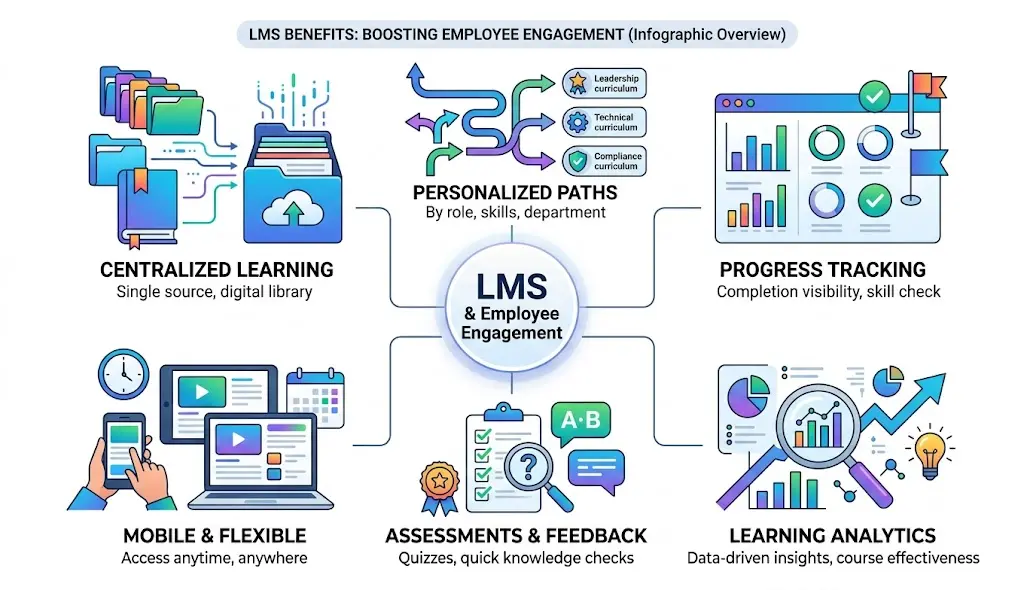
Centralize Learning
One place for all courses, resources, and records, instead of scattered files and folders.
Personalize Learning Paths
Automated assignment of content based on role, department, or skill gap.
Track Progress
Visibility into who’s completed what, and where people are stuck.
Support Mobile and Flexible Learning
Access from a phone or tablet, on the employee’s own schedule where possible.
Deliver Assessments and Feedback
Built-in quizzes and knowledge checks that give employees a quick read on how they’re doing.
Use Learning Analytics
Data that helps L&D teams see which content is working and which isn’t.
Connect Training With Employee Development
The best LMS platforms tie learning records to broader development and career planning tools, not just compliance tracking. The goal is supporting real development, not just running a course catalog.
Common Mistakes That Reduce Training Engagement
Treating Completion as Success
Finishing a course isn’t the same as learning or applying anything from it.
Making Everyone Take the Same Training
Ignoring role differences guarantees some portion of every group finds the content irrelevant.
Ignoring Employee Feedback
If employees say a course isn’t working and nothing changes, they stop bothering to give feedback at all.
Using Passive Content for Every Topic
Some topics need interaction and practice. Defaulting to video-and-quiz for everything wastes that opportunity.
Failing to Involve Managers
Training without manager involvement rarely translates into changed behavior on the job.
Disconnecting Training From Career Growth
If employees can’t see where training leads, they stop seeing the point of it.
Measuring Learning but Not Behavior
Completion and quiz scores are easy to track. Behavior change is harder, but it’s what actually matters.
What Training Can and Cannot Fix About Employee Engagement
Problems Training Can Address
Skill gaps, confidence issues, unclear processes, and inconsistent performance across a team are all things good training can genuinely fix.
Problems That Require Management or Organizational Change
Poor pay, unclear career paths, bad management, unrealistic workloads, and toxic team dynamics are not training problems. No course fixes a bad manager or an unfair compensation structure.
Why Training Should Not Be Used as a Substitute for Workplace Improvements
Training is sometimes offered as a quick fix for deeper organizational issues, and that rarely works. If engagement scores are low because of leadership or culture problems, a new course will not move the needle, and it may even come across as tone-deaf. Diagnose the real cause first, and use training for what it’s actually good at — building skill and confidence, not repairing broken systems.
Employee Engagement Through Training: A Practical Action Plan
A simple framework to keep the whole effort organized:
Assess → Personalize → Engage → Apply → Reinforce → Measure → Improve
30-60-90 Day Implementation Roadmap
Days 1-30: Assess and Plan Run engagement surveys, review existing skill gaps, and segment employees by role and need. Define clear learning and engagement goals before building anything.
Days 31-60: Build and Launch Design or select training formats matched to each segment, personalize learning paths, and communicate the “why” behind the program before rollout. Get managers briefed and involved early.
Days 61-90: Reinforce and Measure Follow up with coaching and manager check-ins, track completion alongside behavioral change, and gather feedback to refine the next round of training.
FAQs About Improving Employee Engagement Through Training
1. How does training improve employee engagement?
Training improves engagement by building confidence, showing employees a path for growth, and signaling that the organization is willing to invest in them.
2. What type of training improves employee engagement most?
Training that’s relevant to the employee’s actual role and interactive rather than passive tends to drive the most engagement, especially when it’s tied to career development.
3. How do you make employee training more engaging?
Personalize it by role, make it interactive with scenarios and practice, keep sessions reasonably short, and follow up with manager reinforcement after training ends.
4. Why do employees disengage from training?
Common reasons include generic content that doesn’t match their role, overly long or passive formats, difficult access, and no follow-up after the training ends.
5. How can managers improve employee engagement through training?
Managers can protect time for learning, discuss training in one-to-ones, give feedback on how new skills are applied, and connect learning to career goals.
6. How does career development affect employee engagement?
When employees can clearly see how training connects to promotions or new opportunities, they engage with it more seriously because the payoff feels real.
7. Can an LMS improve employee training engagement?
Yes. An LMS can personalize learning paths, track progress, support mobile access, and surface analytics that help teams improve the program over time though the platform alone won’t fix poor content or lack of manager support.
8. How do you measure employee engagement after training?
Combine learning metrics like completion and assessment scores with engagement surveys, manager observations of behavior change, and business outcomes like retention or productivity.
9. Does training reduce employee turnover?
It can, particularly when it’s tied to visible career growth, but training alone rarely offsets deeper issues like poor pay or weak management. It works best as one part of a broader retention strategy.
10. What should companies do when employees do not participate in training?
Ask why before assuming laziness or disinterest. Common causes include lack of relevance, poor access, competing workload demands, or simply not understanding the value each of which points to a different fix.
Conclusion
Improving employee engagement through training isn’t about running more courses, it’s about running the right ones, in the right way, at the right time. Relevant content, personalized paths, practical formats, easy access, and a clear tie to career growth all work together to make training feel worth an employee’s time and attention.
The piece that gets skipped most often is reinforcement. A course without manager follow-up, practice opportunities, or feedback fades within days, no matter how well it was designed. If you want training to actually move engagement, build the “after” into the plan from the start not as an afterthought.
Start small. Pick one team, apply the assess-personalize-engage-apply-reinforce-measure-improve framework, and use the 30-60-90 day roadmap to structure the rollout. Measure behavior change, not just completion. Then use what you learn to expand the approach across the organization.
Training will never fix every engagement problem, pay, management, and culture still matter. But when it’s done well, it’s one of the most reliable levers a company has for helping people feel capable, valued, and genuinely invested in where their work is headed.