


Corporate training is under pressure from two sides. Skills are changing faster than most course catalogs can keep up, and leaders want proof that training pays off. The state of corporate training in this year reflects both pressures: more AI, more focus on skills, and far less patience for programs that only report completions.
Here is the main point of this article. Judge training by the capabilities it builds and the results it supports, not by how many courses you deliver. A team that finishes 50 modules but cannot do the job any better has not been trained. It has been busy.
Below, you will find the key numbers (with their limits), the trends that matter, the biggest challenges, and a practical plan you can use this year.
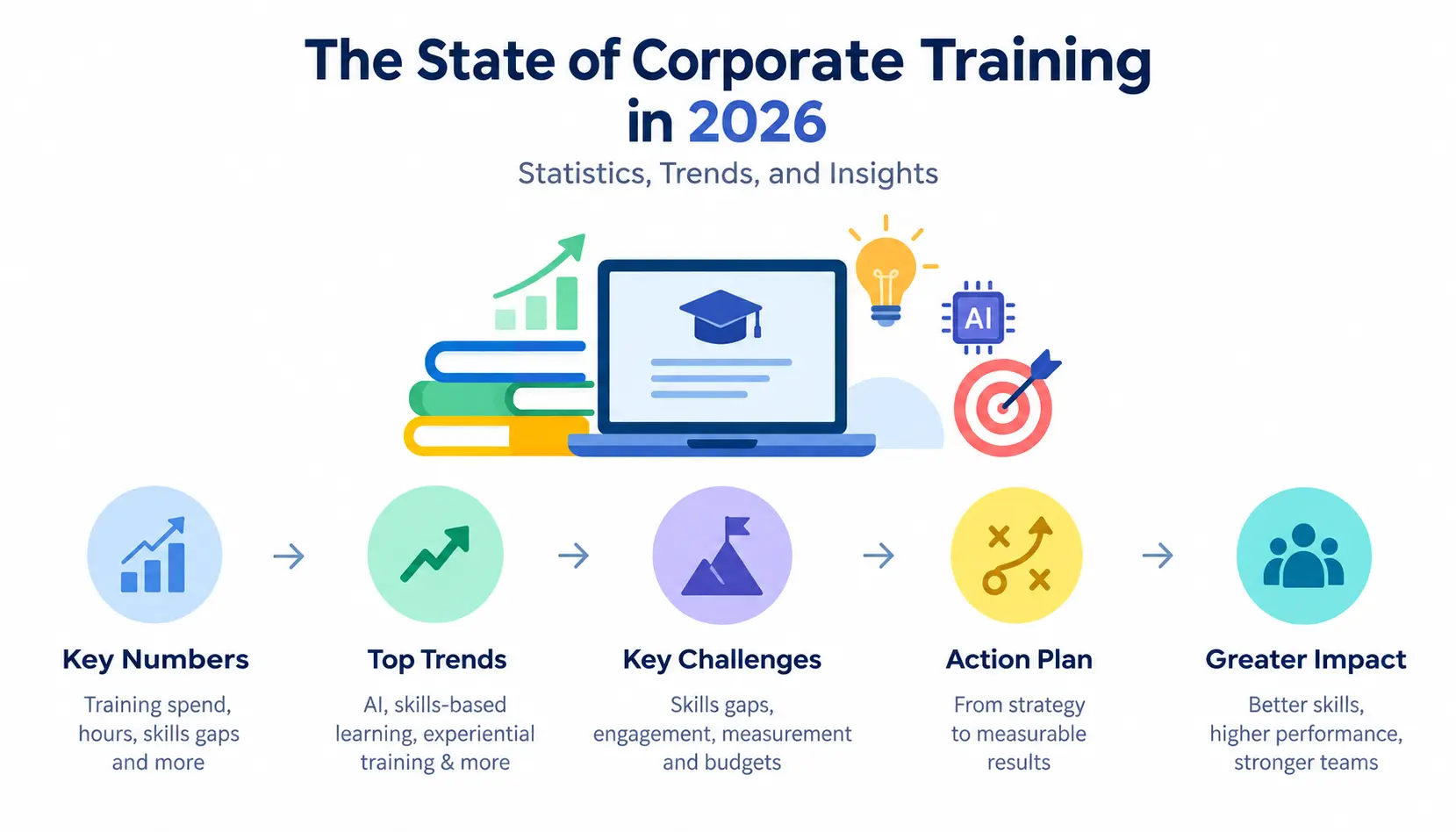
The State of Corporate Training in 2026 at a Glance
Before the detail, here is a quick summary of the most reliable benchmarks. Treat the figures as reference points, not universal truths, because each comes from a different population and year.
| Topic | What the research shows | Source | Data year | Geography |
| Skills change | Employers expect around 39% of core skills to change by 2030 | World Economic Forum, Future of Jobs Report | 2025 report | Global employer survey |
| Training need | About 59 in 100 workers will need training by 2030; roughly 11 of them may not receive it | World Economic Forum | 2025 report | Global |
| Skills gaps | Employers most often name skills gaps as the top barrier to business transformation | World Economic Forum | 2025 report | Global |
| Total training spend | Around US$100 billion a year in the U.S. | Training Magazine, Training Industry Report | Recent annual editions | U.S. |
| Direct spend per employee | Typically above US$1,000 per employee | ATD, State of the Industry | Recent annual editions | Mostly U.S.-based organizations |
| Formal training hours | Commonly reported in the range of roughly 30 or more hours per employee per year, depending on the survey | ATD and Training Magazine | Recent annual editions | Mostly U.S. |
| L&D priorities | Aligning learning with business goals, building AI skills, and developing managers rank near the top | LinkedIn Workplace Learning Report | Recent annual editions | Global |
Spend and hours vary by survey, year, and method, so check the latest edition of each report before you quote a number in a budget request. The sections below explain why.
Corporate Training Statistics Every Business Should Know
How Much Are Companies Spending on Corporate Training?
U.S. organizations spend roughly $100 billion a year on training, according to Training Magazine’s annual industry report. That figure moves up and down with the economy. Companies often trim budgets in uncertain years and restore them when hiring picks up.
Two splits matter when you read spending data. The first is direct versus indirect cost. Direct costs include content, platforms, and instructors. Indirect costs include the salary of employees while they sit in training, which is often the largest hidden expense.
The second split is internal versus external. Internal spend covers your own L&D team and subject experts. External spend covers vendors, off-the-shelf libraries, and consultants. A company that spends heavily on external content but little on internal practice and coaching often gets weaker results.
What Is the Average Corporate Training Budget per Employee?
The Association for Talent Development (ATD) reports average direct learning spend per employee that sits above $1,000 in recent editions of its State of the Industry research. That is a benchmark, not a target.
Be careful with it. ATD’s number counts direct learning costs. Broader estimates that include employee time can be far higher. Mixing the two is one of the most common mistakes in training business cases.
Budgets also vary a lot by industry, company size, and workforce needs. A hospital training clinicians on safety procedures will spend differently from a software firm training engineers on a new language. Use a benchmark to sanity-check your plan, then build your budget from the skills you actually need.
How Many Hours of Training Do Employees Receive?
Surveys report average formal training hours per employee that typically land in the tens of hours per year. The exact number depends on who was surveyed and how “training” was defined.
Formal learning, such as courses and workshops, is only part of the picture. Much of what people learn happens informally: asking a colleague, trying something new, or reading a how-to guide. Most surveys capture formal hours better than informal ones.
More hours do not mean better results. Ten hours of focused practice on a real task can beat forty hours of passive video. Hours tell you about exposure. They say nothing about whether skills improved.
What Do Workforce Skills Statistics Reveal?
The World Economic Forum’s Future of Jobs Report 2025 draws on a survey of more than 1,000 employers worldwide. Employers expected roughly 39% of core skills to change by 2030. They also expected that about 59 of every 100 workers would need training by 2030, and that around 11 of those would be unlikely to get it.
That last number is the real story. The challenge is not only deciding what to teach. It is reaching the people who need it.
The same report points to growing demand for AI and data skills, alongside analytical thinking, resilience, and flexibility. Notice what that mix says: technical skills and human skills rise together.
There is also a gap between what employers expect and what employees can do. Employers may expect staff to adopt new tools quickly. Employees may not yet have the time, guidance, or practice to do it well.
How Is AI Adoption Affecting Training Investment?
AI is now a top learning priority in many organizations. L&D teams are building AI literacy programs, teaching role-specific AI use, and using AI inside their own workflows.
But adopting AI and being competent with it are different things. A company can roll out an AI assistant to every employee in a week. Teaching people to use it well, check its output, and know when not to use it takes much longer.
When you read AI statistics, ask what was measured. Tool access, usage, and skill are three separate things. Most surveys measure the first two.
How to Interpret Corporate Training Statistics Correctly
A few checks will save you from embarrassing mistakes:
- Data year versus publication year. A report published in 2026 may describe 2024 or 2025 data.
- U.S. versus global figures. Many spending benchmarks are U.S.-centered. Do not apply them to a global workforce.
- Survey population. Responses from large enterprises may not reflect small businesses.
- Market revenue versus spending. What vendors earn is not the same as what companies spend on training overall.
- Forecasts versus observed data. A projection for 2030 is a reasoned estimate, not a measurement.
For decision-makers, the takeaway is simple. Use statistics to frame the conversation, then rely on your own data to make the decision.
The Biggest Corporate Training Trends in 2026
A trend matters only if it changes how people gain skills, apply knowledge, or do their work. Here are ten that clear that bar. Some are well established. Others are still early.
1. AI-Powered Learning and Development
AI now supports many parts of the L&D workflow:
- Drafting course outlines, quiz questions, and scenarios.
- Recommending content based on role and past activity.
- Acting as a tutor or assistant that answers learner questions.
- Giving instant feedback on written or spoken practice.
- Adapting assessments to a learner’s level.
- Analyzing skills data across a workforce.
AI-assisted content creation is the most mature use. AI tutors and automated coaching are newer, and results vary widely by tool and use case.
How Companies Can Use AI Without Sacrificing Learning Quality
Speed is the easy win. Quality is the hard part. Protect it with a few habits:
- Human review. A subject expert should check every AI-drafted lesson before release.
- Accuracy. AI can state wrong information with confidence. Verify facts, figures, and policies.
- Privacy. Do not paste employee records or confidential data into tools that are not approved.
- Accessibility. Check that generated content works with screen readers and includes captions.
- Oversight. Name someone who owns AI use in learning and reviews it regularly.
2. Skills-Based Learning and Workforce Planning
Skills-based approaches start with the capabilities the business needs, not the courses you already own. Organizations build a skills taxonomy (a structured list of skills), assess where people stand, and plan development around the gaps.
This supports internal mobility and clearer career pathways. It also helps with workforce planning, because leaders can see which capabilities are thin before a project stalls.
The key shift is in how you set priorities. Train for what the business needs, not for what is easiest to buy.
3. Experiential Learning and Business Simulations
People learn complex skills by doing them. Role-play, scenario-based learning, and simulations let employees make decisions, see consequences, and get feedback without real-world risk.
The cycle that works is practice, feedback, reflection, and another attempt. Skip the feedback and reflection, and the practice teaches much less.
Here is a leadership example. A new manager practices a difficult performance conversation with a peer or a simulation. A coach points out where they avoided the real issue. They try again with a clearer opening. That is far closer to the job than a slide deck on feedback models.
Customer service works the same way. Agents handle a simulated angry customer, then review the call against a simple rubric.
4. Learning in the Flow of Work
This means putting help where work happens: a short video inside the CRM, a checklist in a project tool, or an AI assistant that answers a process question on demand. These are often called job aids or performance support.
It works well for quick, specific needs, such as how to complete a form. It works less well for deep skills like negotiation or leadership, which need structured practice and feedback.
Use in-the-flow support for “how do I do this step?” and structured instruction for “how do I get good at this?”
5. Personalized Learning Paths
Personalization means shaping what someone learns based on their role, existing knowledge, and skill gaps. Adaptive systems can skip what a learner already knows and add practice where they struggle.
It saves time, but it has limits. Employees still want some choice in their development, and many benefit from a human guide such as a manager or mentor. A path built purely by an algorithm can miss context that a person would catch.
6. Microlearning and Blended Training
Microlearning delivers content in short bursts, often a few minutes. It suits single concepts, refreshers, and reinforcement.
It is not enough on its own for complex skills. Nobody learns to lead a team from a series of three-minute videos. The better approach is blended: short digital modules for knowledge, workshops or instructor-led sessions for discussion, and on-the-job practice to lock it in.
7. Leadership and Manager Development
Managers sit at the center of most training outcomes. They decide whether employees get time to practice, whether new behavior is noticed, and whether it is rewarded.
Strong programs cover coaching, communication, decision-making, change management, people management, and feedback conversations. Just as important, they prepare managers to reinforce what their team learns. Without that, even great training fades.
8. Upskilling and Reskilling for Changing Roles
The two terms get mixed up, so here is the difference:
- Upskilling builds new or deeper skills so someone can do their current role better or take on a larger version of it.
- Reskilling builds a different skill set so someone can move into a new role.
Common focus areas include technical skills, digital literacy, AI literacy, analytical thinking, adaptability, and critical thinking. Reskilling also needs career support, such as a clear target role and a realistic timeline.
9. Learning Analytics and Outcome-Based Measurement
Learning analytics is the use of data about learners to understand and improve learning. Modern dashboards can track skills assessments, proficiency, and links to workplace performance.
The shift in 2026 is from activity data to outcome data. Attendance and completion rates show who showed up and who clicked through. They cannot show whether a program worked. Only skill checks and workplace results can do that.
10. Human Skills and Collaborative Learning
As AI handles more routine tasks, human skills carry more weight. These include communication, critical thinking, collaboration, empathy, conflict resolution, ethical judgment, and problem-solving.
They complement technical training. Someone who can use an AI tool but cannot question its output or explain a decision to a colleague is only half-ready. Peer discussion, group projects, and communities of practice build these skills well.
A note on evidence: Trends 1, 4, and 5 are moving fastest, and results differ by tool and context. Ask vendors for evidence from real deployments, not just demos.
Why Corporate Training Is Changing in 2026
Rapid Changes in Workforce Skills
Business needs shift faster than they used to. A skill that was optional two years ago may now be required. That makes learning a continuous process rather than a one-time event.
AI and Automation Across Job Functions
AI is changing the tasks inside many jobs, not always the jobs themselves. Drafting, summarizing, and analysis are where many people notice it first.
Do not assume every role or industry will change the same way. A warehouse supervisor, a nurse, and a marketing analyst will each see different effects. Plan by role, not by headline.
Pressure to Demonstrate Business Value
Executives want evidence. When budgets tighten, training that cannot show a link to goals like quality, speed, or retention is the first to be questioned. That pushes L&D teams toward better measurement.
Employee Expectations for Career Development
Many employees want to grow where they work. Relevant learning, visible career paths, and chances to move internally all shape how people view an employer.
Remote, Hybrid, and Distributed Workforces
Teams spread across locations need flexible delivery, accessible formats, and consistent experiences. A workshop that works in a head office may need rethinking for a remote team in three time zones.
The Biggest Challenges Facing Corporate Training Teams
Persistent Skills Gaps
Spotting a skill gap is only step one. Closing it takes practice, time, and support. And training will not fix every performance problem, which is why a needs analysis comes first.
Low Engagement and Completion Rates
People skip training that feels irrelevant, arrives at a bad time, or lacks manager backing. Weak course design makes it worse. Fix relevance and workload first, then look at the content.
Difficulty Measuring Training Effectiveness
Collecting learning data is easy. Showing that workplace performance changed is hard. It needs a baseline, a clear target, and cooperation from the business teams who own the metrics.
Limited Budgets and Competing Priorities
When money is tight, focus on business-critical capabilities. Ask which two or three skills, if improved, would most affect results. Fund those well rather than spreading thin.
Inconsistent Manager Support
Employees often leave training eager and return to a job that gives them no time or reason to use it. Without chances to practice, new skills fade. This is one of the most common reasons good programs fail.
The forgetting curve, first described by Hermann Ebbinghaus, shows how quickly people lose new information without review. Reinforcement is not optional.
AI Accuracy, Privacy, and Governance
AI in learning raises real risks:
- Data protection: learner and company data must be handled securely.
- Content accuracy: generated material can be wrong.
- Bias: outputs can reflect unfair patterns.
- Intellectual property: check what content tools can use and produce.
- Accessibility: make sure all learners can use the result.
- Human oversight and policy: set clear, responsible AI rules and enforce them.
Too Much Content, Not Enough Application
More courses rarely mean more capability. Many companies have huge libraries that few people use well. Cut what is unused and invest in practice, coaching, and on-the-job application instead.
Which Corporate Training Methods Work Best?
The best method depends on the learning objective, the audience, your resources, and the level of proficiency you need. No single format wins every time.
| Training method | Best use | Main limitation | How to evaluate it |
| Instructor-led training | Discussion and facilitated learning | Scheduling and cost | Skill demonstration |
| Self-paced e-learning | Standardized knowledge | Limited interaction without support | Knowledge assessment |
| Blended learning | Combining instruction and practice | Requires coordination | Proficiency and application |
| On-the-job training | Role-specific tasks | Inconsistent delivery | Time to proficiency |
| Coaching and mentoring | Leadership and complex interpersonal skills | Depends on coaching quality | Behavior change |
| Simulation-based learning | Decisions and realistic scenarios | Design and implementation effort | Scenario performance |
| AI-supported learning | Personalized practice and feedback | Requires validation and oversight | Skill gain and application |
How to Choose the Right Training Method
Work through these questions:
- What skill do employees need?
- How complex is the task?
- How costly are mistakes? Higher risk calls for more supervised practice.
- Do learners need hands-on practice?
- How many learners are there, and where are they?
- What budget do you have?
- What workplace outcome do you expect?
A short compliance update may be fine as self-paced e-learning. Training nurses on a new medication process should include supervised practice.
How to Build an Effective Corporate Training Strategy in 2026
This eight-step process works for most organizations, from a 50-person company to a global enterprise.
Step 1: Identify Business-Critical Skill Gaps
Start with business goals. Then gather input from performance data, employee feedback, and managers. The aim is a short list of capabilities that matter most, not a wish list. Once you have identified these priorities, use our guide to building an effective employee training program to turn skill gaps into a structured learning plan.
Step 2: Conduct a Training Needs Analysis
A needs assessment checks whether training is the right fix. Poor results may come from unclear processes, missing tools, weak communication, or conflicting incentives.
Here is a common scenario. A sales team misses its targets, and leadership requests a negotiation course. Interviews reveal reps are using an outdated pricing sheet. A new sheet solves the problem in a week. A course would have cost thousands and fixed nothing.
Training is not always the answer.
Step 3: Set Measurable Learning Objectives
State what employees should be able to do afterward. “Understand customer empathy” is vague. “Resolve a billing complaint in one call using the approved framework” can be observed and measured.
Step 4: Select the Right Learning Format
Match format to objective, audience, and resources, using the table above. Knowledge points may suit short digital modules. Complex behaviors need practice and feedback.
Step 5: Choose Appropriate Learning Technology
Start from requirements, not vendor names. Know what each category does:
- Learning management systems (LMS): deliver and track courses and records.
- Learning experience platforms (LXP): surface and recommend content from many sources.
- AI learning tools: support content creation, tutoring, and feedback.
- Digital learning libraries: provide broad off-the-shelf content.
- Simulation platforms: let learners practice decisions in realistic scenarios.
- Learning analytics tools: connect learning data with performance data.
Many organizations need only two or three of these. Do not buy a platform to solve a design problem.
Step 6: Build Practice and Reinforcement Into the Program
Plan for what happens after the session:
- Role-play and job-based assignments.
- Coaching and feedback.
- Spaced refreshers.
- Manager check-ins that reinforce the new behavior.
If a program has no practice or reinforcement, expect little change.
Step 7: Measure Results and Improve the Program
Compare baseline data with post-training results. Look at other factors that could explain the change, such as new tools, seasonal demand, or staffing shifts. Then refine the program based on what you learn.
Step 8: Scale What Works
Pilot with one team first. Gather learner and manager feedback, check results, and fix problems. Expand only once the evidence supports it.
How to Measure Corporate Training Effectiveness and ROI
Track Training Participation
Track enrollment, attendance, completion, and time spent learning. These are useful operating numbers. They describe participation, not effectiveness. For practical ways to monitor course completion, assessment results, and learner progress, see our guide on how to track employee training progress efficiently.
Measure Knowledge and Skill Improvement
Use pre- and post-training assessments, practical tasks, and scenario-based tests. The goal is to see proficiency, not just recall.
Measure Behavior Change at Work
Ask whether people actually work differently. Manager observations, quality reviews, and checks on process use give the best view.
Measure Business Performance
Pick indicators that match the objective:
- Error rates
- Productivity
- Time to proficiency
- Customer satisfaction
- Sales performance
- Compliance incidents
- Employee retention
Choose one to three. Tracking everything makes it hard to see anything.
Calculate Training ROI
The standard formula, popularized in training by Jack Phillips and used widely in finance as return on investment, is:
Training ROI (%) = [(Monetary Benefits − Training Costs) ÷ Training Costs] × 100
For example, if a program costs $50,000 and you can defensibly attribute 80,000inbenefitstoit,ROIis(80,000 − $50,000) ÷ $50,000 × 100 = 60%.
The hard part is not the math. It is the estimate of benefits. Be transparent about assumptions, include indirect costs like employee time, and account for other factors that influenced results.
Use the Kirkpatrick Model to Evaluate Training
The Kirkpatrick model evaluates training at four levels:
- Reaction: how learners felt about the training.
- Learning: what they learned.
- Behavior: whether they apply it at work.
- Results: the effect on business outcomes.
Positive feedback at level one is nice to have. It cannot, on its own, show business impact.
Example: Measuring the Impact of Customer Service Training
This is a hypothetical example for illustration.
A customer service team receives training to reduce repeat contacts, which means customers calling back about the same issue.
- Baseline. Before training, 22% of contacts are repeats. Quality scores are recorded.
- Skill check. After training, agents handle simulated cases scored against a rubric.
- Monitor. Over the next 90 days, the team tracks repeat-contact rates weekly.
- Compare. Repeat contacts fall to 17%.
Before crediting the training, check for other causes. Did a product bug get fixed? Did call volume change? Was a new knowledge base launched? A fair comparison with a similar team that did not yet receive training makes the claim much stronger.
How Corporate Training Benefits Employees and Businesses
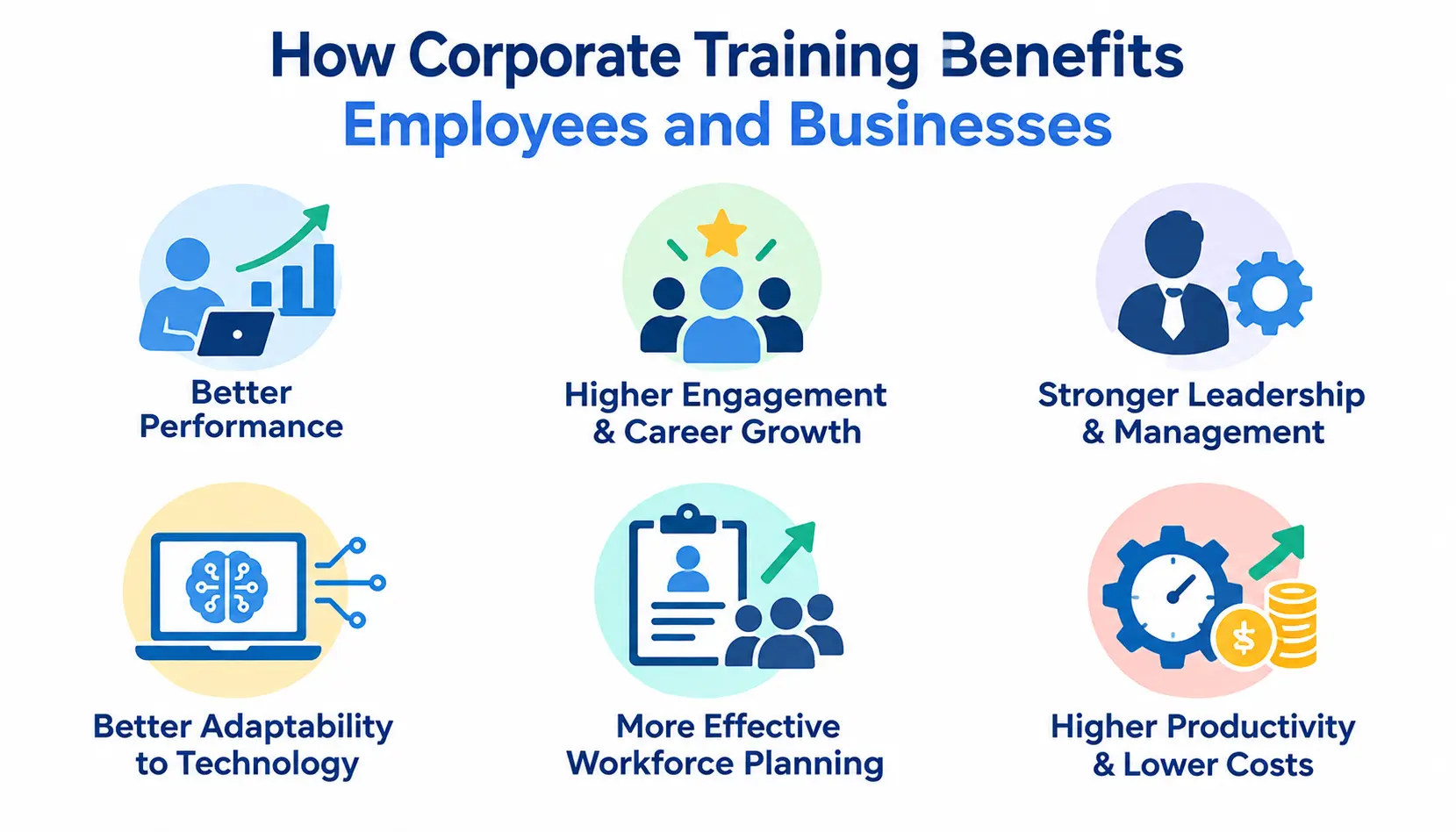
Improved Employee Performance
Relevant, practical training improves job-specific capabilities. The key word is relevant.
Higher Employee Engagement and Career Development
Learning opportunities signal investment in people and can support internal progression. That tends to help engagement, though it is one factor among many.
Stronger Leadership and Management Capabilities
Structured development helps new and experienced managers handle coaching, feedback, and change.
Better Adaptability to Technological Change
Ongoing learning builds digital literacy and AI readiness, so employees adjust more easily when tools change.
More Effective Workforce Planning
When you know which skills you have and which you need, you can plan hiring, development, and moves between roles with more confidence.
Potential Productivity and Cost Benefits
Training can raise productivity, reduce errors, or lower costs when it targets a real gap, includes practice, and gets manager support. It is not a guaranteed return. Anyone promising a fixed ROI without evidence is selling something. Explore these outcomes further in our guide to increasing workforce productivity through training, which covers practical ways to improve employee performance and reduce errors.
What the Future of Corporate Training Looks Like Beyond 2026
These are likely developments, not certainties. Some already have supporting evidence. Others are forecasts.
More AI-Supported Practice and Feedback
AI could make coaching-style practice available at scale, such as rehearsing a sales call or a tough conversation any time. Quality and fairness of feedback will need close checking.
Greater Emphasis on Skills Intelligence
Skills data may increasingly guide development and workforce planning. This depends on accurate, regularly updated data, which many organizations do not yet have.
More Integrated Learning and Performance Support
Learning resources will likely sit closer to daily tools, so help appears when people need it.
Increased Attention to Human Judgment and AI Literacy
Knowing when to trust AI output, and when to challenge it, will matter alongside technical skills. Critical thinking and ethical decision-making are part of AI readiness.
Greater Scrutiny of Learning Outcomes
Expect more questions from finance and executive teams about what training delivers. Programs with clear baselines and results will be easier to defend.
A Practical Corporate Training Action Plan for 2026
Use this roadmap to turn the ideas above into action.
| Phase | Priority | Deliverable |
| Phase 1 | Identify skill gaps | Prioritized capability assessment |
| Phase 2 | Set objectives | Measurable learning goals |
| Phase 3 | Design the program | Training plan and delivery method |
| Phase 4 | Run a pilot | Initial learner and performance data |
| Phase 5 | Evaluate | Learning, behavior, and business results |
| Phase 6 | Improve and scale | Refined program and expansion plan |
Timelines depend on your organization’s size, learning needs, and complexity. A small team may complete a pilot in weeks. A global rollout may take much longer.
Frequently Asked Questions About Corporate Training in 2026
1. What Is the Current State of Corporate Training in 2026?
Corporate training in 2026 is moving from course delivery toward skills development, AI-supported learning, and measurable business results. Organizations are building AI literacy, focusing on manager development, and being asked to prove that training changes performance, not just completion rates.
2. What Are the Biggest Corporate Training Trends in 2026?
The main trends are AI-powered learning, skills-based planning, simulations and practice, learning in the flow of work, personalized paths, blended formats, manager development, upskilling and reskilling, outcome-based analytics, and human skills. See the trends section above for detail.
3. How Much Do Companies Spend on Corporate Training?
Training Magazine’s industry report puts U.S. organizational training spend at around $100 billion a year. ATD reports direct learning spend per employee typically above $1,000. These figures are U.S.-centered, vary by year, and cover different populations, so check the latest editions before citing them.
4. How Is AI Changing Corporate Training?
AI helps draft content, recommend learning, answer learner questions, give feedback, and analyze skills data. It speeds up work, but humans still need to review accuracy, protect privacy, and oversee how it is used.
5. What Is the Difference Between Upskilling and Reskilling?
Upskilling builds new or deeper skills for someone’s current role. Reskilling builds a different skill set so someone can move into a new role. Both support workforce adaptability, but reskilling usually needs more time and career support.
6. How Can Companies Measure Corporate Training ROI?
Use this formula: ROI (%) = [(Monetary Benefits − Training Costs) ÷ Training Costs] × 100. It only works with defensible benefit estimates and full cost data. Its main limitation is attribution, since other factors often influence the same results.
7. What Are the Most Effective Corporate Training Methods?
Effectiveness depends on the learning objective, the workforce, and the chance to practice. Blended approaches that combine instruction, hands-on practice, and coaching tend to suit complex skills, while self-paced modules suit simple knowledge.
8. How Can Businesses Close Employee Skill Gaps?
Start by identifying business-critical gaps, then run a needs analysis to confirm training is the right fix. Set measurable objectives, choose a fitting format, build in practice and manager reinforcement, measure results, and scale what works.
9. Why Is Employee Training Important for Retention?
Career development opportunities help employees see a future with their employer, which can support retention. But retention also depends on pay, management quality, workload, and culture. Training helps, but it cannot offset those factors alone.
Conclusion
The state of corporate training in 2026 comes down to one shift: from counting courses to building capabilities. AI makes content faster to produce and practice easier to scale. Skills are changing quickly. And leaders want proof.
The path forward is practical. Find the skill gaps that matter, confirm training is the right fix, set clear objectives, build in practice, and measure results at work. Keep humans in charge of quality, especially where AI is involved.
Start small. Pick one business-critical skill, run a pilot, and measure honestly. That single cycle will teach you more than another year of course completions.