

If your reports show that 94% of staff finished a course, but sales, quality, or customer scores did not move, you have a completion problem, not a learning win. The fix is to align employee training with business goals from the start, so every program has a clear job to do.
This guide shows you how. You will learn what alignment means, why it matters, where it usually breaks down, and a seven-step process you can follow. You will also see five worked examples, a 30-60-90-day plan, and answers to common questions.
What Does Aligning Employee Training With Business Goals Mean?
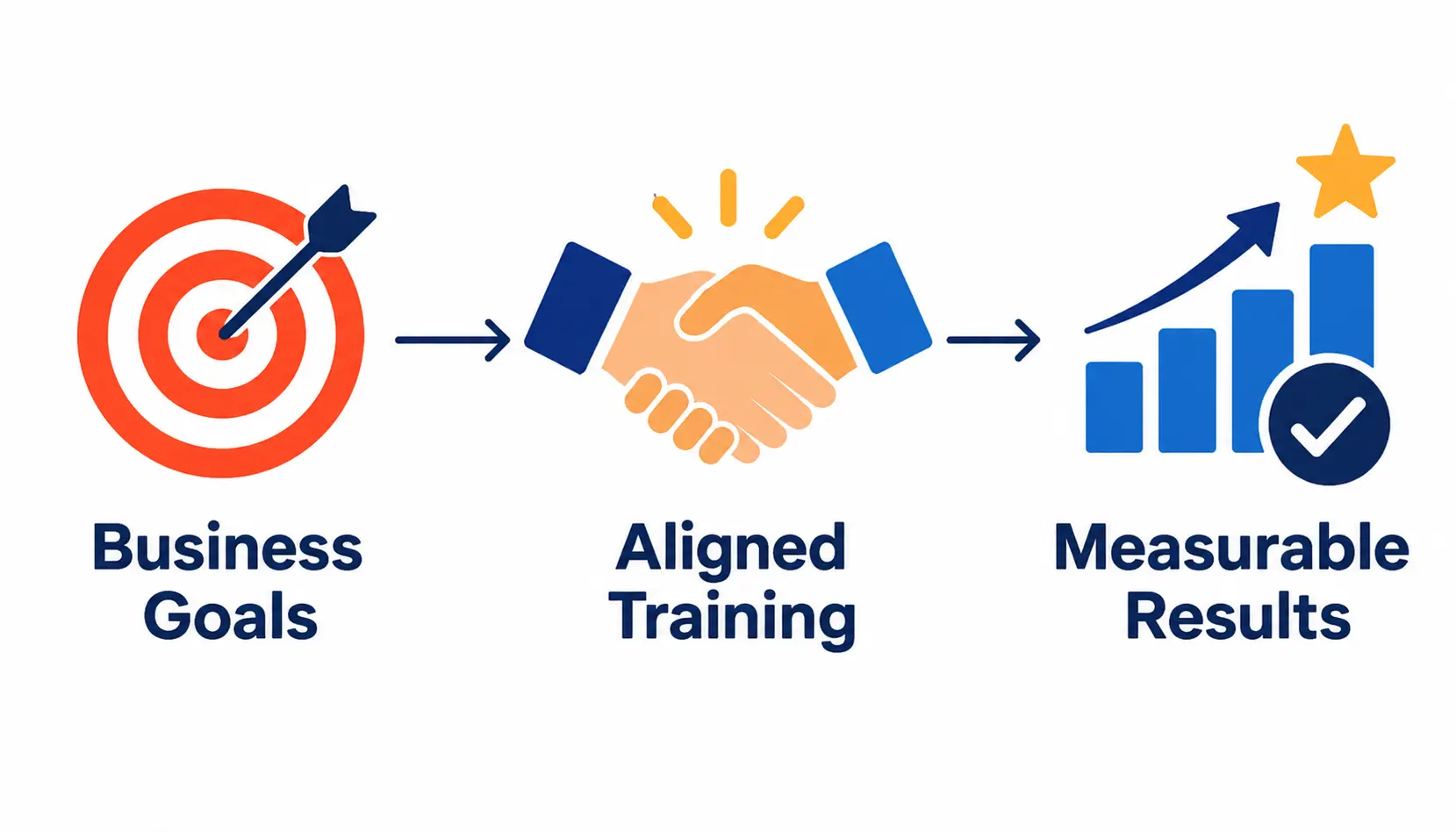
Aligning employee training with business goals means designing learning programs around the results the company needs, such as higher revenue, better quality, or lower turnover, and then measuring whether the training helped deliver them.
In plain English: you start with the business problem, not the course catalog. Training becomes a tool for solving something, not an activity to tick off.
This is different from general professional development. A leadership workshop can be useful on its own. But it is aligned only when it connects to a goal like “reduce manager-related turnover” and you track that goal afterward.
Employee Training Goals vs. Business Goals
People often mix these up, so it helps to separate them.
- Business goals describe what the company wants to achieve. Example: cut order errors by 20% this year.
- Training goals describe what employees must know or do differently to help. Example: warehouse staff can follow the new picking and checking process without mistakes.
The business goal sits on top. The training goal is the bridge that gets people there. If you cannot draw a line from one to the other, the training probably needs rethinking.
How Training Alignment Supports Organizational Strategy
Every strategy depends on people having the right skills at the right time. If the company plans to enter a new market, launch a product, or adopt new software, someone has to learn how to do that work.
Aligned training turns strategy into daily skills. It also gives leaders a clear answer when someone asks, “Why are we spending money on this?”
Why Is It Important to Align Employee Training With Business Goals?
When training links to real goals, you spend less on programs that do nothing and more on the ones that matter. Here are the main benefits.
Improves Employee Productivity and Operational Efficiency
People work faster and make fewer mistakes when training targets the exact tasks they do. A new process or tool delivers value only after the team knows how to use it well. Focused training shortens that gap.
Develops Skills Required to Achieve Business Objectives
Goals fail quietly when the skills are missing. If you want to grow enterprise sales, your reps need different skills than they use for small deals. Alignment makes you ask, “What must people be able to do?” before you buy a course.
Improves Employee Engagement and Retention
Employees notice when training is relevant. Learning that helps them do their job better, or move to a better role, feels worth their time. Learning that feels random does not. Better employee retention is a common side benefit of useful, career-linked development.
Increases Customer Satisfaction and Service Quality
Customers feel the quality of your training. Support agents who know the product and handle hard conversations well resolve problems faster. That shows up in customer satisfaction results.
Helps Businesses Achieve Better Training ROI
Training costs real money: course fees, platform costs, and staff time away from work. Alignment helps you pick programs with a clear payoff and drop the ones without it. We cover how to calculate this later.
Supports Innovation and Long-Term Business Growth
Companies that keep building skills adapt faster when markets or technology change. Alignment keeps that learning pointed at where the business is going, not where it has been.
Common Challenges That Prevent Training and Business Goal Alignment
Most alignment problems are not about effort. They come from a few repeating gaps.
Unclear Organizational Objectives
If leaders have not set clear, measurable goals, the training team has nothing to aim at. “Be better at customer service” is too vague. “Raise CSAT from 82 to 88 within two quarters” is something you can train toward.
Generic Training Programs That Ignore Role-Specific Needs
Off-the-shelf courses are easy to buy, but they treat a new hire and a senior specialist the same. Employees tune out when content does not match their daily work.
Limited Communication Between HR and Department Managers
L&D teams often plan from the top down without asking managers what their teams struggle with. Managers see the real performance gaps. Without their input, training misses the mark.
Lack of Employee Skill Assessments
Without data on what people can already do, you are guessing. You may train people on things they already know, or skip the skills they badly need.
Difficulty Measuring Training Effectiveness
Completion and satisfaction are easy to track. Behavior change and business results are harder. Many teams stop at the easy numbers and never learn if the training worked.
Low Employee Participation and Engagement
Even good programs fail if people do not take part. Heavy workloads, unclear benefits, and poor timing are the usual causes.
Training Budgets Not Connected to Business Priorities
Budgets are often split by headcount or last year’s spending. Alignment means directing money to the skills that support the top priorities this year.
How to Align Employee Training With Business Goals: 7 Practical Steps
Here is the process in short, followed by detail on each step.
- Identify your organization’s business goals.
- Run a training needs and skills gap analysis.
- Turn business objectives into measurable training goals.
- Build role-specific training programs.
- Choose the right methods and technology.
- Measure effectiveness using business KPIs.
- Monitor, evaluate, and keep improving.
Step 1: Identify Your Organization’s Business Goals
Start by learning what the business is trying to achieve this year and over the next few years. Do not guess. Ask.
Sit down with executives and department heads. Ask three simple questions: What are your top priorities? What is getting in the way? How will you know you succeeded?
Then turn the answers into measurable key performance indicators (KPIs). Pick the two or three goals that matter most. Trying to support everything at once spreads your training budget too thin.
Examples of Common Business Goals
- Increase revenue
- Improve customer satisfaction
- Reduce operational costs
- Improve employee retention
- Increase productivity
- Improve product quality
Step 2: Conduct a Training Needs and Skills Gap Analysis
A skills gap is the difference between what people can do today and what they need to do to hit the goal. A needs assessment helps you find it.
First, list the skills the goal requires. Then check what your people can actually do now. Compare the two. The gaps become your training priorities.
One caution: not every performance problem is a skills problem. Sometimes the cause is a broken process, unclear expectations, or poor tools. Check this before you build a course (more on this in the mistakes section).
Methods to Identify Employee Skill Gaps
- Skills assessments: Short tests or practical tasks that show current ability.
- Performance evaluations: Review past results and recurring issues.
- Employee surveys: Ask people where they feel least confident.
- Manager interviews: Managers know where their teams struggle.
- Competency mapping: List the skills each role needs and rate people against them.
- Workforce skills inventories: Keep a central record of who can do what.
Use more than one method. Self-reported surveys alone can be too generous or too harsh.
Step 3: Translate Business Objectives Into Measurable Training Goals
Now connect the goal to the learning. For each business objective, ask: “What would people need to do differently for this to happen?”
Then write training goals using the SMART goals approach: specific, measurable, achievable, relevant, and time-bound.
Compare these two goals:
- Weak: “Improve customer service skills.”
- Strong: “Within 90 days, 80% of support agents will resolve billing questions on the first contact, as measured by first-contact resolution rate.”
The second one tells you what to teach and how to check it. Link each training goal to a departmental KPI so results are easy to read later.
Examples of Business Goals and Corresponding Training Objectives
| Business objective | Training objective |
| Increase sales | Improve negotiation and closing skills |
| Improve customer satisfaction | Develop communication and problem-solving skills |
| Reduce operational errors | Improve technical and process knowledge |
| Increase productivity | Develop time-management and workflow skills |
Step 4: Develop Role-Specific Employee Training Programs
Build learning paths around what each role actually does. A frontline agent, a team lead, and an engineer need different content, even if they share the same company goal. A well-structured employee training program helps organizations define learning objectives, select suitable delivery methods, and measure training outcomes.
Mix technical and soft skills. A salesperson needs product knowledge and the ability to listen. A technician needs process skills and the ability to explain problems clearly.
Also leave room for career growth. When people see how training helps their own path, they put in more effort. Aim for the overlap between what the company needs and what the employee wants.
Examples of Department-Specific Training Programs
- Sales training
- Customer service training
- Leadership development
- Technical training
- Digital skills training
- Compliance training
Step 5: Choose the Right Employee Training Methods and Technologies
Pick the format that fits the skill, not the one that is easiest to roll out. Common options include:
- Instructor-led training: Good for complex topics and group discussion.
- Online learning: Flexible and easy to scale.
- Blended learning: Combines online content with live practice.
- On-the-job training: Best for hands-on skills.
- Mentoring and coaching: Helps people apply skills in real situations.
- Microlearning: Short lessons that fit into a busy day.
A practical rule: use online content to teach knowledge, and use practice, coaching, and feedback to build skill. Videos alone rarely change behavior.
How LMS Platforms Support Business-Aligned Training
A learning management system (LMS) is software for delivering and tracking training. A good one helps with alignment in several ways:
- Centralized learning management: One place for courses and records.
- Personalized learning paths: Different content for different roles.
- Employee progress tracking: See who has started, finished, or is stuck.
- Training analytics: Spot which content works and which does not.
- Performance reporting: Share results with managers and leaders.
Popular platforms include Docebo, Moodle, and Cornerstone. They differ in cost, flexibility, and features, so test a few against your actual needs before you commit. The tool matters less than the plan behind it. Understanding how a learning management system works can help businesses choose the right platform for managing courses, employee progress, assessments, and training reports.
Step 6: Measure Training Effectiveness Using Business KPIs
This step is where alignment becomes visible. Follow this sequence:
- Record baseline performance before training starts.
- Track learning progress during training.
- Check whether behavior changes on the job.
- Compare business KPIs before and after.
- Collect feedback from managers and employees.
Without a baseline, you cannot show change. Take your “before” numbers early. To evaluate training effectiveness, compare employee performance before and after training, review assessment results, and measure improvements in business outcomes.
Important KPIs to Measure Employee Training Success
| Training metric | What it tells you |
| Course completion rate | How many people took part |
| Knowledge assessment scores | Whether employee knowledge improved |
| Time to proficiency | How fast people become productive |
| Error reduction | Whether operational quality improved |
| Customer satisfaction score | Whether customer experience improved |
| Employee retention rate | Whether the workforce is more stable |
| Revenue per employee | Whether business productivity improved |
Completion rate shows participation, not impact. Pair it with at least one metric that reflects a real business result.
Using the Kirkpatrick Model to Evaluate Training
The Kirkpatrick Model is a widely used way to judge training. It has four levels:
- Reaction: Did participants find the training useful and relevant?
- Learning: Did they gain the intended knowledge or skills?
- Behavior: Are they applying what they learned at work?
- Results: Did the business outcomes improve?
Many teams stop at levels one and two. Aligned training pushes through to levels three and four, because that is where business value lives.
How to Calculate Employee Training ROI
Training return on investment compares the financial benefit of training to its cost. The formula is:
ROI (%) = (Training Benefits − Training Costs) ÷ Training Costs × 100
Here is a simple example with clear assumptions:
- Training costs: $10,000 (course fees, platform, and staff time).
- Attributable financial benefits over the following year: $15,000 (for example, savings from fewer errors).
ROI = (15,000 − 10,000) ÷ 10,000 × 100 = 50%
The hard part is the word “attributable.” Do not give training credit for every improvement. Seasonal demand, new tools, or staffing changes may also have played a part. Where you can, use a comparison group that did not receive the training, or ask managers to estimate how much of the gain came from it. Be conservative and state your assumptions openly. A modest, honest number earns more trust than an inflated one.
Step 7: Monitor, Evaluate, and Continuously Improve Training Programs
Alignment is not a one-time project. Business goals shift, and training must shift with them.
- Review training performance on a regular schedule.
- Collect feedback from employees and managers.
- Find modules that people skip or that do not change results, then fix or remove them.
- Update content when priorities change.
- Build a habit of continuous learning, so people share knowledge without waiting for a formal course.
A short quarterly review with department leaders is often enough to keep things on track.
Practical Examples of Aligning Employee Training With Business Goals
The scenarios below are illustrative examples, not case studies from a specific company. The numbers are sample targets to show how the thinking works.
Example 1: Aligning Sales Training With Revenue Growth
- Business challenge: A software company wants to grow revenue from mid-size accounts, but reps keep losing deals at the pricing stage.
- Required skills: Discovery questions, value-based selling, and handling price objections.
- Training initiative: A six-week program with short lessons, role-play sessions using real lost deals, and manager coaching on live calls.
- Performance indicators: Win rate, average deal size, and sales cycle length.
- Expected business outcome: Higher win rate on mid-size deals within two quarters.
Example 2: Aligning Customer Service Training With Customer Satisfaction
- Business challenge: Customer satisfaction scores are falling because agents struggle with upset customers.
- Communication and problem-solving skills: Active listening, calming language, and clear next steps.
- Training intervention: Scenario-based practice using recorded calls (with names removed), plus peer feedback.
- Measurement: Track CSAT, Net Promoter Score, and first-contact resolution before and after.
Example 3: Aligning Technical Training With Operational Efficiency
- Technical skill gaps: Operators misuse a new machine setting, causing rework.
- Employee upskilling: Short, hands-on sessions at the machine, led by the most experienced operator.
- Practical training: Operators complete a checklist task under observation before working alone.
- Measurement: Track error rate, rework hours, and output per shift.
Example 4: Aligning Leadership Training With Employee Retention
- Management challenges: New team leads were promoted for technical skill and have little people-management experience. Their teams show higher turnover.
- Leadership development: A program on feedback, delegation, and one-on-one meetings.
- Coaching and mentoring: Each new lead is paired with a senior mentor for six months.
- Measurement: Track engagement survey scores and team turnover over the next year.
Example 5: Aligning Digital Skills Training With Business Transformation
- Technology adoption requirements: The company is rolling out a new CRM and AI-assisted tools.
- Digital competency assessment: A short skills check shows who needs basics and who is ready for advanced use.
- AI and software training: Role-based sessions that use the team’s real workflows, not generic demos.
- Measurement: Track tool adoption rates, data quality, and time saved on routine tasks.
How to Create a 30-60-90-Day Employee Training Alignment Plan
A phased plan keeps the work manageable. Adjust the timing to your company’s size and pace.
First 30 Days: Assess Business Goals and Employee Skill Gaps
- Meet with leadership to confirm top priorities.
- Identify objectives for each department.
- Run skills assessments and manager interviews.
- Record baseline KPIs so you can compare later.
Days 31-60: Develop and Launch Training Programs
- Write SMART training goals tied to each KPI.
- Build role-specific learning paths.
- Select methods and tools for each audience.
- Start training with a pilot group if you can, then expand.
Days 61-90: Evaluate Performance and Improve Training
- Check what employees learned.
- Look for changes in on-the-job behavior.
- Compare business KPIs with your baseline.
- Gather feedback from managers, employees, and leaders.
- Fix weak spots and plan the next cycle.
Keep in mind that some business results, like retention or revenue, take longer than 90 days to show. Use the 90-day mark to check early signals, then keep tracking.
Best Practices for Maintaining Alignment Between Employee Training and Business Goals
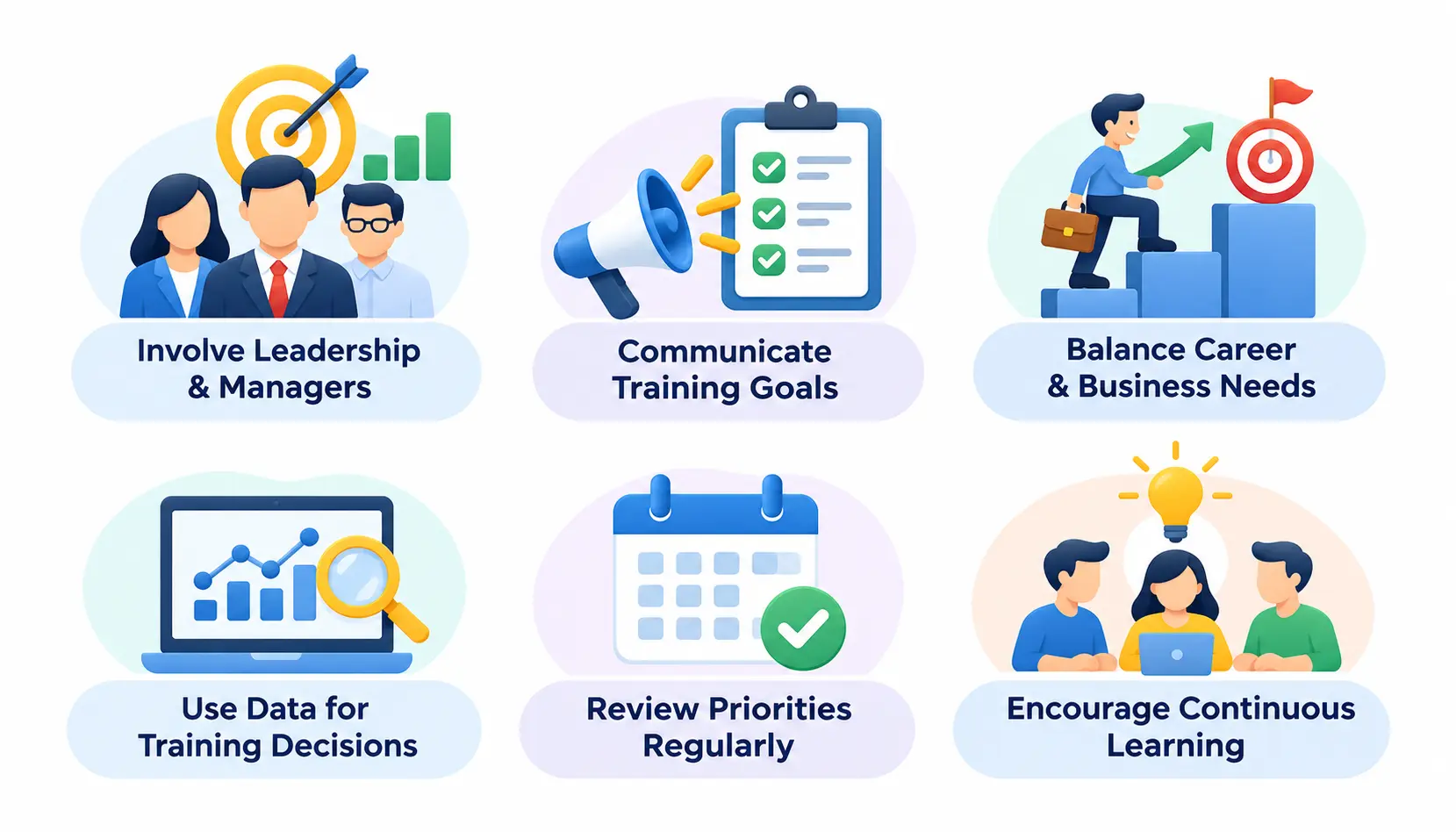
Involve Leadership and Department Managers
Get leaders to co-own the training goals. Managers also play a big role after training ends, because they reinforce new habits.
Communicate Training Objectives to Employees
Tell people why the training exists and how it connects to company goals and their own growth. Clear purpose improves participation.
Balance Employee Career Development With Business Needs
Offer paths that serve both sides. When an employee’s ambitions overlap with a business need, motivation is highest.
Use Data to Make Training Decisions
Let assessment results, performance data, and feedback guide what you build. Opinions are useful, but data keeps you honest.
Review Training Priorities as Business Goals Change
Schedule regular check-ins, such as every quarter. If the company pivots, your training plan should too.
Encourage Continuous Learning and Knowledge Sharing
Support peer learning, lunch-and-learns, and internal mentoring. Some of the best training comes from colleagues who already do the work well.
Common Mistakes to Avoid When Aligning Employee Training With Business Goals
Focusing Only on Course Completion Rates
A high completion rate can hide zero impact. Always add a behavior or business measure.
Ignoring Employee Feedback
Employees can tell you if content is outdated, too basic, or disconnected from real work. Ask, then act on what you hear.
Using the Same Training Program for Every Department
One-size-fits-all training wastes time. Tailor content to roles.
Setting Unrealistic Training Objectives
A single workshop will not turn a struggling team into top performers. Set goals that match the effort and timeline.
Failing to Measure Post-Training Performance
If you never look at results, you cannot improve. Schedule follow-up measurement before training begins.
Treating Every Performance Problem as a Training Problem
Before you train, ask if people lack the skill, or if something else is blocking them, like unclear goals, bad tools, or weak incentives. Training cannot fix a broken process.
Frequently Asked Questions About Aligning Employee Training With Business Goals
1. How do you align employee training with business goals?
Start with the company’s priorities, find the skills needed to reach them, and measure current gaps. Then set SMART training goals, build role-specific programs, and track business KPIs. Review and adjust regularly.
2. Why is it important to align employee training with business objectives?
It ensures training money and time go toward results the company needs. It also helps employees see why learning matters and gives leaders evidence of impact.
3. What are the benefits of strategic employee training?
Benefits include better productivity, stronger skills, higher engagement and retention, better customer service, and clearer returns on training spend.
4. How do you identify employee training needs?
Compare the skills your goals require with what people can do now. Use skills assessments, performance reviews, surveys, manager interviews, and competency mapping.
5. What KPIs measure employee training effectiveness?
Common KPIs include assessment scores, time to proficiency, error rates, customer satisfaction, retention rate, and revenue per employee. Choose the ones linked to your specific goal.
6. How do you calculate employee training ROI?
Subtract training costs from attributable benefits, divide by training costs, and multiply by 100. For example, $15,000 in benefits against $10,000 in costs gives a 50% ROI. Attribute benefits carefully.
7. What is the Kirkpatrick Model of training evaluation?
It is a four-level framework that evaluates training by reaction, learning, behavior, and results. It helps you look beyond satisfaction scores to real business impact.
8. How can an LMS help align employee training with business goals?
An LMS centralizes training, assigns role-based learning paths, tracks progress, and reports on results. That makes it easier to link learning data to business KPIs.
9. How often should companies review their employee training programs?
A quarterly review works well for most teams, with a deeper annual review tied to planning. Review sooner if goals, tools, or processes change.
10. How can managers ensure employees apply what they learn?
Managers can set clear expectations, give people time to practice, coach on real tasks, and give feedback. Following up a few weeks after training makes a big difference.
Conclusion
Training works best when it has a job to do. When you align employee training with business goals, you stop guessing and start building skills that move real numbers.
The path is straightforward. Learn the goals, find the skill gaps, set measurable training targets, build role-specific programs, and track results. Then review and improve on a steady schedule.
Start small. Pick one business goal and one team, run the process, and learn from the results. Once you can show a clear link between training and performance, getting support for the next program becomes much easier.