


Every organization depends on people who can guide others. Yet many companies promote their best performers into leadership roles and hope for the best. That approach rarely works.
Leadership development programs give you a better way. They help current and future leaders build the skills, habits, and judgment they need to lead teams well. Done right, they strengthen employee performance, support growth, and make succession planning far less stressful.
This complete guide explains what leadership development programs are, why they matter, and which types exist. You will also learn which skills to teach, how to design and run a program, how much it may cost, and how to measure results.
What Is a Leadership Development Program?
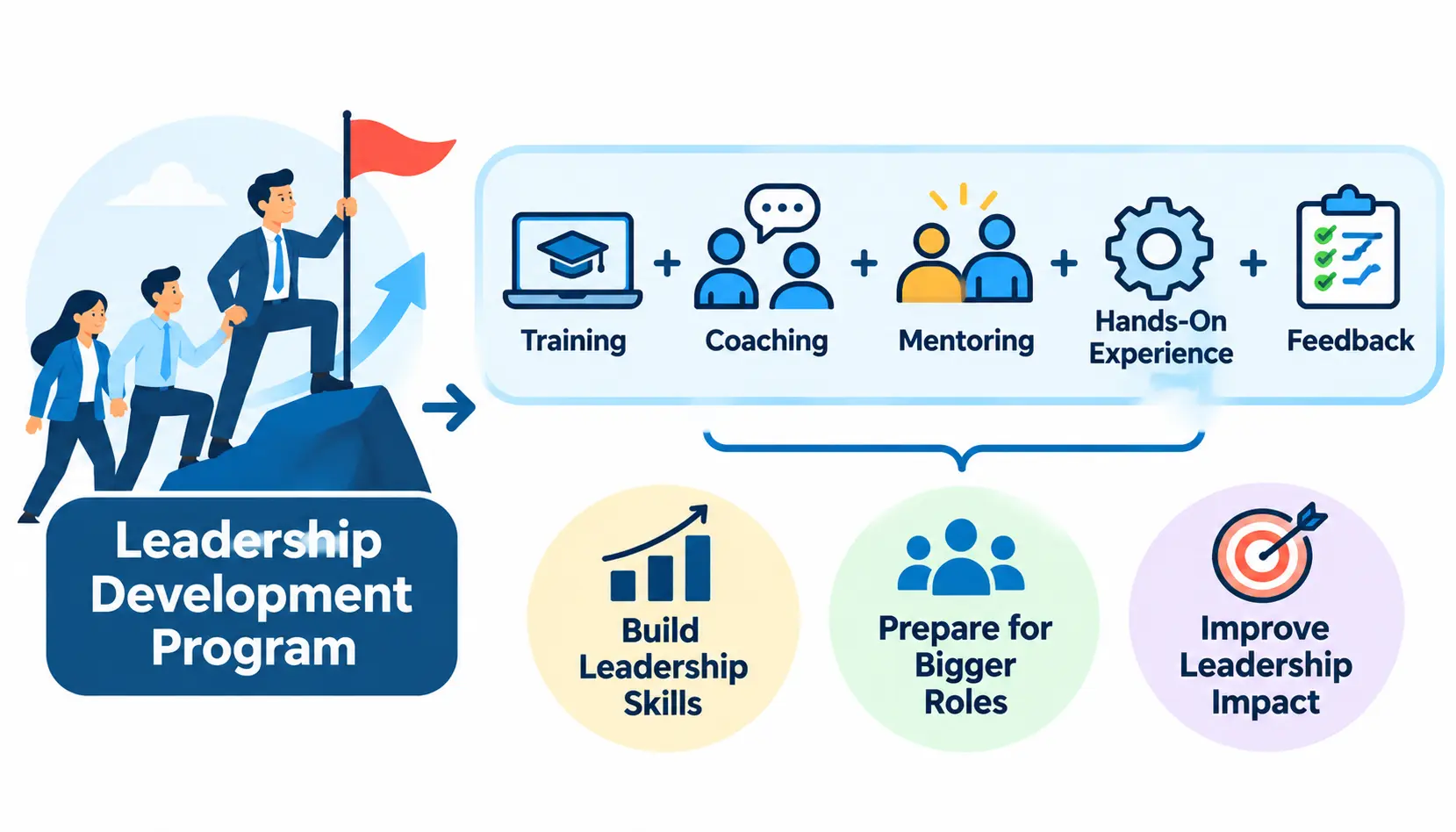
A leadership development program is a structured, ongoing effort to build the skills, behaviors, and mindset people need to lead others. It usually combines training, coaching, mentoring, hands-on experience, and regular feedback. The goal is to prepare people for bigger leadership responsibilities and improve how they lead today.
Think of it as a journey, not a single event. A one-day workshop might teach a useful tool. A development program helps people use that tool, get feedback, and improve over months.
Leadership Development vs. Leadership Training
Leadership training teaches a specific skill in a short time. Examples include a half-day session on giving feedback or a course on running effective meetings.
Leadership development is broader and slower. It builds leadership capability over time through practice, reflection, coaching, and new responsibilities. Training is often one part of a development program, not a replacement for it.
Leadership Development vs. Management Development
Management development focuses on running the work: planning, budgeting, scheduling, managing resources, and keeping daily operations on track. Leadership development focuses on guiding people: setting direction, influencing others, building trust, and inspiring change.
In real jobs, the two overlap. A good team manager needs both. But the learning goals are different, so your program design should reflect that.
What Are the Main Goals of a Leadership Development Program?
Most programs aim to do six things:
- Build leadership competencies that match your business needs.
- Improve decision-making at every level.
- Develop future leaders from within.
- Strengthen team performance.
- Support organizational goals and strategy.
- Prepare employees for greater responsibility.
If your program does not connect to at least a few of these goals, it is probably training for training’s sake.
Why Are Leadership Development Programs Important?
Leaders shape how work gets done. They set the tone, decide priorities, and influence whether people stay or leave. Investing in their growth pays off in many areas.
Build a Strong Leadership Pipeline
A leadership pipeline is your supply of ready-to-go leaders at every level. Without one, you scramble every time a role opens up.
Development programs spot people with potential early and give them structured practice. By the time a position opens, you already have candidates who understand the business and have practiced leading.
Improve Employee Engagement and Retention
People want to grow. When employees see that the company invests in their development, they are more likely to see a future there.
Good leaders also make a big difference day to day. Many people leave jobs because of their relationship with their manager, so better leadership often leads to better retention.
Strengthen Business Continuity and Succession Planning
When a key leader leaves, the impact can be large. Projects stall, teams lose direction, and morale can dip.
Program graduates are prepared internal candidates. Succession planning becomes a calm, planned process instead of an emergency search.
Improve Team Performance and Productivity
Capable leaders set clear expectations, communicate openly, and hold people accountable in a fair way. They also resolve conflict early instead of letting it grow.
These habits show up in team results: smoother collaboration, fewer misunderstandings, and stronger ownership of outcomes.
Support Organizational Growth and Change
Growth, restructuring, new technology, and market shifts all test leaders. Someone has to explain the “why,” calm worries, and keep the team moving.
Leaders who have practiced these situations handle change better. They are less likely to freeze or avoid hard conversations.
Develop a Culture of Continuous Learning
When leaders keep learning, others follow. They ask for feedback, admit what they do not know, and try new approaches.
Over time, this shapes how the whole organization thinks about growth. Learning becomes normal, not something reserved for new hires.
What Are the Different Types of Leadership Development Programs?
No single program fits everyone. The right choice depends on leadership level, current skill gaps, and your business objectives. Here are the most common types.
First-Time Manager Development Programs
Becoming a manager for the first time is a big shift. You go from doing the work to getting work done through others.
These programs cover delegation, communication, giving feedback, resolving conflict, and basic team management. They help new managers avoid common early mistakes, like doing everything themselves.
Mid-Level Management Development Programs
Mid-level managers sit in the middle: they carry strategy down and share ground-level reality up. Their programs often cover cross-functional collaboration, strategic thinking, performance management, and managing other managers.
That last skill is tricky. Leading managers requires a different approach than leading individual contributors.
Executive Leadership Development Programs
Executive leadership development prepares senior leaders for decisions with wide impact. Topics usually include organizational strategy, executive decision-making, change leadership, stakeholder management, and communicating a clear vision.
These programs often rely heavily on coaching, peer discussion, and real business challenges.
High-Potential Leadership Development Programs
High-potential (HiPo) programs focus on employees who show strong ability and ambition to take on larger roles. Participants typically get stretch assignments, exposure to senior leaders, and focused coaching.
Be transparent about how people are selected. Unclear selection can frustrate those who are left out.
Emerging Leader Development Programs
Emerging leader programs reach people early in their careers, often before they manage anyone. They build initiative, communication, influence, and project ownership.
This is a smart way to grow your pipeline because it builds habits before people step into formal roles.
Coaching and Mentoring Programs
Coaching and mentoring add a personal layer. Individual and executive coaching help leaders work on specific challenges with a trained coach. Formal mentoring pairs a less experienced person with a seasoned colleague, while peer mentoring connects people at similar levels.
These programs work well alongside group training because they turn general ideas into personal action.
Team Leadership Development Programs
Sometimes the whole team needs to grow, not just the leader. Team-based programs focus on collaboration, trust, communication, psychological safety, and shared performance goals.
Psychological safety means people feel safe to speak up, ask questions, and admit mistakes without fear of punishment.
Change Leadership Development Programs
These programs teach leaders how to explain change clearly, handle resistance, and guide teams through transitions. They are especially useful before a merger, restructuring, or major technology rollout.
Women in Leadership Development Programs
Some organizations run programs designed to widen access to leadership roles. These often include mentoring, sponsorship, career planning, and networking.
Sponsorship is different from mentoring. A mentor gives advice, while a sponsor actively advocates for someone’s advancement. Strong programs make sure these opportunities are open and inclusive.
What Skills Should a Leadership Development Program Teach?
Before you pick topics, build a competency framework. This is simply a list of the skills and behaviors your leaders need to succeed in your organization. Without it, program content tends to drift toward whatever is popular.
Here are the core skills most programs cover.
Communication and Active Listening
Leaders spend much of their day communicating. Clear messages prevent confusion, and active listening shows people they are heard. Both build trust.
Emotional Intelligence
Emotional intelligence is the ability to notice and manage your own emotions and understand others’. Leaders with this skill respond calmly under pressure and build stronger relationships.
Strategic Thinking and Decision-Making
Strategic thinking connects daily work to long-term goals. Good decision-making means weighing options, using data, and being willing to decide when information is imperfect.
Problem-Solving and Critical Thinking
Leaders face messy problems with no obvious answer. Critical thinking helps them question assumptions, find root causes, and avoid quick fixes that create new issues.
Delegation and Accountability
Delegation means handing over responsibility, not just tasks. It frees leaders to focus on higher-value work and helps team members grow. Accountability makes sure agreed work actually gets done.
Conflict Resolution and Negotiation
Disagreements are normal. Leaders need to address them early, listen to each side, and find workable solutions. Negotiation skills help when interests compete.
Coaching and Employee Development
Great leaders grow their people. They ask good questions, give useful feedback, and help team members build their own skills.
Adaptability and Change Management
Plans change. Adaptable leaders stay steady, adjust quickly, and help their teams do the same.
Collaboration and Relationship Building
Most results depend on cooperation across teams. Leaders who build strong relationships get things done faster and with less friction.
Digital Literacy and AI Awareness
Leaders do not need to be engineers. But they should understand how digital tools and AI affect their work, know the basic risks and limits, and be able to guide teams in using them responsibly.
The table below links each competency to a simple development activity.
| Leadership competency | Why it matters | Development activity |
| Communication | Builds clarity and trust | Lead team meetings |
| Emotional intelligence | Improves relationships | Reflection and feedback |
| Strategic thinking | Connects work with business goals | Join planning sessions |
| Decision-making | Improves problem resolution | Lead a project |
| Delegation | Builds team ownership | Assign and monitor responsibilities |
| Conflict resolution | Helps manage disagreements | Practice workplace scenarios |
| Coaching | Develops other employees | Mentor a junior colleague |
| Adaptability | Supports organizational change | Join a change initiative |
How to Create a Leadership Development Program
A successful program starts with business priorities and real leadership needs, not with a catalog of courses. Follow these ten steps to build one that sticks.
Step 1: Identify Your Organization’s Leadership Needs
Start by asking where leadership matters most. Which roles are critical to your success? What are your goals over the next three to five years? Where do you expect leadership gaps?
Talk to executives, HR partners, and team leads. Their answers show you which skills and which people to focus on first.
Step 2: Define Program Goals and Expected Outcomes
Turn needs into clear goals. A weak goal sounds like “improve leadership.” A strong goal sounds like “help new managers give regular, useful feedback within six months.”
For each goal, decide what participants should be able to do after the program. Then pick success indicators you can measure, such as skill scores, engagement results, or internal promotion rates.
Step 3: Assess Current Leadership Skills
You cannot close a gap you have not measured. Several tools can help:
- Skills gap analysis to compare current and required capabilities.
- 360-degree feedback, which gathers input from managers, peers, and direct reports.
- Performance data to see where results are strong or weak.
- Leadership interviews to understand challenges firsthand.
- Competency assessments to benchmark skills.
Use more than one source. Each shows a different part of the picture.
Step 4: Identify Participants and Leadership Levels
Decide who the program serves. Common groups include first-time managers, mid-level managers, senior leaders, high-potential employees, and emerging leaders.
Avoid giving everyone the same program. A new team lead and a vice president face very different challenges, so their learning should differ too.
Step 5: Develop a Leadership Curriculum
Choose the competencies you want to build. Organize them into modules, pick learning materials, and add practical exercises. Match the content to what participants actually do at work.
A good test: can a participant use something from each module the following week? If not, the content may be too abstract.
Step 6: Choose the Right Learning Methods
Mix formats to keep people engaged and to support different learning styles. Options include:
- Workshops
- Online learning
- Executive coaching
- Mentoring
- Simulations
- Job rotation
- Stretch assignments
Later in this guide, we cover these methods in more detail.
Step 7: Involve Senior Leaders and Mentors
Programs work better when senior leaders take part. They can sponsor the program, share real stories, mentor participants, and model the behaviors you want to see.
When participants see executives treat development as a priority, they do too.
Step 8: Implement the Program
Now put it into action:
- Set a clear schedule.
- Assign program owners.
- Communicate expectations to participants and their managers.
- Provide learning resources.
- Track participation and progress.
Start with a pilot group if you can. A small first run helps you fix problems before scaling up.
Step 9: Evaluate Performance and Learning Outcomes
Measure whether people improved their skills, applied what they learned, changed their behavior, and delivered better results. Do not stop at “did they like it?” Satisfaction matters, but it does not prove impact.
Step 10: Improve the Program Continuously
Gather participant feedback, manager observations, and performance data. Then adjust content, timing, and methods.
The best programs evolve as the business changes.
What Should a Leadership Development Program Include?
The steps above show how to build a program. This section shows what goes inside it. Think of it as a practical curriculum overview you can adapt.
Leadership Foundations and Self-Awareness
Start with the basics: what leadership means in your organization and how each person currently leads. Self-assessments and reflection exercises help participants see their strengths and blind spots.
Communication and People Management
Cover how to run one-on-ones, give clear direction, listen well, and handle team dynamics. Role-play works well here because people get to practice before the stakes are real.
Strategic Leadership and Business Planning
Help participants see how their work connects to company goals. A small planning project, where they build a simple plan for their team, makes the ideas concrete.
Decision-Making and Problem-Solving
Teach practical ways to frame problems, compare options, and decide with incomplete information. Business case studies give participants real material to work with.
Conflict Management and Difficult Conversations
Many leaders avoid hard conversations. Give them a simple structure, such as describing the situation, explaining the impact, and agreeing on next steps, then let them practice.
Coaching, Mentoring, and Team Development
Show leaders how to ask open questions, give balanced feedback, and support growth. Pair this module with real mentoring so the skills get used right away.
Change Management and Innovation
Explain how people react to change and how leaders can respond. Include ways to encourage new ideas and test them safely.
Practical Leadership Projects and Assessments
End with a real project. Participants apply what they learned to a live business challenge and present results. Follow-up assessments show how far they have come.
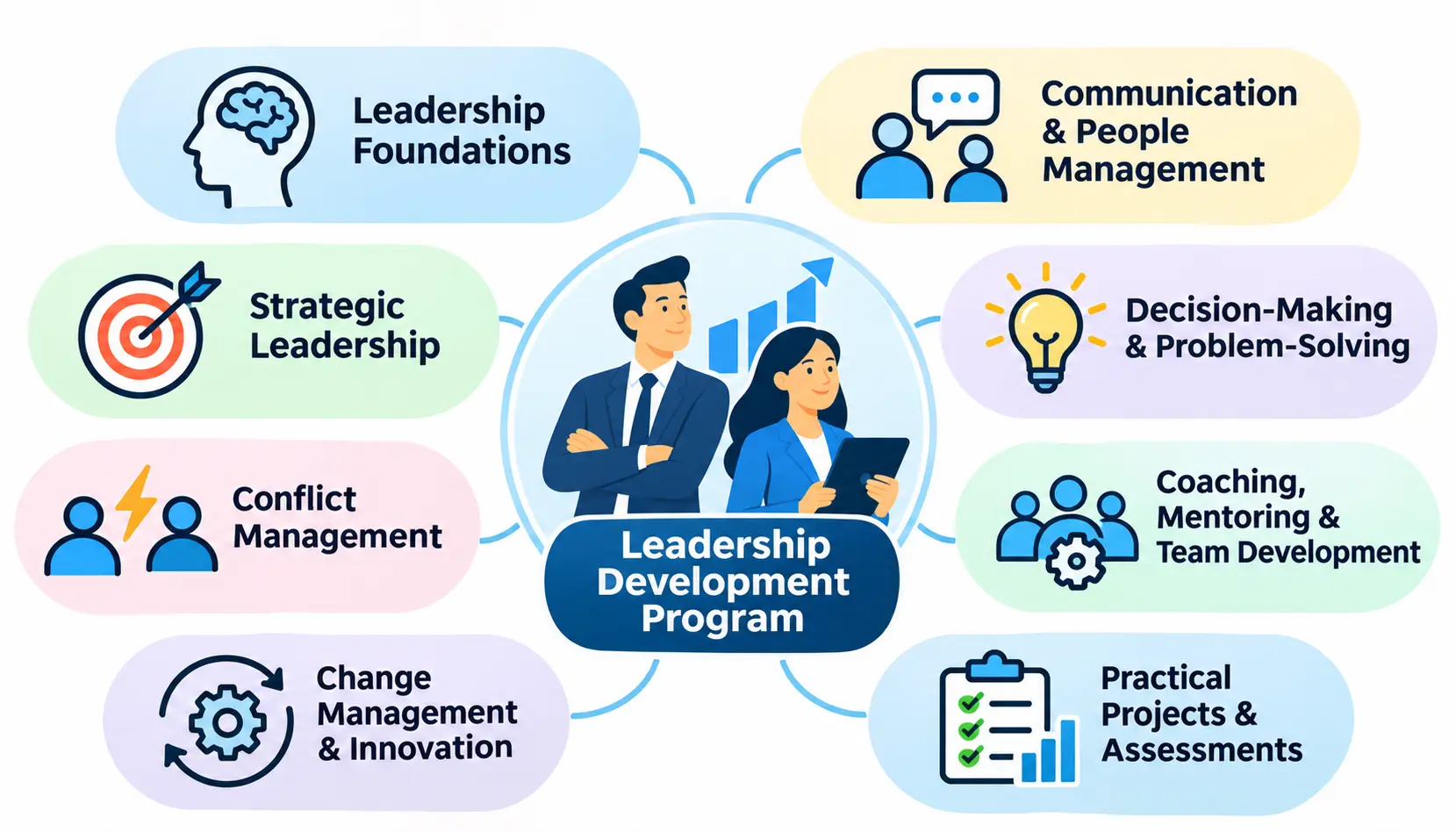
Here is a sample curriculum you can adjust.
| Module | Learning activity | Expected outcome |
| Leadership foundations | Self-assessment and workshop | Understand leadership responsibilities |
| Communication | Role-play and presentations | Communicate clearly |
| People management | Team management exercise | Manage team performance |
| Decision-making | Business case study | Make informed decisions |
| Conflict resolution | Workplace simulation | Handle disagreements |
| Strategic thinking | Business planning project | Connect actions to business goals |
| Coaching | Mentoring practice | Support employee development |
Leadership Development Methods and Learning Models
People learn in different ways, so strong programs mix methods. Here are the most common ones and when each works best.
On-the-Job Learning
Most leadership growth happens at work. Project ownership, stretch assignments, acting roles, and added responsibilities give people real practice with real consequences.
The key is support. A stretch assignment without a mentor or feedback can feel like being thrown in the deep end.
Executive Coaching
Executive coaching is personalized support from a trained coach. It focuses on a leader’s specific challenges, such as handling a difficult stakeholder or changing a habit that holds the team back.
It works best when the leader is open to feedback and has clear goals.
Mentoring and Peer Learning
Mentoring gives emerging leaders access to experience. A mentor can share lessons, open doors, and offer honest advice. Peer learning groups let leaders compare challenges and swap ideas.
Both are low-cost and highly effective when set up with clear expectations.
Leadership Workshops and Formal Training
Workshops provide structure. Facilitated sessions, courses, and exercises introduce frameworks and give everyone a shared language.
On their own, they rarely change behavior. They work best as the starting point for practice and follow-up.
Job Rotation and Cross-Functional Projects
Working in another department builds a wider view of the business. Participants learn how different teams think, which helps them make better decisions and collaborate more easily later.
Online and Blended Learning
Online learning offers flexibility. People can learn at their own pace, and virtual sessions make it easier to include remote teams. A learning management system (LMS) provides a centralized platform to deliver online courses, organize learning materials, manage assessments, and monitor learning progress.
Blended learning combines online content with in-person or live sessions. Many organizations find this mix gives them both convenience and meaningful connection.
Simulation-Based Leadership Training
Simulations let leaders practice in a safe setting. Examples include crisis scenarios, business simulations, role-playing, and timed decision exercises.
Mistakes in a simulation cost nothing, and the debrief afterward is where much of the learning happens.
The 70-20-10 Model of Leadership Development
The 70-20-10 model is a learning framework often linked to research by Morgan McCall, Michael Lombardo, and Robert Eichinger at the Center for Creative Leadership. It suggests how development experiences may be balanced:
- 70% from experiential learning, such as challenging assignments.
- 20% from relationships and feedback, such as coaching and mentoring.
- 10% from formal learning, such as courses and workshops.
Treat it as a guide, not a strict formula. The exact split will vary by role, organization, and person. Its main message holds up well: most leadership growth comes from doing the work, not sitting in a classroom.
How to Choose the Right Leadership Development Program
Some organizations build programs in-house. Others work with external providers. Either way, use the same criteria to judge quality.
Identify Your Organization’s Specific Needs
Begin with your own gaps and goals. A program that looks impressive but does not address your needs is a poor fit.
Compare Program Content and Learning Outcomes
Look at the competencies covered and the outcomes promised. Ask what participants will be able to do afterward, not just what they will learn.
Evaluate Trainer and Coach Experience
Check that facilitators have real leadership or coaching experience in relevant settings. Ask for examples of similar work and how they handled challenges.
Check Assessment and Feedback Methods
Good programs measure progress. Look for baseline assessments, ongoing feedback, and follow-up checks.
Compare Online, In-Person, and Hybrid Delivery
Think about your people. Do they work across locations or time zones? Can they step away for full-day sessions? Pick a format they can actually attend and use.
Review Customization and Scalability
Ask whether the content can be adapted to your business and whether the program can grow. A pilot for twenty people may need a different setup when it expands to two hundred.
Evaluate Reporting and Progress Tracking
You need to see how participants are doing. Check whether the program offers clear reports on participation, skill growth, and results.
Compare Program Costs and Expected Value
Look beyond price. A cheaper program that changes nothing wastes money, while a costlier one that builds real capability may deliver more value.
Use this table as a quick checklist.
| Selection factor | What to check |
| Curriculum | Does it match the required competencies? |
| Trainers | Do they have relevant experience? |
| Customization | Can content be tailored to the organization? |
| Delivery | Does the format fit employee schedules? |
| Assessment | Are skills and progress measured? |
| Support | Are coaching and follow-up included? |
| Reporting | Can the organization evaluate results? |
| Cost | Does the investment fit the available budget? |
How Much Does a Leadership Development Program Cost?
Costs vary widely. They depend on how many people take part, how long the program runs, and which methods you use. Because prices differ by region, provider, and scope, it is better to build your own estimate than to rely on a single number.
Factors That Influence Program Costs
The main cost drivers are:
- Number of participants
- Program duration
- Training format
- Coaching and mentoring requirements
- External facilitators
- Assessment and technology tools
- Travel and operational expenses
Do not forget the cost of time. Participants and their managers spend hours away from regular work, and that is a real investment too.
In-House vs. External Program Costs
In-house programs usually require staff time for design, delivery, and administration. You may save on provider fees, but you need internal expertise and capacity.
External programs bring ready-made content and outside experience. They often involve higher direct fees, but they can save design time. Neither option is always cheaper. The better choice depends on your scale, in-house skills, and how much customization you need.
How to Build a Leadership Development Budget
List every expense, assign an owner, and compare estimates with actual spending as you go. Here is a simple worksheet to start with.
| Expense category | Estimated cost | Actual cost | Owner |
| Program design and curriculum | L&D lead | ||
| External facilitators or coaches | HR / L&D | ||
| Assessments and 360-degree feedback tools | HR | ||
| Learning platform or technology | IT / L&D | ||
| Materials and resources | L&D | ||
| Travel and venue | Operations | ||
| Mentoring program administration | HR | ||
| Evaluation and reporting | L&D / Finance | ||
| Contingency | Program owner |
Fill in the estimated column before launch. Update the actual column each quarter so there are no surprises.
How Long Should a Leadership Development Program Last?
There is no single right answer. Duration depends on your goals, the leadership level, and how ready participants are.
Short-Term Leadership Training
Short programs, lasting a few days to a few weeks, target specific skills. Examples include feedback skills for new managers or a workshop on running effective meetings.
Medium-Term Leadership Development
Programmes lasting several months suit most first-time and mid-level managers. They allow time for learning, practice, mentoring, and progress reviews.
Long-Term Executive Development
Senior leadership responsibilities are complex. Building judgment, influence, and strategic ability often takes a year or more, and it usually includes coaching and real assignments.
Here is a sample twelve-month timeline. You can shorten it to six months by compressing the phases.
| Phase | Timing | Focus |
| Launch and assessment | Months 1-2 | Kick-off, baseline assessments, goal setting |
| Core skills | Months 3-5 | Workshops on communication, decision-making, and people management |
| Applied practice | Months 6-8 | Stretch assignments, mentoring, and coaching |
| Strategic focus | Months 9-10 | Business planning project and cross-functional exposure |
| Review and next steps | Months 11-12 | Follow-up assessments, presentations, and development plans |
How to Measure Leadership Development Program Success
If you do not measure results, you cannot prove value or improve the program. Track a mix of learning, behavior, and business measures.
Leadership Skill Improvement
Compare baseline competency assessments with follow-up results. This shows whether participants grew in the skills you targeted.
Behavior Change at Work
Skills matter only if people use them. Gather manager observations, 360-degree feedback, and specific examples of applied learning.
Employee Engagement and Retention
Watch engagement survey results, employee feedback, and turnover on participants’ teams. Improvements can take time to appear, so look at trends instead of single data points.
Internal Promotions and Leadership Readiness
Track how many leadership roles are filled internally and how many employees are ready for future roles. A growing bench of ready successors is a strong sign the program is working.
Team Performance and Productivity
Link results to the goals your teams already track, such as delivery times, quality, or customer outcomes. Be careful to note that many factors affect performance, not just leadership.
Leadership Development ROI
Return on investment compares the program’s measurable benefits with its costs. To keep it honest, write down your assumptions. For example, state how you estimated savings from lower turnover.
Be cautious about claiming that the program caused every improvement. Use comparison groups or conservative estimates where possible.
| KPI | What it measures | Review frequency |
| Skill improvement | Growth in targeted competencies | Before and after program |
| Behavior change | Application of learned skills | Quarterly |
| Engagement | Employee experience within teams | Quarterly or biannually |
| Internal promotion rate | Leadership roles filled internally | Annually |
| Retention | Turnover among participants and their teams | Quarterly |
| Leadership readiness | Availability of prepared successors | Every six months |
| Program ROI | Benefits compared with program costs | Annually |
Common Leadership Development Program Challenges and How to Overcome Them
Even well-planned programs hit obstacles. Here are the most common ones and how to handle them.
Lack of Clear Program Goals
Solution: Tie every goal to a business need and a measurable outcome before you design content. If you cannot explain why a module exists, remove it.
Difficulty Identifying the Right Participants
Solution: Use clear, published criteria, such as performance, potential, and role needs. Combine manager nominations with assessment data to reduce bias.
Generic Training That Does Not Match Job Responsibilities
Solution: Build content around real situations your leaders face. Ask participants to bring actual challenges to sessions.
Low Employee Participation
Solution: Protect time for learning, explain the benefits, and get managers to support attendance. People join when they see the program as valuable, not as extra work.
Limited Management Support
Solution: Brief participants’ managers before the program starts. Give them simple ways to reinforce learning, like regular check-ins on development goals.
Insufficient Practical Learning Opportunities
Solution: Add stretch assignments, projects, and job shadowing. Learning sticks when people apply it quickly.
Inconsistent Feedback and Follow-Up
Solution: Schedule feedback at set points, such as monthly coaching conversations and quarterly reviews. Put the dates in the calendar from day one.
Difficulty Measuring Business Impact
Solution: Pick a small number of meaningful metrics before launch and collect baseline data. Review them on a regular schedule instead of waiting until the end.
Best Practices for Building an Effective Leadership Development Program
These habits show up in strong programs again and again.
Align Leadership Development With Business Strategy
Start with where the business is heading. If you plan to expand into new markets, build skills for leading across regions. If you expect big change, focus on change leadership. A well-planned corporate learning and development strategy helps organizations align leadership initiatives with long-term business goals and build a consistent learning culture.
Customize Learning for Different Leadership Levels
Give new managers, mid-level managers, and executives different content. Each group faces different challenges and needs different tools.
Combine Training With Practical Experience
Pair every new idea with a chance to use it. A short workshop followed by a real assignment beats a long course with no application.
Encourage Continuous Feedback and Reflection
Growth speeds up when people reflect on what worked and what did not. Build in regular feedback from managers, peers, and coaches, and give participants time to think.
Involve Senior Leaders in Development
Executives can sponsor, teach, and mentor. Their involvement signals that leadership development is a real priority.
Make Development Opportunities Accessible and Inclusive
Check who gets selected and who does not. Offer flexible formats, clear criteria, and support for people across roles, locations, and backgrounds.
Review and Update the Program Regularly
Review content at least once a year. Remove what no longer fits and add what the business now needs.
Future Trends in Leadership Development Programs
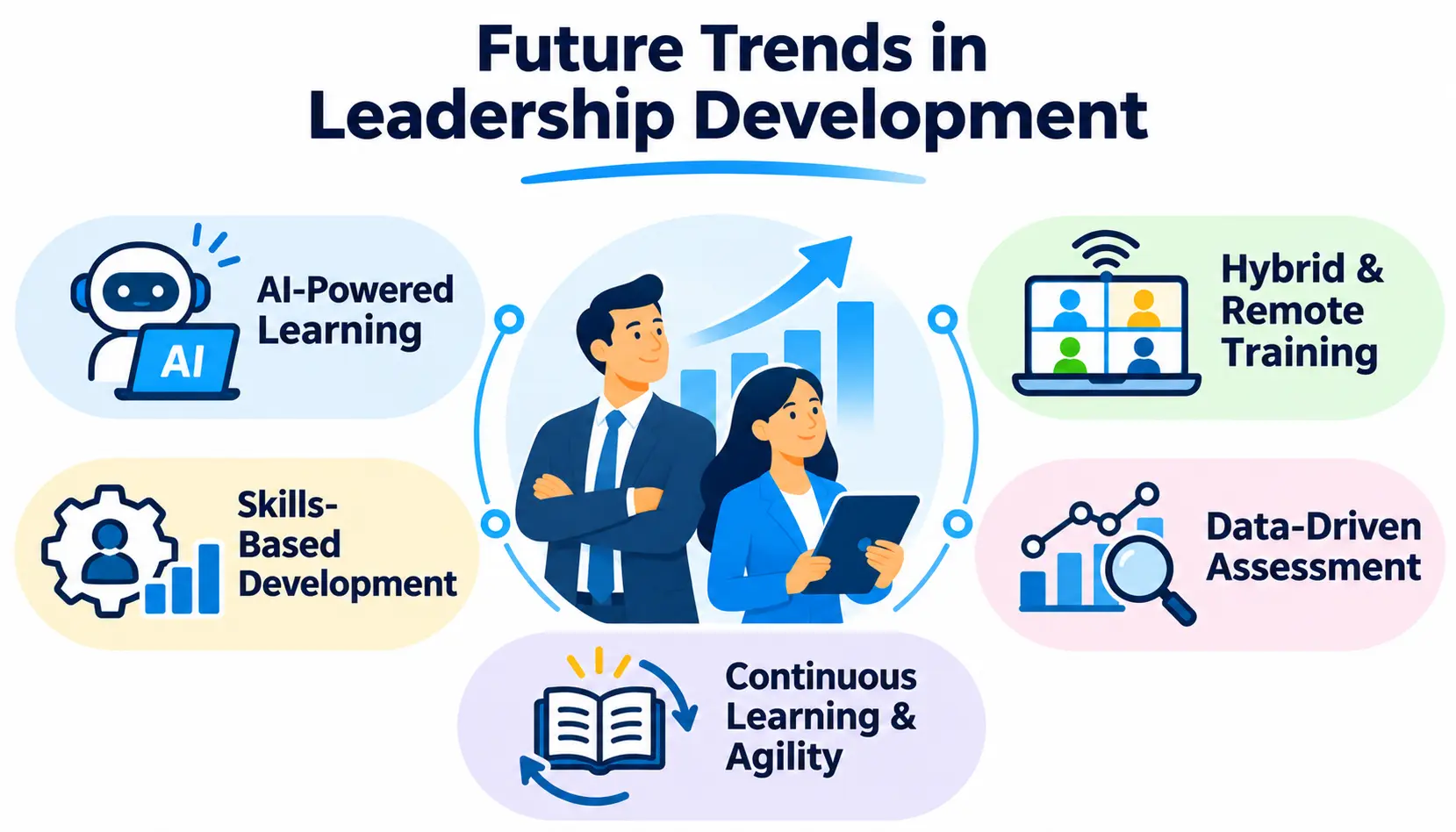
Leadership development keeps evolving. These trends are shaping where it is heading.
AI-Powered Personalized Leadership Learning
AI tools can suggest learning content, offer practice scenarios, and help tailor development to each person. They can support learning, but they work best alongside human coaching and judgment, not in place of them. Organizations can also explore how AI is transforming corporate training through personalized learning recommendations, automated content creation, and data-driven learning experiences.
Skills-Based Leadership Development
More organizations focus on specific skills instead of job titles. This lets them build leadership ability earlier and more broadly, including among people who are not yet managers.
Hybrid and Remote Leadership Training
With many teams working across locations, leaders need to know how to build trust, communicate clearly, and keep people engaged at a distance. Programs now include remote leadership as a core topic.
Data-Driven Leadership Assessment
Organizations increasingly use data from assessments, feedback tools, and performance results to guide development. Used carefully, this helps target support where it is needed most. Privacy and fairness should always come first.
Continuous Learning and Leadership Agility
Leaders now need to learn throughout their careers. Short, frequent learning moments, such as micro-lessons and coaching conversations, are supplementing long courses.
Frequently Asked Questions About Leadership Development Programs
1. What is the main purpose of a leadership development program?
The main purpose is to build the skills and mindset leaders need to guide people and achieve business goals. It prepares current leaders to perform better and prepares future leaders for bigger roles.
2. What are the different types of leadership development programs?
Common types include first-time manager, mid-level management, executive, high-potential, emerging leader, coaching and mentoring, team leadership, change leadership, and women in leadership programs.
3. What skills should a leadership development program teach?
Core skills include communication, emotional intelligence, strategic thinking, decision-making, delegation, conflict resolution, coaching, adaptability, collaboration, and digital and AI awareness.
4. Who should participate in a leadership development program?
Participants can include first-time managers, mid-level managers, senior leaders, high-potential employees, and emerging leaders. Choose based on your business needs and succession plans.
5. How do you create an effective leadership development program?
Identify leadership needs, set clear goals, assess current skills, choose participants, build the curriculum, select learning methods, involve senior leaders, launch, evaluate, and keep improving.
6. How long should a leadership development program last?
It depends on the goals and participants. Short skill programs may last days or weeks. Most development programs run several months, while executive development can last a year or longer.
7. What is the 70-20-10 model of leadership development?
It is a framework suggesting that most development comes from on-the-job experience (about 70%), then from relationships and feedback (about 20%), and then from formal learning (about 10%). It is a guideline, not a fixed rule.
8. How do you measure the success of a leadership development program?
Track skill improvement, behavior change, engagement, retention, internal promotions, leadership readiness, team performance, and ROI. Compare results to a baseline measured before the program starts.
9. What is the difference between leadership training and leadership development?
Leadership training teaches specific skills in the short term. Leadership development is a longer process that builds overall leadership capability through practice, feedback, and experience.
10. How much does a leadership development program cost?
Costs depend on participant numbers, duration, format, coaching, facilitators, tools, and travel. Build a budget by listing each expense category and comparing estimates to actual costs.
Conclusion
Strong leaders do not appear by accident. They grow through clear goals, honest feedback, real practice, and support from people who have walked the path before them.
This complete guide to leadership development programs covered the essentials: what they are, the types available, the skills to teach, how to build and choose a program, what it may cost, and how to measure success. The common thread is simple. Start with your business needs, mix learning with real experience, and review results often.
If you are just getting started, keep it small. Pick one group, run a focused pilot, and learn from it. A modest program that is well-run will do more for your organization than an ambitious one that never gets off the ground.