


An employee development plan is a written agreement between an employee and their manager that sets out which skills the person will build, how they will build them, and by when. Done well, it turns vague career talk into specific actions: a stretch project, a mentor, a course, a review date. Done badly, it becomes a form that gets filed in March and forgotten by April. This guide shows you how to create an employee development plan people actually use. You will get a nine-step process, a completed example, role-based samples, a copy-ready template, and a way to measure results beyond course completion.
What is an employee development plan?
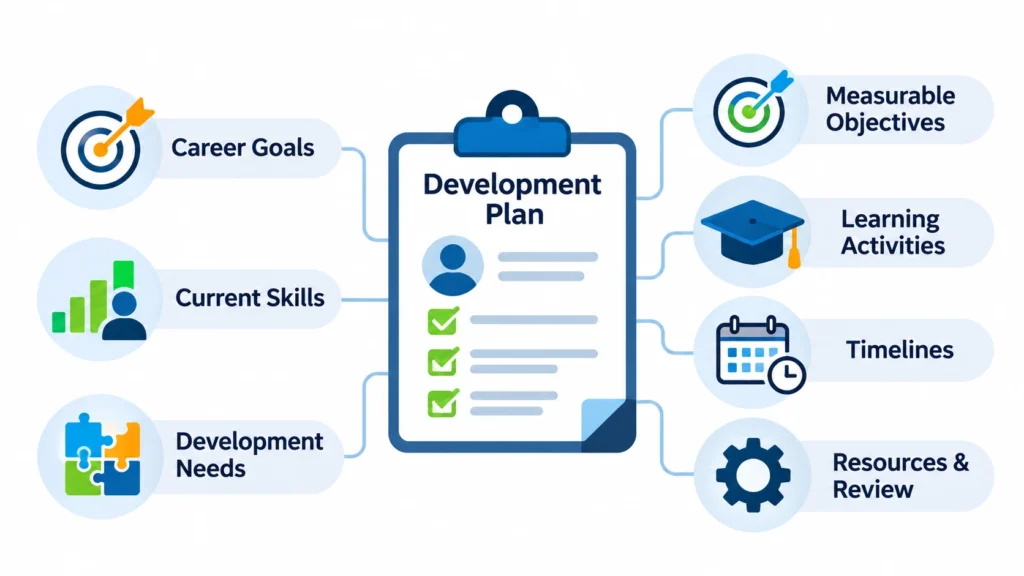
An employee development plan is a structured document that outlines an employee’s career goals, current skills, development needs, and the actions required to build new capabilities. It usually includes measurable objectives, learning activities, timelines, resources, and review dates.
Think of it as a shared map. The employee says where they want to go, the manager says where the business needs them, and the plan lists the steps between the two.
Purpose of an employee development plan
The purpose is to make growth deliberate. Without a plan, development depends on whoever happens to ask for a course. With one, every learning activity has a reason, an owner, and a date.
A plan also gives managers something concrete to talk about. ‘Where do you want to be in two years?’ is easier to answer when a draft is on the table.
Employee development plan vs. individual development plan (IDP)
In most workplaces the two terms mean the same thing. Some companies reserve individual development plan (IDP) for a career-focused version the employee drives, and use employee development plan for the HR-owned template. Pick one term and use it consistently inside your company.
Employee development plan vs. employee development strategy
A plan covers one person. A strategy covers the whole workforce: which skills the company needs, what budget exists, and which programs it will run. The strategy sets the menu and each plan picks from it.
Employee development plan vs. performance improvement plan
The two documents are often confused, and mixing them damages trust. Keep them separate.
| Employee development plan | Performance improvement plan |
| Focuses on professional growth | Focuses on correcting performance issues |
| Builds new skills and competencies | Addresses specific performance gaps |
| Usually employee-led, manager-supported | Usually manager- or HR-directed |
| Supports career progression | Sets corrective expectations |
| Encourages continuous learning | Sets improvement requirements and review periods |
A development plan is also different from a training plan. A training plan covers one task or tool and usually ends when the course does. A development plan runs for months and often includes a formal training program as one of several activities.
Who is responsible for an employee development plan?
The employee owns the goals, because people follow plans they helped write. The manager gives feedback, opens doors, and removes blockers. HR provides the template, the process, and the tools, and checks that every team gets the same access.
Why are employee development plans important?
A plan gives learning a direction and gives managers a reason to check in. The payoff shows up in six places:
- Performance. People who practice the skills their role needs make fewer mistakes and need less supervision.
- Engagement. Growth that is tied to someone’s own goals feels like an investment in them, not a compliance task.
- Retention. LinkedIn’s 2025 Workplace Learning Report found that career progress is people’s number one motivation to learn, and that employees who do not move ahead tend to leave. The same LinkedIn Workplace Learning Report found only 36% of surveyed organizations had mature career development programs.
- Leadership pipeline. Business succession planning means developing internal people for future roles, which is what a plan does one person at a time. Wikipedia’s entry on succession planning gives a short background.
- Skill gaps. Plans show where skills are thin across a team, so you can decide whether to build or hire.
- Internal mobility. A visible path from one role to the next gives people a reason to stay and apply internally.
Main components of an effective employee development plan
Most plans contain the same ten parts:
- Employee information and current role
- Career aspirations
- Existing skills and competencies
- Identified development gaps
- SMART development goals
- Learning and development activities
- Resources and support
- Timelines and milestones
- Success indicators
- Review and evaluation dates
Three of these decide whether a plan survives. Career aspirations come first because motivation starts there. Gaps need evidence, not a hunch. Review dates need to be on the calendar the day the plan is signed, because a plan with no scheduled review is a plan nobody opens again.
Resources deserve honesty too. If a goal needs four hours a week and the employee’s workload leaves one, change the goal or the workload.
Types of employee development plans
Choose the type that matches the problem you are solving. One person may have two at different times.
- Skills development plan. Targets a specific gap, such as data analysis or presenting to executives.
- Leadership development plan. Prepares someone to manage people through coaching, delegation, and feedback practice.
- Career advancement plan. Maps the skills and experience needed for a named next role.
- Performance-based development plan. Responds to a review that showed a skill weakness. It is supportive and separate from a PIP.
- Technical skills plan. Covers certifications, tools, and hands-on projects for engineers, analysts, and similar roles.
- Onboarding and new employee plan. Covers the first 90 days: systems, relationships, and supervised tasks.
- Cross-functional plan. Builds exposure to another team, usually through a project or rotation.
How to create an employee development plan: step-by-step process
Use this cycle as the spine of every plan: assess, plan, develop, measure, improve. Then repeat. The nine steps below follow it.
Step 1: Understand career goals and aspirations
Start with a conversation, not a form. Ask where the employee wants to be in two or three years and what work gives them energy. Write their answers down in their own words. Then add what the business needs from the role so both sides are visible.
Step 2: Assess existing skills and competencies
No single source tells you the full story, so use three.
Conduct employee self-assessments
Ask the employee to rate themselves from 1 to 5 on the skills the role requires. Self-ratings are useful but can run high or low, so treat them as one input.
Gather manager and peer feedback
Managers see output. Peers see collaboration. A short 360-degree feedback round, even three or four people, adds context that a performance appraisal alone misses.
Use skills matrices and competency frameworks
A skills matrix is a grid of required skill levels against current levels. If your company has a competency framework, use it as the standard. If not, write five to eight observable behaviors for the role. Wikipedia’s page on competence in human resources is a useful primer.
Step 3: Identify skill gaps and development priorities
Subtract current level from required level. Then rank the gaps by business impact, urgency, and how much the employee cares. Pick one to three priorities. Plans with ten goals tend to produce none.
If you need a more formal method, a structured needs analysis helps you check whether a gap is really about skill or about tools, process, or workload.
Step 4: Establish SMART development goals
A SMART goal is specific, measurable, achievable, relevant, and time-bound. The acronym comes from George T. Doran’s 1981 article in Management Review, and the SMART criteria are still the standard way to write objectives.
Weak: ‘Get better at presenting.’ Strong: ‘Present the quarterly sales review to the leadership team in Q3 and score at least 4 out of 5 on the feedback form.’
Step 5: Choose learning and development activities
Pick activities that fit the skill. A useful rule is the 70-20-10 model: roughly 70% of development from on-the-job experience, 20% from other people, and 10% from courses. It came from a survey of executives by Lombardo and Eichinger, and critics note it lacks strong empirical support, so treat it as a rough guide. The 70-20-10 model is explained, with its criticisms, on Wikipedia.
Another sorting aid is the three E’s: experience, exposure, and education. A good plan has at least one of each.
On-the-job training and stretch assignments
Give the employee a task slightly beyond their current level, with support. It teaches faster than most courses because the stakes are real.
Mentoring and coaching
A mentor shares experience and career advice. A coach works on specific behaviors over a shorter period. Both help with judgment and soft skills that courses rarely build.
Formal training and online learning
Use courses and certifications for knowledge and credentials. For people who have different starting points, personalized learning paths let experienced staff skip what they already know.
Job shadowing and cross-functional projects
Shadowing shows how another role works. A cross-functional project builds relationships and business understanding. Both cost little.
Step 6: Assign responsibilities and resources
Write down who does what. The employee completes activities and keeps notes. The manager provides feedback and protects time. HR or L&D supplies content and tracks the record. Add the budget and hours required.
Step 7: Set timelines and milestones
Break the goal into checkpoints, such as a first mentoring session in week two or a draft presentation by week eight. Milestones keep long goals from stalling. Most plans run six to twelve months.
Step 8: Monitor progress and hold regular reviews
Hold a short monthly check-in and a deeper quarterly review. Ask what was done, what was learned, what is blocked, and what changes. Use a spreadsheet for a small team, or an LMS for tracking training progress once headcount grows.
Step 9: Evaluate results and update the plan
At the end of the period, compare the result with the goal. Did the skill improve? Is it showing up at work? Then write the next plan. Retire goals that were met, carry over goals that were not, and ask why.
Employee development plan examples for different roles
The examples below are illustrative, not real case studies. Adjust them to your role definitions and tools.
1. Employee development plan example for a new employee
Goal: reach full role competency within 90 days. Activities: structured onboarding, job shadowing, supervised tasks. Measure: independent completion of core tasks by day 60.
2. Employee development plan example for a team leader
Goal: improve feedback and delegation. Activities: coaching from a senior manager, a leadership workshop, weekly one-on-one practice. Measure: direct-report feedback and team engagement scores after two quarters.
3. Employee development plan example for a software developer
Goal: deepen cloud and security skills. Activities: advanced project work, code reviews with a senior engineer, a relevant certification. Measure: a deployed feature that passes security review.
4. Employee development plan example for a sales executive
Goal: improve negotiation. Activities: role-play using real lost deals, joint customer meetings, mentoring. Measure: win rate and average discount on deals in the next two quarters.
5. Employee development plan example for an HR professional
Goal: build HR analytics skills. Activities: an analytics course, a data project using company turnover data, a review with the finance partner. Measure: one dashboard leadership uses in a monthly meeting.
6. Employee development plan example for career advancement
Goal: prepare for a senior position within 18 months. Activities: a strategic assignment, cross-functional exposure, an executive sponsor. Measure: readiness review against the senior role’s competencies.
Employee development plan template
A template makes the plan repeatable. Without one, every manager invents a different format and comparison across teams becomes impossible.
Essential fields to include in the template
Use the fields below. They cover identity, direction, gaps, actions, and review.
Sample employee development plan template
| Field | What to write |
| Employee name | Full name |
| Current position | Job title and department |
| Manager | Responsible supervisor |
| Development period | Start and end dates |
| Career objective | Desired professional direction |
| Current competencies | Existing strengths and skills |
| Development gaps | Skills that need improvement |
| Development goal | One SMART objective |
| Learning activities | Training, mentoring, projects |
| Required resources | Budget, time, tools, support |
| Success indicators | How achievement will be measured |
| Target dates | Deadlines and milestones |
| Review schedule | Monthly or quarterly |
| Final evaluation | Results and next priorities |
Here is the template filled in for an illustrative case: a sales executive who wants to lead a sales team within 12 months.
| Planning element | Example |
| Development goal | Build leadership and team management skills |
| Identified gap | Limited experience supervising people |
| SMART objective | Lead two team meetings independently within six months |
| Learning activity | Leadership training and mentoring |
| Practical experience | Supervise a small sales project |
| Support | Monthly coaching from the sales manager |
| Timeline | Six months |
| Success measure | Runs meetings well and delivers project outputs |
| Review frequency | Monthly |
Notice how a broad ambition (‘become a team leader’) becomes a task someone can do and a manager can observe.
How to customize the template for different employees
A new hire needs a short plan with supervised tasks. An experienced specialist needs deeper goals and less hand-holding. A future manager needs stretch assignments and people-leadership practice.
Company size matters as well. A 15-person startup can run plans from a shared spreadsheet and monthly lunches. A 5,000-person company needs a standard template, an HRIS to store records, and a learning platform to deliver content. For remote and hybrid staff, schedule virtual mentoring and set milestones that can be checked without being in the room.
Some tools you may already own:
- A learning management system such as Moodle or Cornerstone to deliver courses and track completion.
- An HRIS such as Workday or SAP SuccessFactors to store job and review data.
- A course library such as LinkedIn Learning for external content.
- A feedback and performance platform such as Culture Amp for surveys and goal tracking.
Some platforms also offer AI skills mapping and learning recommendations. Treat their output as a draft. A manager should review it, because automated tools can reflect gaps or bias in the data they learned from.
How to measure the success of an employee development plan
Completion tells you someone showed up. It does not tell you they improved. Measure at three levels: learning progress, workplace competency, and business results.
The Kirkpatrick Model, created by Donald Kirkpatrick in the 1950s, uses the same logic with four levels: reaction, learning, behavior, and results. Wikipedia’s entry on training evaluation is a starting point.
Track skill acquisition and competency improvements
Repeat the Step 2 skills assessment at the end of the plan and compare the gap with the starting point.
Measure learning and training progress
Track milestones met, assessments passed, and mentoring sessions held. A learning management system can record much of this automatically.
Evaluate workplace performance
Ask the manager to observe the skill in real work after four to eight weeks. A skill that passes a quiz but never appears on the job has not been learned in any useful way.
Monitor engagement and retention
Compare engagement survey scores and turnover for people with active plans against those without. Treat the result as a signal, because many things affect retention.
Measure career progression and internal mobility
Count promotions, lateral moves, and internally filled roles. A rising share of internal hires suggests plans are building a pipeline.
Assess the return on investment (ROI) of development initiatives
The basic formula is ROI (%) = (benefits – costs) / costs x 100. Include course fees, mentor time, and the hours employees spent learning. Only claim benefits you can reasonably link to the plan, and state your assumptions.
Best practices for effective employee development planning
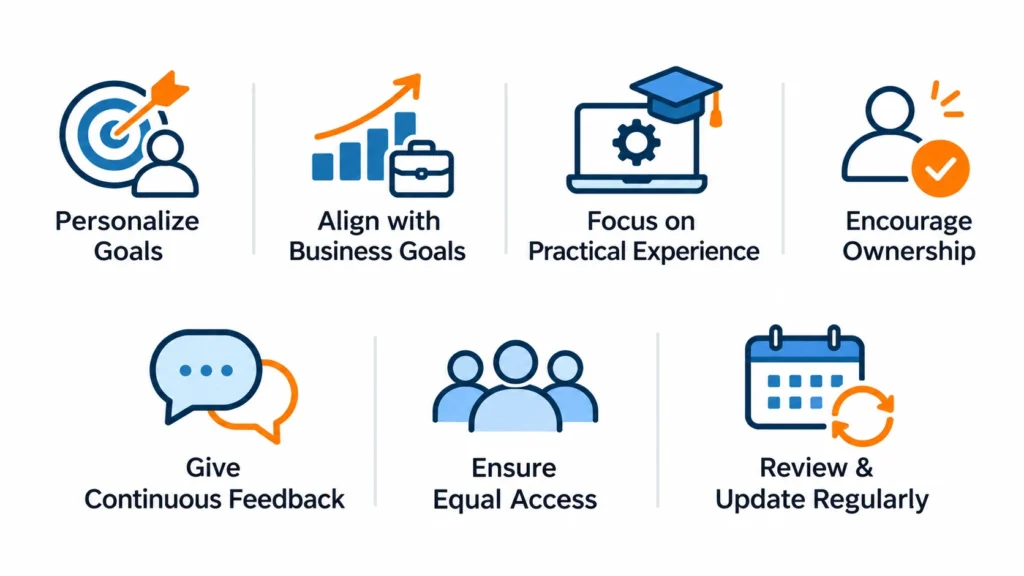
- Personalize plans around employee goals. A plan copied from a template with no personal input gets ignored.
- Tie individual goals to business objectives. Employees see the point more clearly when the plan supports work the company cares about.
- Prioritize practical experience. Put real tasks at the center and courses around the edges.
- Encourage ownership. The employee drives scheduling and brings progress notes to each meeting.
- Give continuous feedback. Managers should comment on skills in use, not wait for a formal review.
- Make development accessible to everyone. Part-time, remote, and frontline staff need the same access as office staff.
- Review and update plans regularly. A plan written for last year’s role is out of date.
How to keep plans fair and practical
Fairness is part of effectiveness. Use more than one source for skill assessments so one biased opinion does not decide a career. Offer the same opportunities across teams. Keep development conversations separate from disciplinary ones. Store assessment and career data securely and limit who can see it. Check that goals are realistic and resources exist. Judge success by outcomes, not course completion alone.
Common employee development planning challenges and how to overcome them
- Vague or unrealistic goals. Rewrite them in SMART form and limit each plan to one to three priorities.
- Low employee motivation. Return to Step 1 and reconnect the goal to something the employee wants.
- Limited budgets. Mentoring, job shadowing, stretch assignments, and peer sessions cost little. You can also lower training costs without lowering quality by cutting waste before cutting learning.
- Weak manager support. LinkedIn’s report lists lack of manager support among the top three barriers to career development, cited by 50% of respondents. Give managers a conversation guide and protect time in their calendars.
- Difficulty measuring outcomes. Decide the success indicator in Step 4, before activities start.
- No follow-up. Book every review at plan signing and track completion of reviews as an HR metric.
HR practitioners also compare notes on these problems in forums such as r/human resources, which can help you check your approach against what other teams try.
Frequently asked questions about employee development plans
1. What is an employee development plan?
An employee development plan is a document that lists an employee’s career goals, current skills, skill gaps, and the actions, timelines, and reviews that will build the needed capabilities.
2. What are the main components of an employee development plan?
The main components are role details, career aspirations, current skills, gaps, SMART goals, learning activities, resources, timelines, success indicators, and review dates.
3. How do you write an employee development plan?
Discuss career goals, assess skills, identify gaps, set SMART goals, choose activities, assign responsibilities, set milestones, review progress, and update the plan.
4. What are examples of employee development goals?
Examples include leading two team meetings, earning a relevant certification, completing a cross-team project, mastering a new tool, or presenting results to senior leaders.
5. How often should an employee development plan be reviewed?
Hold a short check-in monthly, a fuller review quarterly, and a final evaluation at the end of the plan period, which is often six to twelve months.
6. What is the difference between an employee development plan and a performance improvement plan?
A development plan builds skills and supports growth. A performance improvement plan addresses specific performance problems and sets corrective expectations and review periods.
7. Who is responsible for an employee development plan?
The employee owns the goals, the manager supports and gives feedback, and HR provides the template, process, and tools.
8. What is the 70-20-10 model of employee development?
It suggests development comes roughly 70% from on-the-job experience, 20% from relationships and feedback, and 10% from courses. It is a guideline with limited empirical support.
9. How do you measure the success of an employee development plan?
Compare skill levels before and after, check that the skill appears in real work, and track business and retention outcomes, not just course completion.
Conclusion
A good employee development plan is short, personal, and reviewed on a schedule. It starts with what the employee wants, adds what the business needs, and turns the overlap into a few SMART goals with real activities and dates. The plans that work are the ones managers and employees revisit every month and judge by changes in daily work. Start with one team and one template, run a full cycle, and adjust from what you learn.