

To identify and close employee skill gaps, define the skills each role needs, measure what employees can do today, compare the two, rank the gaps by business impact, and close them with targeted learning, coaching, or hiring. Then check whether the new skills show up in real work.
Most teams stall after the first step. Job requirements change faster than job descriptions, and AI tools are adding new tasks to almost every role. Employers surveyed for the World Economic Forum’s Future of Jobs Report 2025 ranked skill gaps as the top barrier to business transformation.
This guide walks through a practical process for identifying and closing employee skill gaps, from the first assessment to the final measurement. You will also get a worked example and a template you can copy.
What Are Employee Skill Gaps?
An employee skill gap is the difference between the skills an employee has today and the skills their job requires, now or in the near future. A gap can be small, like needing more practice with spreadsheet formulas. It can also be large, like a team that has never used the AI tools the company just bought.
Gaps show up in individual output first. Over time they slow projects, raise error rates, and leave the company short of capabilities its strategy depends on.
Types of Employee Skill Gaps
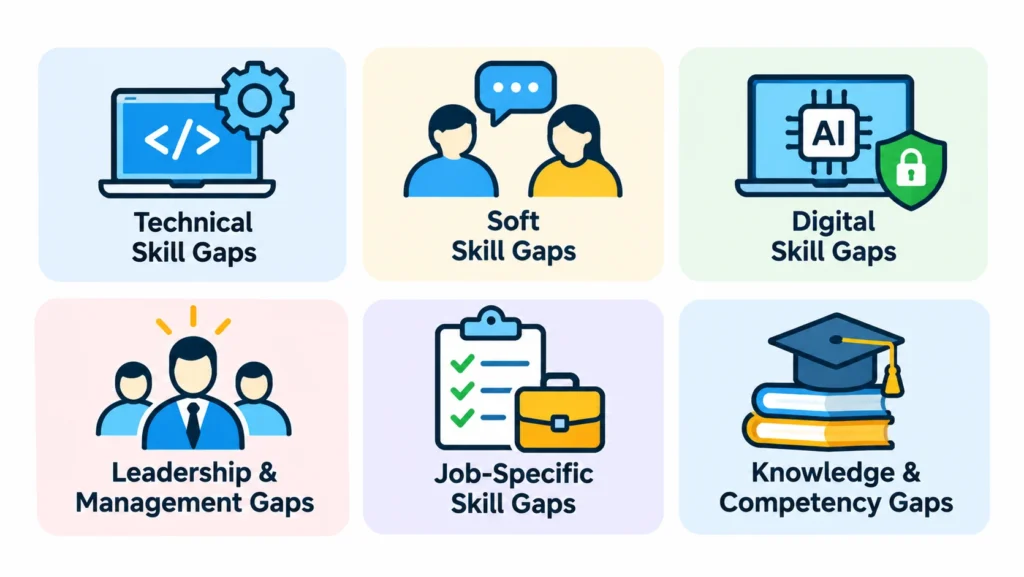
- Technical (hard) skill gaps. Missing ability with tools, methods, or systems, such as data analysis or CRM use.
- Soft skill gaps. Weak spots in communication, collaboration, or handling conflict.
- Digital skill gaps. Limited comfort with digital tools, data, cybersecurity basics, or AI.
- Leadership and management gaps. Trouble with delegation, feedback, or decisions under pressure.
- Job-specific gaps. Skills unique to a function, like financial reporting or claims processing.
- Knowledge and competency gaps. Missing information, or a weak mix of knowledge, skill, and behavior for the role.
Individual, Team, and Organizational Skill Gaps
The same gap looks different depending on the level you measure it at, and the fix changes with it.
| Level | Example | Usual response |
| Individual | An employee lacks the advanced Excel skills their role requires. | Personal learning plan and coaching |
| Team | A marketing team lacks data analytics expertise. | Team training, a shared expert, or a new hire |
| Organizational | A company lacks the AI capabilities its digital plans need. | Workforce planning, reskilling, and external hiring |
Skills Gap vs. Knowledge Gap vs. Performance Gap
These three terms get mixed up, and the mix-up leads to wasted training budgets.
| Gap type | What it means | Example |
| Knowledge gap | The employee does not know something. | A new agent does not know the refund policy. |
| Skill gap | The employee knows what to do but cannot do it well. | An agent knows the policy but handles angry customers poorly. |
| Performance gap | Results fall short of the standard, for any reason. | Handle times are 30% above target. |
A performance gap may come from a skill gap. It may also come from unclear goals, slow software, heavy workloads, or rewards that push people toward the wrong behavior. Training fixes the first two causes only. If you suspect something else is going on, a full training needs analysis helps you trace each problem to its root before you spend money on a course.
Why Identify Employee Skill Gaps?
Finding gaps early gives you more options. You can train, reassign, or hire on your own timeline instead of in a crisis.
Improves Employee Performance and Productivity
When the required skills are written down and measured, managers can coach to specific gaps instead of giving vague advice like “be more proactive.” People also stop spending time on training they do not need.
Supports Employee Development and Career Growth
A gap assessment is the starting point for an individual development plan. It shows employees what the next role requires and where they stand against it. In LinkedIn’s 2024 Workplace Learning Report, 87% of L&D professionals said they can show business value by helping employees gain skills to move into different internal roles.
Improves Retention and Engagement
People tend to stay longer where they can see a path forward. Relevant learning also helps teams raise engagement with training that feels tied to their actual work, not a generic course catalog.
Reduces Recruitment and Training Costs
Hiring is slow and expensive, and new hires have their own ramp-up time. If you know which skills already exist inside the company, you can fill some roles from within and skip courses people do not need.
Supports Strategic Workforce Planning
The skills you need next year are rarely the skills you have now. In the Future of Jobs Report 2025, employers expect 39% of workers’ core skills to change by 2030. The same report found that 85% of surveyed employers plan to make upskilling a workforce strategy.
Helps Organizations Adapt to AI and Technology Changes
Digital literacy, data analysis, and comfort with AI tools now matter in roles that did not need them five years ago. A regular gap review tells you where those skills are thin before a rollout stalls.
What Causes Employee Skill Gaps?
Knowing the cause helps you pick the right fix and avoid repeating the problem.
Rapid Technological Change
AI, automation, and new software change daily tasks faster than most training calendars. A skill that was enough last year may be basic today.
Changes in Job Responsibilities
Promotions, restructures, and new product lines add duties without adding preparation. A strong individual contributor who becomes a manager often has a gap in feedback and delegation.
Too Little Ongoing Training
Training that happens once at onboarding fades quickly. Without refreshers and practice, skills drift out of date.
Weak Workforce Planning
If nobody looks ahead at what the business will need, gaps appear suddenly and get filled in a rush.
Turnover and Lost Institutional Knowledge
When an experienced employee leaves, their know-how often leaves too. Undocumented processes and informal expertise are the hardest things to replace.
Thin Onboarding and Role-Specific Training
Some people start a job with a general welcome session and little else. They learn by trial and error, and the gaps stay hidden until something breaks.
How to Identify and Close Employee Skill Gaps: The Process at a Glance
Here is the full cycle in seven steps. The sections below expand each one.
- Identify the skills each role needs now and in the next year.
- Assess what employees can actually do, using more than one source.
- Prioritize gaps by business impact, urgency, and risk.
- Develop a targeted plan: training, coaching, practice, or hiring.
- Apply the new skills on real work with support from a manager.
- Evaluate with a practical check, not just course completion.
- Reassess on a fixed schedule so new gaps do not pile up.
Steps 1 to 3 are covered in the identification section. Steps 4 and 5 are the closing strategies. Steps 6 and 7 are measurement and prevention.
How to Identify Employee Skill Gaps: 7 Practical Steps
Identifying a skill gap means comparing what the job requires with what employees can demonstrate. These seven steps keep that comparison fair and useful.
Step 1: Identify Organizational Goals and Future Skill Requirements
Start with where the business is going, not with a list of courses. Review current goals, planned projects, and upcoming changes in tools or regulations. Gaps only matter when they block something the business wants, so it helps to link learning to business priorities before you build any skills list.
Here is an example. A company is about to launch AI-powered customer service software. Agents will need to review and correct AI-drafted replies, and they will need stronger communication skills for the cases the AI cannot handle. Those two needs become your first target skills.
Step 2: Define the Skills Required for Each Job Role
Job descriptions are a starting point, but they are often out of date. Watch how your best performers work and ask their managers what separates good from average. Then write each skill as something you can observe, such as “logs a complete customer record without missing fields.”
If your company has one, a competency framework gives you a shared language for this. Next, set a required proficiency level for each skill. A simple five-point scale works well:
- Level 1: Aware of the skill, needs step-by-step help.
- Level 2: Can do basic tasks with guidance.
- Level 3: Works independently on routine tasks.
- Level 4: Handles exceptions and meets quality standards consistently.
- Level 5: Expert who improves the process and coaches others.
The required level can differ by role. The table below is an illustration, not research data.
| Skill | Sales representative | Sales manager |
| Lead qualification | 4 | 3 |
| CRM management | 3 | 4 |
| Negotiation | 3 | 4 |
| Coaching and feedback | 1 | 5 |
| Forecasting | 2 | 5 |
Step 3: Assess Employees’ Existing Skills and Competencies
No single assessment tells the full story. Use at least two of the methods below and compare the results.
Employee Self-Assessments
Self-ratings are quick and give employees a voice. They are also unreliable on their own. Research on the Dunning-Kruger effect suggests that people with less skill tend to overestimate it, while experts sometimes underrate themselves.
Manager Assessments
Managers see day-to-day work and can rate how consistently someone meets the standard. Give them a written rubric so a “3” means the same thing across teams.
Practical Skills Tests
A work sample shows what someone can do, while a quiz mostly shows what they remember. Ask the person to complete a real task, such as building a pivot table or resolving a mock customer complaint, and score it against the rubric.
Employee Interviews and Surveys
Short interviews and surveys uncover what numbers miss: which tasks feel hard, what tools get in the way, and what people want to learn. Keep surveys under fifteen questions.
360-Degree Feedback
360-degree feedback collects input from peers, direct reports, and managers. It works best for behavioral skills like communication, collaboration, and leadership.
Step 4: Review Employee Performance Data and KPIs
Existing data is the cheapest evidence you have. Look at:
- Performance review ratings
- Error and rework rates
- Customer satisfaction scores
- Project completion and on-time delivery
- Quality audit results
- Sales or productivity numbers
Poor numbers do not automatically mean a skill gap. Before you assign training, ask four questions in order:
- Does the employee know what good looks like?
- Can they do it when they try?
- Do they have the tools, time, and clear goals they need?
- Does the system reward the right behavior?
A “no” to question 1 or 2 points to a skill or knowledge gap. A “no” to question 3 or 4 points to a management or process problem that training will not solve.
Step 5: Conduct a Skills Gap Analysis
Now compare required proficiency with current proficiency for each skill and each person. Many teams call this a gap analysis, a general business method that compares where you are with where you need to be. Record the results in a skills matrix: employees down the side, skills across the top, ratings in the cells.
How to Calculate an Employee Skill Gap
Skill Gap = Required Proficiency − Current Proficiency
Both ratings must use the same scale. A negative or zero result means the employee meets or exceeds the standard.
Here is a worked example. This one is illustrative, not drawn from a real company. A customer support role requires CRM proficiency at Level 4. The employee rates themselves a 3. Their manager rates them a 2. In a practical task, they log customer records but miss required fields and skip the search filters, which scores a 2.
The validated current level is 2, so the gap is 4 − 2 = 2. Two sources agree, and the practical task shows exactly what is missing. That is far more useful than the self-rating alone.
Step 6: Prioritize Skill Gaps Based on Business Impact
You will almost always find more gaps than you can fix at once. Rank them using these factors:
- Business impact if the gap stays open
- Urgency, such as a launch date or compliance deadline
- Operational or safety risk
- Cost of doing nothing
- Whether you have the time, people, and budget to fix it now
A simple priority matrix helps:
| Urgent | Not urgent | |
| High impact | Fix now with a focused plan | Schedule within the quarter |
| Low impact | Use a quick fix, like a job aid | Monitor and revisit at the next review |
A small gap in a revenue-critical skill can outrank a large gap in a nice-to-have skill.
Step 7: Validate Assessment Findings With Employees and Managers
Share the results in a short conversation with each employee and their manager. Check that the ratings feel accurate, correct any mistakes, and agree on what to work on first. People commit to a plan they helped shape.
Explain what data you collect, who can see it, and how it will be used. Employees who fear their results will be used against them tend to under-report gaps, which defeats the purpose.
Best Methods for Employee Skills Gap Assessment
Each method answers a different question. The table compares them side by side.
| Method | What it collects | Advantage | Limitation | Best use |
| Self-assessment | Employee’s own view of skills | Fast, involves the employee | Often inaccurate | Starting point and development conversations |
| Manager evaluation | Observed workplace skills | Based on real work | Can be biased or inconsistent | Role-specific competencies |
| Skills test or work sample | Demonstrated ability | Objective for hands-on skills | Takes time to design | Technical and digital skills |
| Performance review and KPIs | Results over time | Data already exists | Cannot show the cause | Spotting where to look |
| 360-degree feedback | Behavior seen by many people | Multiple viewpoints | Needs trust and good design | Leadership and interpersonal skills |
| Skills matrix | Proficiency by person and skill | Shows team-level patterns | Only as good as its inputs | Summarizing and planning |
The strongest approach combines three sources: one opinion (self or manager), one demonstration (a test or work sample), and one data point (a KPI).
Skills Gap Analysis for Small Businesses
You do not need special software to start. A spreadsheet and your existing performance records are enough for a team of up to a few dozen people.
- List the five to eight skills that matter most for each role.
- Rate each person on a 1 to 5 scale, using a manager rating plus one practical check.
- Add a gap column and sort by the largest gaps in the most important skills.
How to Close Employee Skill Gaps: 8 Effective Strategies
Courses help, but most skills improve through practice on real work with feedback. Pick the mix that fits the gap, not the one that is easiest to buy.
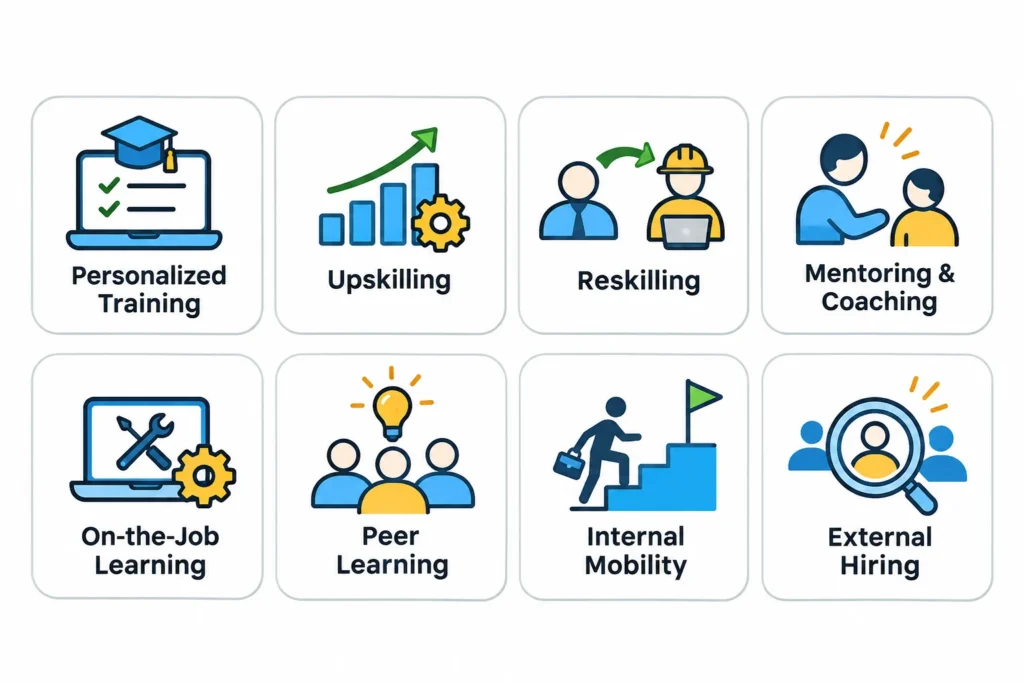
1. Develop Personalized Training Plans
Two employees with the same job title rarely have the same gaps. A skills-based approach to training builds each learning activity around a specific skill and checks the result with a practical task. Employees who start at different levels should not follow the same course, so individual learning paths work better than a one-size-fits-all program.
2. Run Upskilling Programs
Upskilling improves a skill someone already uses. Examples include advanced Excel for an analyst, a writing workshop for a support team, or a data literacy course for marketers. Group related topics into a structured training program with clear objectives, delivery methods, and checkpoints.
3. Offer Reskilling Opportunities
Reskilling prepares someone for a different role. An administrative employee trained as a data analyst is a typical case. Choose people who already have related strengths, like attention to detail or comfort with spreadsheets, so the jump is realistic.
| Upskilling | Reskilling | |
| Goal | Improve skills for the current role | Build skills for a new role |
| Change in duties | Small | Often large |
| Example | Advanced Excel training | Administrative assistant to data analyst |
4. Provide Mentoring and Coaching
A mentor passes on judgment that courses cannot teach. A coach, usually the manager, gives feedback on specific tasks. Pair each employee with someone who already performs the skill at the target level, and set a regular meeting rhythm.
5. Use On-the-Job Training and Practical Learning
These methods turn learning into doing:
- Job shadowing with an experienced colleague
- Stretch assignments slightly above the current level
- Simulations and role-plays for high-stakes situations
- Hands-on projects with real deliverables
- Supervised practice with quick feedback
6. Encourage Peer Learning and Knowledge Sharing
Your own experts are an underused resource. Short internal demos, shared playbooks, and “lunch and learn” sessions spread skills at low cost and capture knowledge before it walks out the door.
7. Support Internal Mobility and Career Development
Some gaps close when you move the person, not the skill. An employee who is strong in client communication but weak in technical writing may fit a customer success role better than the one they hold.
8. Recruit External Talent When Necessary
Training cannot solve every gap. If the skill is needed within weeks, is highly specialized, or would take years to build, hiring or contracting may be the sensible choice.
Train or Hire? A Simple Decision Guide
| Situation | Usually the better route |
| Moderate gap, six or more months of lead time | Train current employees |
| Employee has closely related skills | Reskill or redeploy |
| Specialized skill needed in weeks | Hire or contract |
| Short project, skill not needed afterward | Contractor or consultant |
| Many roles will need the skill for years | Build it internally and hire selectively |
These are rules of thumb. Cost, culture, and the person’s own goals should shape the final call.
Employee Skill Gap Analysis Template and Example
A template turns assessment results into something a manager can act on. It does not need to be fancy.
Essential Components of a Skills Gap Analysis Template
- Employee name or ID
- Department and job role
- Required skills
- Required proficiency
- Current proficiency
- Gap
- Priority level
- Recommended development activity
- Assessment date
- Reassessment date
Employee Skills Gap Analysis Example
This sample uses a five-point scale. The ratings are illustrative.
| Skill | Required level | Current level | Gap | Priority |
| CRM management | 4 | 2 | 2 | High |
| Communication | 4 | 3 | 1 | Medium |
| Data analysis | 5 | 2 | 3 | High |
| Time management | 4 | 4 | 0 | Low |
Read the table from the largest, most important gap down. Data analysis has the biggest gap and CRM sits close behind, so both go first. Communication needs light coaching. Time management needs nothing, and the employee can mentor others on it.
How to Turn Assessment Results Into an Employee Development Plan
For each high-priority skill, write down:
- A development objective in plain terms
- Learning activities, such as a module plus supervised practice
- A mentor or coach
- A timeline with checkpoints
- The target proficiency level
- How and when progress will be checked
Continuing the earlier example, the support agent with a CRM gap of 2 gets eight weeks of hands-on exercises, weekly coaching from a senior agent, and a live-task review every two weeks. At week eight, a practical task scores a 3. The gap shrinks from 2 to 1, so the plan continues for another cycle. A training roadmap helps when several employees need plans that run in parallel.
Best Tools and Software for Identifying Employee Skill Gaps
Start with a spreadsheet and move to software when manual tracking becomes a burden. Tools fall into four groups:
- Learning management systems (LMS). A learning management system delivers courses and records scores and completions. Moodle is an open-source example. Completion data alone does not prove skill, so treat it as one input.
- Skills assessment tools. These platforms test job-related tasks. iMocha is one example.
- HR and talent management suites. Systems such as SAP SuccessFactors and Cornerstone hold employee records, reviews, and learning data in one place.
- Skills intelligence platforms. Tools such as 365Talents and AG5 map skills across the workforce and show gaps by team.
These are examples, not endorsements. Features and pricing change, so run a pilot before you commit.
How to Choose the Right Tool
Compare options on these points:
- Assessment features, including practical tests
- Skills matrix capability
- Reporting and analytics
- Integration with your LMS and HR system
- AI features, and whether a person can review the results
- Data privacy and access controls
- Cost and ability to scale
How AI Can Help Identify and Close Employee Skill Gaps
AI is changing how companies find gaps. MIT Sloan has written about how companies use AI to find and close skills gaps, and the practical uses fall into four groups:
- Skills mapping. AI can infer skills from job histories, projects, and learning records to build employee profiles.
- Automated gap detection. Software compares each profile with the role’s requirements and flags shortfalls.
- Personalized recommendations. Systems suggest courses and practice tasks based on the gap.
- Predictive planning. Models can estimate which skills will be scarce as roles and tools change.
AI has limits you should plan for:
- Inferred skills can be wrong or out of date.
- Training data can carry bias into the results.
- Collecting skills data raises privacy questions.
- Software often misses context, such as a recent role change.
- A person should review any result that affects pay, promotion, or job security.
How to Measure the Effectiveness of Employee Skill Development
Completing a course does not mean a gap is closed. Measure the change at several levels. The Kirkpatrick model is a common way to organize this, covering reaction, learning, behavior, and results.
- Post-training skills assessments. Use the same rubric and a similar task before and after, so the comparison is fair.
- Performance changes. Look at quality, accuracy, speed, and output over the following weeks.
- Application on the job. Ask managers whether the employee now uses the skill in real work. Many teams check at 30, 60, and 90 days.
- Mobility and growth. Track role changes, added responsibilities, and promotions over several quarters.
- Return on investment. Use this formula only when you can put a defensible value on the benefits.
ROI (%) = (Benefits − Costs) ÷ Costs × 100
Costs include content, delivery, and the time employees spend learning. Be honest about what else may have moved the numbers. For day-to-day monitoring, tracking training progress through scores, completions, and manager observations keeps everyone current. To judge whether training worked, pair those numbers with evidence of changed behavior at work.
Best Practices for Preventing Future Employee Skill Gaps
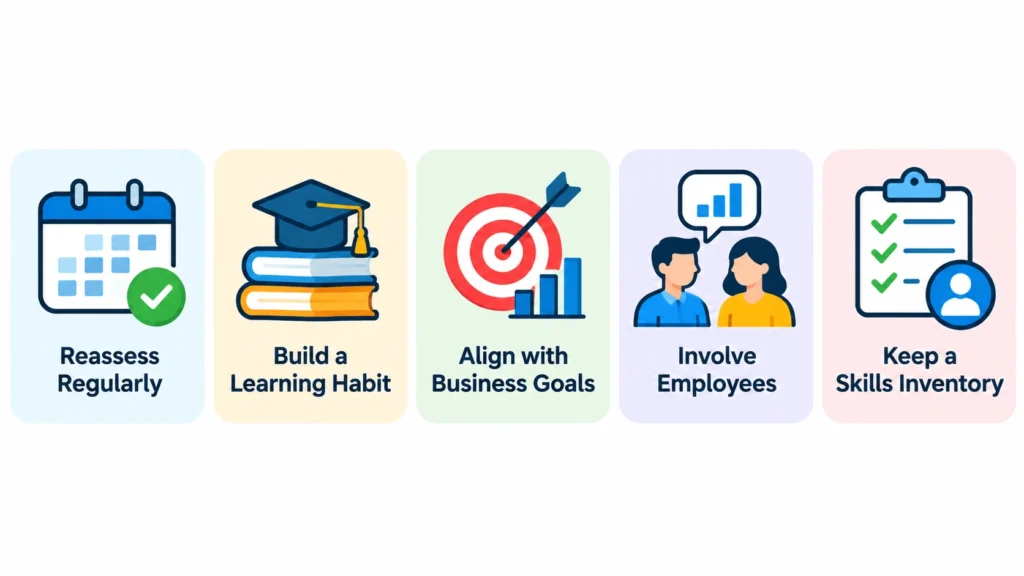
- Reassess on a schedule. Review at least once a year, and again after a major system change, restructure, or strategy shift.
- Build a habit of learning. Give people protected time to practice, and make it normal for managers to talk about skills. A habit of continuous learning keeps small gaps from growing.
- Tie development to business goals. When leaders can see the link between a skill and a result, learning gets funded and protected.
- Involve employees in career planning. Ask what they want to learn. Interests and business needs overlap more often than managers expect.
- Keep a current skills inventory. A simple record of who can do what also supports succession planning when someone leaves.
Common Mistakes to Avoid When Identifying and Closing Skill Gaps
- Relying only on self-assessments. People misjudge their own skills in both directions.
- Treating every performance issue as a skills problem. Check tools, goals, workload, and incentives first.
- Giving everyone the same training. Generic courses waste time for people who already have the skill.
- Ignoring future requirements. A gap analysis based only on today’s job descriptions will be outdated within a year.
- Not measuring results. Without a before-and-after check, you cannot tell whether training worked.
- Leaving employees out of the plan. People resist development that is done to them.
- Skipping reassessment. Skills change, and so should the matrix.
HR and L&D practitioners compare notes on problems like these in communities such as r/human resources. It is a useful reality check before you roll out a new process.
Frequently Asked Questions About Employee Skill Gaps
1. What are the most common skill gaps in the workplace?
Common gaps include digital and AI skills, data analysis, communication, and leadership. The mix depends on your industry and what is changing in your business.
2. How do you identify skill gaps in employees?
Define the skills each role needs, assess current ability with at least two methods, review performance data, and compare the results with the required level.
3. What are the five steps of a skills gap analysis?
A common version is: define goals, list required skills, assess current skills, compare the two, and create an action plan. This guide adds prioritization and validation steps.
4. What is an example of an employee skill gap?
A support agent whose role requires CRM proficiency at Level 4 but who performs at Level 2 has a two-point gap.
5. What is the difference between a skills gap and a performance gap?
A skills gap is a shortfall in ability. A performance gap is a shortfall in results, which can come from skills, tools, goals, workload, or motivation.
6. How do you calculate an employee’s skill gap?
Subtract current proficiency from required proficiency, using the same scale for both.
7. How often should organizations assess skill gaps?
At least once a year, plus after major changes such as new software, restructures, or strategy shifts.
8. What are the best tools for identifying employee skill gaps?
A spreadsheet works for small teams. Larger organizations often use an LMS, a skills assessment platform, an HR suite, or a skills intelligence tool.
9. How can AI help identify skill gaps?
AI can infer skills from work records, compare profiles with role needs, and suggest learning. A person should still check the results.
10. What is the difference between upskilling and reskilling?
Upskilling improves skills for a current role. Reskilling builds new skills for a different role.
11. How do you close skill gaps without hiring?
Use targeted training, coaching, mentoring, on-the-job practice, peer learning, and internal moves.
12. How do you know a skill gap has been closed?
The employee passes a practical task at the required level and uses the skill in real work, confirmed by a manager and performance data.
Conclusion
To identify and close employee skill gaps, start with the skills your roles need, measure what people can do, and rank the gaps by what they cost the business. Then pick the fix that fits each gap, whether that is coaching, practice, reskilling, or a new hire.
The work does not end when the training does. Check the new skills with a practical task, watch for change in daily performance, and repeat the assessment on a schedule. Pick one team and one critical skill this quarter, run the process on a small scale, and build from there.