

To build a skills development program for employees, you map the skills your business needs, measure what your people can do today, close the gaps with targeted learning, and check whether the new skills show up in daily work. It is a repeating cycle, not a one-time course launch.
The timing matters. In the World Economic Forum’s Future of Jobs Report 2025, employers expect 39% of workers’ core skills to change by 2030, and 63% call skill gaps a major barrier to business transformation. A program lets you respond on purpose instead of scrambling once a gap starts costing you money.
This guide walks through ten steps, from setting goals to continuous improvement. You will also get a sample skills gap table, a 90-day roadmap, and a checklist you can adapt for your own organization.
What Is an Employee Skills Development Program?
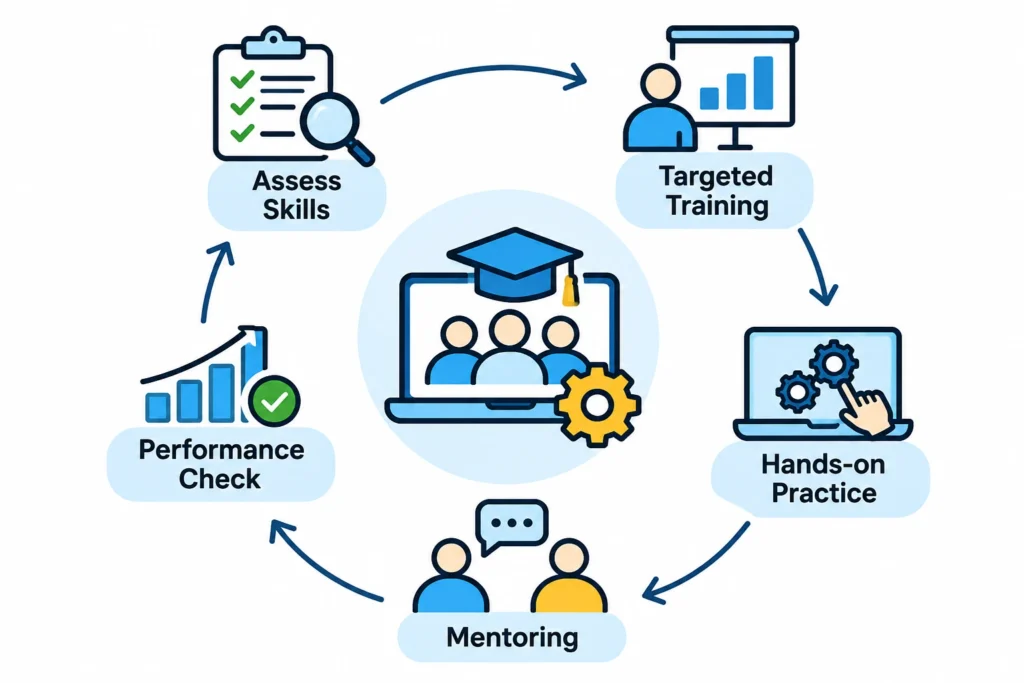
An employee skills development program is a structured, organization-wide initiative that builds the skills employees need for current and future work. It combines skills assessments, targeted training, hands-on practice, mentoring, and performance checks so that workforce capability matches business goals.
What makes it a program, and not a course, is that it keeps running. Each cycle starts with business needs, produces learning plans, and ends with evidence of what changed. That evidence feeds the next cycle.
Skills Development Program vs. Employee Training Program
| Factor | Skills development program | Employee training program |
| Purpose | Build workforce capability for current and future needs | Teach a specific task, tool, or policy |
| Scope | Organization-wide, across many roles | One topic or one group |
| Duration | Ongoing, reviewed in cycles | Often a fixed start and end date |
| Learning approach | Mix of training, practice, mentoring, and rotation | Mostly courses or workshops |
| Expected outcome | Measurable proficiency gains and internal mobility | Task competence or compliance |
A structured training program for a specific role is one building block inside the larger program.
Upskilling vs. Reskilling vs. Employee Development
These terms get mixed up, so here is how they differ.
- Training builds knowledge or skill for a specific task, such as using a new reporting tool.
- Upskilling deepens abilities within a current role, such as moving from basic to advanced data analysis.
- Reskilling prepares someone for a different role, such as a manual reporting clerk becoming a data analyst.
- Development covers broader professional and career growth, including leadership and long-term goals.
Most programs use all four. Training fixes immediate task gaps, upskilling supports growth in place, reskilling covers roles that change or disappear, and development supports retention and succession planning.
Why Is Employee Skills Development Important?
Skills development earns its budget when it solves problems leaders already feel. Here are the five reasons that come up most often.
- It closes gaps before they hurt performance. LinkedIn’s 2025 Workplace Learning Report found that 49% of learning and talent development professionals agree their executives worry employees lack the skills to execute the business strategy.
- It prepares people for technology change. AI tools and automation change daily tasks. The WEF report estimates that if the world’s workforce were 100 people, 59 would need training by 2030.
- It supports retention. LinkedIn’s research names career progress as people’s top motivation to learn, and notes that employees who cannot move ahead tend to leave and take their skills with them.
- It builds internal mobility and succession. When skills are documented, managers can spot people who are ready for bigger roles instead of defaulting to outside hires.
- It gives you options when a skill is scarce. Developing existing employees is one route to fill a hard-to-hire role, next to recruiting.
What Skills Should Organizations Include in a Development Program?
Choose skills based on business goals and role requirements, not on what is trending. Most programs draw from six categories.
| No. | Skill category | Examples |
| 1 | Technical and job-specific skills | Software proficiency, programming, data analysis, equipment operation, industry knowledge |
| 2 | Soft skills | Communication, teamwork, emotional intelligence, conflict resolution |
| 3 | Leadership and management skills | Decision-making, delegation, performance management, people management |
| 4 | Digital and AI skills | Digital literacy, AI literacy, data interpretation, cybersecurity awareness |
| 5 | Transferable skills | Adaptability, problem-solving, time management, critical thinking |
| 6 | Business-specific skills | Product knowledge, internal processes, company systems |
A competency bundles knowledge, skills, and behaviors needed to do a role well, so one competency such as customer relationship management contains several of the skills above. Write each skill as something an assessor can observe, such as “resolves billing disputes without escalating,” so different managers score it the same way.
How to Build a Skills Development Program for Employees: 10 Steps
Here is the full process at a glance.
- Identify organizational goals and workforce requirements.
- Conduct a workforce skills assessment.
- Perform a skills gap analysis.
- Establish clear skills development goals.
- Design role-specific learning pathways.
- Select training and development methods.
- Allocate resources, budget, and responsibilities.
- Implement and launch the program.
- Evaluate employee skills and program effectiveness.
- Review and continuously improve.
Each step is explained below.
Step 1: Identify Organizational Goals and Workforce Requirements
Start with what the business plans to do over the next one to three years, not with a course catalog. Ask leaders which projects, products, or markets depend on skills the company does not fully have today. Then name the roles where those skills matter most.
Here is a hypothetical example. A regional logistics company plans to roll out route-optimization software within twelve months. Dispatchers will need data interpretation and software skills, and supervisors will need to coach teams through the change. Those become your first skill requirements.
To keep this step honest, tie each training goal to a measurable business result, such as fewer late deliveries or faster onboarding. If you cannot name the result, the skill probably is not a priority yet.
Step 2: Conduct a Workforce Skills Assessment
A workforce skills assessment records what your employees can do today. Use at least two of these three methods for every skill.
- Self-assessments. Employees rate themselves against each skill and note what they want to learn. People rate themselves too high or too low, so treat this as a starting point.
- Manager feedback. Managers add an outside view from performance reviews and day-to-day observation.
- Practical assessments. Work simulations, role-specific tests, and short tasks give the most objective evidence for hands-on skills.
If you do not have a skills list yet, borrow structure from free frameworks. SFIA describes IT and digital skills across levels of responsibility, and ESCO is the European classification of skills, competences, and occupations. Adapt them to your own roles instead of copying them whole.
Some gaps come from broken processes or unclear goals, not missing skills. When you are unsure, run a full training needs analysis to check whether training is the right fix before you spend on it.
Step 3: Perform a Skills Gap Analysis
A skills gap analysis compares the proficiency a role requires with the proficiency people have now. The difference is your development need. A simple 1 to 4 scale works well to start.
| Skill | Required level | Current level | Gap |
| Data analysis | 4 | 2 | 2 |
| Communication | 4 | 3 | 1 |
| Project management | 3 | 2 | 1 |
| AI proficiency | 4 | 1 | 3 |
Illustrative data for a sample team, not results from a real company.
Then rank the gaps. Score each one on these five factors.
- Business impact
- Urgency
- Risk, such as compliance or safety exposure
- Number of people affected
- Cost and feasibility of closing it
Separate current gaps from future gaps. In the table above, AI proficiency has the biggest gap, but if no AI tools are planned this year, data analysis may deserve attention first. A small gap in a revenue-critical skill can outrank a large gap in a nice-to-have one.
Step 4: Establish Clear Skills Development Goals
Turn each priority gap into a SMART goal: specific, measurable, achievable, relevant, and time-bound. A good goal names the skill, the target level, the deadline, and how you will check it.
A weak goal says, “Get better at data analysis.” A stronger one says, “By day 90, analysts will build a working dashboard from raw data and pass a practical assessment at level 3.” The second version tells you what to teach and how to test it.
Step 5: Design Role-Specific Learning Pathways
A learning pathway is the sequence of activities that takes a person from their current level to the target level. Different roles need different pathways, even when they share a company goal. Define proficiency levels so everyone knows what progress looks like.
- Foundational: knows the basics and needs guidance for most tasks.
- Intermediate: works independently on routine tasks and needs help with exceptions.
- Advanced: handles complex cases, improves the process, and coaches others.
Link each pathway to career moves. Show employees which skills lead to the next role, and show managers who is close to promotion. The same logic works for individuals when you build personalized learning paths for each role and let people skip what they already know.
Step 6: Select Training and Development Methods
Pick the method that suits the skill. Here are eight common options and where each fits best.
- Instructor-led training suits complex topics and group discussion, but it is costly to schedule.
- Online learning is flexible and scales easily, though it rarely builds judgment on its own.
- Blended learning mixes live sessions with self-paced modules and needs careful coordination.
- On-the-job training builds hands-on skill, and its quality depends on the supervisor.
- Mentoring and coaching help with judgment and leadership, and they rely on senior staff having mentorship time.
- Job shadowing and rotation give exposure to other roles and can disrupt workflow if poorly planned.
- Microlearning and social learning work for short refreshers and peer exchange, but not for complex skills.
- AI-powered personalized learning recommends content from skills data and still needs human review for accuracy and fairness.
You may hear about the 70:20:10 model, which says roughly 70% of development comes from experience, 20% from other people, and 10% from coursework. It grew out of a 1996 survey in which nearly 200 executives reported how they believed they learned, and critics point out it is not a scientific formula. Treat it as a reminder to put practice and coaching around every course, not as a budget split.
Step 7: Allocate Resources, Budget, and Responsibilities
List your cost lines before you launch: content and licenses, internal and external trainers, employee learning time, technology, and assessments. Divide total program cost by the number of employees trained to get a cost per employee you can track over time.
If money is tight, look for waste in your training budget, such as duplicate content and unused software seats, before you cut practice time or assessments.
Then assign ownership. A program without named owners stalls within a quarter.
| Group | Main responsibilities |
| Senior leaders | Sponsor the program, link it to strategy, protect budget and learning time |
| HR and L&D | Own design, assessments, reporting, and updates |
| Managers | Coach, assign practice on real work, give feedback |
| Employees | Set goals with their manager, complete activities, apply new skills |
Step 8: Implement and Launch the Skills Development Program
A good launch is mostly good communication. Follow this order.
- Explain why the program exists and what it offers each employee.
- Pilot with one team so you can fix problems before a wider rollout.
- Schedule protected learning time. Training squeezed into spare hours rarely sticks.
- Brief managers on how to coach and what to look for.
- Set up a way to track progress through assessments and dashboards from week one.
HR practitioners trade rollout lessons in communities such as r/humanresources, which can be a useful sanity check on your plan. Treat what you read there as anecdotes, and test ideas in your pilot.
Step 9: Evaluate Employee Skills and Program Effectiveness
Finishing a course does not prove someone can do the job. Check four things.
- Post-training skills assessments, scored against the same rubric you used at the start.
- Workplace application, observed by managers at 30, 60, and 90 days.
- Feedback from employees and managers on what helped and what did not.
- Business outcomes compared with the baseline you recorded in Step 1.
Step 10: Review and Continuously Improve the Program
Skills change, so the program has to change with them. Run a quick check each quarter and a formal review once or twice a year. Update pathways when tools, roles, or business goals shift, retire outdated content, and add new skills as they emerge.
Feed what you learn back into Step 1. That loop is what keeps the program useful after the launch energy fades.
How to Create an Employee Skills Development Plan
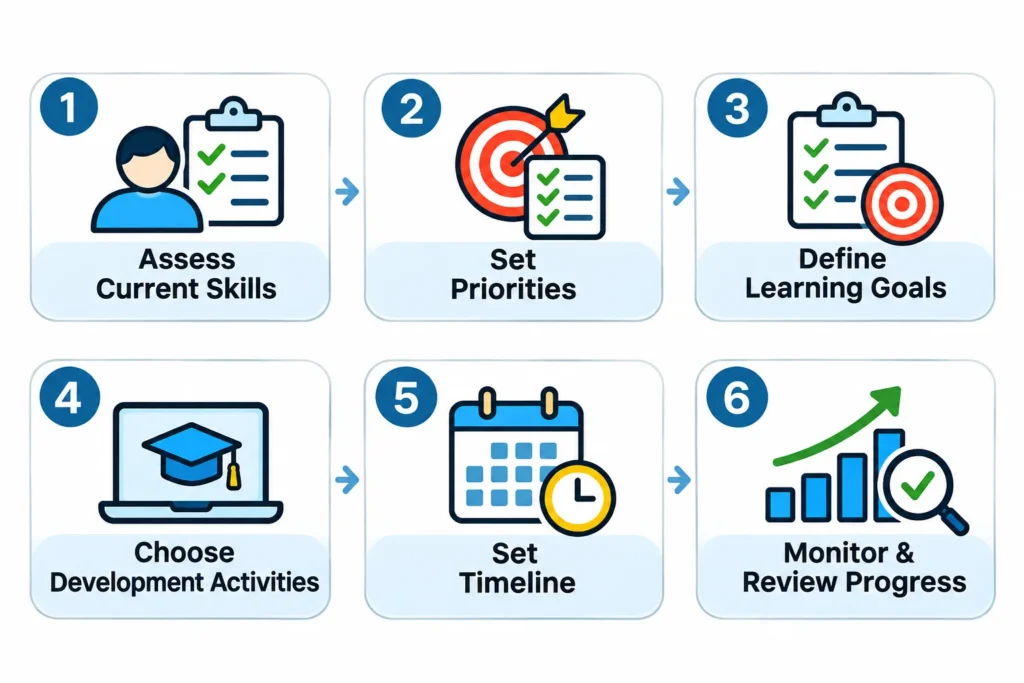
The program covers the organization. A skills development plan covers one person. Build one for each employee in the program using these six steps.
- Identify the employee’s current skills.
- Choose individual development priorities, based on the gap analysis and the employee’s goals.
- Set measurable learning objectives.
- Select development activities that fit the skill.
- Set a timeline.
- Monitor progress and review outcomes with the manager.
Here is a sample plan.
| Element | Example |
| Employee role | Marketing executive |
| Skill to develop | Data analysis |
| Current proficiency | Beginner |
| Target proficiency | Intermediate |
| Development activity | Analytics training and practical projects |
| Timeline | 60 days |
| Evaluation | Practical project assessment |
Best Practices for an Effective Skills Development Program
- Tie every skill to a business objective, so leaders see why it matters.
- Involve employees in planning. People commit to plans they helped shape.
- Personalize where you can. Let people skip what they already know.
- Give employees time to practice new skills on real work.
- Provide regular feedback and coaching, not just a final test.
- Secure manager and leadership support early, because managers decide whether learning gets time.
- Use data from assessments and performance to decide what to build next.
Common Challenges and How to Overcome Them
| No. | Challenge | Recommended solution |
| 1 | Limited training budgets | Prioritize critical skills and use internal experts |
| 2 | Low employee participation | Involve employees in development planning |
| 3 | Lack of management support | Connect development goals to business outcomes |
| 4 | Unclear skill requirements | Use competency frameworks and role-based assessments |
| 5 | Difficulty measuring results | Record baseline assessments and performance indicators |
| 6 | Outdated training content | Review learning materials on a set schedule |
| 7 | Limited time for learning | Offer flexible and microlearning options |
| 8 | Poor application of learned skills | Use practical assignments, coaching, and follow-up assessments |
How to Measure the Success of a Skills Development Program
Measure success through skill assessments, proficiency gains, practical demonstrations, workplace performance, internal mobility, and relevant business results. Completion rates alone show who attended, not who improved.
| No. | Metric | What it measures | How to track it |
| 1 | Skill proficiency improvement | Growth in capability | Pre- and post-assessments against one rubric |
| 2 | Completion and participation | Who took part | Learning platform reports |
| 3 | Time to competency | How long it takes to reach the target level | Dates of assessment results |
| 4 | Performance and productivity | Whether skills show up at work | Manager reviews, quality and output data |
| 5 | Internal mobility and promotion | Movement into new roles | HR records |
| 6 | Engagement and retention | Whether people stay | Surveys and turnover data |
| 7 | Cost per employee trained and ROI | Financial return | Program cost records and attributed benefits |
The Kirkpatrick model, developed by Donald Kirkpatrick in the 1950s, gives you four levels to work through.
- Reaction: did participants find the training relevant?
- Learning: did they gain the intended knowledge or skill?
- Behavior: are they applying it at work?
- Results: did business outcomes improve?
Many teams stop at levels one and two. Levels three and four are where the business value shows up. The Phillips ROI methodology adds a fifth level that converts benefits into money.
For return on investment, use ROI (%) = (program benefits − program costs) ÷ program costs × 100. The hard part is deciding how much of a result came from training, since other changes may have helped. State your assumptions openly, and pair completion data with a method to measure training effectiveness beyond completion.
How Technology Can Support Your Skills Development Program
Spreadsheets are fine for a pilot. As headcount grows, you will want tools in these five categories.
- Learning management systems (LMS) handle course delivery, enrollment, assessments, and reporting.
- Learning experience platforms (LXP) focus on learner-driven discovery and recommendations.
- Skills management and competency mapping software records who has which skills and at what level.
- AI-powered learning tools suggest content from skills data. Review their recommendations before acting on them.
- Learning analytics show where people get stuck and which content works.
Examples across these categories include Moodle, an open-source LMS, along with Cornerstone, 360Learning, LinkedIn Learning, and Coursera for Business. Features and pricing change often, so check current capabilities and run a pilot before you commit.
90-Day Roadmap for Building a Skills Development Program
| Timeline | Key activities | Expected deliverable |
| Days 1 to 30 | Assess business needs, map roles, evaluate skills, identify gaps | Workforce skills assessment |
| Days 31 to 60 | Set goals, design learning pathways, select methods, allocate resources | Skills development program |
| Days 61 to 90 | Launch training, monitor participation, run initial assessments, gather feedback | Implementation and evaluation report |
Treat this as a starting framework. A 50-person company can move faster than a 5,000-person one, and a first pilot can cover just one team.
Employee Skills Development Program Checklist
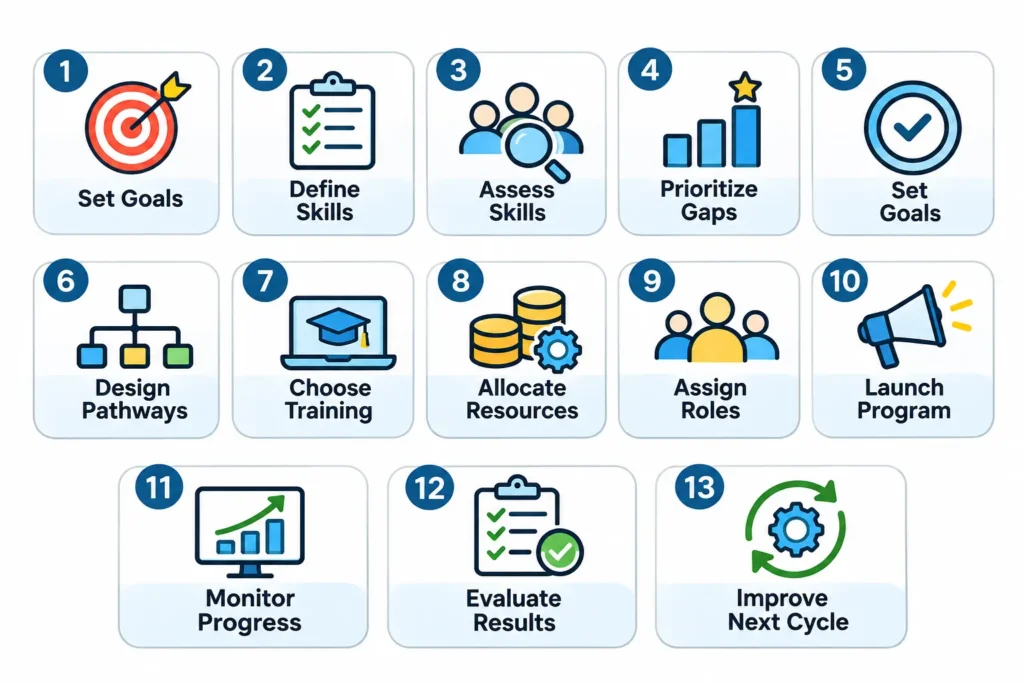
- Organizational goals identified
- Required workforce skills documented
- Employee skills assessed
- Skills gaps prioritized
- Measurable development goals set
- Learning pathways designed
- Training methods selected
- Budget and resources allocated
- Responsibilities assigned
- Program communicated and launched
- Progress monitored
- Results evaluated
- Improvements made for the next cycle
Frequently Asked Questions About Employee Skills Development Programs
1. How do you build a skills development program for employees?
Follow ten steps: identify business goals, assess workforce skills, analyze gaps, set measurable goals, design learning pathways, choose training methods, assign budget and owners, launch, evaluate results, and review regularly. Start with one team as a pilot, then expand.
2. What should an employee skills development program include?
It should include a skills inventory, assessments, a gap analysis, development goals, role-based learning pathways, a mix of learning methods, a budget with named owners, a measurement plan, and a scheduled review cycle.
3. What are the most important skills to develop in employees?
It depends on your strategy and roles. Most programs cover technical skills, communication, problem-solving, leadership, and digital or AI literacy. The WEF’s 2025 survey found analytical thinking is still the top core skill, with seven in ten companies calling it essential.
4. How do you identify employee skill gaps?
List the skills each role requires, set target levels, and assess current levels with at least two methods, such as self-assessment, manager review, and practical tests. Subtract current from required, then rank gaps by business impact and urgency.
5. What is the difference between employee training and skills development?
Training teaches a specific task or topic and often has a fixed end date. Skills development is an ongoing, organization-wide effort that builds capability over time through assessment, practice, mentoring, and review.
6. How often should skills development programs be reviewed?
Check progress each quarter and run a formal review once or twice a year. Review sooner when you adopt new tools, enter new markets, or restructure roles, since those changes shift which skills matter.
7. How can organizations measure the success of employee development programs?
Combine skill assessments, workplace performance, time to competency, internal mobility, and retention with cost data. Use the Kirkpatrick levels to look beyond satisfaction scores and completion rates to behavior change and business results.
8. How can small businesses develop employee skills with limited budgets?
Pick two or three priority skills, build a simple skills matrix in a spreadsheet, and use internal experts, mentoring, and job shadowing. Add free or low-cost courses where they fit, and move to paid software once the process works.
9. What role does an LMS play in employee skills development?
An LMS delivers courses, assigns learning paths, records assessment results, and reports progress. It supports the program but does not replace practice, coaching, or manager observation, which are what prove a skill is being used.
10. How can organizations prepare employees for future skill requirements?
Review business plans and planned technology changes each year, then add the skills they will need, such as AI literacy. Run small pilots, keep your skills framework current, and refresh learning pathways as roles change.
Conclusion
Knowing how to build a skills development program for employees comes down to a loop: assess, plan, teach, measure, and improve. Each step is simple. The discipline is in repeating them as roles, tools, and business goals change.
Start small. Choose one team and two or three critical skills, build a skills matrix, run a 90-day pilot, and compare the results with your baseline. A modest program with clear evidence will win support faster than a large plan that never launches.