


Employee learning has changed a lot over the ten years.
Companies used to have training that was done in a classroom or with a schedule. Now employees want to learn in a way that’s easy for them to use and feels like the apps they use every day.
When companies start using learning they often talk about two things: Learning Management System and Learning Experience Platform.
Both of these are used for learning at work. They do different things and help with different problems.
It is really important to know the difference between Learning Management System and Learning Experience Platform if you want to make your employee training better, get your employees more involved or build a team for the future.
In this guide we will explain what Learning Management System and Learning Experience Platform are.
LMS vs LXP
What is the difference between LMS and LXP?
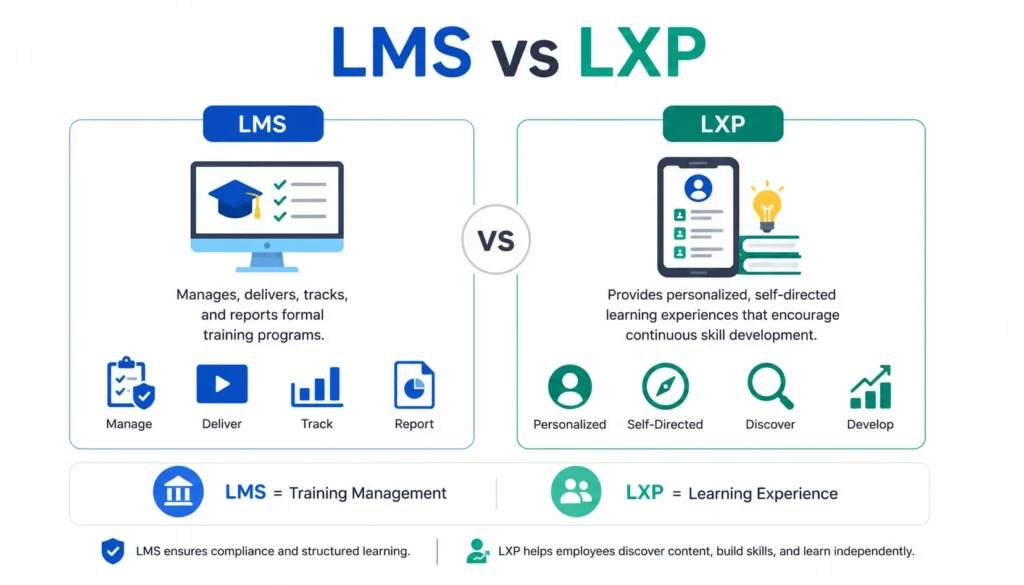
An LMS (Learning Management System) focuses on managing, delivering, tracking, and reporting formal training programs.
An LXP (Learning Experience Platform) focuses on personalized, self-directed learning experiences that encourage continuous skill development.
In simple terms:
- LMS = Training Management
- LXP = Learning Experience
Organizations often use LMS platforms to ensure compliance and structured learning, while LXPs help employees discover content, build skills, and learn independently.
What Is a Learning Management System (LMS)?
A Learning Management System (LMS) is a software platform used to create, deliver, manage, and track training programs.
It acts as a centralized hub for organizational learning.
Common LMS Functions
- Employee onboarding
- Compliance training
- Certification management
- Course delivery
- Learning progress tracking
- Assessments and quizzes
- Reporting and analytics
LMS Example
Imagine a healthcare organization that must ensure every employee completes annual HIPAA compliance training.
An LMS can:
- Assign courses automatically
- Track completion status
- Send reminders
- Generate audit reports
- Maintain certification records
This makes LMS platforms ideal for structured learning environments.
What Is a Learning Experience Platform (LXP)?
A Learning Experience Platform is a website that helps people learn in a way that is just right for them.
It gives them the chance to learn things that’re really interesting to them and that will help them get better at what they do.
Being told what to learn from a Learning Experience Platform helps people find things to learn that match what they like and what they want to achieve.
Common LXP Functions
- Personalized learning recommendations
- AI-driven content suggestions
- Social learning
- User-generated content
- Skill development pathways
- Knowledge sharing
- Content aggregation
LXP Example
Imagine a software developer who wants to learn artificial intelligence.
An LXP can recommend:
- Courses
- Videos
- Podcasts
- Articles
- Expert communities
- Skill pathways
The employee chooses what to learn and how to learn it.
This creates a more engaging learning experience.
LMS vs LXP: Key Differences
Understanding the distinctions between LMS and LXP helps organizations make informed decisions.
1. Primary Purpose
LMS: A Learning Management System (LMS) primarily focuses on managing, delivering, and administering employee training. Its main goals are to ensure compliance with organizational and regulatory requirements, manage certifications, deliver mandatory learning programs, and provide detailed reporting to track learner progress and training outcomes.
LXP: A Learning Experience Platform (LXP) focuses on enhancing learner engagement and supporting continuous skill development. Its primary goals are to promote ongoing learning, encourage career growth, facilitate knowledge sharing, and deliver personalized learning experiences tailored to each individual’s interests, goals, and development needs.
2. Learning Approach
LMS: A Learning Management System (LMS) follows a top-down learning model where organizations assign courses, and learners complete the required training based on predefined objectives and compliance needs.
LXP: A Learning Experience Platform (LXP) follows a bottom-up learning model that empowers learners to discover and explore content aligned with their interests, skills, and career goals, encouraging self-directed and continuous learning.
3. Content Delivery
LMS: A Learning Management System (LMS) primarily delivers structured learning through organized courses, training modules, assessments, and certification programs. Content is carefully planned and assigned to ensure learners complete required training and meet organizational objectives.
LXP: A Learning Experience Platform (LXP) provides access to a wide range of learning resources, including videos, podcasts, articles, webinars, external educational content, and community-generated knowledge. It often aggregates content from multiple sources into a single, personalized learning experience, allowing learners to explore topics that match their interests and career goals.
4. Personalization
LMS: A Learning Management System (LMS) offers limited personalization, with most learners receiving the same courses and training content based on their role, department, or organizational requirements.
LXP: A Learning Experience Platform (LXP) delivers a highly personalized learning experience by recommending content based on AI, user behavior, skills data, and individual learning preferences. This helps learners discover relevant resources that align with their goals and interests.
5. Learner Control
LMS: A Learning Management System (LMS) gives organizations full control over the learning process. Administrators decide what employees need to learn, when they should complete their training, and how the learning is delivered to ensure consistency and compliance.
LXP: A Learning Experience Platform (LXP) gives learners greater autonomy by allowing them to choose topics, follow their interests, and create personalized learning journeys that support their individual career goals and skill development.
6. Reporting and Compliance
LMS: A Learning Management System (LMS) provides robust reporting and analytics, enabling organizations to track course completion rates, certifications, assessment scores, and compliance status. These insights help administrators monitor training progress and meet regulatory requirements.
LXP: A Learning Experience Platform (LXP) places less emphasis on compliance tracking and focuses more on learner engagement and development. Its reporting typically highlights learning behavior, content engagement, skill growth, and overall learning activity to support continuous improvement.
7. Social Learning
LMS: A Learning Management System (LMS) traditionally offers limited opportunities for social interaction, with learning primarily centered on assigned courses and individual progress.
LXP: A Learning Experience Platform (LXP) is designed to encourage collaborative learning by incorporating features such as discussion forums, content sharing, peer recommendations, and expert communities. These social learning tools help employees exchange knowledge, learn from one another, and build stronger learning networks.
LMS vs LXP Comparison Table
| Feature | LMS | LXP |
| Purpose | Training management | Learning experience |
| Learning Style | Structured | Self-directed |
| Compliance Training | Excellent | Limited |
| Personalization | Basic | Advanced |
| AI Recommendations | Limited | Strong |
| Social Learning | Basic | Extensive |
| Reporting | Advanced | Moderate |
| Employee Engagement | Moderate | High |
| Skill Development | Good | Excellent |
| Content Discovery | Limited | Excellent |
When Should You Choose an LMS?
An LMS is the best option when your organization needs structured learning management.
Ideal LMS Use Cases
Employee Onboarding
Standardized onboarding ensures consistency across departments.
Compliance Training
Industries with strict regulations rely heavily on LMS platforms.
Examples include:
- Healthcare
- Finance
- Manufacturing
- Government
Certification Programs
LMS platforms simplify certification tracking and renewals.
Enterprise Training Programs
Organizations delivering mandatory learning at scale benefit from LMS functionality.
Businesses That Benefit Most
- Large enterprises
- Regulated industries
- Compliance-driven organizations
- Corporate training departments
When Should You Choose an LXP?
An LXP is ideal when the goal is continuous learning and workforce development.
Ideal LXP Use Cases
Upskilling Employees
Employees can learn new skills at their own pace.
Reskilling Initiatives
Organizations preparing for digital transformation often use LXPs.
Leadership Development
Future leaders can explore personalized learning paths.
Knowledge Sharing
Employees contribute expertise and resources.
Businesses That Benefit Most
- Technology companies
- Professional services firms
- Learning-focused organizations
- Rapidly evolving industries
Can an LMS and LXP Work Together?
Yes—and increasingly, they do.
Many organizations combine LMS and LXP platforms to create a complete learning ecosystem.
How They Complement Each Other
The LMS handles:
- Compliance
- Assignments
- Certifications
- Reporting
The LXP handles:
- Personalized learning
- Skill development
- Engagement
- Knowledge sharing
Example
A company requires mandatory cybersecurity training through its LMS.
After completing the course, employees use the LXP to explore:
- Advanced cybersecurity topics
- Industry trends
- Expert discussions
- Additional certifications
This combination balances compliance with continuous growth.
Why Many Organizations Are Moving Toward LXPs
The modern workforce has different expectations.
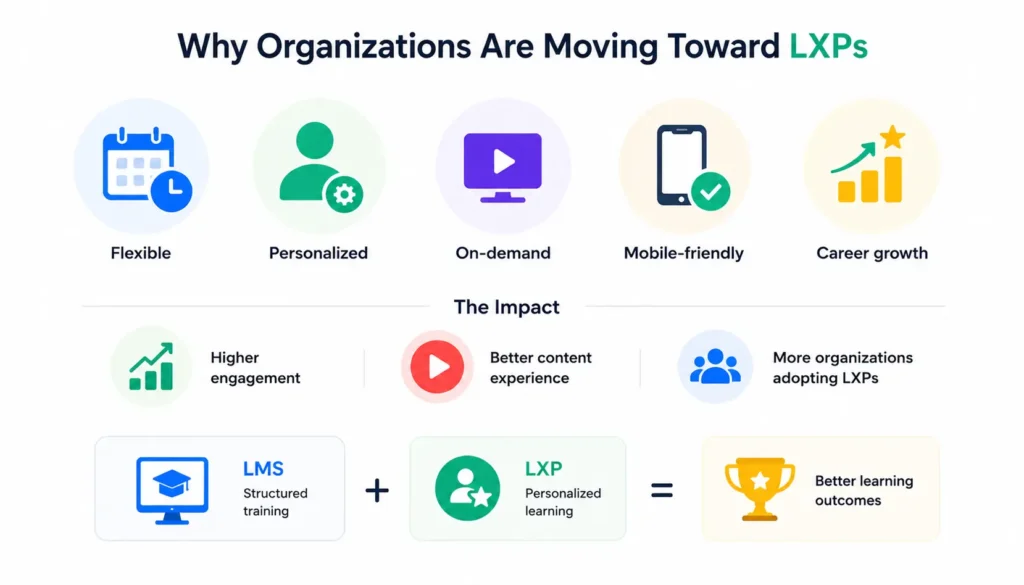
Employees want learning experiences that are:
- Flexible
- Personalized
- On-demand
- Mobile-friendly
- Relevant to career growth
Research consistently shows that learner engagement increases when employees have control over their learning journey.
LXPs address these expectations by delivering content that feels more like Netflix or Spotify than traditional corporate training.
As a result, many organizations are adopting LXPs alongside their LMS platforms.
How to Decide Between LMS and LXP
Ask yourself the following questions.
Do You Need Compliance Tracking?
Choose an LMS.
Do You Need Personalized Learning?
Choose an LXP.
Do You Need Certification Management?
Choose an LMS.
Do You Want Continuous Skill Development?
Choose an LXP.
Do You Need Both?
Many organizations benefit from using both systems together.
Future of Workplace Learning
The future of workplace learning is not LMS versus LXP.
It’s LMS plus LXP.
Organizations are increasingly building integrated learning ecosystems that combine:
- Formal learning
- Informal learning
- Personalized learning
- Social learning
- Skills intelligence
- AI recommendations
As artificial intelligence becomes more advanced, learning platforms will continue evolving toward adaptive, personalized experiences that align learning with business outcomes.
The companies that embrace this shift will be better positioned to attract, develop, and retain top talent.
Frequently Asked Questions (FAQs)
Is an LXP replacing LMS platforms?
No. Learning Experience Platforms or LXPs are not taking the place of Learning Management Systems or LMS. Many organizations actually use both LXPs and LMS platforms together. They do this to meet goals, for learning and development.
Which is better, LMS or LXP?
Neither is universally better. LMS platforms excel at compliance and structured training, while LXPs excel at engagement and personalized learning.
Can an LMS have LXP features?
Many modern learning management systems have features. These features include things, like recommendations that’re just for you learning with other people and finding new content with the help of artificial intelligence. The learning management systems have these features now. They are trying to make learning with personalized recommendations, social learning and artificial intelligence that helps you find new things to learn.
Do small businesses need an LXP?
Not always. Small businesses focused primarily on onboarding and compliance may only need an LMS. As learning needs grow, an LXP can add value.
Is an LXP more expensive than an LMS?
Costs vary significantly by vendor, features, and user count. Organizations should evaluate total value rather than price alone.
Should enterprises use both LMS and LXP?
For many enterprises, combining LMS and LXP functionality creates the most effective learning ecosystem by balancing compliance requirements with employee development.
Conclusion
The debate about Learning Management System versus Learning Experience Platform is not about picking a winner.
It is about knowing what each platform does for learning in the workplace today.
If you need to make sure people follow the rules, do structured training and get certified then a Learning Management System is still the base of your learning plan.
If you want to get people excited, make things personal and help them get better at their skills all the time, a Learning Experience Platform can completely change how your employees learn.
A lot of companies find that using both technologies together is the way to create a place where people can learn and it also meets the needs of the business.
This helps the employees to grow and be good at their jobs.
As people’s ideas about work continue to change, companies that get the learning tools will be way ahead when it comes to making their employees better, keeping them happy and doing well as a business, in the long run.