


Every business wants its people to grow, but training does not always go the way it is planned. Sometimes employees lose interest halfway through a course. Sometimes managers cannot tell whether the training actually worked. And sometimes the whole program just costs more time and money than it should.
Employee training is one of the most reliable ways to help a business grow. It sharpens skills, keeps people confident in their roles, and builds a workforce that can handle change instead of being surprised by it. Even so, well planned training programs run into real obstacles, and most teams end up solving the same handful of problems again and again.
This guide walks through the most common employee training challenges companies face today, along with practical, easy to apply solutions. We will also look at how a learning management system like SkillForce LMS can take a lot of that pressure off your team.
Why Do Businesses Face Employee Training Challenges?
Before jumping into solutions, it helps to understand where these challenges actually come from. Most training problems trace back to a handful of root causes.
Changing Workforce Skills
Job roles keep evolving as new tools, processes, and technologies enter the workplace. Skills that felt essential a few years ago may already be outdated, which means training content has to keep pace with a moving target.
Limited Time and Resources
Employees are busy, and so are the teams running the training. Fitting learning into an already packed schedule, without pulling people away from their actual work, is a constant balancing act.
Different Employee Learning Needs
Not everyone learns the same way. A single training format rarely works for a diverse workforce spread across roles, experience levels, and even time zones.
Difficulty Measuring Training Results
It is one thing to run a training session. It is another to prove it actually improved performance. Many companies struggle to connect training activity to real business outcomes.
Common Employee Training Challenges and Solutions
Here is a closer look at the training challenges that come up most often, along with practical ways to solve them.
1. Low Employee Engagement
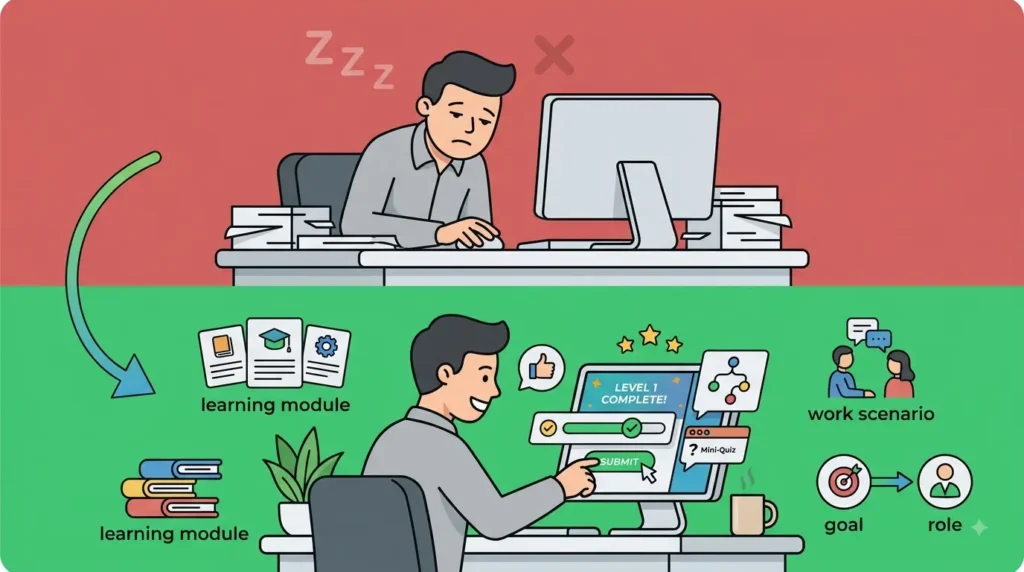
Challenge: Employees may find training boring or irrelevant to their actual day to day work, so they tune out early.
Solution:
- Use interactive content such as quizzes, simulations, or scenario based lessons
- Add real workplace examples that employees can relate to
- Use shorter learning modules instead of long lectures
- Connect training directly to employees’ roles and goals
2. Lack of Time for Training
Challenge: Employees often struggle to fit structured training into an already full work schedule.
Solution:
- Use microlearning to break lessons into small, focused bursts
- Offer self paced courses employees can complete on their own schedule
- Provide mobile learning so training fits into spare moments
- Create flexible learning schedules instead of rigid, fixed sessions
3. Difficulty Identifying Skill Gaps
Challenge: Businesses often do not have a clear picture of exactly which skills their employees need to build.
Solution:
- Conduct regular skills assessments across teams
- Use employee performance data to spot recurring gaps
- Collect manager feedback on where employees struggle
- Create role based learning paths built around real needs
4. Training Content Becomes Outdated
Challenge: Training material can quickly fall out of step with current processes, technologies, or regulations.
Solution:
- Review content on a regular schedule, not just once a year
- Update courses whenever business processes change
- Use current, real world examples instead of dated case studies
- Track compliance requirements so mandatory training stays accurate
5. One Size Fits All Training
Challenge: Employees in different roles, at different experience levels, learn in different ways, so a single generic course rarely fits everyone well.
Solution:
- Create personalized learning paths for different roles
- Provide role based courses instead of one universal program
- Offer a mix of learning formats such as video, text, and hands on practice
- Allow employees to learn at their own pace
6. Low Training Completion Rates
Challenge: Employees start courses with good intentions but often do not finish them.
Solution:
- Set clear deadlines so training does not slip indefinitely
- Send automated reminders to keep courses top of mind
- Break courses into smaller, less intimidating modules
- Track progress so gaps are visible before they become a problem
7. Difficulty Measuring Training Effectiveness
Challenge: Finishing a course does not automatically mean an employee gained a useful, lasting skill.
Solution:
- Use assessments to check understanding, not just attendance
- Track knowledge retention over time
- Monitor on the job performance after training
- Collect employee feedback on what actually helped
- Measure business outcomes tied to the training goal
8. High Employee Training Costs
Challenge: Traditional, in person training can require significant time, travel, trainers, and physical resources.
Solution:
- Use online training to cut travel and venue costs
- Centralize training through an LMS instead of scattered tools
- Reuse digital content across teams and cohorts
- Automate administrative tasks like enrollment and reporting
9. Training Remote and Hybrid Employees
Challenge: Distributed teams often work across different schedules, time zones, and training needs, which makes consistency hard.
Solution:
- Use online learning that does not depend on location
- Offer self paced courses for flexible time zones
- Provide mobile access for employees on the go
- Track remote employee progress centrally, in one place
10. Difficulty Managing Training at Scale
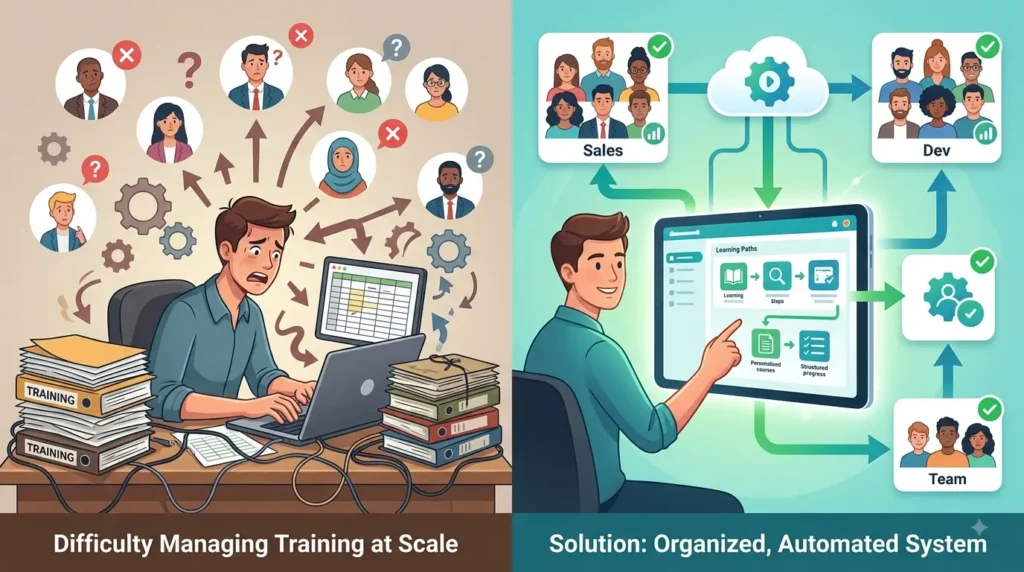
Challenge: As a workforce grows, keeping training organized and consistent becomes noticeably harder.
Solution:
- Automate course assignments instead of manual enrollment
- Use structured learning paths for different teams
- Centralize employee training records in one system
- Use dashboards and reporting to keep visibility as headcount grows
How an LMS Can Help Solve Employee Training Challenges
A good learning management system does not just host courses. It quietly solves most of the challenges listed above by keeping training organized, personalized, and measurable. This is exactly where a platform like SkillForce LMS fits in.
Centralized Training Management
Every course, employee record, and completion status lives in one place instead of being spread across spreadsheets and inboxes.
Automated Course Assignments
New hires and existing employees can be enrolled automatically based on role, department, or compliance requirement, saving hours of manual work.
Learning Paths
Employees follow a structured, role based journey instead of a random mix of unrelated courses.
Progress Tracking
Managers can see exactly who has started, who is behind, and who has finished, without chasing anyone for an update.
Assessments and Certifications
Built in quizzes and certificates confirm that learning actually happened, not just that a video played in the background.
Reporting and Analytics
Dashboards turn raw training data into clear insights, making it far easier to prove training effectiveness to leadership.
Automated Notifications
Reminders and deadline alerts help nudge employees toward completion without anyone having to send a manual follow up email.
AI Powered Learning
Smart recommendations and adaptive content help employees spend time on what they actually need to learn, rather than repeating what they already know.
Together, these features naturally connect back to SkillForce LMS, which is built specifically to help companies manage onboarding, compliance, and ongoing employee development without the usual chaos.
How to Build a Training Program That Avoids Common Challenges
A few thoughtful steps early on can prevent most of the problems covered above before they even start.
- Start with training needs, based on real skill gaps rather than guesswork
- Set clear learning objectives so employees know exactly what success looks like
- Create role based training instead of one generic program for everyone
- Choose the right learning formats for your workforce, whether that is video, text, or hands on practice
- Track employee progress consistently, not just at the end of a course
- Measure training effectiveness against real performance, not just completion
- Continuously improve the program based on feedback and results
Employee Training Challenges Checklist
Here is a quick reference table summarizing the challenges and solutions covered in this guide.
| Challenge | Recommended Solution |
|---|---|
| Low engagement | Interactive and relevant content |
| Limited time | Microlearning and self paced training |
| Skill gaps | Skills assessments |
| Outdated content | Regular content reviews |
| Low completion | Reminders and progress tracking |
| High costs | Online training |
| Remote employees | Digital learning |
| Difficult reporting | LMS analytics |
Frequently Asked Questions
What are the most common employee training challenges?
The most common challenges include low engagement, limited time, unclear skill gaps, outdated content, low completion rates, high training costs, and difficulty measuring results, especially for remote teams.
How can businesses improve employee training?
Businesses can improve training by making content relevant and interactive, offering flexible formats like microlearning, and using an LMS to track progress and outcomes consistently.
How do you increase employee training engagement?
Engagement improves when training feels relevant to the employee’s actual role, uses interactive elements, and is delivered in short, focused modules instead of long sessions.
How can businesses reduce training costs?
Moving training online, centralizing it through an LMS, and reusing digital content across teams significantly cuts down on trainer, travel, and venue expenses.
How do you improve employee training completion rates?
Clear deadlines, automated reminders, smaller course modules, and visible progress tracking all help employees finish what they start.
How can an LMS solve employee training challenges?
An LMS centralizes course management, automates assignments and reminders, tracks progress, and provides reporting that makes it easy to see what is working and what is not.
How do you measure employee training effectiveness?
Effectiveness is measured through assessments, knowledge retention checks, on the job performance monitoring, employee feedback, and clear business outcomes tied to the training goal.
How can businesses train remote employees effectively?
Online, self paced, and mobile friendly training works best for remote teams, especially when paired with centralized tracking so managers stay aware of progress across time zones.
Conclusion
Employee training will always come with a few bumps along the way, from low engagement to tight schedules to the challenge of proving it actually worked. The good news is that almost every one of these problems can be solved with better planning, more relevant content, flexible delivery, and consistent tracking.
As a workforce grows, keeping all of this organized manually becomes harder and harder. That is where a learning management system earns its place.
SkillForce LMS brings employee training, onboarding, compliance, and progress tracking into a single, easy to manage platform. Whether the goal is closing skill gaps, training a growing remote team, or simply proving that training is working, a well organized LMS turns employee training from a recurring headache into a straightforward, measurable part of how the business runs. To understand the broader concept this guide builds on, see Training and Development.