


If you work in L&D, HR, or corporate training, you’ve probably felt it: the old LMS playbook isn’t cutting it anymore. Employees want learning that fits into their day, not a course library they have to hunt through. Leadership wants proof that training actually moves the needle. And AI is rewriting what a learning platform can do, almost every quarter.
This article walks through the future trends in Learning Management Systems that are actually worth your attention right now not hype, but the shifts that are already showing up in vendor roadmaps, analyst reports, and real deployments. Whether you’re evaluating a new platform or trying to future-proof the one you have, this is your practical guide.
The Future of Learning Management Systems at a Glance
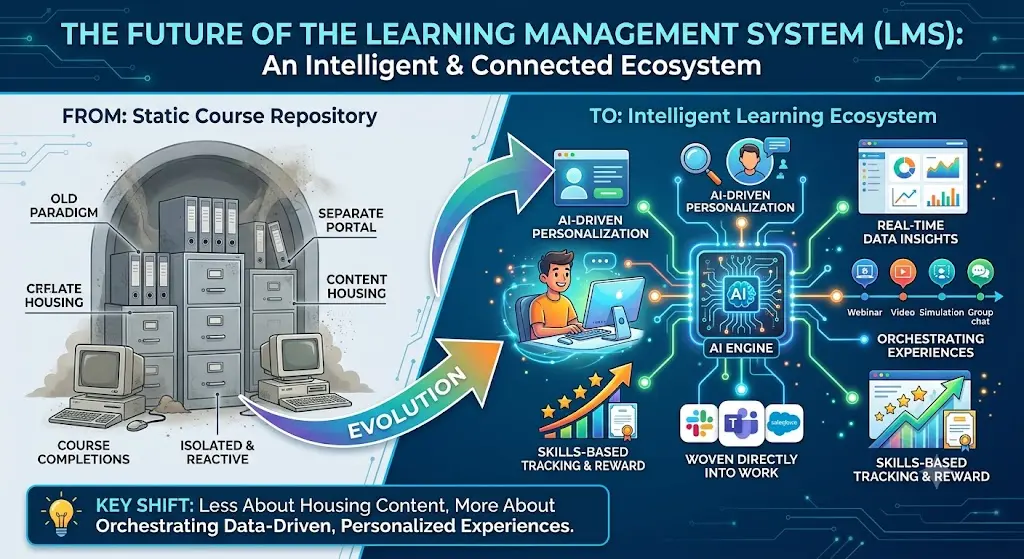
In short: the LMS is moving from a static course repository to an intelligent, connected learning ecosystem. AI is baked into the experience rather than bolted on. Learning happens inside the tools people already use, not in a separate portal. And skills, not just course completions, become the currency that gets tracked and rewarded.
If you only remember one thing from this article, remember this: the future of Learning Management Systems is less about housing content and more about orchestrating experiences personalized, data-driven, and woven directly into work.
What Is Driving the Evolution of LMS?
Nothing changes in a vacuum. A few forces are pushing LMS platforms to evolve faster than they have in the past 20 years combined.
AI-powered workplaces
Generative AI tools are now part of daily work for millions of employees. According to Wikipedia’s overview of learning management systems, modern LMS platforms already build in intelligent algorithms that generate automated course recommendations based on a learner’s skill profile, pulling metadata from learning materials to make those suggestions sharper. That shift didn’t happen by accident; it happened because AI became cheap enough and good enough to embed everywhere, including learning platforms.
Skills-first organizations
More companies are hiring, promoting, and building teams around verified skills instead of job titles or degrees. This forces LMS vendors to think in terms of competencies and proficiency levels, not just “courses completed.”
Hybrid work
Distributed teams need learning that works across time zones and devices. A platform built for a single classroom or office doesn’t hold up when half your team is remote.
Continuous learning culture
Annual training days are fading out. Employees now expect learning in small, constant doses a shift that pushes LMS design toward always-on, in-the-flow experiences rather than scheduled events.
Top Future Trends in Learning Management Systems
Here’s the detailed breakdown of where LMS platforms are headed.
1. Artificial Intelligence and Generative AI
Artificial Intelligence is really changing the way we learn with technology these days. Artificial Intelligence is used in platforms in a few different ways.
2. AI copilots and virtual tutors
This is like having a study buddy inside the platform. The learner can ask the study buddy a question about a course topic. The study buddy will give the learner an instant answer that makes sense. This way the learner does not have to search through a PDF file. Some platforms are trying out tutors that talk to the learners. These tutors will go through the parts of the course with the learners one step at a time. The tutors will help the learners understand the course topic.
3. AI-generated learning content
When we take courses we do not have to start from nothing. We can use Artificial Intelligence to make a version of the course. Artificial Intelligence can also translate the course into languages. It can take a policy document and turn it into a short training module very quickly.
Humans will still look over the course. Make it better.. Now we do not have to start with a blank page. Artificial Intelligence makes the draft of the course.
4. Automated assessments
Artificial Intelligence can now look at finished answers, find out what a student does not know and make a quiz easier or harder for the student, in real time based on how the student is doing. This helps teachers because they do not have to spend much time grading papers. The students also get to know how they are doing a lot faster. Artificial Intelligence makes it possible for students to get feedback from their teachers quickly.
5. Hyper-Personalized Learning Experiences
Regular school catalogs are not used anymore. New systems make a plan for a person who wants to learn. This plan is based on the person’s job, the skills they have now, what they want to do in the future and how they like to learn. Some people like to watch videos, some like to read text. Some like to do hands-on work. This is similar to how Netflix suggests movies to people. Now this idea is used to help people learn things for their jobs. The new systems are made for people who want to learn and get better at their jobs like the Generic course catalogs. These new systems are better because they are made for each person.
6. Skills-Based Learning and Competency Mapping
Modern platforms do things differently. They do not just track what classes people take like “John completed Excel 101”. Now they track what people can actually do, like “John’s proficient in intermediate data analysis”. This is important because it helps organizations see what people are really good at. They can find out where people need training. This way organizations can make sure people have the skills they need to do their jobs. They are not just looking at who attended training classes.
7. Learning in the Flow of Work
This trend is about meeting people where they already’re inside Slack Microsoft Teams or a CRM. We are talking about the trend where people do not have to leave these places. A sales rep needs to learn about handling objections fast like in two minutes. The sales rep should not have to log into a new system to do this. The sales rep should be able to get this information, inside Slack, Microsoft Teams or a CRM.
8. Microlearning and Mobile-First Learning
Attention spans are short and phones are always in hand. Bite-sized lessons, five minutes or less, delivered on mobile, consistently outperform long-form courses for retention and completion rates. Expect future LMS platforms to default to this format rather than treat it as an add-on.
9. Learning Experience Platform (LXP) Integration
An LXP focuses on curating and recommending content the way a streaming service recommends shows, while a traditional LMS focuses on structured, compliance-driven courses. Wikipedia describes the Learning Experience Platform as essentially the next evolutionary step beyond the traditional LMS. Increasingly, vendors are merging both capabilities into a single platform rather than making buyers choose.
10. Predictive Learning Analytics
Instead of only reporting what already happened, future LMS platforms use historical data to forecast what’s likely to happen, which employees are at risk of falling behind on compliance training, or which skill gaps will hurt a project three months from now.
11. AI-Powered Learning Recommendations
This is a close cousin of personalization, but focused specifically on “next best content.” A learner who just completed a project management course might get nudged toward a related certification, based on what similar learners in similar roles did next.
12. Gamification and Social Learning
Points, badges, leaderboards, and peer discussion aren’t just fun add-ons they tap into genuine motivation psychology. Social learning features (comments, peer reviews, discussion threads) also turn a solo course into a shared experience, which tends to improve completion rates.
13. Immersive Learning with AR and VR
For high-stakes or hands-on training, think equipment operation, medical procedures, or emergency response augmented and virtual reality let learners practice in a safe, simulated environment before they ever touch the real thing. Adoption is still early for most organizations, but the technology is maturing fast.
14. Digital Credentials, Badges, and Certifications
Verifiable digital badges and micro-credentials are becoming the standard way to prove a skill was actually learned, not just attempted. These credentials are increasingly shareable on professional profiles, which gives learners an external incentive to finish what they start.
15. Cloud-Native and API-First LMS Platforms
Older LMS platforms were built as closed systems. Newer ones are built cloud-native, with open APIs, so they can plug into whatever other software an organization already uses. This matters more than it sounds; it’s the difference between a platform that adapts to your tech stack and one that forces you to adapt to it.
16. Enterprise Integrations (HRIS, CRM, Collaboration Tools)
A future-ready LMS doesn’t sit in isolation. It talks to your HR system to know who just got promoted, your CRM to know which sales rep is struggling with a specific deal type, and your collaboration tools to deliver training exactly where work happens.
17. Learning Analytics and Business ROI
L&D leaders are under more pressure than ever to prove training actually drives business results, not just completion percentages. Expect LMS dashboards to shift toward metrics like performance improvement, retention, and revenue impact, not just “hours trained.”
18. Compliance Automation and AI Governance
As AI gets embedded deeper into learning platforms, organizations also need to govern how it’s used, making sure AI-generated content is accurate, unbiased, and compliant with industry regulations. This is an emerging trend rather than a solved problem, and it’s one worth watching closely if your industry is regulated (finance, healthcare, pharma).
19. Sustainability and Green Learning
Some organizations are factoring environmental impact into their learning strategy by reducing travel-based training in favor of digital delivery, and choosing vendors that report on data center energy use. It’s a smaller trend today, but it’s gaining traction among enterprises with formal ESG commitments.
Traditional LMS vs Future AI-Powered LMS
| Aspect | Traditional LMS | Future AI-Powered LMS |
| Content delivery | Fixed course catalog | Personalized, adaptive paths |
| Tracking | Course completions | Skills and competencies |
| Content creation | Fully manual | AI-assisted drafting |
| Assessment | Static quizzes | Adaptive, AI-graded assessments |
| Where learning happens | Separate portal | Embedded in daily work tools |
| Analytics | Completion reports | Predictive, ROI-focused insights |
| Recommendations | Manual assignment | AI-driven, next-best-content |
LMS vs LXP: Will They Merge?
This is one of the most common questions L&D teams ask, and the honest answer is: they already are merging. An LMS was traditionally built for structured, mandatory training, think compliance courses and onboarding. An LXP was built for discovery-driven, self-directed learning, closer to a content feed.
The lines are blurring fast. Most major vendors now offer LXP-style content recommendations inside their LMS, and LXPs are adding the compliance tracking and reporting that used to be LMS-only territory. Within the next few years, expect the distinction to matter far less than the actual capabilities a platform offers.
Technologies Shaping the Next Generation of LMS
A few underlying technologies are doing the heavy lifting behind every trend above.
Large Language Models (LLMs)
These are the AI models behind chatbots and content generators. In an LMS context, LLMs power course drafting, tutoring conversations, and automated summarization of training materials.
Natural Language Processing
NLP is what lets a platform understand a learner’s question in plain English and respond usefully, rather than requiring exact keyword matches.
Machine Learning
ML is the engine behind personalization and predictive analytics it learns from patterns in learner behavior to make better recommendations over time.
xAPI and Learning Record Stores
xAPI (Experience API) is a data standard that lets learning systems track experiences well beyond a single course including simulations, on-the-job activities, and even offline learning. According to Wikipedia’s entry on the specification, Experience API is an e-learning software specification that records and tracks many types of learning experiences, storing them in a Learning Record Store that can live inside a traditional LMS or run as its own standalone system. This is the plumbing that makes true learning analytics possible across multiple tools, not just inside one platform.
Knowledge Graphs
A knowledge graph maps how skills, roles, and content relate to each other. It’s what lets a platform say, “because you’re learning data visualization, here’s how it connects to your goal of becoming a data analyst.”
AI Agents
The newest layer: autonomous AI agents that can proactively assign training, flag skill gaps, or even negotiate a personalized learning schedule with a manager’s calendar moving from reactive tools to proactive learning assistants.
Benefits of Future-Ready LMS Platforms
- Faster onboarding, since new hires get personalized ramp-up paths instead of generic modules
- Higher engagement, thanks to microlearning and gamification
- Better visibility into real skill gaps, not just training attendance
- Lower content creation costs, with AI handling first drafts
- Stronger connection between training and business outcomes
- Easier compliance tracking across a distributed, hybrid workforce
Challenges Organizations Should Prepare For
- Data privacy concerns, especially as platforms collect more granular behavioral data
- AI accuracy and bias, since AI-generated content still needs human review
- Change management, because employees and trainers both need time to adapt to new tools
- Integration complexity, when connecting an LMS to HRIS, CRM, and collaboration platforms
- Budget justification, as leadership will want clear ROI before funding a platform overhaul
- Skills framework gaps, since many organizations haven’t yet defined what “proficient” actually means for each role
A discussion thread on the r/humanresources community on Reddit is a good place to see these challenges debated candidly by practitioners who are living through LMS migrations right now, rather than reading about them in a vendor pitch deck.
How to Future-Proof Your Learning Strategy
Evaluate current LMS
Start with a candid audit. Where is your current platform failing completion rates, content freshness, integration gaps, or reporting? You can’t future-proof what you haven’t honestly assessed.
Build a skills framework
Define what “skilled” actually looks like for each role in your organization before you go shopping for AI features. Without this foundation, even the smartest LMS has nothing meaningful to measure against.
Adopt AI responsibly
Pilot AI features on a small scale first. Review AI-generated content for accuracy and bias before it reaches learners, and be transparent with your workforce about where AI is being used.
Measure learning outcomes
Move beyond completion rates. Track how training connects to performance reviews, retention, productivity, or sales numbers whatever ties most directly to your organization’s goals.
How to Choose a Future-Ready LMS
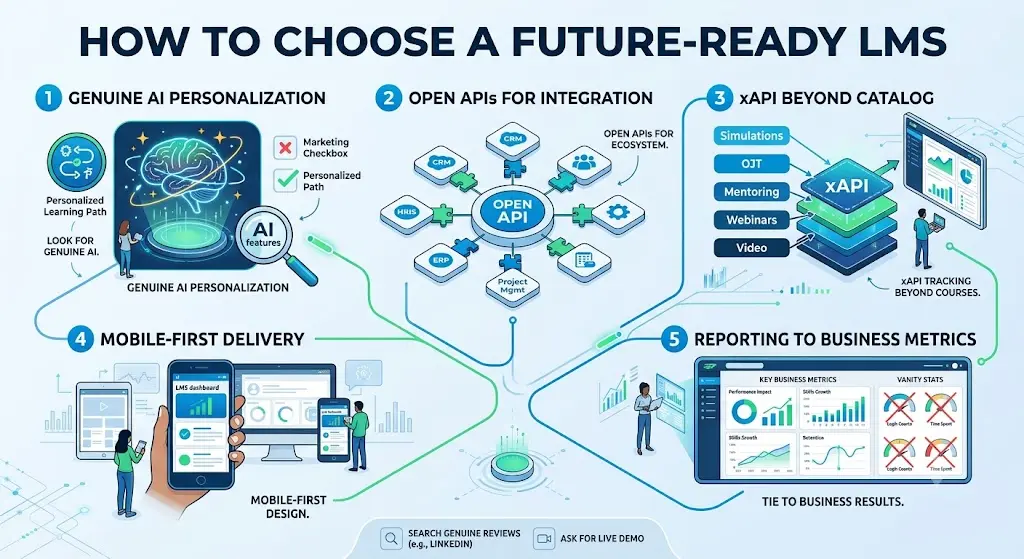
Look for a platform that offers genuine AI-driven personalization (not just a marketing checkbox), open APIs for integration with your existing tech stack, support for xAPI so you can track learning beyond the course catalog, mobile-first delivery, and reporting that ties back to business metrics rather than vanity stats like login counts. Ask vendors for a live demo of their AI features, specifically plenty of platforms that still bolt AI onto an old architecture rather than building around it. A useful sanity check before signing a contract: search for the vendor’s name alongside “review” to see what actual practitioners, not just case studies, are saying about the rollout experience.
Frequently Asked Questions
1. What is the biggest trend in Learning Management Systems right now?
The thing that is affecting everything the most is personalization that uses Artificial Intelligence. It affects how we make content what we recommend, how we assess things and how we look at analytics at the same time. Personalization that uses Artificial Intelligence is really changing a lot of things. It is changing how we create content and what personalization that uses Artificial Intelligence suggests we should do.
2. Will AI replace instructional designers?
That is not entirely true. Artificial intelligence is taking over the drafts and the tasks that need to be done over and over but human designers are still very important for making sure things are accurate for understanding the context and for using good judgment when it comes to teaching. Artificial intelligence is taking over some tasks. Human designers are still essential for these things and that is why human designers are still needed to work with artificial intelligence.
3. Is LXP going to replace LMS completely?
It is unlikely that separate categories will exist on their own. Separate categories will simply merge into one. We should expect that future platforms will blend compliance tracking with discovery-driven content recommendations all, in one system. This means that future platforms will have structured compliance tracking and discovery-driven content recommendations together in one system.
4. How is xAPI different from SCORM?
SCORM tracks activity only within a single course player, while xAPI can track learning experiences across multiple tools, devices, and even offline activities, storing them in a Learning Record Store.
5. What should a small business prioritize when choosing an LMS?
When you are looking for something it is really important that it is easy to use. You should be able to get to it from your phone. It is also great if it works with the tools you already have. The fancy artificial intelligence features are not as important as having a platform that your team will actually use. Your team needs to like the platform. I want to use it every day.
Conclusion
The way Learning Management Systems are going to work in the future is pretty clear. They will have static content and more smart and personalized experiences that are part of the actual work. Artificial Intelligence, tracking skills and better integrations are not things that will happen someday. They are already. Will be big in 2026 and after that.
The companies that will do well are not the ones that try to get every feature. They will be the ones that make a plan for skills, use Artificial Intelligence in a smart way and pick a platform that can change and grow with their workers. If you start with that it will be a lot easier to get ready for the future.