


If you have ever tried to train a hospital’s night shift three clinics across two states and a compliance team at once using spreadsheets and email reminders you already know why this article exists. A healthcare Learning Management System is the tool that takes that chaos and turns it into something you can actually track, report on and trust during an audit of a healthcare organization.
This guide walks through what a healthcare Learning Management System is, why healthcare organizations rely on a healthcare Learning Management System, the features that matter most to a healthcare organization and how to pick a platform that will not fall apart the moment a new regulation lands for a healthcare organization.
Whether you are a training director at a hospital network or an HR lead at a growing clinic group this is meant to be the reference you bookmark and come back to for information about a healthcare Learning Management System.
What Is a Healthcare LMS?
A healthcare LMS is a learning platform for staff. It handles training, compliance and competency needs of non-clinical staff in hospitals, clinics and other medical settings.
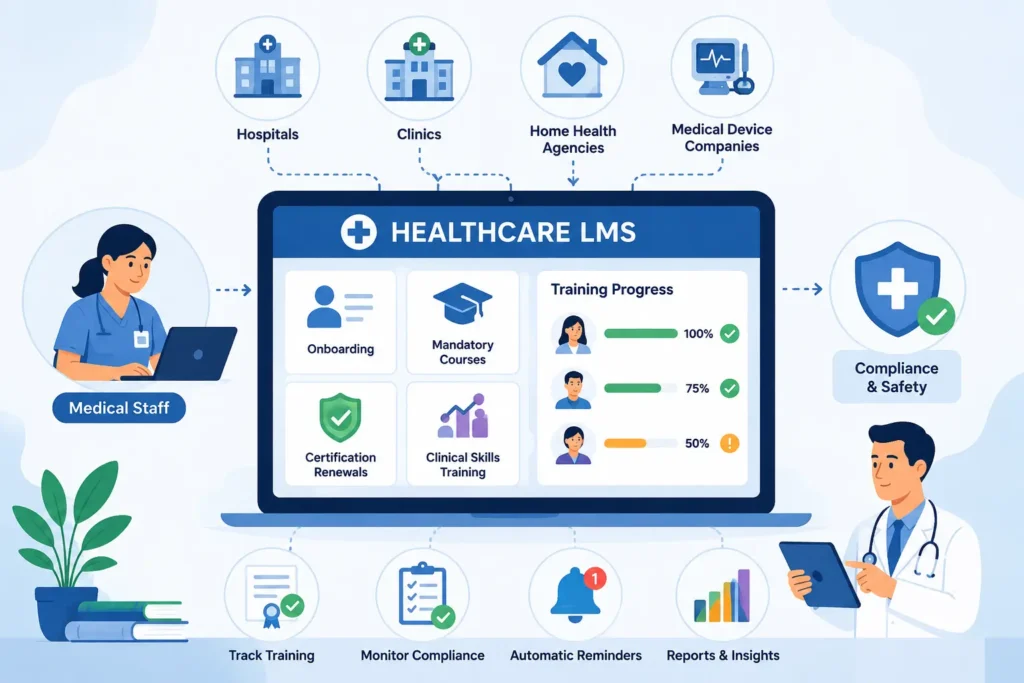
This platform is where medical staff complete onboarding modules, mandatory courses, certification renewals and clinical skills training. Think of a healthcare LMS as the training system of a healthcare organization.
It helps with tracking staff training. For example it can show who completed their HIPAA training and which nurses need to renew their BLS certification.
The system tracks everything automatically. Hospitals, clinics, home health agencies and medical device companies use it. They host all their training in one place. This makes it easier to manage staff training and compliance. The healthcare LMS is like a hub, for all training needs.
How It Differs from a Traditional LMS
A regular learning system is made to be used by any type of business such as stores, technology companies or factories. But a learning system for healthcare is different; it is made for a purpose. This system already has things like rules to follow, ways to track licenses and certificates and steps to take that are based on how healthcare teams work, like their schedules, deadlines to get certified and mandatory training they need every year.
A traditional learning system might need a lot of changes to keep track of when a nurses license’s going to expire or to start the process of getting certified again. A learning system for healthcare usually has these things already built in from the beginning.
Why Healthcare Organizations Need Specialized Learning Platforms
Healthcare is a tightly controlled field. If you miss a deadline for following the rules you are not just late with your training. You could get fined, have problems with accreditation or in some cases put patients in harm’s way.
That is why ordinary training tools do not work well for healthcare. A special learning system for healthcare is made with the fact in mind that training in healthcare’s not something you can choose to do or not. It is often required by law and it needs to be recorded in a way that can withstand close examination. Healthcare training is very important. A specialized healthcare learning system is designed to handle this.
Why Healthcare Organizations Need an LMS
1. Regulatory Compliance
Healthcare organizations have to deal with a lot of bodies, like OSHA and The Joint Commission and CMS and state licensing boards.
A healthcare learning management system is really helpful because it keeps track of everything so you know who completed which training and when.
This is very important if a healthcare organization is ever audited because the healthcare learning management system has a documented and timestamped record of all the training that was completed.
2. Workforce Development
People who work in healthcare need to keep learning things. They cannot just learn something once. Then stop. A good system helps hospitals and clinics create a plan for people like nurses and technicians to keep getting better at their jobs. This way they can keep growing and learning things over time. They do not have to stop learning after their week of training. Healthcare staff, like nurses and administrative staff can use this system to become better at what they do. The system is very helpful for healthcare staff to keep learning and growing.
3. Clinical Competency Management
When we know that someone has watched a training video it does not mean they can really do the procedure correctly. The thing is, watching a video and doing something are two things. Healthcare Learning Management System platforms have things like competency checklists and assessments. These things help managers see if someone can really do a task, not just if they finished a course. Healthcare Learning Management System platforms are useful for this. They help managers verify that someone has the hands-on skill, not just that they completed a course.
4. Continuing Medical Education (CME)
Physicians and other licensed clinicians have to earn continuing education credits. This helps them keep their licenses active. A healthcare Learning Management System can track CME credits automatically.
This saves clinicians a lot of work. They do not have to deal with a lot of paperwork.
5. Standardized Training Across Locations
If you are in charge of hospitals or a group of clinics you know it is really tough to make sure that the training is the same at every place. A learning management system or LMS for short helps to make sure that every hospital or clinic gives the basic training in the same way and, with the same paperwork. The training is the same because the LMS makes sure every site does it the way.
Benefits of a Healthcare LMS
1. Improved Compliance Management
Automated reminders, deadline tracking, and audit-ready reports mean fewer people falling through the cracks. When surveyors show up, you pull a report instead of scrambling through file cabinets.
2. Faster Employee Onboarding
New hires can start required training before their first day, which shortens time-to-productivity. Standardized onboarding paths also mean a new nurse in Ohio gets the same foundational training as one in Texas.
3. Better Patient Safety
This is really the whole point. Well-trained staff make fewer errors, and consistent training on protocols like infection control and medication safety translates directly into safer patient outcomes.
4. Reduced Administrative Work
I spend a lot of time every week manually tracking certifications and sending reminder emails. I also have to compile compliance reports, which takes up more of my time. If I could automate all of that work, training teams like mine would have time to focus on the quality of the training we provide instead of just maintaining spreadsheets. This would be a help because certifications and compliance reports are really important and so is the quality of the training that training teams provide. Automating certifications and compliance reports would really make a difference.
5. Centralized Learning Management
Of course content all over shared drives USB drives and email attachments we keep everything in one easy-, to-search system. This way staff and administrators can get to it anytime they need it. They can search for what they want. Find it fast. Our system is always available so they can access it whenever they want.
6. Certification Tracking
The system flags expiring certifications before they expire. This is really important because it stops a staff member from working in a role they are no longer certified to do. The system does this before the certifications actually expire, not after. This one thing can prevent a lot of problems. For example it can prevent a staff member from doing a job that requires a certification they no longer have. The system flags expiring certifications to help with this issue.
6. Continuous Professional Development
Healthcare LMS platforms are really good for people who want to keep learning things. They do not just help with the training that people have to do every year. Healthcare LMS platforms also support staff who want to learn skills or get a new job in the company. This is very helpful for staff who want to build skills or move into new roles in the Healthcare field. Healthcare LMS platforms are very useful for this kind of thing.
7. Better Reporting and Analytics
Dashboards show completion rates, at-risk compliance areas, and training gaps at a glance, so leadership can make decisions based on real data instead of guesswork.
8. Increased Employee Engagement
Modern healthcare LMS platforms use interactive content, mobile access, and gamification to make mandatory training feel less like a chore, which tends to improve completion rates and retention of the material.
9. Scalable Training Programs
Whether you are adding 20 people or 2,000 to your team the system grows with you. It does not need a lot more administrative staff to handle the growth.
Essential Features of a Healthcare LMS
1. Compliance Training Automation
Automatic assignment of required courses based on role, location, or department, with built-in deadline tracking and escalation reminders.
2. Learning Paths
Structured sequences of courses tailored to specific roles a new ICU nurse follows a different path than a billing coordinator.
3. Certification Management
Automated tracking of licenses and certifications, including expiration alerts and renewal workflows.
4. Competency Tracking
Tools for documenting hands-on skill verification, not just course completion often tied to checklists that a supervisor signs off on.
5. Skills Assessments
Quizzes, simulations, and practical evaluations that measure whether training actually stuck.
6. Mobile Learning
Staff working rotating shifts or in the field need to complete training from a phone or tablet, not just a desktop computer.
7. AI-Powered Learning Recommendations
Some platforms now use AI to suggest relevant courses based on a staff member’s role, past performance, or skill gaps.
8. Gamification
Badges, leaderboards, and progress tracking that make repetitive compliance training a little more engaging.
9. Virtual Instructor-Led Training
Live, remote sessions for topics that benefit from real-time interaction, like complex clinical procedures or Q&A-heavy compliance updates.
10. Reporting Dashboards
Real-time visibility into completion rates, compliance status, and training ROI, usually customizable by department or location.
11. Role-Based Access
Different permission levels for administrators, managers, and learners, so sensitive data and course-editing tools stay restricted appropriately.
12. Multi-language Support
Essential for organizations with diverse staff or multi-country operations.
13. Content Authoring
Built-in tools to create and update training content without needing a separate design tool or outside vendor.
14. SCORM and xAPI Support
Compatibility with standard e-learning formats, which means an organization isn’t locked into one vendor’s proprietary content format. (SCORM is an established technical standard for packaging e-learning content you can read more about it on <a href=”https://en.wikipedia.org/wiki/Sharable_Content_Object_Reference_Model” target=”_blank” rel=”noopener”>Wikipedia</a>.)
15. Security and HIPAA Readiness
Encryption, access controls, and audit trails that support an organization’s broader HIPAA compliance efforts though it’s worth noting no software is “HIPAA certified” on its own, since HIPAA compliance is an organizational responsibility, not a checkbox a vendor can tick for you.
Healthcare LMS Use Cases
1. Hospital Staff Onboarding
New hire orientation, policy acknowledgment, and role-specific training delivered before or during the first week on the job.
2. Nursing Education
Ongoing skills training, protocol updates, and specialty certifications for nursing staff across units.
3. Physician Training
CME tracking, credentialing documentation, and specialty-specific education modules.
4. Compliance Training
Annual mandatory training on topics like HIPAA, OSHA safety standards, and workplace conduct policies.
5. Infection Control
Protocol training on hand hygiene, PPE use, and outbreak response procedures especially critical after the lessons learned during COVID-19.
6. Clinical Skills Development
Hands-on competency verification for procedures, equipment use, and emergency response.
7. Emergency Preparedness
Disaster response drills, evacuation protocols, and mass casualty training tracked and documented in one place.
8. Patient Safety Programs
Training is directly linked to reducing mistakes, falls and other preventable bad events.It helps to decrease errors.
These errors include falls and other incidents that can be avoided. The goal of this training is to make healthcare safer by reducing these adverse events and medical errors.
Reducing errors and preventable adverse events, like falls, is a key part of this training.
9. Continuing Education
Ongoing professional development that keeps licenses active and skills current across all clinical roles.
Healthcare LMS vs Traditional Training
| Aspect | Traditional Training | Healthcare LMS |
| Delivery | In-person sessions, printed manuals, scheduled classroom time | On-demand, mobile-friendly, self-paced or blended |
| Compliance | Manually tracked, easy to miss deadlines | Automated tracking with alerts and escalation |
| Tracking | Spreadsheets, sign-in sheets, paper records | Centralized digital records with audit trails |
| Scalability | Limited by instructor availability and room capacity | Scales instantly across locations and shifts |
| Reporting | Manual compilation, time-consuming | Real-time dashboards and exportable reports |
| Cost | Lower upfront cost but higher long-term labor cost | Software investment offset by reduced admin time |
Healthcare LMS vs General LMS
1. Industry-Specific Requirements
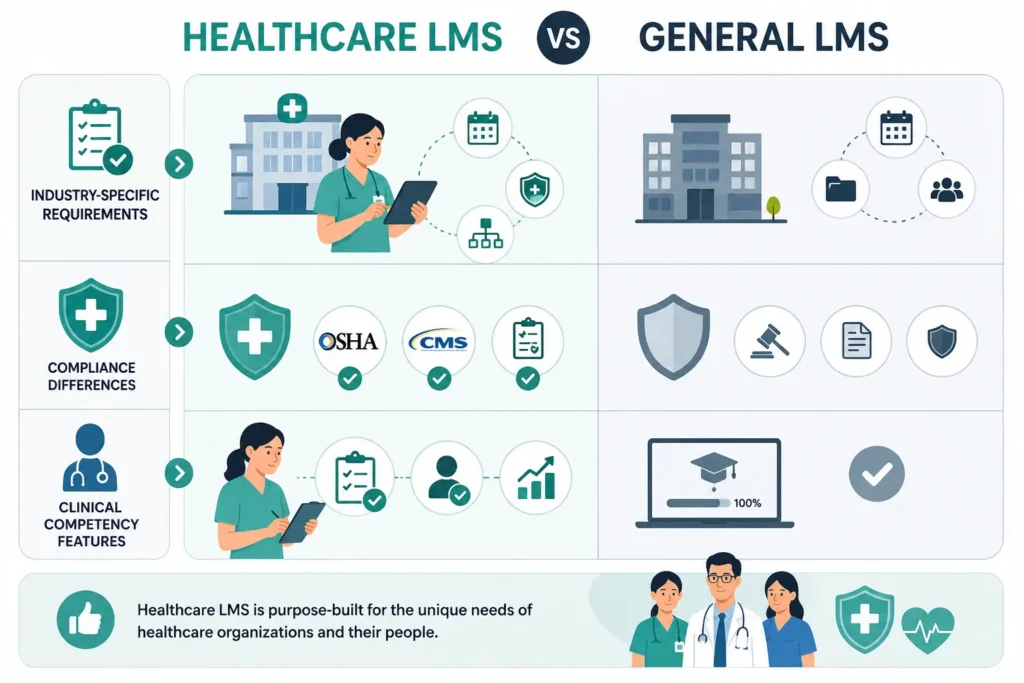
A healthcare LMS is built around clinical workflows, credentialing cycles, and regulatory frameworks that a general-purpose LMS simply wasn’t designed to handle out of the box.
2. Compliance Differences
General LMS platforms may support compliance training in a broad sense, but they rarely come with pre-built frameworks for healthcare-specific regulations like OSHA bloodborne pathogens standards or CMS conditions of participation.
3. Clinical Competency Features
General LMS platforms are usually focused on course completion. Healthcare LMS platforms go further, supporting skills checklists, preceptor sign-off, and competency validation that ties training back to actual job performance.
How to Choose the Best Healthcare LMS
1. Define Training Goals
Start with what you’re actually trying to fix, onboarding time, compliance gaps, inconsistent training across sites before you start comparing vendors.
2. Evaluate Compliance Needs
Map out which regulations apply to your organization and confirm the platform has relevant built-in frameworks or the flexibility to build your own.
3. Consider Integrations
Check whether the LMS connects with your existing HRIS, credentialing software, or electronic health record system, since manual data entry between systems creates errors and wasted time.
4. Assess User Experience
The platform needs to be easy to use. If it is not clinical staff will not use it all the time. You should ask for a trial so that the people who will actually be using the platform every day can try it out. This means the frontline staff, not the people, in charge should test the platform to see how it works for them.
5. Review Reporting Capabilities
Make sure the reporting is flexible enough to generate the specific documentation your compliance and accreditation teams need not just generic completion percentages.
6. Compare Pricing
The cost of something can be figured out in a lot of ways. Sometimes you pay for each person who uses it. Times you pay for each person who is actually using it. Some people charge you based on what features you want.
Then there are people who just charge a flat fee for your whole organization. You should try to get an idea of how much it is really going to cost you. This includes what it takes to get it set up and what it costs to get help when you need it. You want to know the cost of the pricing models, including what it costs to implement them and the fees, for support.
7. Evaluate Vendor Support
Ask about implementation support, ongoing customer service response times, and whether there’s a dedicated account manager. A platform is only as good as the support behind it when something breaks during a live audit.
Healthcare LMS Implementation Best Practices
1. Build a Rollout Plan
Set a realistic timeline with clear milestones, and identify which departments go live first.
2. Migrate Existing Training
Audit your current content and decide what can be moved as-is, what needs updating, and what should be retired entirely.
3. Train Administrators
Your internal Learning Management System administrators need to feel comfortable using the system. This is important before you ask frontline staff to use it. They will be the people to provide support.
4. Pilot the Platform
Try it with a group of people first. This way you can find the problems. Fix them. Then you can use what you learned from the group to make it better before you show it to the whole organization. Use the feedback from the group to make changes before the full organizational launch.
5. Gather Feedback
Survey learners and administrators regularly during rollout, not just at the end. Small usability issues are easier to fix early.
6. Measure Success
Define what success looks like before launch completion rates, compliance scores, time saved ,so you can actually evaluate whether the platform is delivering.
Common Challenges and How to Overcome Them
1. User Adoption
Staff resistance is something that happens a lot especially when you are dealing with teams that are really busy. If you give them access to things on their phones, make the courses they have to take shorter and make sure the people in charge are fully on board then the staff are more likely to get on board with new things. Mobile access and shorter course modules really make a difference. When the leadership shows they are committed it helps with the adoption of new things, by the staff.
2. Content Updates
Things like rules and best practices are always changing. We need to make sure someone is in charge of keeping the course content up to date so it does not get old and useless. This person will be responsible for course content. They will make sure course content stays current and relevant which means course content will always be useful, for people who take the course.
3. Compliance Changes
Build a process for monitoring regulatory updates so training content gets revised promptly rather than reactively after a citation.
4. Technical Integration
Work closely with IT early in the process to avoid surprises when connecting the LMS to existing systems like HR or credentialing software.
5. Budget Constraints
Start with a phased rollout focused on your highest-priority compliance areas, then expand as budget allows, instead of trying to implement everything at once.
Measuring Healthcare LMS Success
1. Completion Rates
The most basic metric are people actually finishing assigned training on time?
2. Certification Status
Track how many staff are current versus lapsed on required certifications at any given moment.
3. Compliance Scores
Aggregate compliance performance across departments or locations to spot patterns and problem areas.
4. Training ROI
Compare the cost of the platform against measurable outcomes like reduced incident rates, faster onboarding, or lower turnover.
5. Clinical Competency
Track how many staff have been validated on specific clinical skills, not just course completion.
6. Employee Engagement
Look at voluntary course enrollment, satisfaction survey results, and time spent engaging with optional development content as signals of genuine engagement, not just compliance box-checking.
Future Trends in Healthcare Learning
1. Artificial Intelligence
AI is increasingly used to personalize learning recommendations, flag at-risk compliance areas, and even help generate draft training content.
2. Adaptive Learning
Courses that adjust difficulty and content based on a learner’s demonstrated knowledge, rather than a one-size-fits-all module.
3. Virtual Reality Simulations
VR is being used for high-stakes clinical training scenarios like emergency response or surgical procedures — where hands-on practice in a real setting isn’t practical or safe.
4. Skills-Based Learning
A shift away from purely credential-based training toward validating actual demonstrated skills, which better reflects real job readiness.
5. Learning Experience Platforms (LXPs)
Some organizations are blending LMS functionality with more consumer-style, Netflix-like learning discovery experiences to boost voluntary engagement.
6. Predictive Analytics
Using historical training data to predict compliance risks or staffing gaps before they become a problem.
Frequently Asked Questions
1. What is a Healthcare LMS?
A healthcare LMS is a learning management platform designed specifically for training, compliance tracking, and competency management in healthcare organizations like hospitals, clinics, and long-term care facilities.
2. Who uses Healthcare LMS software?
Hospitals, clinics, home health agencies, medical device companies, and any healthcare organization that needs to manage staff training, licensing, and compliance documentation.
3. Is Healthcare LMS HIPAA compliant?
A healthcare LMS can be configured to support HIPAA compliance through features like encryption, access controls, and audit trails, but no software vendor can make an organization “HIPAA compliant” on its own that responsibility ultimately sits with the organization’s policies and practices.
4. What features are most important?
Compliance training automation, certification tracking, competency management, and strong reporting tend to top most organizations’ priority lists, though the right mix depends on your specific regulatory environment.
5. Can it integrate with HR systems?
Most modern healthcare LMS platforms offer integrations with common HRIS platforms, though the depth of integration varies by vendor always confirm compatibility with your specific systems before purchasing.
6. What is competency-based learning?
It’s an approach that measures whether someone can actually perform a skill or task correctly, rather than just measuring whether they completed a course or passed a quiz.
7. How much does a Healthcare LMS cost?
Pricing varies widely based on organization size, feature set, and pricing model (per-user, per-active-learner, or flat licensing), so it’s best to request quotes from a few vendors based on your specific needs.
8. How long does implementation take?
Implementation timelines range from a few weeks for smaller organizations to several months for large, multi-site health systems with complex integration needs.
conclusion
A healthcare LMS isn’t just a nice-to-have training tool, it’s the system that keeps a healthcare organization compliant, its staff competent, and its patients safer. The right platform saves administrative time, reduces compliance risk, and gives leadership real visibility into workforce readiness.
- A healthcare LMS is purpose-built for the compliance, credentialing, and clinical competency needs that a general LMS wasn’t designed to handle.
- Core benefits include improved compliance management, faster onboarding, better reporting, and stronger patient safety outcomes.
- The best platforms combine compliance automation with competency tracking, mobile access, and strong integration options.