


If you have seen a new employee have a time during their first month because nobody took the time to show them how things really work then you already know why an employee training program is important. It is not something that’s just nice to have in the human resources handbook. It is what makes the difference between a team that gets better at their jobs and one that falls behind without anyone noticing.
I have worked with all sorts of companies from startups with only 15 people to big companies with thousands of employees.. The thing that always happens is the same. The companies that do not make training a priority lose employees and keep making the same mistakes. The companies that create an employee training program with clear goals, good methods and a way to track progress see good results in terms of employees staying, getting more work done and even making more money.
This guide will take you through every step you need to take to build an employee training program from the beginning. It will show you what to do one step, at a time to create an employee training program that really works.
What Is an Employee Training Program?
An employee training program is a plan that a company uses to help employees learn what they need to know to do their jobs. This program can teach employees things like how to use a computer program or how to talk to a team when things get tough.
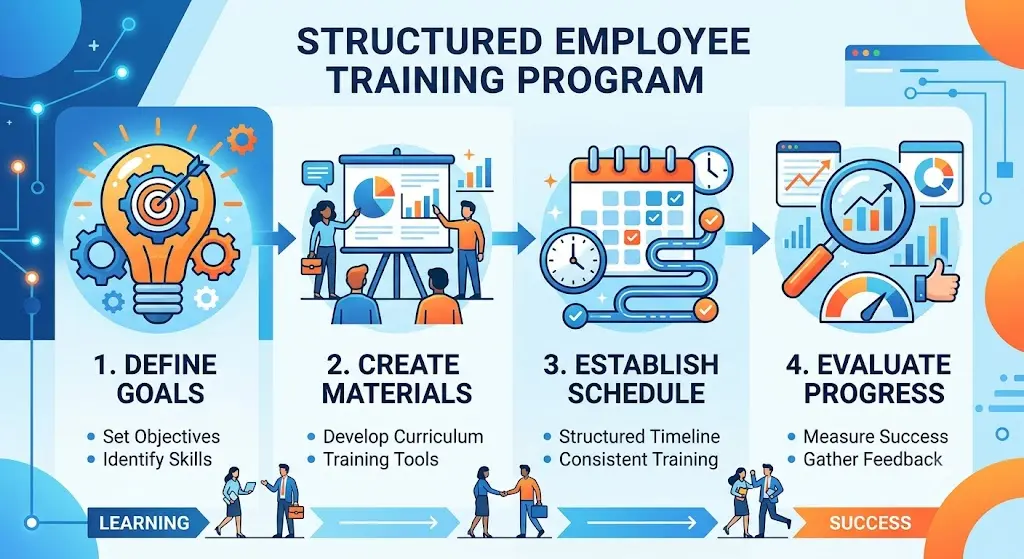
The important thing about an employee training program is that it is structured. This means it is not a bunch of random meetings or classes. An employee training program has goals, a way to teach the material, a schedule and a way to see if the program is working.
Purpose
The goal of employee training is straightforward: bridge the difference between what employees know and what they need to know to do their jobs well. That difference can be seen everywhere. With workers who are still learning how things work, with experienced employees who have to get used to a new system or with managers who have never been taught how to lead.
Strong training also helps the company. It makes sure people are safe, makes sure the company follows the rules and makes sure the quality of work stays the same as the company grows.
Employee Training vs Employee Development
These two words are often used this way but they are not the same. Training is usually for a time and related to a specific job: like “how to handle a customer refund” or “how to work with our new CRM system.” Development is for a time and connected to a person’s career like leadership training or a path that lasts for many years with a mentor. A good training program has both parts. Training helps someone do their job well. Development gets them ready, for what comes.
Why Employee Training Is Important
Business Benefits
Well-trained employees make fewer costly mistakes, and they ramp up faster. According to Wikipedia’s overview of training and developmen, structured training is directly linked to improved organizational performance and adaptability. Companies that invest in training also tend to attract better talent, because job seekers notice when a company is willing to invest in their growth.
There’s also a competitive angle. When your industry shifts new technology, new regulations, new customer expectations a trained workforce adapts faster than an untrained one
Employee Benefits
For employees training is not about doing the job better. Training helps employees build confidence. An employee who has received training will walk into a difficult customer call or a new project with a lot less anxiety than an employee who is not really sure what they are doing.
Training also shows employees that the company cares about them, not the work they do. This is something that matters a lot to employees when it comes to how they feel about their job and the company they work for. The company is invested in the employee. That is important to employees.
Impact on Productivity, Engagement, and Retention
This is where the business case really stands out. Employees who do not get training are more likely to lose interest and eventually quit. Talks in groups like r/humanresources on Reddit keep coming back, to this same point: bad onboarding and limited training are some of the main reasons new workers leave within the first 90 days.
On the side, proper training usually links to better engagement ratings and fewer employees leaving on their own. It is one of the human resources investments where the results appear in many different measures at the same time. These measures include productivity, attitude and keeping workers.
Signs Your Organization Needs a Better Training Program
Sometimes it’s obvious a program needs work. Other times, the warning signs are quieter. Here’s what to watch for.
1. Skill Gaps
When employees keep asking the questions over and over or they are passing on tasks that they should be able to do themselves or they are staying away from certain jobs that is a skill gap with the employees. These skill gaps with the employees will just get bigger and bigger until something like a deadline is near or a customer complains and then the skill gap with the employees becomes very clear.
2. Poor Performance
A single person who does not do well might just be a fit.. When a lot of people in a team or department have problems with their work the main reason is usually that they did not get the right training rather than they are not trying hard enough. It is worth thinking about this: did we ever actually show them how to do this. Did we think they would learn it on their own?
3. High Turnover
When people leave a company it costs a lot of money. One big reason people leave is because they do not get the training they need. This is something that companies can easily fix. New employees who feel they are not getting the help they need in the few months are more likely to quit their jobs. If people say they felt like they were just thrown into their job during their exit interviews that means the company did not do a job of training them it is not because the company hired the wrong person.
4. Compliance Issues
Missed certifications, safety incidents, or regulatory violations are a clear sign that compliance training isn’t sticking. These aren’t just performance issues they carry legal and financial risk, which makes them one of the fastest ways to justify investment in a better program.
Types of Employee Training Programs
Not every training need looks the same, so programs typically fall into a few categories.
1. Onboarding
When new employees start working they often feel confused, on the day. Onboarding training helps these new hires to become contributors. This training usually teaches them about the company culture and the tools they need to use. It also covers the company policies and the basic things they need to know for their role. Onboarding training is very important for new hires to learn about the company culture and their role.
2. Technical Skills
This covers the hard skills employees need for their specific role: software proficiency, machinery operation, coding languages, or industry-specific processes.
3. Soft Skills
Communication, collaboration, time management, and emotional intelligence fall here. These are harder to measure but often have the biggest impact on team dynamics.
4. Compliance
Compliance training covers legally required topics like workplace safety, data privacy, anti-harassment policies, and industry regulations. It’s usually mandatory and tracked closely.
5. Leadership Development
This prepares high-potential employees and existing managers to effectively lead everything from giving feedback to managing conflict to strategic thinking.
6. Product Training
Employees, especially in sales and support roles, need deep knowledge of what the company actually sells. Product training keeps that knowledge current as offerings evolve.
7. Sales Training
This covers selling techniques, objection handling, negotiation, and use of sales tools like CRMs. It directly ties to revenue, which makes it easy to measure ROI on.
8. Customer Service Training
Customer-facing teams need training on tone, conflict resolution, and problem-solving under pressure. This training protects brand reputation as much as it protects the customer relationship.
How to Build an Effective Employee Training Program (10-Step Framework)
Here’s the framework I use when building a program from the ground up. It works whether you’re designing for a 20-person team or a 5,000-person company.
Step 1: Define Business Goals
Start with the business outcome you’re trying to influence, not the training itself. Are you trying to reduce customer complaints? Speed up onboarding? Cut down on compliance violations? Every decision after this step should trace back to that goal.
Step 2: Conduct a Training Needs Assessment
A training needs assessment is how you figure out where the real gaps are, rather than guessing. This usually involves surveys, manager interviews, performance data, and direct observation of how work actually gets done.
Step 3: Perform a Skills Gap Analysis
Once you know the business goal, compare the skills your team currently has against the skills they need to hit it. This is where you get specific — not “improve communication,” but “managers need to learn how to deliver difficult feedback.”
Step 4: Set SMART Learning Objectives
Vague objectives produce vague training. Use the SMART framework Specific, Measurable, Achievable, Relevant, Time-bound so you know exactly what success looks like. “Employees will be able to process a return in under 3 minutes by the end of week two” is a SMART objective. “Employees will understand our systems better” is not.
Step 5: Identify Your Target Learners
Different learners need different approaches. A group of new hires needs different pacing and content than a group of experienced managers learning a new leadership skill. Segment your audience before you build content, not after.
Step 6: Choose the Right Training Methods
There’s no single best training method; the right choice depends on the content, the audience, and your resources.
1. Instructor-Led Training
Live sessions whether they happen in a room or online work well for subjects that need instant conversation and questions. They take a lot of effort. They are good for detailed subjects like leadership or how to talk things through. Live sessions whether they happen in a room or online work well for subjects that need instant conversation and questions. They take a lot of effort. They are good for detailed subjects, like leadership or how to talk things through.
2. eLearning
Self-paced online courses are really helpful for employees because they can learn when it is convenient for them. This is especially good for things like compliance training that has to be the same, for everyone and needs to be given to a lot of people at the time.
3. Blended Learning
This program puts together classes that a teacher leads with lessons that you can do on your own time. The instructor-led sessions are like being in a class and the online parts are like doing homework. Many companies think this is the way to do things because it is easy to work with. You get the things from live training and the freedom to do the online parts when you want. Many organizations like this way of doing things because it works well for them.
4. Microlearning
Short lessons are really good. They are usually five minutes or less. This is a way to help employees learn specific skills. It does not take them away from work for a time. You can think of it like eating a meal. You do not eat the thing at once. You take bites of food. It is the same with learning. We can call it training in bites. This way employees can learn something and then go back to work. The lessons are short and helpful. Employees can learn skills with these short lessons.
5. Mobile Learning
Delivering training through mobile apps gives employees, especially those in the field or without desk access, the ability to learn anywhere. It’s become essential for distributed and frontline workforces.
6. Social Learning
People get a lot of knowledge by watching others and talking with people not only from official classes. Programs where experienced people help others coaching between colleagues and places where people share what they know inside the company are all part of social learning.
7. AI-Powered Learning
AI tools can now create personalized learning paths. They can also make practice scenarios. They can give employees feedback. When used properly this can make training more connected to each person. It can make training better, for each individual. It can avoid a way of teaching that fits everyone.
Step 7: Develop Engaging Learning Content
Content should be practical, not just informative. Use real scenarios employees will actually face, keep videos and modules short, and build in interaction quizzes, role plays, and simulations rather than long passive lectures.
Step 8: Deliver the Training Program
Rolling out training well matters as much as designing it well. Communicate expectations clearly, give employees time to actually complete the training (not just squeeze it in after hours), and make sure managers are reinforcing it on the job.
Step 9: Measure Effectiveness Using KPIs
You can’t improve what you don’t measure. Track completion rates, assessment scores, and most importantly whether the training changed behavior and business results on the job.
Step 10: Continuously Improve the Program
Training isn’t a one-and-done project. Collect feedback after every session, review the data quarterly, and update content as processes, tools, and business goals evolve.
Employee Training Plan Template
Use this simple structure when building out any individual training initiative.
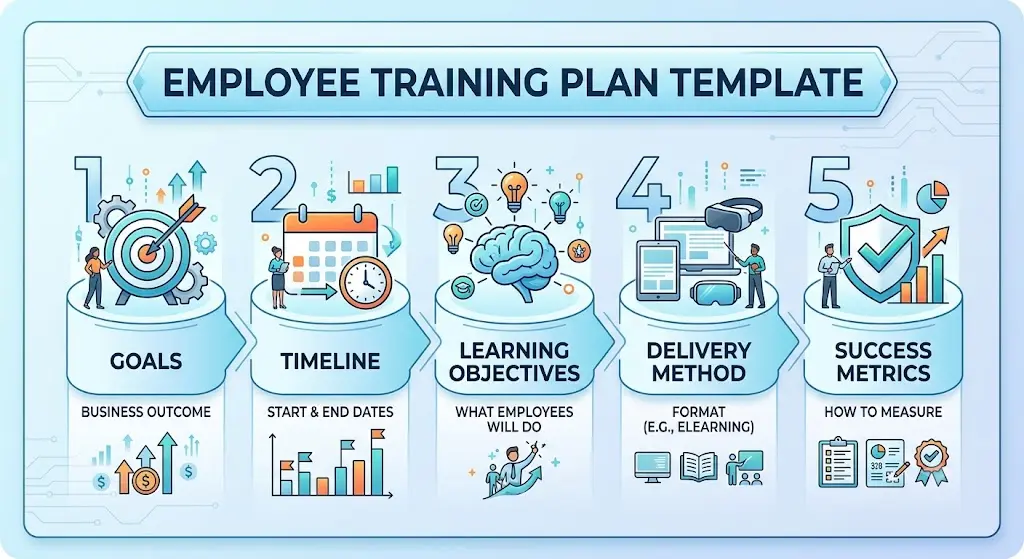
1. Goals
What business outcome is this training meant to influence?
2. Timeline
When does training start, and when should employees complete it?
3. Learning Objectives
What should employees be able to do by the end of training?
4. Delivery Method
Which format instructor-led, eLearning, blended, microlearning fits this content best?
5. Success Metrics
How will you know the training worked? (Completion rate, assessment score, on-the-job performance change, etc.)
Employee Training Checklist
- Define the business goal driving this training
- Complete a training needs assessment
- Identify specific skill gaps
- Write SMART learning objectives
- Segment your target learners
- Choose the appropriate delivery method
- Build or source engaging content
- Communicate the rollout plan to managers and employees
- Set a completion deadline
- Track KPIs after delivery
- Gather participant feedback
- Review and revise the program regularly
Best Practices for Employee Training
1. Personalize Learning Paths
Not every employee needs the same training at the same pace. Where possible, let people skip what they already know and spend more time on what they don’t.
2. Encourage Continuous Learning
Training shouldn’t stop after onboarding. Build a culture where ongoing learning courses, certifications, stretch projects are expected and supported.
3. Use AI Responsibly
AI can personalize and speed up training, but it shouldn’t replace human judgment, especially for sensitive topics like harassment training or leadership coaching. Use it to support your program, not to run it unsupervised.
4. Support Managers as Coaches
Formal training only goes so far if it isn’t reinforced day-to-day. Equip managers to coach their teams and reinforce what was learned in actual work situations.
5. Reinforce Learning Over Time
People forget most of what they learn within weeks if it isn’t reinforced. Use refreshers, spaced repetition, and follow-up check-ins to make sure training actually sticks.
Common Employee Training Mistakes to Avoid
A few mistakes show up again and again, regardless of company size:
- Treating training as a one-time event instead of an ongoing process.
- Skipping the needs assessment and building training based on assumptions.
- Overloading content with too much information in one session.
- Ignoring feedback from employees who actually went through the training.
- Not tracking outcomes, so you never know if the training actually worked.
- Copying a competitor’s program without adapting it to your own goals and culture.
Measuring Training ROI
1. KPIs
Track completion rates, time-to-competency, and assessment scores as your baseline indicators.
2. Engagement Metrics
Look at participation rates, time spent in training, and voluntary re-engagement with optional content; these tell you whether employees find the training genuinely useful.
3. Knowledge Retention
Use follow-up quizzes or spaced assessments weeks after training ends, not just immediately afterward, to see what actually stuck.
4. Business Outcomes
Tie training back to the metrics that matter: reduced errors, faster onboarding time, higher sales conversion, fewer compliance incidents.
5. ROI Formula
A simple way to estimate training ROI:
ROI (%) = [(Benefit of Training − Cost of Training) / Cost of Training] × 100
The hardest part is usually quantifying the “benefit” side — try to tie it to a measurable outcome like reduced turnover cost or improved productivity per employee.
Best Employee Training Software
1. LMS Platforms
Learning Management Systems host and track structured courses, making them a good fit for compliance training and standardized onboarding content.
2. LXP Platforms
Learning Experience Platforms lean more toward personalized, employee-driven learning, often pulling in content from multiple sources based on individual interests and gaps.
3. AI Learning Tools
These platforms use AI to personalize learning paths, generate quizzes, or provide coaching-style feedback in real time.
4. Collaboration Platforms
Tools like internal wikis, Slack channels, or forums support informal, peer-driven learning that complements formal training programs. Professional networks like <a href=”https://www.linkedin.com/learning” target=”_blank” rel=”noopener”>LinkedIn Learning</a> are also widely used to supplement internal training with structured external courses.
Real-World Employee Training Examples
1. Small Business Example
A 25-person marketing agency struggling with inconsistent client onboarding built a simple blended program: a short video walkthrough of their process, paired with a live 30-minute session for questions. Within two months, onboarding errors dropped noticeably, and new hires were handling client accounts independently a full week sooner.
2. Enterprise Example
A large retail chain rolled out mobile microlearning for its frontline staff five-minute modules delivered through an app during shift breaks. This let them train thousands of employees across locations without pulling anyone off the floor for hours at a time.
3. Remote Team Example
A fully remote software company leaned heavily on asynchronous eLearning combined with peer mentorship pairings for new hires. Because there was no shared office to absorb culture naturally, they made social learning a deliberate part of the program rather than leaving it to chance.
Future Trends in Employee Training
1. AI Coaches
AI-driven coaching tools are increasingly used to give employees real-time feedback on things like sales calls or customer interactions, without needing a human coach present for every session.
2. Skills Intelligence
More organizations are using data-driven “skills intelligence” platforms to map existing employee skills against future business needs, making workforce planning more proactive.
3. Personalized Learning
Training is moving away from one-size-fits-all courses toward paths tailored to an individual’s role, pace, and existing knowledge.
4. Immersive Learning (AR/VR)
Virtual and augmented reality are being used for high-risk or hands-on training like equipment operation or emergency response where mistakes in the real world are costly.
5. Learning Analytics
Better data on how training is consumed and retained is helping L&D teams make faster, more informed decisions about what’s working and what isn’t.
Frequently Asked Questions
1. What is the goal of an employee training program?
The goal is to close the gap between the skills employees currently have and the skills they need to meet business objectives, while also supporting engagement and retention.
2. How long should employee training take?
It depends on the content; onboarding might run two to four weeks, while a specific skills course might take a few hours. The key is matching the length to the complexity of what’s being taught, not a fixed rule.
3. What’s the difference between training and development?
Training is short-term and job-specific; development is long-term and career-focused. Both are needed for a well-rounded program.
4. How often should training be updated?
Review core training content at least annually, and update it immediately whenever tools, policies, or regulations change.
5. What makes a training program effective?
Clear objectives tied to business goals, the right delivery method for the content, engaged learners, and a way to measure whether it actually changed behavior on the job.
6. Can small businesses build a training program without a big budget?
Yes. Many effective programs start with simple tools, recorded videos, shared documents, and peer mentoring before scaling into paid software.
7. How do you measure training success? Combine completion and engagement data with actual business outcomes, like reduced errors, faster ramp-up time, or improved retention.
Conclusion
Building an effective employee training program isn’t about running more workshops or buying more software. It’s about following a clear framework starting with business goals, identifying real skill gaps, choosing the right delivery methods, and measuring whether the training actually worked.
The organizations that get the most value out of employee training treat it as an ongoing process, not a one-time project. They revisit their program regularly, listen to employee feedback, and adjust as business needs change.
If you take one thing from this guide, let it be this: align every part of your employee training program with your long-term business goals, and keep improving it from there. That’s what turns training from a checkbox exercise into a real driver of growth.