

If you’ve noticed your top employees quietly updating their resumes you’re not seeing things wrong. Skills are becoming outdated quicker than job descriptions can catch up and the companies that are moving forward in 2026 are the ones who see their people’s growth as a business strategy, not something in the HR budget.
That is the point of an employee development program: a planned continuous effort to help people improve their skills, their knowledge and their careers so the business grows alongside them. When done well it is one of the valuable investments a company can make this year. When done badly or not at all it shows up as people leaving, ideas not moving forward and leaders who weren’t prepared when it was their time to step up.
This guide explains what employee development really means, why it is more important, in 2026 than it was a couple of years ago and how to create a program that people actually want to use.
What Is an Employee Development Program?
Definition
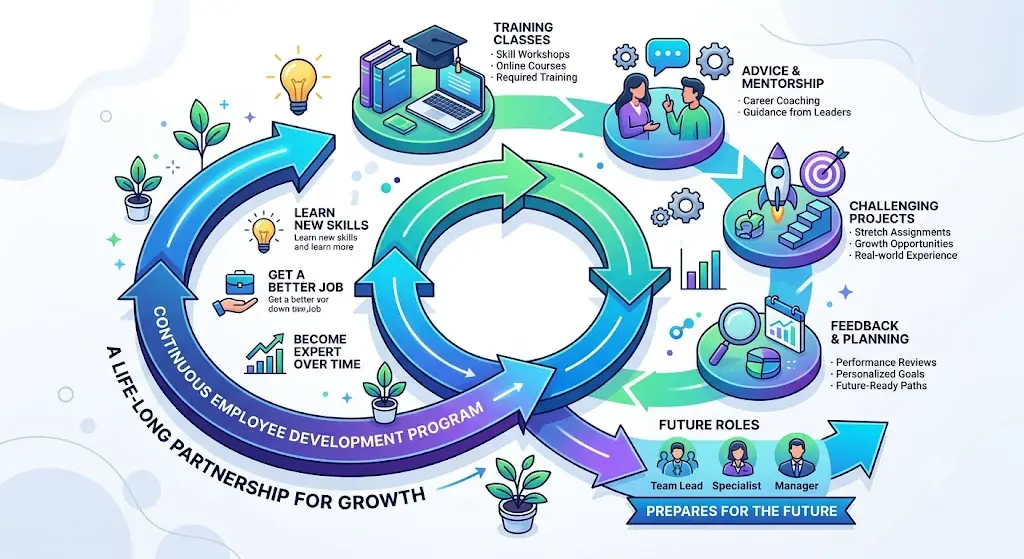
An employee development program is something that helps employees get better at what they do. It is a bunch of things like classes and people who can help them. The employee development program is made to help employees learn things, get a better job and become really good at what they do over time.
It usually has things like classes that employees have to take and also things that are not classes like people who can give them advice and projects that’re a little harder than what they normally do.
Think of the employee development program as something that is always going on between the company and the employee. It is not one thing that happens and then it is over. The employee development program is always. It helps the employee get ready for what they will do in the future.
Purpose
The main goal is easy to say. It is tough to do. We need to help the business get what it needs and at the time help the employees build the careers they want. When these two things work together people will stay with the company longer, do their jobs better and take on roles when the company needs them to.
A good program is also like a message. When a company puts time and money into helping someone grow it shows that person they’re important and that means a lot. This is especially true, in a job market where people often switch companies to get a salary. A good program tells employees that the company believes in them and wants to help them succeed.
Employee Development vs Employee Training
These two terms get used interchangeably, and that’s a mistake worth fixing early. Training is usually short-term and task-specific teaching someone how to use a new tool or follow a new compliance process. Development is broader and longer-term building someone’s overall capability and career trajectory.
Put simply: training teaches you how to do your current job better. Development prepares you for the job you don’t have yet. Both matter, and we’ll come back to this distinction later in the article because it changes how you should design a program.
Why Employee Development Matters More Than Ever
1. AI Is Reshaping Work
AI tools are now a part of our work routine in most offices and this is changing what it means to do your job well. Jobs that used to be about doing tasks are now more about using your judgment, keeping an eye on things and working with AI systems.
The AI tools are not going to teach themselves to employees. Employees need help to learn how to use AI tools. They need to know how to look at what the AI tools are telling them and use that information in a responsible way. This is where a good employee development program comes in and it can really help employees learn how to work with AI tools and this is what a good employee development program is, for it is to help employees learn how to use AI tools well.
2. The Skills Gap Is Growing
Technology is evolving faster than most degree programs or onboarding processes can track. The result is a widening gap between the skills companies need and the skills their current workforce has, a pattern well documented in labor market research on skills-based hiring and training.
Companies that wait for the “perfect” external hire to close this gap are competing for a shrinking pool of candidates. Companies that invest in developing existing talent are closing the gap from the inside, which is usually faster and cheaper.
3. Employees Expect Career Growth
Career growth has become table stakes, not a perk. Conversations across professional communities, including active discussions on r/humanresources, consistently point to a lack of growth opportunities as one of the top reasons people start looking elsewhere.
If a company can’t answer “what does my growth look like here?” In a compelling way, its best people will find someone who can answer it for them.
4. The Rise of Skills-Based Organizations
More companies are moving away from job titles. They are focusing on skills as the thing that really matters.
By asking what someone’s job title is, companies that focus on skills want to know what that person can do and what they can learn to do next.
This change makes helping employees get better at their jobs a part of how work is given out, how people get paid and how they can move to different jobs inside the company.
It helps companies that pay attention to skills and help them grow on purpose. Companies that do this with skills are the ones that really benefit. Skills are what matter to these companies.
Benefits of Employee Development Programs
1. Higher Employee Engagement
People really get into their work when it helps them learn and become better. When employees can see how what they are learning will help them get they come to work with a lot more energy and they want to do things on their own.
2. Improved Productivity
Skilled employees work faster, make fewer errors, and need less oversight. Development isn’t just good for morale, it directly improves the quality and speed of the work getting done.
3. Better Employee Retention
Replacing an employee is expensive, and most of that cost is hidden in lost productivity, onboarding time, and institutional knowledge walking out the door. Development programs give people a reason to build their career inside the company instead of outside it.
4. Stronger Leadership Pipeline
Leaders aren’t discovered; they’re built, usually through years of stretch assignments, mentorship, and deliberate practice. A strong development program means the company isn’t scrambling to hire externally every time a leadership seat opens up.
5. Increased Innovation
People who keep learning bring new ideas, frameworks, and ways of solving problems back into their teams. Innovation rarely comes from people doing the exact same tasks the exact same way for years.
6. Higher Employee Satisfaction
Growth and satisfaction are closely linked. Employees who feel stuck, regardless of pay, tend to report lower satisfaction than employees who feel like they’re moving forward, even in a demanding role.
7. Improved Business Agility
A workforce that has a lot of skills that are up to date can change direction quickly when the business needs to do something different. Training people to do things helps the business be flexible and this is really hard to find when you need it right away and it is hard to find good workers.
8. Better Succession Planning
When development is done on purpose, planning for the stops is a guess. Leaders can see information about skills and how ready people are instead of hoping the right person is there when an important job becomes available.
Employee Development vs Employee Training
1. Key Differences
Training is narrow, short-term, and tied to a specific task or tool. Development is broad, long-term, and tied to a person’s overall career trajectory. Training is often mandatory and standardized; development is usually personalized and ongoing.
2. When to Use Each
You should use training when you have a problem that needs to be fixed right away like when you are rolling out new software or when there is a change in the rules that you have to follow or when you are changing the way you do things.
Use development when you are thinking about the future: you want to get someone ready for a promotion or you want to help them learn new skills or you want to make sure you have a strong team for the next few years. The training is for the software rollout or a compliance update or a process change. The development is for preparing someone for a promotion or broadening their skill set or building bench strength for a few years.
3. Why Organizations Need Both
Training without development creates employees who can do today’s job but aren’t ready for tomorrow. Development without training leaves gaps in the skills people need right now. The strongest programs layer both together deliberately.
Types of Employee Development Programs
1. Career Development
This helps people see the picture of their job and where they can go from here. It includes talking about their career, setting goals and knowing what they need to do to get a promotion. This way people can understand what it takes to get to where they want to be in their career. It helps them make a plan to get there. Career conversations and goal-setting are a part of this and companies also need to be clear about what it takes to get a promotion.
2. Leadership Development
Focused on building the skills that future managers and current managers need: giving feedback running meetings that work making decisions when things are not clear. Leadership development is one of the return on investment areas because bad managers are one of the top reasons people leave their jobs.
3. Technical Skills Development
Covers the hard, job-specific skills coding languages, data analysis, industry certifications, tool proficiency. This is the category most likely to need frequent updates as technology moves.
4. Soft Skills Development
Things like communication and collaboration are really important. Communication and collaboration are skills that’re tough to learn in a classroom. People usually pick up communication and collaboration skills over time. Emotional intelligence and adaptability are also crucial. These skills, including intelligence and adaptability, are often more important for doing well in the long run than just being good at technical things.
5. Mentorship Programs
Pairing less experienced employees with more experienced ones for guidance, feedback, and career advice. Mentorship works because personal advice lands differently coming from someone who’s actually walked the path.
6. Coaching Programs
Similar to mentorship but usually more structured and goal-focused, often involving a professional coach or trained manager working through specific performance or career objectives. Coaching tends to be shorter-term and more targeted than mentorship.
7. Cross-Functional Learning
Giving employees exposure to other departments so they understand how the business fits together. This builds better collaborators and often surfaces people suited for roles they’d never have considered otherwise.
8. Job Rotation
Moving employees through different roles or teams on a set schedule to broaden their experience. It’s especially common in graduate and early-career programs, but works well for mid-career employees too.
9. Stretch Assignments
Giving someone a project slightly beyond their current skill level, with support, so they grow into it. This is one of the fastest ways to develop someone’s real work under real stakes and teaches faster than most courses.
How to Build an Effective Employee Development Program
1. Assess Organizational Goals
Start with where the business is headed, not just where employees want to go. A development program disconnected from business strategy tends to lose funding the first time budgets get tight.
2. Conduct Skills Gap Analysis
Map the skills the business will need against the skills the current workforce has today. This analysis should be honest and specific vague conclusions like “we need more leadership” don’t give you anything actionable to build against.
3. Create Individual Development Plans (IDPs)
An IDP is a simple document that lays out an employee’s goals, the skills they need to build, and the actions they’ll take to get there. It works best as a living document, revisited every few months rather than filed away after one conversation.
4. Define Learning Objectives
Every development activity should tie back to a clear, specific objective — not just “improve leadership skills” but “run a project with cross-functional stakeholders by Q3.” Specific objectives make progress measurable and keep the program from feeling vague.
5. Choose Learning Methods
eLearning
Self-paced online courses that employees can complete on their own schedule. Best for foundational knowledge and topics that don’t change often.
Microlearning
Short, focused lessons are often five to ten minutes designed to fit into a busy workday. Effective for reinforcing skills or covering narrow, specific topics without requiring a big time commitment.
Blended Learning
Combines self-paced online learning with live sessions, workshops, or coaching. Usually the most effective approach because it pairs flexibility with real human interaction.
Social Learning
Learning through peers discussion groups, communities of practice, internal knowledge-sharing sessions. People often learn faster from a colleague who solved the same problem last month than from a generic course.
AI-Powered Learning
Adaptive platforms that personalize content based on an employee’s role, skill level, and pace. In 2026, this has become one of the fastest-growing categories because it scales personalization in a way human-led programs can’t match alone.
Measure Progress
Track completion, but don’t stop there look at whether skills are actually showing up in the work. Manager feedback, project outcomes, and internal mobility are often better indicators of real progress than course completion rates.
Continuously Improve
Treat the program itself as something to develop. Collect feedback regularly, watch what’s actually being used versus ignored, and adjust rather than letting the program run on autopilot for years.
Best Practices for Employee Development in 2026
1. Personalize Learning
Generic, one-size-fits-all training rarely sticks. Personalization tailoring content to someone’s role, goals, and current skill level dramatically improves engagement and completion.
2. Foster Continuous Learning
Development shouldn’t be an annual event. Building small, regular learning habits into the normal workweek keeps skills current instead of letting them go stale between big training pushes.
3. Empower Managers as Coaches
Managers have more influence over an employee’s growth than any course ever will. Training managers to have real coaching conversations not just performance reviews is one of the highest-impact moves a company can make.
4. Encourage Internal Mobility
Make it easy and normal for employees to move into new roles internally rather than treating every transfer as an exception. Companies with strong internal mobility tend to retain talent longer because people don’t have to leave to grow.
5. Support Career Pathing
Give employees a visible sense of what’s next the skills, experience, and milestones tied to future roles. Ambiguity about career paths is one of the quiet reasons people disengage.
6. Build a Learning Culture
Culture is the multiplier that makes everything else work. When learning is visibly valued, leaders talk about what they’re learning, curiosity is rewarded, mistakes are treated as part of growth development programs and get used instead of ignored.
Common Challenges and How to Overcome Them
1. Limited Budgets
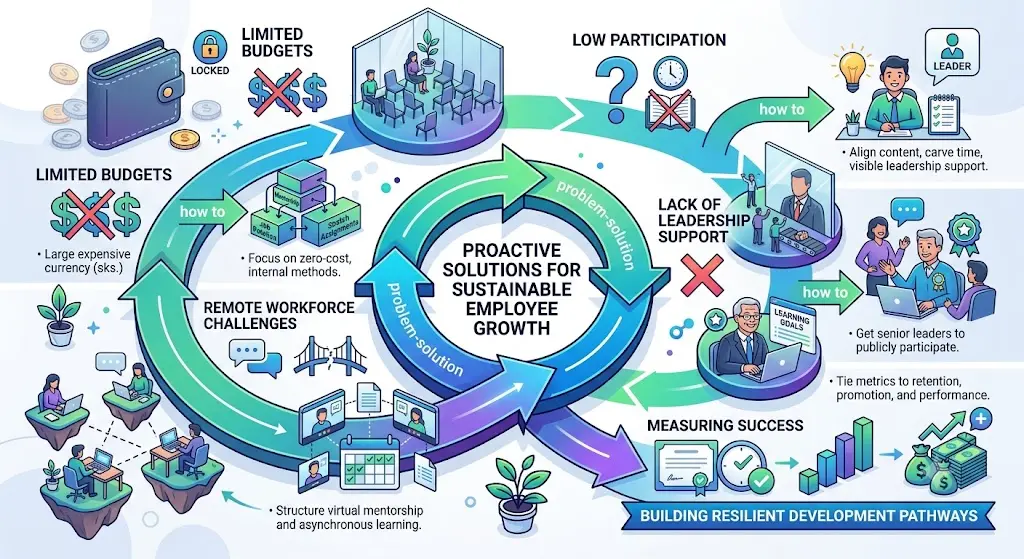
Not every program needs a big budget. Mentorship, stretch assignments, job rotation, and internal knowledge-sharing cost very little and can be just as effective as expensive external courses.
2. Low Participation
Low participation is usually a signal, not a mystery the content isn’t relevant, employees don’t have time carved out, or leadership isn’t visibly supporting it. Fix the root cause rather than just sending more reminder emails.
3. Lack of Leadership Support
Development programs stall without visible buy-in from leadership. Getting a few senior leaders to publicly participate mentoring, sharing their own learning goals tends to shift the culture faster than a policy document ever will.
4. Measuring Success
Many companies stop at completion rates, which tell you almost nothing about actual impact. Tie measurement to business outcomes instead: retention, internal promotions, and performance changes tied to the skills being developed.
5. Remote Workforce Challenges
Remote and hybrid teams lose some of the informal learning that used to happen naturally in an office. Deliberate structures, virtual mentorship, scheduled coaching check-ins, asynchronous learning content help close that gap.
Measuring the Success of Employee Development Programs
1. KPIs
Good KPIs connect learning activity to business results: skill assessment scores, internal promotion rates, retention among program participants, and manager-rated performance improvements. Pick a small set and track them consistently rather than measuring everything loosely.
2. Employee Engagement
Engagement survey scores, especially questions specifically about growth and development opportunities, are a strong early indicator of whether a program is landing. Watch trends over time rather than single snapshots.
3. Internal Promotions
The percentage of open roles filled internally is one of the clearest signs a development program is working. A rising internal promotion rate usually means the pipeline is genuinely being built, not just talked about.
4. Retention Rates
Compare retention among employees who actively participate in development programs against those who don’t. In most organizations, the gap is significant enough to justify the program’s cost on its own.
5. Productivity Metrics
Look at output, quality, and error rates before and after targeted development efforts. This is where development shows its bottom-line value most concretely.
6. ROI
Calculating ROI means weighing program costs against measurable gains in retention, productivity, and reduced hiring costs. It won’t be a perfectly clean number, but even a rough estimate helps justify continued investment to finance and leadership.
Best Employee Development Tools and Platforms
1. LMS Platforms
Learning Management Systems host and track formal training content courses, certifications, compliance modules. They’re the backbone of most structured programs, especially at larger organizations.
2. Learning Experience Platforms (LXP)
LXPs go a step further than an LMS, curating and recommending content based on an employee’s role and goals, closer to a Netflix-style experience for learning. They tend to drive higher engagement than a static course catalog.
3. AI Learning Tools
AI-powered tools can generate personalized learning paths, simulate practice scenarios, and give employees instant feedback. They’re increasingly used to fill gaps between formal courses and real on-the-job application.
4. Career Development Platforms
These tools help employees map internal career paths, identify skill gaps for target roles, and connect with mentors or open internal opportunities. Professional platforms like LinkedIn Learning have become a common piece of this stack for many organizations.
Real-World Employee Development Examples
1. Startup Example
A 40-person startup can’t afford a big LMS budget, so it builds development around mentorship pairs, monthly skill-share lunches, and stretch projects where junior employees lead small initiatives with senior support. It costs almost nothing and still meaningfully improves retention.
2. Enterprise Example
A large enterprise builds a formal leadership development track: a cohort-based program combining workshops, 360-degree feedback, and a year-long rotation through two departments. Participants become the primary internal candidates for manager openings.
3. Hybrid Workforce Example
A hybrid company blends asynchronous microlearning modules with quarterly in-person coaching days when remote employees come into the office. This keeps development consistent regardless of where people are working from that week.
Future Trends Shaping Employee Development
1. AI Career Coaches
AI-driven coaching tools that offer employees on-demand guidance, feedback, and career suggestions are becoming more common. They won’t replace human mentors, but they extend coaching access to far more employees than a limited pool of human coaches ever could.
2. Skills Intelligence
Companies are getting better at mapping the actual skills inside their workforce in real time, rather than relying on outdated job descriptions and resumes. This “skills intelligence” makes workforce planning and development targeting far more precise.
3. Internal Talent Marketplaces
Platforms that let employees see and apply for internal projects, gigs, and roles based on their skills are gaining traction. They make internal mobility something employees can act on themselves, instead of waiting to be tapped on the shoulder.
4. Personalized Learning
Learning paths tailored to an individual’s role, pace, and goals continue to outperform generic training in engagement and completion. Expect personalization to become the default expectation, not a premium feature.
5. Learning Analytics
Better data on what’s actually working, which content drives skill gains, which formats employees complete lets L&D teams make sharper decisions about where to invest. This shifts development from a gut-feel function to a data-informed one.
6. Immersive Learning (AR/VR)
Simulation-based training through AR and VR is expanding beyond high-risk industries like aviation and healthcare into more everyday skill-building, especially for practicing difficult conversations or hands-on technical tasks. It’s still a smaller slice of most learning budgets, but the use cases are growing.
Frequently Asked Questions
1. What is the difference between employee development and employee training?
Training builds skills for a current task or tool; development builds broader, longer-term career capability. Most strong programs use both together.
2. Why is employee development important in 2026?
AI is changing how work gets done, skills are aging faster, and employees increasingly expect visible growth paths. Companies that don’t invest in development risk losing talent and falling behind on capability.
3. How much should companies spend on employee development?
There’s no universal number; it depends on industry, company size, and goals. What matters more than the budget size is whether spending is tied to clear objectives and measured against outcomes like retention and internal promotions.
4. What are the most effective employee development methods?
Blended learning, mentorship, stretch assignments, and manager coaching consistently perform well because they combine structured content with real, applied practice.
5. How do you measure the ROI of an employee development program?
Compare program costs against measurable gains in retention, productivity, and internal promotion rates, along with reduced external hiring costs. It’s rarely a perfectly clean calculation, but even directional data supports the case for continued investment.
6. Can small businesses run employee development programs without a big budget?
Yes. Mentorship, job shadowing, stretch assignments, and peer learning cost very little and can be just as effective as expensive formal programs, especially at a smaller scale.
Conclusion
Employee development isn’t a nice-to-have anymore, it’s a strategic investment that determines whether a company can keep pace with how fast work is changing in 2026. The organizations pulling ahead are the ones building continuous learning into how they operate, not treating it as an occasional event.
The businesses that get this right won’t just retain more people. They’ll have the skills, leadership bench, and agility to adapt faster than competitors still hiring their way out of every gap. Whatever stage your organization is at, the next step is the same: connect employee development directly to your long-term business goals, and keep it that way.