


Most training programs fail before the first session starts. Someone notices a problem, a course gets booked, and nobody checks whether training was the fix in the first place.
Knowing how to conduct a training needs analysis stops that cycle. A training needs analysis (TNA) connects a real business problem to the skills, behaviors, and solutions your people actually need. It tells you who needs help, with what, and whether training is even the right tool.
This guide walks you through the eight steps I use with L&D and HR teams. You will also find a worked example, a reusable template, sample questionnaire questions, and a plain-English way to measure results.
What Is a Training Needs Analysis (TNA)?
A training needs analysis is a structured process for finding the gap between the skills, knowledge, and behaviors a business needs and what its employees can do today. The results show where training, or another fix, will improve performance.
Think of it as a diagnosis before a prescription. You would not take medicine without knowing what is wrong. The same logic applies to training budgets.

What a Training Needs Analysis identifies
A good TNA tells you four things:
- Which business goals or problems are driving the need
- Which roles, teams, or individuals have gaps
- What kind of gap it is: knowledge, skill, behavior, or something outside the person’s control
- What solution fits, and in what order to tackle the gaps
The purpose of a TNA in employee development
The purpose is to make development targeted instead of generic. Employees get support that matches their role and goals. The business spends money where it changes results.
It also builds trust. When people see that training follows real evidence, they take it more seriously.
Training Needs Analysis vs. training needs assessment
In everyday use, the two terms mean nearly the same thing, and many articles swap them freely. If you want a distinction, “assessment” often refers to the data-gathering part, while “analysis” covers the whole process: gathering data, finding root causes, prioritizing, and recommending action.
The wider idea comes from needs assessment, a method used across education, health, and business to compare current and desired states.
Training Needs Analysis vs. skills gap analysis
A skills gap analysis compares the skills people have with the skills they need. It is one piece of TNA.
TNA goes further. It starts with the business problem, checks non-training causes, ranks priorities, and recommends a plan. A skills gap analysis alone can tell you what is missing. It will not tell you whether training is the answer.
When an organization should conduct a TNA
Run a TNA when something changes or breaks. Common triggers include:
- Performance dips, such as rising errors, complaints, or escalations
- A new system, product, process, or regulation
- Rapid growth, restructuring, or new leaders
- High turnover or slow onboarding
- Annual planning for learning budgets
Why Is a Training Needs Analysis Important?
Without a TNA, training becomes guesswork. With one, every course, coaching plan, or job aid has a reason to exist.
Aligning training with business goals
A TNA ties learning to outcomes leaders care about, such as lower costs, faster delivery, or better customer scores. That makes it much easier to win support and budget.
Identifying capability gaps before they affect performance
Gaps are cheaper to fix early. A manager who struggles with feedback conversations today becomes a retention problem in six months. TNA surfaces these patterns before they show up in your exit interviews.
Prioritizing training budgets and resources
You will always have more needs than time or money. A TNA gives you a fair, evidence-based way to rank them and say “not yet” to the rest.
Supporting employee development and workforce planning
The same data helps with career paths, succession planning, and hiring. If you know which skills are thin across the team, you can decide whether to build them or buy them.
Avoiding unnecessary or ineffective training
Some problems are caused by broken processes, poor tools, or unclear goals. Training will not fix those. A TNA helps you spot them early and save everyone’s time.
What Are the Three Levels of Training Needs Analysis?
The three levels are organizational, job or task, and individual. Each looks at the problem from a different angle. This framework is widely used in the training field and is often credited to the work of Irwin Goldstein.
Organizational analysis
This level asks where the business is heading and what capabilities it needs to get there.
Business strategy, operational results, and future capability needs
Look at strategic plans, operating results, planned technology changes, and market shifts. For example, if your company plans to launch a self-service product, your support team will need new skills, and you can plan for that now.
Job or task analysis
This level asks what a role requires to be done well.
Role requirements, responsibilities, competencies, and expected behaviors
Break the role into key tasks. Then describe the knowledge, skills, and observable behaviors that make each task successful. A competency framework helps here if your company already has one.
Individual analysis
This level asks who needs what.
Current employee capability, performance evidence, and development needs
Use performance data, manager input, assessments, and employee voice to see where each person or group stands against the role standard.
How to choose the right level—or combine all three
If a strategic change is coming, start with the organizational level. If one role keeps underperforming, start with the job level. If only a few people struggle, start with the individual level.
In practice, the best TNAs touch all three. You rarely understand a gap well from just one angle.
How to Conduct a Training Needs Analysis in 8 Steps
Here is the full process. Each step has an action, evidence to use, a decision to make, and an output to hand off to the next step.
Step 1. Define the Business Problem and Desired Outcomes
Start with the problem, not the course. “Our team needs communication training” is a solution in disguise. “Escalations rose 30% in six months” is a problem.
What to do:
- Describe the performance issue or strategic goal in one clear sentence
- Pull baseline numbers, such as error rates, handling time, sales, or audit scores
- Set a measurable target, such as reducing escalations by 15% within two quarters
- Agree on scope, timeline, budget, and who signs off
Decision to make: Is this worth solving now, and how will we know it is solved?
Output: TNA objectives and success criteria.
Step 2. Identify Stakeholders and Employees in Scope
A TNA done in isolation usually produces a report nobody uses. Bring the right people in early.
What to do:
- Involve HR or L&D, senior leaders, line managers, employees, and subject matter experts (SMEs)
- List the roles, teams, and locations affected
- Define who does what, including who collects data and who approves actions
- Tell employees how their feedback will be used and kept confidential
Decision to make: Who must be involved for the findings to be trusted and acted on?
Output: A stakeholder and audience map.
Step 3. Define Required Skills, Competencies, and Behaviors
You cannot measure a gap until you define the standard. Describe what “good” looks like in plain, observable terms.
What to do:
- Review job descriptions, task lists, and competency frameworks
- Ask top performers and SMEs how the work is really done
- Write behaviors that someone could actually see, such as “confirms the customer’s issue in their own words before offering a fix”
- Set proficiency levels, for example beginner, proficient, expert
Decision to make: What level of skill does this role need on day 30, day 90, and at full performance?
Output: A required-skills and behavior checklist.
Step 4. Collect Evidence of Current Performance
Now check what is happening today. The strongest TNAs mix what people say with what the data shows.
What to do:
- Use surveys, interviews, focus groups, assessments, observation, and performance data
- Compare employee views with manager views and objective metrics
- Record limits in the data, such as small samples or conflicting results
Decision to make: Do we have enough reliable evidence to name real gaps?
Output: An evidence-based picture of current performance.
Step 5. Identify Skill Gaps and Diagnose Root Causes
Compare the standard from Step 3 with the evidence from Step 4. Then ask why the gap exists.
What to do:
- Rate required versus current proficiency for each skill
- Label each gap as a knowledge gap (they don’t know), a skill gap (they can’t do it well), or a behavior gap (they know how but don’t do it)
- Look for barriers: unclear processes, weak tools, conflicting incentives, heavy workloads, or poor manager support
- Use simple methods like the “5 Whys” or root cause analysis
Decision to make: Is this gap about ability, motivation, or environment?
Output: A gap and root-cause matrix.
Step 6. Prioritize the Most Important Training Needs
You cannot fix everything at once. Score each gap so the ranking is fair and easy to explain.
What to do:
- Rate each gap on business impact, urgency, risk, number of people affected, feasibility, and cost
- Flag compliance-critical and time-sensitive needs first
- Separate immediate priorities from longer-term development
Decision to make: Which three to five needs get attention this quarter?
Output: A ranked list of needs with reasons.
Step 7. Recommend the Right Intervention and Build an Action Plan
Only now do you choose the solution. Sometimes it is a workshop. Often it is a mix.
What to do:
- Decide whether the fix is training, coaching, job aids, process changes, better tools, or a combination
- Write learning objectives that describe what people will be able to do
- Choose delivery methods that suit the audience: live sessions, e-learning, on-the-job practice, mentoring
- Assign owners, budgets, deadlines, and dependencies
Decision to make: What is the smallest, most effective set of actions that closes the gap?
Output: A cost TNA action plan.
Once you have identified and prioritized the skill gaps, use this guide to build an effective employee training program with clear objectives, suitable delivery methods, and measurable outcomes.
Step 8. Measure Results, Review Findings, and Repeat
A TNA is a cycle, not a one-time project. Plan your measurement before you launch anything.
What to do:
- Set baseline and follow-up dates, for example 30, 60, and 90 days after training
- Track learning (tests, practice), workplace behavior (observation, manager check-ins), and business results (your Step 1 metrics)
- Share results with stakeholders and note what to change next time
Decision to make: Did the gap close, and what should we adjust or repeat?
Output: An evaluation report with next-step recommendations.
To monitor whether employees are developing the required skills, learn how to track employee training progress using assessment scores, completion records, and workplace performance data.
Training Needs Analysis Methods: How to Choose the Right One
No single method tells the whole story. Pick two or three that complement each other, such as one that captures opinions and one that captures facts.
Employee surveys and questionnaires
Surveys reach many people quickly and cheaply. They are good for spotting patterns and rating confidence. Their weakness is that people often rate themselves too high or too low.
Structured interviews and manager discussions
One-on-one conversations uncover the “why” behind the numbers. Managers can tell you where work actually breaks down. Use the same questions with everyone so you can compare answers.
Focus groups
Small group discussions work well for exploring shared problems, like a confusing new process. Keep groups to six to eight people. Separate managers from their teams so people speak openly.
Skills assessments and knowledge tests
Quizzes, simulations, and practical tasks give you objective proof of what people know and can do. They work best for technical or compliance skills.
Workplace observation and task analysis
Watching real work, or shadowing someone for a few hours, often reveals problems no survey will. You see workarounds, shortcuts, and system frustrations first-hand.
Performance reviews and operational KPIs
Existing data is the cheapest evidence you have. Look at sales numbers, error rates, handling times, and review ratings. Check the quality of the data before you trust it.
Customer feedback and quality audits
Customers and auditors see what internal teams miss. Complaint themes, QA scores, and call reviews point straight to behaviors that need work.
Job descriptions, competency frameworks, and workforce data
These documents set the standard you measure against. Workforce data, such as turnover, tenure, and upcoming retirements, helps you plan for future skill needs.
Comparing methods by time, cost, depth, and reliability
| Method | Time | Cost | Depth | Reliability |
| Surveys | Low | Low | Medium | Medium (self-reported) |
| Interviews | Medium | Medium | High | Medium to high |
| Focus groups | Medium | Medium | High | Medium |
| Skills assessments | Medium | Medium | Medium | High |
| Observation | High | Medium | High | High |
| Performance data / KPIs | Low | Low | Medium | High (if data is clean) |
| Customer feedback / audits | Low to medium | Low | Medium | High |
A practical combination for most teams: a short survey, a handful of manager interviews, and one or two key performance metrics.
How to Tell Whether Training Is the Right Solution
Training fixes one thing: a lack of knowledge or skill. If people already know what to do and still don’t do it, more training will not help.
This idea has long roots in the field of human performance improvement. Thomas Gilbert and Robert Mager both argued that you should check for environmental barriers before you reach for a course. Ask these questions in order.
Is the required knowledge or skill missing?
If people could not do the task even with a gun to their head, they likely lack the skill. Training, practice, and coaching can help.
Are employees able to apply the skill in their actual work?
Some people pass the course and still struggle on the job. That points to a lack of practice, feedback, or support after the training ends.
Are unclear processes, limited tools, or unrealistic targets contributing?
If the system is slow, the process is confusing, or the targets are impossible, fixing those will do more than any workshop.
Are incentives, workload, or manager expectations blocking performance?
People do what gets rewarded. If speed is rewarded and quality is not, you will get speed. Managers who say one thing and reward another can undo good training in a week.
A practical decision tree for training vs. non-training solutions
- Do people know what good looks like? No: build knowledge with training, job aids, or examples.
- Can they do it when they try? No: add practice, coaching, and feedback.
- Do they have the tools, time, and clear process? No: fix the process, tools, or workload.
- Do incentives and manager expectations support the behavior? No: align goals, rewards, and leadership.
- If all four are yes and performance is still low: check hiring fit, role design, or motivation.
Training Needs Analysis Example: From Performance Gap to Action Plan
This is a hypothetical example built to show the process. The numbers are illustrative, not from a real organization.
Imagine a 40-person customer support team at a software company. Escalations to the senior tier have been climbing.
The business problem and baseline
Over two quarters, escalations rose from 12% to 18% of tickets. Customer satisfaction dropped from 88% to 82%. The target is to bring escalations back to 12% within two quarters.
Required behaviors and competencies
The team lead and two senior agents define what good looks like:
- Confirms the customer’s issue before troubleshooting
- Uses the knowledge base to solve common problems
- Knows when to escalate and writes a clear handoff note
- Explains next steps in plain language
Evidence gathered from employees, managers, and performance data
The L&D partner collects four inputs:
- A short survey of all 40 agents
- Interviews with six team leads and senior agents
- A review of 60 escalated tickets
- Ticket data on product area and handling time
The ticket review shows that about half of escalations come from a product feature released three months earlier. Agents say they never got a proper walkthrough. Many also say the knowledge base article on that feature is outdated.
Root-cause diagnosis
The gap is mixed. Some of it is a knowledge gap: agents don’t understand the new feature. Some of it is a process issue: the knowledge base is stale. A third part is a behavior gap: agents escalate quickly because the team is measured on handling time, not resolution.
Prioritized gaps and recommended interventions
| Gap | Impact | Fix |
| Product knowledge on new feature | High | Two live sessions plus a hands-on sandbox |
| Outdated knowledge base | High | Product team updates articles; owner named |
| Escalation judgment | Medium | Decision guide and weekly coaching from team leads |
| Handling time targets | Medium | Leadership reviews the metric with a resolution measure added |
Notice that only one of four fixes is a classic training course. That is common.
Success metrics and follow-up review
The team tracks escalation rate, customer satisfaction, and first-contact resolution monthly. They also run a short knowledge check at 30 days and a ticket quality review at 60 days. A full review happens in 90 days.
Training Needs Analysis Template: What to Include
You do not need fancy software. A simple document and a spreadsheet will do. Here is what to include.
TNA report structure
- Summary: problem, key findings, and top recommendations
- Objectives and scope
- Methods and data sources
- Required skills and behaviors
- Findings: gaps and root causes
- Priorities and recommendations
- Action plan with owners, budget, and dates
- Measurement plan and review schedule
Keep the first page short enough for a busy executive to read in two minutes.
Skills gap matrix
| Skill or behavior | Required level (1–5) | Current level (1–5) | Gap | Evidence | Root cause |
| Example: Escalation judgment | 4 | 2 | 2 | Ticket review | Unclear guidelines |
Priority scoring matrix
Score each gap from 1 to 5 on impact, urgency, risk, reach, and feasibility. Add the scores, then rank. Weight the factors if one matters more, such as risk in regulated work.
| Gap | Impact | Urgency | Risk | Reach | Feasibility | Total |
Action plan with owners, budgets, and deadlines
| Action | Owner | Budget | Deadline | Dependency | Success measure |
Measurement plan and review schedule
List the baseline, the target, how you will measure, when, and who reviews it. Include at least one learning measure, one behavior measure, and one business measure.
Training Needs Analysis Questionnaire: Sample Questions
Keep questionnaires short. Ten to fifteen well-chosen questions beat a long survey that people rush through.
Questions for employees
- Which tasks in your role do you find hardest, and why?
- How confident are you in each of these skills, on a scale of 1 to 5?
- What gets in the way of doing your best work: tools, time, information, or something else?
- When did you last receive useful feedback on your work?
- What one skill would help you most in the next six months?
- How do you prefer to learn: live sessions, online modules, coaching, or hands-on practice?
Questions for managers and team leaders
- Where do you see the biggest performance gaps on your team?
- Which mistakes or delays come up most often?
- What do your top performers do differently?
- Which gaps are urgent, and which can wait?
- What support can you give after training to help people apply it?
Questions for subject matter experts
- What are the five most important tasks in this role?
- What does excellent work look like, step by step?
- Which mistakes do new people make most often?
- What has changed recently in the tools, rules, or products?
How to combine questionnaire responses with objective evidence
Place survey results next to hard data. If employees say they are confident but error rates are rising, you have found something worth digging into. If a group rates itself low and performs well, they may need confidence more than skills.
Privacy, confidentiality, and responsible data handling
Tell people why you are asking and how the results will be used. Report group-level findings, not individual answers, unless people have agreed otherwise. Store data securely, and follow your company’s privacy rules and local law.
Tools for Conducting a Training Needs Analysis
The best tool is the one your team will actually use. Start simple.
Spreadsheets and skills matrices
A spreadsheet handles the skills matrix, scoring, and action plan for most teams under a few hundred people.
Surveys and assessment platforms
Online survey tools make it easy to collect and sort responses. Assessment platforms add scored quizzes and simulations.
HRIS and performance management systems
Your HR system may already hold job data, reviews, tenure, and goals. Reuse what exists before you collect more.
Learning Management Systems (LMS) and learning analytics
A learning management system shows who completed what and how they scored. That helps, but completion alone does not prove skill. Use it as one input, not the whole picture.
How to select tools based on organizational size and complexity
Small teams do well with spreadsheets and a free survey tool. Mid-size companies often benefit from connecting HR and learning data. Large organizations may need skills-mapping software, but only after the process is working manually.
How to Measure the Success of a Training Needs Analysis
A TNA succeeds when the problem you named in Step 1 gets better. Everything else is a supporting signal.
The Kirkpatrick model is a well-known way to think about this. It looks at four levels: reaction, learning, behavior, and results.
Completion and participation vs. actual learning
Attendance and completion rates tell you people showed up. They do not tell you anyone learned. Pair them with tests, practice tasks, or demonstrations.
Assessing behavior change at work
The real test is what people do on the job weeks later. Use manager observation, call or ticket reviews, and short check-ins at 30, 60, and 90 days.
Tracking business outcomes against a baseline
Go back to the metrics from Step 1. Compare them to the baseline and to the target. Be careful about claiming all the credit, since other factors may also move the numbers. For a deeper look at evaluation methods and performance metrics, explore this guide on measuring training effectiveness in the workplace.
Calculating training costs and ROI when reliable data is available
The basic formula is:
ROI (%) = (Benefits − Costs) ÷ Costs × 100
Costs include development, delivery, materials, and the time people spend learning. Benefits might be saved time, fewer errors, or lower turnover. Only calculate ROI when you can put a defensible value on the benefits. Otherwise, report the measured improvements and be clear about what you could not measure. See return on investment for the general concept.
Setting review dates and continuous improvement cycles
Put review dates on the calendar when you approve the plan. Review quarterly for fast-changing roles and annually for stable ones. Each cycle should feed the next TNA.
Common Training Needs Analysis Mistakes to Avoid
Choosing a course before defining the problem
This is the most common error. A vendor demo or a leader’s hunch turns into a course, and the real issue stays hidden. Write the problem statement first.
Relying only on self-assessments
People don’t always know what they don’t know. Back up surveys with performance data, observation, or tests.
Confusing training completion with improved performance
A 95% completion rate is not a result. Look for changes in behavior and business metrics.
Ignoring non-training barriers
If tools, processes, or incentives are the real problem, training will frustrate people. Check these during root-cause analysis.
Failing to prioritize gaps
Trying to fix everything spreads your budget thin. Pick the top few and do them well.
Collecting data without assigning actions or owners
A report with no owners and no dates is a filing exercise. Every recommendation needs a name and a deadline.
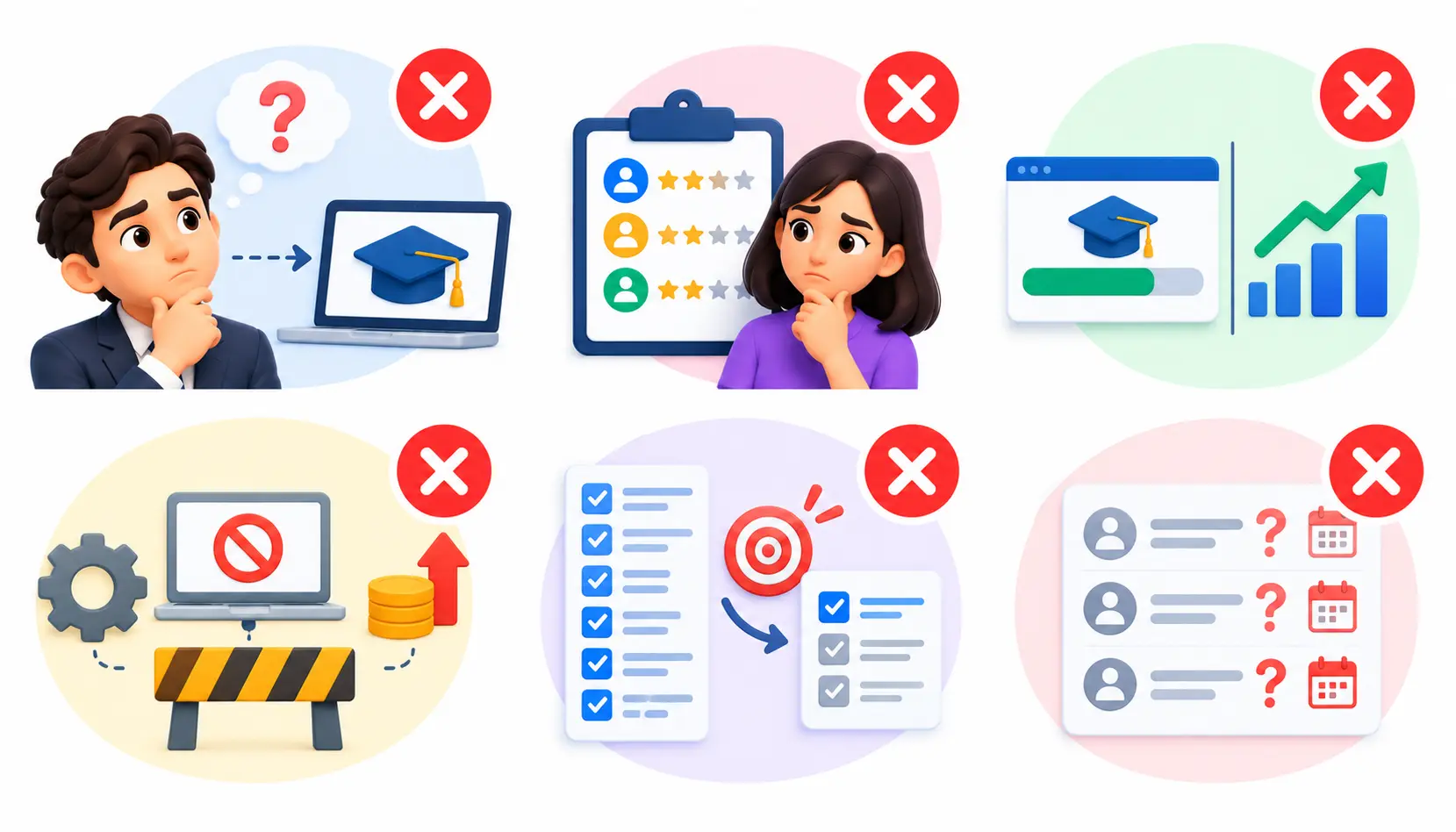
Frequently Asked Questions About Training Needs Analysis
1. What is a Training Needs Analysis?
A training needs analysis is a process that compares the skills a business needs with what employees can do now. It identifies gaps, finds their causes, and recommends the right fix, whether that is training or something else.
2. What are the steps involved in conducting a TNA?
There are eight steps: define the business problem, identify stakeholders, define required skills, collect evidence, identify gaps and root causes, prioritize needs, recommend interventions and build an action plan, and measure results and repeat.
3. What are the three levels of TNA?
The three levels are organizational (business goals and future needs), job or task (what the role requires), and individual (what each person can do now).
4. What is the difference between TNA and a training needs assessment?
The terms are often used interchangeably. When a distinction is made, assessment usually means the data collection, while analysis covers the full process through to recommendations.
5. What methods are used to assess training needs?
Common methods include surveys, interviews, focus groups, skills tests, observation, performance data, customer feedback, and a review of job descriptions and competency frameworks. Using two or three together gives the best results.
6. How long does a TNA take?
It depends on scope. A focused TNA for one team may take two to four weeks. An organization-wide analysis can take several months. Planning the scope in Step 1 keeps the timeline realistic.
7. Who is responsible for conducting a TNA?
HR or L&D usually leads it, but managers, employees, and SMEs all contribute. Business leaders should sponsor it so that findings lead to action.
8. How often should a TNA be conducted?
Most organizations run a full TNA once a year, often tied to planning, and a smaller one whenever something big changes, such as a new system, a new regulation, or a sudden drop in performance.
9. What should a TNA report include?
A good report includes a summary, objectives, methods, required skills, findings, root causes, prioritized needs, an action plan with owners and budgets, and a measurement plan.
10. How do you know if training is necessary?
Training is necessary when people lack the knowledge or skill to do the job. If they already know how and still don’t perform, look at tools, processes, incentives, and management support first.
Conclusion
Knowing how to conduct a training needs analysis comes down to a few habits. Start with a clear business problem. Define what good looks like. Gather evidence from more than one source. Find the root cause before you pick a solution. Then prioritize, act, and measure.
You don’t need a big budget to begin. Pick one team with a visible problem, run the eight steps on a small scale, and share what you learn. That first result will make your next TNA far easier to get approved.
If you take one thing away, let it be this: the best training programs begin with a good question, not a course catalog.